How to track gym progress for maximum gains and motivation
Stop guessing and start gaining. Learn exactly how to track gym progress with our guide on key metrics, essential tools, and data-driven training adjustments. To get anywhere in the gym, you need a plan. And the only way to know if that plan is working is to track your progress. This means consistently logging what you do—the weight you lift, the reps you hit, and the sets you complete. This log is what allows you to apply progressive overload, the single most important principle for building muscle and strength.


Why tracking your gym progress is non-negotiable
Let’s be direct: if you’re not tracking your workouts, you are leaving results on the table. Going to the gym and just "listening to your body" or training based on how you feel is a recipe for hitting a wall. While intuition has its place, it's a poor substitute for objective data when your goal is long-term improvement.
Tracking turns your training from random guesswork into a clear, measurable process. Without a record of what you did last week or last month, it's impossible to know if you're actually doing more over time. That’s all progressive overload is—gradually increasing the demands on your body. It’s the engine of all strength and muscle gains.
The Big Picture: You can't progressively overload what you don't measure. Tracking is the tool that makes this crucial principle a reality in your training.
Built for progress
Take the guesswork out of training
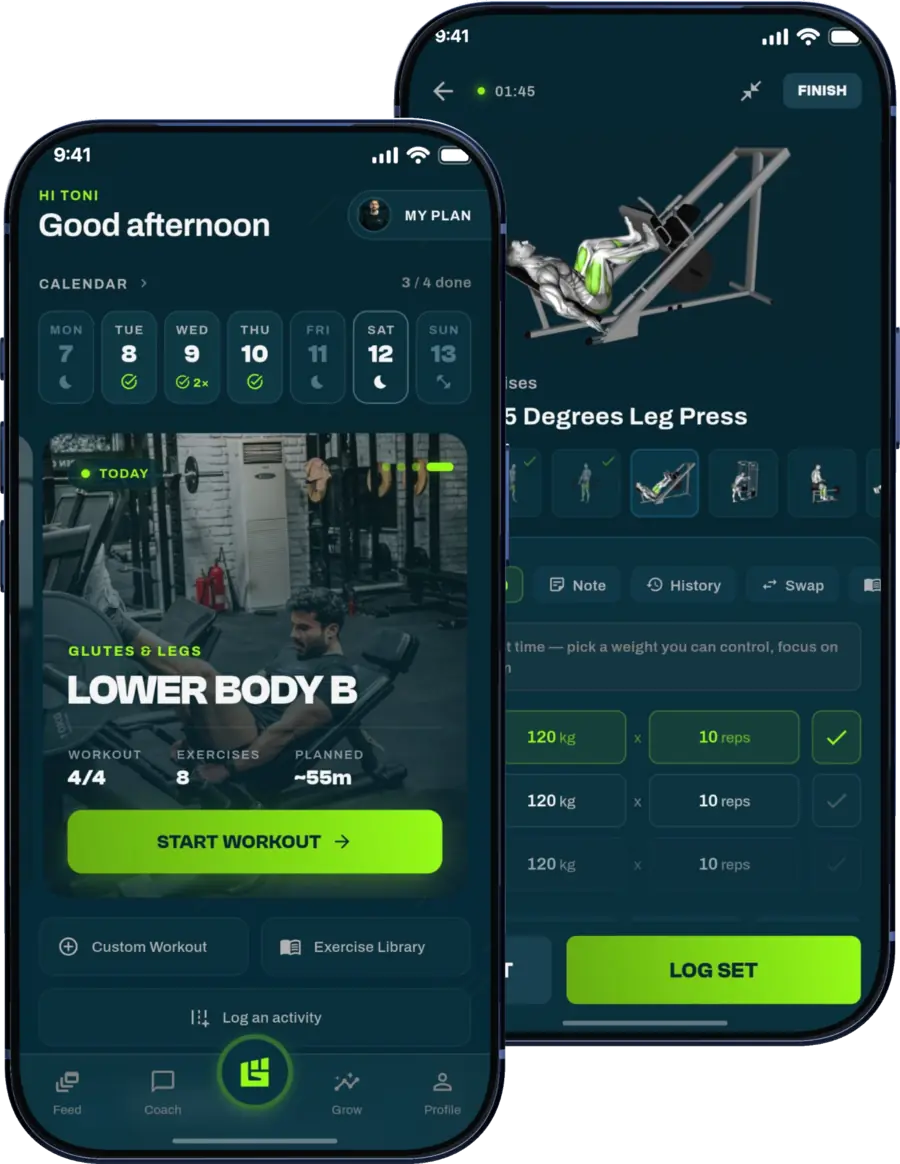
Get a personalized workout plan built around your goal, equipment and schedule. Train smarter, track every rep and keep moving forward, one workout at a time.






The data-driven advantage in the gym
Logging your workouts does more than just create a record. It gives every session a purpose. When you walk into the gym with a logbook or an app, you have a clear mission: beat your last performance. This constant, objective feedback is incredibly motivating.
And this isn't just a feeling; it’s backed by real-world data. One study found that individuals who meticulously logged their workouts increased their strength gains by 34% over 12 weeks compared to those who didn't. Other research shows consistent logging can lead to 2.5 times faster progress in muscle growth. You can see more on this in the 2025 State of Fitness report.
When you track, you build accountability and can see plateaus coming, allowing you to make smart adjustments before you get stuck.
Your gym progress dashboard at a glance
| Metric to Track | What It Measures | Tracking Frequency |
|---|---|---|
| Strength & Volume | The weight, reps, and sets you complete for each exercise. Your primary performance indicator. | Every Workout |
| Body Composition | Changes in body weight, key body measurements (arms, waist, etc.), and progress photos. | Weekly or Bi-Weekly |
| Performance | Improvements in functional tasks, like plank hold times or circuit completion speed. | Monthly or Bi-Monthly |
Together, these metrics paint a complete picture of your development, showing you exactly how your hard work is paying off.
The essential metrics for strength and muscle growth

Alright, you know why you need to track your workouts. Now let's get into the what. If you're serious about building strength and muscle, you need to focus on the numbers that actually matter. These metrics are your compass, telling you if your training is heading in the right direction.
For anyone trying to get stronger, the most critical data comes straight from your workouts. The numbers you log are the raw proof of progressive overload in action. Without them, you’re just guessing.
Quantifying your strength gains
When your goal is to lift heavier, your logbook is your most powerful tool. The numbers you write down are the ultimate truth-tellers. They cut through how you feel and give you cold, hard data on whether you’re actually getting stronger.
Your main focus should be workout volume. It’s a simple but powerful formula: Sets x Reps x Weight. If this number is trending up over time for your main lifts, you are making progress. It’s the most reliable sign that you're successfully applying progressive overload.
For example, let’s say one week you squat:
- 3 sets of 8 reps at 200 lbs = 4,800 lbs of total volume.
A few weeks later, you might hit:
- 4 sets of 8 reps at 200 lbs = 6,400 lbs of total volume.
The weight on the bar didn't change, but your volume increased significantly. That is undeniable progress.
Training volume is the bedrock of strength and hypertrophy. If you track only one thing inside the gym, make it this. A rising volume trend is the clearest sign that your program is working.
Another key metric is workout intensity. This isn’t about how hard a workout feels; it’s about the weight on the bar relative to your maximum. Tracking your estimated One Rep Max (1RM) is a great way to gauge raw strength gains. You can use an online One Rep Max (1RM) calculator to get a good estimate without performing a risky, all-out max lift.
Measuring muscle growth and body composition
Strength numbers are vital, but they don't tell the whole visual story. To track hypertrophy (muscle growth), you also need to look at how your body itself is changing. The scale alone can be misleading, especially if you're gaining muscle and losing fat at the same time—a process known as body recomposition.
This is where body measurements come in. A simple, flexible tape measure gives you objective data on whether your muscles are actually growing.
Make sure to consistently measure key areas:
- Arms: At the peak of your flexed bicep.
- Chest: Across the nipple line, keeping the tape level.
- Waist: At the narrowest point or across your navel.
- Hips: Around the widest part of your glutes.
- Thighs: At the midpoint between your hip and knee.
For the most accurate data, always measure under the same conditions. The best approach is to do it first thing in the morning, before eating or drinking, on the same day each week or month. This consistency minimizes noise from daily fluctuations, giving you a much truer picture of your progress.
The power of visual progress photos
Finally, don't underestimate progress photos. While numbers are objective, photos give you a qualitative, highly motivational view of your transformation. The scale and tape measure can easily miss subtle changes in muscle definition and shape that a camera will capture perfectly.
To make your photos a reliable tool, you need to standardize the process, just like with your measurements.
Follow these simple rules for effective progress photos:
- Consistent Lighting: Use the same light source every time. Natural light from a window is often best.
- Stable Background: Pick a plain, uncluttered wall.
- Standard Poses: Always take photos from the front, side, and back. You can do both relaxed and flexed shots.
- Same Time of Day: Morning, before you've eaten, is ideal to avoid any bloating.
Take photos every four to six weeks. Any more frequently and the changes might be too subtle to notice, which can be discouraging. When you compare your photos month-over-month, the visual proof of your hard work becomes a powerful motivator to keep pushing forward.
Choosing the right tools to log your workouts
Now that we’ve covered the "what" and "why" behind tracking your progress, let's get into the "how." The tool you use for logging can be the difference between a habit that sticks and one that fizzles out after a few weeks. We'll walk through the best options out there—from classic pen-and-paper to modern tech—so you can find what fits your style.
The way we track gym progress has completely changed. Back around 2010, only about 12% of gym-goers were consistently logging their workouts, and it was common to see people hit frustrating strength plateaus in about 10 weeks.
Flash forward to 2026, and that number has jumped to 68%. Most people now use apps, which has helped slash plateau times down to just 3 weeks and drive 42% better gains on average. This isn't just some passing trend; it’s a fundamental shift in how we approach fitness, something you'll see echoed in recent ACSM fitness trend reports.
The classic pen and notebook
There’s a certain charm to the old-school workout journal. It's simple, tangible, and completely free of digital distractions. For a lot of lifters, the physical act of writing down sets, reps, and weights helps lock them into the workout.
It’s completely customizable, never needs a charge, and won’t buzz with notifications mid-set. But it has some real limitations. Trying to analyze trends over months is a manual nightmare, you can't automate any calculations, and there's always the risk of losing it. It's a great place to start, but not the most efficient tool for making data-driven decisions.
Key Takeaway: A notebook is excellent for focus and simplicity. But if you want to analyze trends, visualize progress, or automate calculations, you'll outgrow it fast.
Spreadsheets for the data-savvy lifter
If you love digging into data and want total control, a spreadsheet app like Google Sheets or Microsoft Excel is a huge step up. You can build your own templates from scratch, create formulas to automatically track total volume or estimate your 1RM, and generate charts to visualize your strength gains.
This method gives you complete control over your data without the tedious manual math of a notebook. You can track whatever you want, however you want. The main trade-off is the initial setup time and needing a bit of spreadsheet know-how. It’s a powerful option if you're a DIY type.
The power of dedicated fitness apps
For most people who are serious about getting results in 2026, dedicated fitness apps are the most powerful and efficient choice. These tools are built specifically for tracking gym progress, combining the best parts of notebooks and spreadsheets into a clean, easy-to-use package.
Modern apps are designed to do the heavy lifting for you, offering features that were unimaginable with a simple logbook.
- Automated Calculations: Apps instantly calculate your total training volume, log your personal records (PRs), and give you an estimated 1RM after each workout. This saves you time and cuts out the risk of math errors.
- Massive Exercise Libraries: You get access to hundreds of exercises, usually with video demos and step-by-step instructions. This helps ensure your form is on point, which is key for avoiding injuries.
- Adaptive Workout Plans: The best platforms use your performance data to tell you what to do next. For example, a personalized strength training app from https://grabgains.com/ can automatically adjust your weights, reps, or even the exercises themselves based on how you’re progressing, making sure you're always challenged.
- Visual Analytics: Your progress comes to life with clear charts and graphs. This visual feedback is incredibly motivating and helps you spot trends or plateaus before they become a problem.
These tools turn tracking from a chore into a dynamic part of your training. Instead of just being a record of what you did, the app helps guide what you should do next. They’re less like a logbook and more like a pocket-sized personal trainer, pushing you toward your goals with data-backed intelligence.
Turning your data into smarter training decisions
Logging your workouts is only half the battle. The other half—the part that actually makes you stronger—is learning how to read what you wrote down and turn those numbers into smarter training decisions.
Think of your workout log as intelligence you've gathered from the front lines. Now it’s time to step back, analyze that intel, and act like your own coach. This is how you spot a problem before it kills your momentum and make sure you’re always moving forward.
This decision tree can help you pick the right tool for the job, depending on whether you value simplicity or deep data analysis.

As the chart shows, there's a clear fork in the road. If you just want to get the job done, a simple notebook works. If you're serious about analyzing your performance, an app is your best bet.
How to spot a true plateau in your data
A plateau isn't just one bad day in the gym—we all have those. It’s a stubborn pattern of stagnation that shows up clearly in your logbook. It’s a signal that your body has adapted and needs a new challenge.
Look for these warning signs in your data over three to four weeks:
- Stalled Lifts: You haven't been able to add weight or even one more rep to your main compound lifts for several sessions in a row.
- Decreasing Volume: Your total training volume (sets x reps x weight) for a key lift or muscle group has flatlined or, even worse, started to dip.
- Increased Perceived Exertion: The same workouts that felt manageable a month ago now feel like a grind.
It's absolutely critical to look at the trend, not a single workout. Your performance can swing daily based on sleep, stress, or what you ate. A multi-week pattern, however, is undeniable proof that it's time for a change.
Using scenarios to guide your next move
Once you've spotted a plateau, your data will point you toward the fix. Let's walk through a couple of common scenarios to see how you can turn that logbook information into an action plan.
Scenario 1: Your Squat Strength Has Stalled
You flip through your log and notice your squat hasn't budged in three weeks. You’re stuck at 3 sets of 5 reps with 225 lbs, and trying to add even five pounds feels impossible.
- Your Data Shows: A clear strength plateau.
- Potential Problem: Your body has either fully adapted to this specific workload or you're running into a recovery deficit.
- Actionable Solution: Time for a deload week. Cut your squat volume by 40-50% but keep the weight the same. For example, do just 2 sets of 3 reps at 225 lbs. This gives your nervous system a much-needed break and often leads to a surge in strength the following week.
Scenario 2: Your Muscle Growth Has Slowed Down
You've been tracking your measurements, but the tape shows your arms and chest haven't grown in over a month. Your log confirms you've been hammering away in the same 8-12 rep range for months.
- Your Data Shows: A hypertrophy plateau.
- Potential Problem: Your muscles are bored. They've adapted to the stimulus. Your nutrition might also be holding you back.
- Actionable Solution: Introduce a new stimulus. Switch things up and run a strength-focused block of 4-6 reps on your main lifts for a few weeks. You could also increase your total weekly volume by adding an extra set to a few key exercises. Finally, double-check your nutrition log to make sure you’re in a slight calorie surplus with enough protein to actually build new tissue.
A plateau isn't a dead end; it's a data point telling you where to turn next. Use it as an opportunity to introduce a strategic change to your training or recovery.
If you want to get even more granular with your recovery, advanced metrics can be a game-changer. For example, tracking your Heart Rate Variability (HRV) can tell you if your body is primed for a high-intensity day or if you'd be better off with a lighter session. This is what turning data into truly smart training is all about.
Building a sustainable tracking habit that sticks

Knowing what to track is one thing. Actually sticking with it is what separates people who get incredible results from those who just fizzle out. The goal isn't to turn tracking into another chore—it's to make logging your lifts feel as automatic as racking the weight after a set.
The secret isn’t more discipline; it's a better system. Instead of waiting until you’re exhausted and ready to go home, you need to log your numbers during the workout. The perfect time is in the rest periods between your sets.
Doing it this way solves two problems. First, the data is perfectly accurate because the numbers are fresh in your mind. Second, you get rid of that mental hurdle of having a "logging task" waiting for you after you’ve already cooled down.
Integrating tracking into your routine
The key to any lasting habit is removing friction. You need to make it so easy to track gym progress that it feels like more effort not to do it. The best way I've found is to record your numbers on your phone or in a notebook the moment you finish a set.
Think about it: after your first set of bench presses, you sit up, catch your breath, and instantly punch in the weight and reps. By the time your 60-90 second rest is over, the data is logged, and you’re ready for the next set. This turns tracking from a chore into a productive part of your rest.
A habit isn't built on motivation; it's built on a reliable system. By logging your lifts during your rest periods, you make tracking a natural part of the workout itself, not an afterthought.
This small timing shift makes a huge difference. It completely avoids that end-of-workout feeling where you're too drained to remember the details or just want to get out the door.
Creating a powerful weekly review workflow
Your daily logs give you the raw data. The weekly review is where you turn that data into a plan. Set aside a specific time each week—Sunday mornings work well for a lot of people—to zoom out and look at the big picture. This is your strategy meeting with yourself.
A good weekly workflow is simple and repeatable:
- Review Performance: Open your app or logbook and scan the past week’s training. Did your total volume for key lifts go up? Did you hit any new personal records (PRs)? See what went well and where you stalled.
- Take Measurements: This is the ideal time for your weekly or bi-weekly check-in. Grab your body measurements and weight under the same conditions to keep things consistent.
- Set Clear Targets: Based on your review, set a couple of clear, achievable goals for the week ahead. It could be as simple as "add 5 pounds to my squat for sets of 5" or just "complete all my scheduled workouts."
This weekly ritual creates a powerful feedback loop. You see your progress, which fuels your motivation, and then you set new targets, giving your training for the next week a clear purpose. It turns a bunch of disconnected workouts into a real, goal-driven plan.
The motivational power of visual feedback
The single biggest reason people stick with tracking is simple: they see it working. When your motivation drops—and it will—visual proof that your hard work is paying off is what will keep you in the game. This is where good fitness apps really shine, turning your numbers into easy-to-read charts and graphs.
Seeing a line chart of your squat strength steadily climbing over three months is incredibly powerful. It’s objective proof that your effort is making a difference. This visual feedback is what gets you to the gym on days you feel tired or uninspired. It’s a constant reminder that every single rep you log is another point on an upward trend.
The data backs this up. Research from the International Health, Racquet & Sportsclub Association (IHRSA) found that gyms using integrated progress tracking retain 67% more members after a year. In facilities with data-driven apps, dropout rates fell from 50% to just 18% in six months, largely because visual charts boost continuation rates to a massive 89%. You can read more in the Health & Fitness Business research report. It proves that seeing your progress is what turns tracking into a sustainable, lifelong habit.
Common questions about tracking gym progress
Even with a solid plan, a few questions always seem to pop up once you start logging your workouts seriously. We've been there. Let's clear up some of the common hangups that can get in the way of your progress.
How often should I take progress pictures and measurements?
Once a month. That’s the sweet spot.
This frequency is just right for spotting real trends without getting lost in the daily noise of water weight or what you ate for dinner. Any more often, and you risk getting discouraged by fluctuations that have nothing to do with actual fat loss or muscle gain.
For reliable data, consistency is king. Always take your measurements and photos on the same day of the month, first thing in the morning before eating, and with consistent lighting and angles.
This approach gives you a much truer picture of your body composition changes over time.
My strength is up but my weight is the same—should I worry?
Not at all. In fact, this is usually a fantastic sign.
This is a classic signal of body recomposition, especially for newer lifters. It means you're building dense, lean muscle while shedding body fat at the same time. The scale might not move, but your physique is absolutely improving.
The only exception is if your goal is a dedicated bulk. If you're trying to gain significant size and your weight has completely stalled, it's a clear sign you need to bump up your daily calories to fuel that new growth.
What is the single most important metric to track?
If you had to pick just one, it would be total training volume.
Calculated as sets x reps x weight, this number is the engine behind progressive overload. It’s the most direct indicator of whether you're doing more work over time.
If your total volume for key lifts is trending up week after week, you are virtually guaranteed to be getting stronger and building muscle. It's the clearest sign your program is working. Luckily, any good fitness app will calculate this for you automatically, so you don't have to break out the calculator after every workout.
Is tracking in my head good enough?
In a word: no. We all think we can remember what we lifted last week, but mental tracking is a recipe for stalled progress.
You can’t spot a plateau if you can't remember the exact numbers from three weeks ago. The whole point of tracking is to gather objective data so you can make smart, informed decisions about your training.
You need a written record. It doesn't matter if it's a beat-up notebook or a modern app, but it has to live somewhere outside your memory. Without a log, you're just guessing—and guessing isn't a strategy.
Ready to stop guessing and start making real, measurable progress? The GrabGains app takes all the guesswork out of tracking. With automated volume calculations, visual progress charts, and personalized workout recommendations, it’s the ultimate tool to ensure every workout moves you closer to your goals. Download GrabGains on iOS or Android today and experience truly intelligent fitness tracking.
Get inspired and motivated