Tracking calories vs intuitive eating: a modern fitness guide
Explore tracking calories vs intuitive eating. Discover which method aligns with your fitness goals and learn how to build a sustainable nutrition strategy. The big debate of tracking calories vs. intuitive eating really boils down to one question: do you prefer a data-driven approach or a mindful one? Calorie tracking gives you precise control over your energy intake, while intuitive eating is all about listening to your body’s internal signals. The right choice depends on whether you thrive on structure and numbers or feel better without external rules.
Choosing your path: tracking calories vs. intuitive eating
Deciding between tracking calories and intuitive eating is about matching your nutrition strategy to your goals and personality. One method gives you quantitative certainty; the other focuses on a qualitative connection with your body. Neither is better than the other—the best approach is simply the one you can stick with.
Calorie tracking is straightforward: you log what you eat and drink to monitor your energy intake. This provides clear, objective data, turning nutrition into a manageable equation. It’s perfect for creating a predictable calorie deficit for weight loss or a surplus for muscle gain.
Intuitive eating, on the other hand, asks you to ditch the diet mentality. Instead of relying on numbers from an app, you build trust in your body’s natural hunger and fullness cues to guide your choices.
Built for progress
Take the guesswork out of training
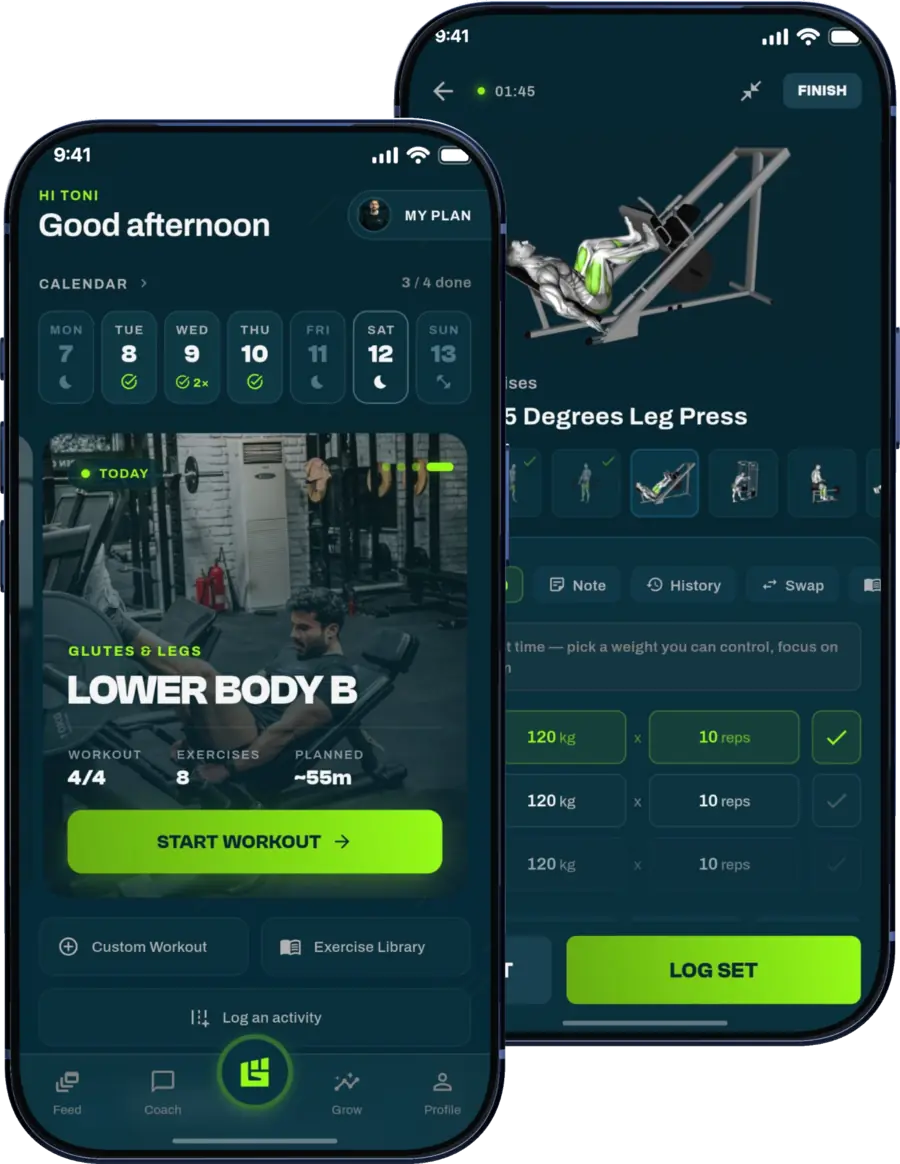
Get a personalized workout plan built around your goal, equipment and schedule. Train smarter, track every rep and keep moving forward, one workout at a time.






The core conflict is Precision vs. Perception. Calorie tracking removes guesswork with objective data. Intuitive eating relies on subjective feelings to rebuild body attunement.
Comparing the core philosophies
At their heart, these two strategies are opposites. Calorie tracking is an external, rule-based system. It treats the body like a machine that can be managed with inputs and outputs, which is great for people who love structure and seeing measurable progress.
Intuitive eating is internal and principle-based. It sees the body as a wise guide that tells you what it needs through hunger, satiety, and cravings. This works well for anyone who feels trapped by rigid diets and wants to heal their relationship with food.
Consistency with tracking often leads to predictable results. For example, one landmark 6-month study found that people who tracked their food intake diligently lost significantly more weight. You can read the full research on how logging frequency impacts weight loss results.
Calorie tracking vs. intuitive eating at a glance
To make the differences even clearer, here's a quick side-by-side comparison.
| Aspect | Calorie Tracking | Intuitive Eating |
|---|---|---|
| Primary Focus | Quantitative data (calories, macros) | Qualitative signals (hunger, fullness, satisfaction) |
| Guiding Force | External rules and targets | Internal body cues and principles |
| Best For | Specific body composition goals (fat loss, muscle gain) | Healing relationship with food, long-term sustainability |
| Psychological Impact | Can create structure but may lead to obsession | Promotes food freedom but can feel unstructured |
| Meal Decisions | Based on fitting foods into a daily budget | Based on what the body wants and needs |
This table simplifies the two philosophies, but remember, many people find success by blending elements from both. The key is to find what works for your body and mind.
The data-driven approach of calorie tracking
At its core, calorie tracking is about quantifying your food intake to manage your body’s energy balance—the simple principle of calories in versus calories out. It’s a method rooted in objective data, giving you a clear, measurable path toward your fitness goals.
The science is simple. If you eat fewer calories than your body burns—a caloric deficit—you lose weight. If you eat more—a caloric surplus—you provide the energy needed for muscle growth. Calorie tracking turns these ideas from abstract concepts into a practical, daily strategy.
By logging what you eat, you get precise control over your energy intake. The guesswork that so often derails progress is gone. You’re no longer just hoping your choices align with your goals; you’re working with hard numbers.
The tools of precision nutrition
What used to involve notebooks and tedious manual math is now a straightforward habit, thanks to modern tech. Digital food scales and nutrition apps have completely changed the game.
These tools make the process almost effortless:
- Barcode Scanners: Instantly log packaged foods.
- Massive Food Databases: Find nutritional info for just about any ingredient or restaurant meal.
- Recipe Builders: Calculate the exact calories and macros in your homemade meals.
This has made data-driven nutrition accessible to everyone, not just pro bodybuilders. To get the most out of it, learning how to track calories accurately is a fundamental skill that will pay dividends.
Why data delivers predictable results
The biggest advantage of tracking calories is predictability. When you consistently hit a specific caloric deficit or surplus, you can reliably forecast your rate of weight change. This structure is incredibly powerful for anyone with a deadline or specific body composition goal.
Tracking forces a level of accountability you just can't ignore. It’s hard to overlook when your daily log shows you’ve overshot your target, creating an honesty that is often missing from less structured eating styles.
This method also dramatically improves your nutritional literacy. Over time, you start to internalize the calorie and macro content of your favorite foods. You’ll learn what a real serving of peanut butter looks like or how much protein is in a chicken breast without even thinking about it.
For instance, a new tracker might be shocked to learn their "healthy" salad dressing adds 300 calories to their meal, or that their post-workout smoothie has more sugar than a can of soda. This knowledge empowers you to make smarter choices, even on days you aren’t tracking.
Platforms like GrabGains take this a step further by integrating tools like a macro calculator directly into your plan. This lets you set precise protein, carb, and fat targets that sync with your adaptive training plan, ensuring your nutrition actively supports every single workout. When you pair quantified eating with quantified training, you create a powerful system for measurable progress.
The mindful practice of intuitive eating
Intuitive eating is less of a "method" and more of a mindset shift. It’s about ditching the external rules from diets and apps and learning to trust your body’s own built-in signals for hunger, fullness, and satisfaction. It's not about a lack of discipline—it's about developing a deep self-awareness that food rules often silence.

The real goal here is to get to a place where food isn't a source of anxiety or guilt. You learn to move away from the all-or-nothing thinking that traps so many people in a cycle of strict dieting followed by burnout and rebound.
Rejecting the diet mentality
The first, and honestly the hardest, step is to actively reject the diet mentality. This means you have to stop looking for the next "perfect" diet that promises to solve all your problems. It’s about acknowledging that for most people, diets don’t work long-term and often just mess up their relationship with food.
From there, you give yourself unconditional permission to eat. This can sound terrifying, but it's the only way to strip "forbidden" foods of their power. When nothing is off-limits, those intense cravings and the guilt-driven binges that follow them start to lose their grip.
Honoring hunger and fullness
A huge part of intuitive eating is learning to actually listen to your hunger. Instead of pushing through hunger pangs to make it to a scheduled mealtime or stay within a calorie budget, you respond by giving your body the fuel it’s asking for.
This simple act rebuilds trust between your mind and body. It sends a clear signal that your needs will be met, which quiets the primal panic that often leads to overeating.
Just as important is learning to respect your fullness. This is about tuning in during a meal and recognizing that point of comfortable satisfaction—not uncomfortably stuffed.
You can practice noticing fullness by:
- Eating Slowly: It takes time for your stomach to tell your brain it’s had enough. Give it a chance.
- Checking In Mid-Meal: Pause halfway through and just ask yourself, "How full am I? Am I still actually hungry?"
- Focusing on Satisfaction: Pay attention to when the food stops tasting as incredible as the first few bites. That's a good cue.
This is how you learn to stop eating when you’re content, not just when the plate is empty or an app gives you the green light.
Intuitive eating isn't about eating whatever you want, whenever you want. It's about learning to trust your body to tell you what it needs and how much, freeing you from the mental burden of food rules.
While calorie tracking offers precision, it can become a source of stress and obsession for some. A 2017 study, for example, found that of the college students using fitness tracking apps, 73.1% felt the apps contributed to their disordered eating symptoms. It’s a powerful reminder that for some people, the rigidity of tracking can do more harm than good. You can read more about the study's findings on tracking app behaviors.
A detailed comparison of precision vs perception
When you pit calorie tracking against intuitive eating, you're not looking at a fight between right and wrong. You're looking at a classic trade-off: hard data versus internal cues.
Each approach is built on a totally different way of thinking. One gives you a mathematical map to follow, while the other hands you a compass to read your body’s own signals. Knowing how they differ in accuracy, mental impact, and real-world sustainability is the key to picking the tool that actually fits your goals.
Accuracy: the objective vs. the subjective
The biggest split between these two methods is accuracy. Calorie tracking is built on objective numbers. You weigh your food, you log it, and you get a clear, data-driven picture of your energy intake. This precision is what makes it so effective for changing your body composition.
Intuitive eating, on the other hand, runs on subjective feelings. You eat based on hunger and fullness signals—a skill you have to develop over time. While it’s a powerful approach, human perception is famously unreliable. Studies consistently show that most of us are terrible at guessing how much we’ve actually eaten.
Here's the core difference: Calorie tracking tells you what is—it’s undeniable data. Intuitive eating relies on what you feel—a useful but less precise guide that can be skewed by stress, old habits, or a bad day.
This data-first approach is exactly why so many people with specific goals stick with tracking. The research is clear: when it comes to weight management, sticking to your tracking plan is directly tied to your success.
Psychological impact: structure vs. freedom
The mental game is where these two methods really diverge. For many, calorie tracking brings a sense of structure and control that feels motivating. Seeing the numbers add up provides instant feedback that you’re on the right path.
But for some, that same structure can quickly become a cage. The constant focus on numbers can spiral into food anxiety, guilt over hitting your targets, and a strained relationship with eating. It can turn food from fuel into a math problem.
Intuitive eating is designed to do the opposite: create food freedom. By getting rid of external rules, it aims to dismantle the guilt and anxiety that so often comes with dieting. The end goal is to build a peaceful, trusting relationship with food where no single meal is a moral failure. The challenge? For anyone used to clear targets, that lack of structure can feel like chaos.
Sustainability: the habit vs. the skill
Which one is more sustainable? That depends completely on you. If you’re a data-driven person who thrives on routine, logging your meals can become a simple daily habit, no different than brushing your teeth. The process just becomes part of your day.
But if weighing and logging feels like a constant, draining chore, you’re headed for burnout. This is where intuitive eating can win out. Once you’ve mastered the skill of listening to your body, you don't need an app or a food scale. It’s a skill you carry with you for life.
The debate over which is more sustainable is a huge part of the tracking calories vs. intuitive eating discussion. It’s not about which one is "easier," but which one clicks with your personality and protects your mental health long-term.
Suitability for performance goals
When peak performance is on the line, precision is non-negotiable. Competitive athletes, bodybuilders, or anyone trying to hit a specific body composition target needs the tight control that calorie tracking delivers. It’s the only way to guarantee you’re getting the exact fuel needed for performance, recovery, and physical change.
The evidence backs this up. For example, a massive 71.8% of competitive athletes track their calories, a rate far higher than the general population. That number tells you everything you need to know about how critical precision is when results matter most. You can discover more insights about tracking habits among different groups if you're curious.
Intuitive eating is fantastic for supporting general fitness and a healthy lifestyle. However, it often falls short for elite-level goals that require specific macro splits or tightly controlled calorie targets. Its real strength is in building healthy, sustainable behaviors, not in fine-tuning your body for a competition deadline.
Matching the method to your lifestyle
The debate over calorie tracking vs. intuitive eating isn’t about finding one superior method—it’s about finding the one that works for you. Your goals, personality, and history with food will decide whether a data-driven or a perception-based approach makes the most sense. The right strategy shouldn't feel like a chore; it should feel like a natural fit.
This decision tree helps visualize the choice. Are you chasing quantitative precision, or are you looking to build a healthier relationship with food based on your body’s signals?

The flowchart shows how different goals lead you toward either precision-based tracking or perception-based eating, clarifying which mindset aligns with each strategy.
The strength and hypertrophy enthusiast
For anyone serious about building muscle and strength, precision is key. Gaining mass demands a consistent and controlled calorie surplus with enough protein to fuel growth. Tracking your calories and macros simply removes the guesswork, ensuring your body has the exact building blocks it needs to repair and grow after tough workouts.
It’s incredibly easy to unknowingly undereat and stall your progress without tracking. For committed lifters, counting isn't a chore; it’s strategic fueling for predictable results.
The endurance athlete
Endurance athletes, from marathon runners to HYROX competitors, have massive energy demands. Your performance hinges on keeping glycogen stores topped off for fuel and getting enough nutrients for recovery. Here, calorie tracking is a powerful tool to make sure you're hitting your carb targets for long sessions and protein goals for muscle repair.
It also helps prevent Relative Energy Deficiency in Sport (RED-S), a condition where athletes don’t eat enough to support their training load, leading to poor performance and health issues. For these athletes, tracking is a form of risk management.
For anyone with specific, time-bound performance goals—like a competition or a body composition target—calorie tracking provides the structure and predictability needed to get there. It's the most direct route from point A to point B.
When intuitive eating is the better choice
On the other side of the coin, intuitive eating is a powerful approach for anyone looking to heal their relationship with food. It’s an excellent fit for:
- Those with a history of disordered eating: Calorie tracking can easily become a trigger for obsessive behaviors. Intuitive eating offers a path away from numbers and rules, focusing instead on rebuilding trust with your body.
- Chronic dieters: If you’re tired of the endless cycle of restriction and rebound, intuitive eating is your way out. It helps you break free from the "diet mentality" and find a sustainable way of eating for life.
- People seeking food freedom: For those who feel constant anxiety or guilt around food choices, this practice is liberating. It teaches you to enjoy food again, stress-free.
The hybrid model: a powerful compromise
You don't have to pick a side and stick with it forever. A hybrid approach often delivers the best of both worlds and is one of the most sustainable paths to long-term success. This model involves using calorie tracking as an educational tool for a set period, usually 4-12 weeks.
During this phase, you’re not dieting; you’re building nutritional literacy. You learn what appropriate portion sizes look like and get an instinctive feel for the macronutrient content of your favorite foods. You’re simply collecting data.
Once you feel confident in that knowledge, you can transition to a more intuitive style. You’ll be equipped to make smart choices based on your body’s cues but with a solid foundation of nutritional knowledge to back them up. This strategy lets you maintain a healthy body composition without the daily grind of logging every single meal.
How to use our tools to support your goals
So, should you count every calorie or learn to eat by feel? No matter where you land in the tracking calories vs. intuitive eating debate, the right tools will make your life easier and your results better. Our platform is built to give you the structure and feedback you need, whether you’re a data-driven athlete or a mindful eater.
Think of a personalized fitness platform as a support system. It shouldn't lock you into a single method. Instead, it should have specific features that work for both data-focused tracking and intuitive eating, giving you what you need to back up your decisions in the kitchen.
For the dedicated calorie tracker
If you’re someone who thrives on data and has specific body composition goals, our tools are designed to give you a serious advantage. It all comes down to precision—and connecting your nutrition directly to your training is where the real magic happens.
Start with our Macro Calculator. It’s your first step to setting clear, goal-oriented targets for calories, protein, carbs, and fats. This isn't just some random number generator; it's designed to sync with the demands of your adaptive workout plan, making sure your nutrition is perfectly timed to fuel performance and recovery.
When you link your macro targets to your training schedule, you create a powerful feedback loop. You stop eating for a generic number and start eating to support your next deadlift PR or to recover from a brutal HIIT session.
This integration cuts out all the guesswork. It turns nutrition from a chore into a core part of your training strategy, ensuring the hard work you put in at the gym is fully backed by what you do in the kitchen.
For the mindful intuitive eater
Intuitive eating is all about listening to your body’s cues, but that doesn’t mean you have to fly completely blind. Objective feedback is still incredibly useful for making sure your mindful choices are actually moving you toward your goals. This is where our progress tracking features shine.
Instead of tracking every gram of food, you can shift your focus to tracking performance. Are your lift numbers consistently climbing? Is your endurance getting better? These are powerful, objective signs that your body is well-fueled and recovering like it should.
You can also use our tools to monitor changes in body measurements over time. This gives you a non-scale way to see progress, helping you confirm your intuitive approach is working without getting hung up on daily weight fluctuations.
This approach gives you the best of both worlds:
- Performance Data: Use your workout stats to see if your fueling strategy is on point.
- Body Measurements: Track long-term changes in composition without fixating on the scale.
- Training Structure: Follow your adaptive workout plan while still eating intuitively.
Ultimately, our platform provides the essential training structure and data insights. It’s up to you to pair that with the nutritional strategy that works for your body and your mindset, creating a path to your goals that is truly your own.
Frequently asked questions
When it comes to calorie tracking vs. intuitive eating, a lot of questions come up. The theory is one thing, but making it work in the real world is another. Let’s clear up some of the most common points of confusion so you can move forward with a strategy that actually fits your life.
Can I combine calorie tracking and intuitive eating?
Yes, absolutely. In fact, for many people, a hybrid approach is the most realistic and sustainable way to go. The key is to see tracking not as a lifelong prison sentence, but as a temporary educational tool.
You could track your intake for a set period—say, 4 to 12 weeks—to get a real-world understanding of nutrition. This isn't about judgment; it's about data. You'll learn what a real portion of peanut butter looks like and see the macronutrient breakdown of your go-to meals. It’s a crash course in what your body is actually taking in.
Once you’ve built that foundation, you can start shifting toward a more intuitive style. You'll be equipped to listen to your hunger and fullness cues, but now those signals are backed by knowledge, not just guesswork. Many people find a rhythm in tracking when they have a specific goal, like fat loss, and then eating more intuitively during maintenance phases.
Is one method more practical for a busy professional?
There’s no one-size-fits-all answer here; it really comes down to your personality and the demands of your schedule.
For some busy professionals, calorie tracking is a perfect fit. With modern apps, it takes just a few minutes a day and provides the kind of clear, data-driven structure that high-performers often thrive on. Planning meals based on macro targets can free up a ton of mental energy during a chaotic workweek.
On the other hand, if logging every bite feels like another tedious item on your never-ending to-do list, it’s a recipe for burnout. In that case, a more structured form of intuitive eating might be a better bet. This could be as simple as having a few non-negotiable rules, like making sure every meal has a protein source and a side of veggies. A popular hybrid approach is to track on weekdays for consistency and then switch to intuitive eating on weekends for more social freedom.
Does calorie tracking cause eating disorders?
This is a serious question, and the answer is nuanced. While the tool of calorie tracking is neutral, a lot of research does show a link between tracking and obsessive thoughts or disordered eating patterns. The risk is especially high for people who already have perfectionistic or anxious tendencies.
This is where self-awareness is non-negotiable. You have to pay close attention to your headspace when you start tracking.
If you find yourself consumed by guilt for going over your calorie target, dodging social events because of food, or feeling like you're losing control, those are massive red flags. It likely means tracking is not a healthy tool for you.
If you notice any of this, the safest and smartest move is to stop tracking immediately. Exploring intuitive eating, perhaps with support from a qualified professional, is a much better path forward. Your mental well-being should always come first.
How long does it take to learn intuitive eating?
Intuitive eating isn't a 30-day program; it's a skill you build over a lifetime. It’s really a process of unlearning diet culture, not just learning a new set of rules. How long that takes is completely individual.
If you’re coming from years of chronic dieting, it might take several months to a year—or even longer—to fully dismantle all those old food rules and reconnect with your body’s signals. You’re essentially rebuilding a relationship of trust with yourself, and that process is rarely a straight line.
You’ll have days where you feel completely in sync and others where old habits or thoughts creep back in. The goal isn’t perfection. It’s about building a more peaceful, sustainable, and guilt-free relationship with food.
Ready to align your nutrition with a smarter training plan? GrabGains offers the tools you need, from a Macro Calculator to adaptive workout plans that track your performance. See how our platform can support your unique fitness journey.
Get inspired and motivated