Your workout program not working? Here's how to fix it
Struggling with a workout program not working? Get expert tips to bust plateaus, optimize nutrition, and restart gains in 2026. If your workout program isn't delivering, the problem usually boils down to one of three things: your body has adapted and is bored (a lack of progressive overload), your nutrition isn't fueling your goals, or you're simply not recovering enough. The trick is to figure out which one is the bottleneck and make a targeted fix.


Why your workout has stopped delivering results
It’s one of the most demoralizing feelings in fitness. You show up, you put in the work, and you stay consistent, but the scale won’t budge, your lifts are stuck, and the mirror looks exactly the same. When it feels like your workout program is not working, it’s easy to get frustrated and think about throwing in the towel.
But what if the problem isn’t your effort, but your strategy?
Hitting a wall, or a plateau, is a totally normal part of training. In fact, it’s a good sign—it means your body successfully adapted to the demands you put on it. The routine that once sparked rapid change has now become your body's new normal. To keep progressing, you need to give it a new reason to change.
Built for progress
Take the guesswork out of training
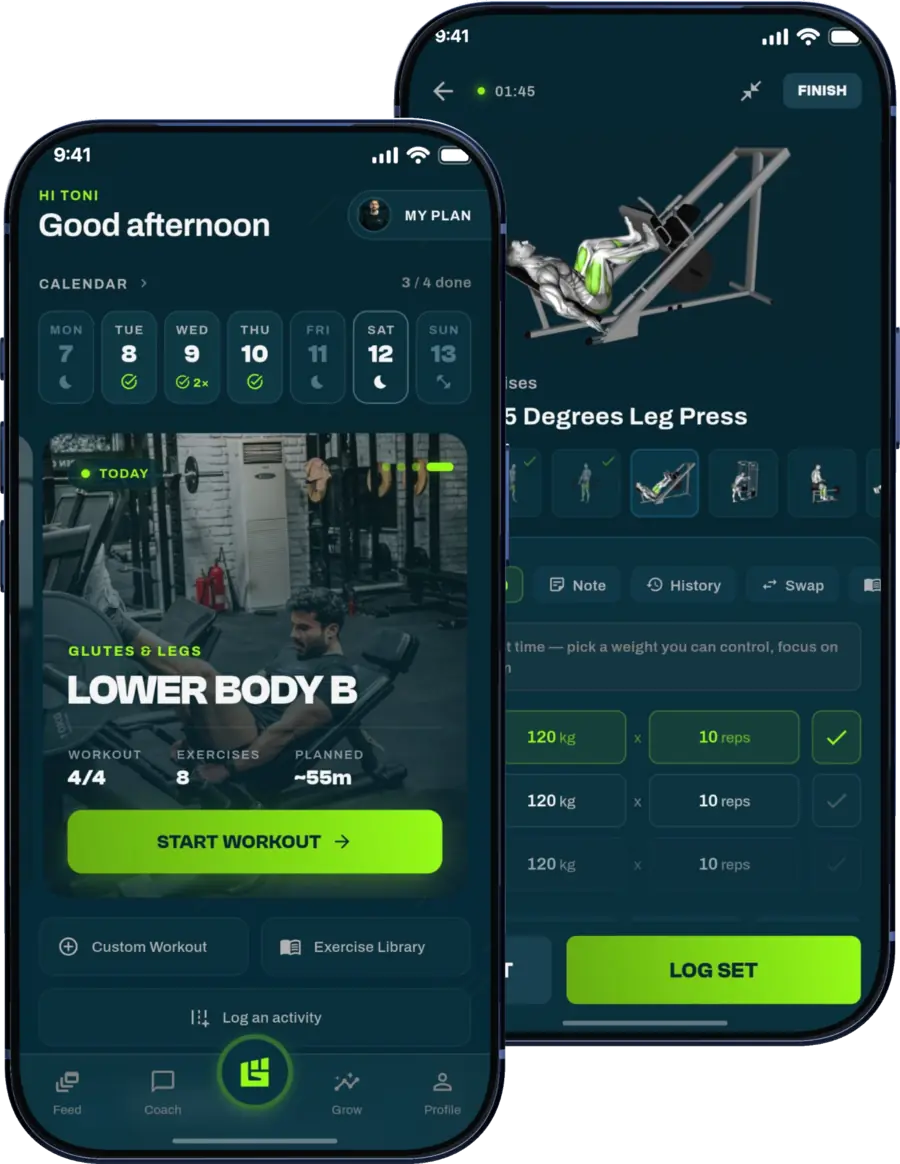
Get a personalized workout plan built around your goal, equipment and schedule. Train smarter, track every rep and keep moving forward, one workout at a time.






This is where most people get stuck. They either double down on what’s stopped working—mindlessly adding more reps or longer sessions—or they scrap their entire plan out of sheer frustration. The real solution is to methodically check the three pillars of fitness:
- Your Training: Is your program designed to get progressively harder, or have things gone stale?
- Your Nutrition: Are you eating to support performance and recovery, or are you accidentally undermining your own hard work?
- Your Recovery: Are you giving your body the downtime it needs to repair muscle, or is chronic fatigue secretly holding you back?
The decision tree below can help you visualize how to work through these factors to find out what's really going on.

As you can see, stalled progress is rarely a single issue. It’s almost always an interconnected problem that requires you to look beyond just the exercises you're doing in the gym.
Before we dive into the nitty-gritty of fixing your program, this quick-glance table can help you diagnose the most common failure points.
Diagnosing stalled progress: quick fixes
Use this diagnostic tool to pinpoint why your program is failing and discover the corrective actions you can take.
| Problem Area | Common Symptom | Actionable Fix Preview |
|---|---|---|
| Training | Lifts haven't increased in weeks; workouts feel "easy" or monotonous. | Introduce progressive overload by increasing weight, reps, or sets. |
| Nutrition | Constant fatigue, poor performance, or weight loss/gain has stalled. | Track your food intake for one week to check calorie and macro alignment. |
| Recovery | Persistent soreness, poor sleep quality, or lack of motivation. | Prioritize 7-9 hours of sleep and add a dedicated rest day. |
This table gives you a starting point. From my experience helping countless people break through plateaus, the issue is almost always found in one of these areas. It’s rarely about a lack of effort but rather a misapplication of it.
"A plateau doesn't mean you've failed; it means you've succeeded at making your old routine easy. It's not an endpoint—it's a signal that it's time to evolve your approach."
Think of yourself as a detective looking for clues. Is your sleep schedule all over the place? Have your meals become an afterthought? Or have you been doing the exact same sets and reps for the past three months? Each one is a major clue. This guide will give you a clear roadmap to turn those clues into an actionable plan, getting you back on track from stalled to successful.
How to perform a full training audit
Before you scrap your entire routine, you need to play detective. When a training program stops working, it’s almost never a complete failure. More often, a few key parts have just gone stale.
A full training audit is about taking an honest, objective look at what you’re actually doing in the gym—not just what you think you’re doing. This isn't about assigning blame. It's about gathering cold, hard data so you can make smart, effective changes.
Are you pushing hard enough or too hard?
The engine of every successful workout plan is progressive overload. All this means is that you have to consistently ask your body to do more than it's used to. If your workouts have felt "comfortable" for a few weeks, this is the most likely culprit for your plateau.
But there’s a flip side. Pushing too hard, too often, is just as bad. Overtraining leads to burnout, constant fatigue, and a higher risk of injury, all of which will stop your progress dead in its tracks. The goal is to find that sweet spot between challenging your limits and allowing your body to recover.
Think of your training like an engine. If you never push the RPMs, you won’t go any faster. But if you constantly redline it without any maintenance, you’re headed for a breakdown. The goal is to find the optimal performance zone.
Grab your workout logs from the last 4-6 weeks and look for these red flags:
- Stagnant Lifts: Are the weights on your key exercises—like squats, bench presses, or deadlifts—exactly the same as they were a month ago?
- Identical Reps and Sets: Have you been stuck on 3 sets of 10 for every exercise, without ever trying to add one more rep or a little more weight?
- Constant Fatigue: Do you feel drained before your workouts even start? This could be a sign that your volume (total work) is too high for your body to handle.
Analyzing your training variables
Let's break down the "big three" of program design: volume, intensity, and frequency. A small imbalance in any one of these can bring your results to a grinding halt.
Volume (how much you do) Volume is the total amount of work you’re doing, usually calculated as sets × reps × weight. If your volume is too low, you're not giving your muscles a strong enough reason to grow. If it's too high, you’re digging a recovery hole you can’t climb out of.
Intensity (how hard you train) Intensity is all about how heavy you’re lifting compared to your max (your one-rep max, or 1RM). A classic mistake is training with weights that are just too light to force your body to adapt. For building muscle, the last 1-3 reps of a set should be genuinely difficult to finish with good form.
Frequency (how often you train) Frequency refers to how often you hit a specific muscle group each week. For many people, training a muscle just once a week isn't going to cut it. Research suggests that hitting a muscle 2-3 times per week often delivers better results for both strength and size, as long as your total weekly volume is managed correctly.
Here’s a real-world scenario: A lifter's squat has been stuck at 225 lbs for three months. They squat once a week for 3 sets of 5 reps. An audit might point to two problems:
- Low Frequency: Squatting just once a week might not be enough practice to improve the movement and get stronger.
- Mismatched Intensity: Are those 5 reps truly hard, or could they squeeze out 8 if they really pushed?
A simple fix could be adding a second squat day with lighter weight and higher reps. This boosts both frequency and total volume without leading to burnout.
Are you doing the right exercises?
Not all exercises are created equal. Your program should be built around a solid foundation of compound movements—lifts that work multiple muscle groups at the same time. These give you the most bang for your buck for strength, muscle growth, and burning calories.
Key compound movements checklist:
- Squat Variation: (e.g., Barbell Back Squat, Goblet Squat)
- Hinge Variation: (e.g., Deadlift, Romanian Deadlift)
- Upper Body Push: (e.g., Bench Press, Overhead Press, Push-up)
- Upper Body Pull: (e.g., Pull-up, Bent-Over Row)
If your routine is packed with isolation work like bicep curls and tricep kickbacks but neglects these big lifts, you're leaving a ton of growth on the table. And don't forget form. "Ego lifting" with sloppy technique means the target muscles aren't doing the work, a common reason why a workout program is not working for muscle growth.
The hidden culprits: nutrition and recovery
You can have the most dialed-in workout plan on the planet, but if you ignore what’s happening in the other 23 hours of the day, you’ll never see the results you’ve earned. Progress isn’t just made in the gym; it's fueled by what you eat and solidified while you sleep.
When a workout program isn't working, most people immediately blame the exercises. The truth is, the real problems are often hiding in plain sight: your plate and your pillow. It’s time to get strategic and move past vague advice like "eat clean."
Is your nutrition fueling progress or holding it back?
Food is fuel. Forgetting this simple fact is the fastest way to stall out. Your body needs the right building blocks to repair the muscle you break down in the gym and the energy to perform your best during your next session.
If you don't provide that fuel, those critical repair processes just can't happen. This is exactly why so many people work their tails off in the gym but get frustrated when nothing changes. Your nutrition has to be just as much of a priority as your training.
First, let's talk calories. To build muscle, you need to be in a slight calorie surplus. To lose fat, you must be in a calorie deficit. There’s no getting around this fundamental law of energy balance. If fat loss is your goal and the scale isn’t moving, the first step is making sure you’re consistently in a calorie deficit meal plan.
Just as important is protein. Protein delivers the amino acids required for muscle protein synthesis—the process of rebuilding and growing stronger muscle tissue. A solid rule of thumb is to aim for 0.7–1.0 grams of protein per pound of your body weight. For a 180-pound person, that's 126–180 grams of protein every single day.
Your body is like a construction site. Workouts are the demolition crew, and your nutrition is the shipment of bricks, mortar, and steel needed to rebuild stronger. If the supply truck doesn't arrive (or brings the wrong materials), construction grinds to a halt.
Think of it this way: poor nutrition is like giving your body bad service. You're not providing the resources it needs to do its job. It’s no surprise that in the fitness industry, service-related issues are the top reason members quit, accounting for 32.43% of all gym dropouts. When your nutrition isn't serving your goals, you're essentially failing your body's service expectations.
The unspoken power of sleep and recovery
If nutrition is the fuel, sleep is the master mechanic that puts it all together. During deep sleep, your body goes into repair overdrive. It releases growth hormone, mends damaged muscle fibers, and consolidates motor learning, which helps you get better and more efficient at complex lifts.
Skimping on sleep is non-negotiable if you’re serious about making progress. Consistently getting fewer than 7 hours of sleep a night can wreck your hormones, tanking testosterone while jacking up cortisol—the stress hormone that encourages fat storage and breaks down muscle.
I’ve seen countless motivated clients hit a wall because they treated sleep like an optional luxury. They’d nail their workouts and diet, then wonder why they felt weak, puffy, and stalled. The answer, almost every time, was their 5-6 hours of nightly sleep.
Here are a few tell-tale signs that poor recovery is sabotaging your hard work:
- Persistent Soreness: Being sore for days after every single workout isn’t a badge of honor. It’s a red flag that your body can't keep up with repairs.
- Stagnant or Declining Strength: If your numbers are going down instead of up, your central nervous system (CNS) is likely fried.
- Low Motivation and Irritability: Overtraining and under-recovering have a direct impact on your mood and your drive to even get to the gym.
Don't forget about active recovery. This doesn’t mean being a couch potato on your off days. It means doing low-intensity activities that promote blood flow and help flush out metabolic waste. Think of these not as extras, but as part of your training week.
Effective active recovery methods:
- Light Cardio: A 20-30 minute walk, easy bike ride, or swim on your rest days does wonders.
- Foam Rolling: A little self-myofascial release can help ease muscle tightness and soreness.
- Dynamic Stretching: Focus on gentle, movement-based stretches like leg swings and arm circles to keep things moving.
By finally prioritizing these "hidden" factors, you give your body the support it desperately needs to adapt to your training. That’s how you ensure the hard work you put in at the gym actually turns into the visible, measurable results you’re chasing.
Making smart changes to reignite progress

After taking a hard look at your training, nutrition, and recovery, you've probably spotted a few weak links. The answer isn't to rip up your plan and start over. Instead, it's about making small, calculated adjustments and tracking their impact.
This turns your progress from a frustrating guessing game into a clear, data-driven process. When a workout program isn’t working, the fix is usually a simple tweak, not a complete overhaul.
Adopt a one-variable-at-a-time approach
The single biggest mistake I see people make when they hit a plateau is changing everything at once. If you swap your exercises, add cardio, and slash your calories all in the same week, you’ll have no clue what actually worked—or didn't.
Instead, commit to changing only one variable at a time. It's a scientific approach that lets you isolate the effect of each adjustment and truly understand how your body responds.
Think of it like a sound mixer. If you push all the faders up at once, all you get is noise. The goal is to adjust one level at a time until you find the perfect mix.
Once you make a change, give your body time to adapt. A period of 2-4 weeks is usually enough to see if a specific modification is moving the needle. You have to be patient here; lasting progress is built on consistent, deliberate adjustments, not panicked, sweeping changes.
How to methodically change your workouts
Using what you learned from your training audit, you can now start making targeted changes. Just remember to pick one to start with.
Here are a few real-world examples of how to apply the "one variable" rule:
- If you need more volume: Your lifts have stalled and your workouts feel a little too easy. The fix? Add one set to your main compound lifts (like squats or bench press) for the next three weeks. Keep everything else—reps, weight, and exercises—exactly the same.
- If you need more intensity: The last few reps of your sets don't feel like a real challenge. Your move is to increase the weight on your primary exercises by 2-5% while aiming for the same number of reps. If you can do it, that's your new working weight.
- If you need more frequency: You're only hitting each muscle group once a week, and it feels like you've recovered long before the next session. Add a second, lighter day for a lagging body part. For instance, if your chest is stuck, throw in a session of light dumbbell presses and push-ups later in the week.
By isolating the change, you can directly link any new progress—or lack of it—to that specific adjustment. This empowers you to make smarter decisions down the line. Don't forget that poor recovery can be a hidden culprit, too. Exploring the best recovery tools for athletes can make a world of difference.
Track what matters most
You can’t manage what you don’t measure. To know if your changes are actually working, you need to look beyond the number on the scale. Real progress is holistic, and tracking the right metrics is the only way to see the full picture.
Get a workout journal. It can be a physical notebook or an app—it doesn't matter. What matters is that you use it. Recording your data is the only way to ensure you're applying progressive overload instead of just guessing.
Key metrics to track for a complete view:
- Performance Metrics: This is your most important data. Log the exercise, weight, sets, and reps for every single workout. The goal is to see these numbers slowly but surely trending upward over time.
- Body Measurements: Once every 2-4 weeks, take measurements of key areas like your waist, hips, chest, and arms. A shrinking waist while your arm measurement holds steady is a huge win for body recomposition, even if the scale hasn’t budged.
- Progress Photos: Snap front, side, and back photos in the same lighting and pose every 4-6 weeks. The visual changes you see in photos are often far more motivating and telling than any single number.
Combining these tracking methods gives you a 360-degree view of your progress. This data-driven approach helps you see small wins, stay motivated, and make informed adjustments. You're no longer just "working out"—you're actively steering your progress with precision. This is how you break through plateaus and make sure your workout program finally starts working for you.
When to choose a smarter workout solution
After you’ve audited your training, nutrition, and recovery, you might find that the problem isn’t just one small variable. Sometimes, the issue is the workout plan itself. A static, one-size-fits-all program is like a road map with only one route—it can’t find a new path when you hit a dead end.
This inflexibility is a huge reason why so many people get stuck. A generic plan you downloaded online doesn’t know you. It doesn't know you got stronger last week, slept poorly last night, or that your motivation is starting to dip. It just keeps giving you the same instructions, leading you right back to the plateau you’re trying to break.
The inherent flaws of static workout plans
The fitness industry has a massive retention problem, and it’s largely because standard programs fail to keep people progressing. A staggering 50% of new gym members quit within just six months, and the average gym loses about half its members every single year. These aren’t just numbers; they represent a huge gap between people’s goals and the support they actually get.
This high dropout rate isn't from a lack of effort. It’s born from the frustration of using a rigid plan that can’t evolve with you. As you get stronger, your program needs to get smarter.
A static workout plan is like a pre-recorded language lesson. It can teach you the basics, but it can’t hold a real conversation, listen to your pronunciation, or correct you in real-time. To become fluent, you need interactive feedback.
A generic plan fails because it cannot automatically:
- Adjust for strength gains: When you hit all your reps and sets, the plan should know to bump up the weight or reps next time. A static plan doesn't.
- Adapt to fatigue: If you’re struggling to finish, a smart system would dial back the volume or intensity to prevent overtraining and burnout.
- Optimize exercise selection: It can't recommend a different exercise if a movement is causing joint pain or just isn’t a good fit for your body.
These limitations force you to become your own expert programmer, which is a time-consuming and difficult job. When your workout stops working, it's usually because it stopped adapting to you.
How adaptive AI solves the plateau problem
This is where technology offers a much better path forward. An AI workout builder acts like an expert coach in your pocket, analyzing your performance after every single session. It takes all the guesswork out of progressive overload and makes sure your hard work is always channeled effectively.
Instead of you manually digging through your logbook and deciding what to change, an adaptive platform does it for you. It automatically adjusts variables like volume, intensity, and exercise selection based on the data you provide.
Here’s what that looks like in a real-world scenario:
Let's say your program calls for 3 sets of 8 reps on the bench press with 150 lbs. You hit all your reps. The AI logs this and automatically programs your next session with a small increase—maybe to 155 lbs for the same reps, or 150 lbs for sets of 9.
On the other hand, if you only manage 6 reps per set, the system recognizes you're struggling. Instead of pushing you toward burnout, it might drop the weight for your next session or even suggest a deload week to help you recover. This constant, micro-level feedback loop ensures you’re always training in your personal sweet spot for growth. It makes your effort smarter, not just harder, and finally gets your progress moving again.
Clearing up your questions on stalled progress
Once you’ve figured out why your program isn’t working, a new set of questions usually pops up. This is where we get into the common "what ifs" and "how longs" that can leave you feeling uncertain.
Let's tackle the biggest concerns we hear from people who are stuck in a rut. Getting straight answers will help you set realistic goals and get back on track.
How quickly should I see results from a new program?
This is the big one. The honest answer? It depends, but you should start to feel a difference within the first 2-4 weeks. Real, visible changes like noticeable muscle gain or fat loss take a bit longer.
Those first signs of progress won't always show up on the scale or in the mirror. Instead, look for these early wins:
- You feel stronger. Maybe you can squeeze out one more rep or add a tiny bit more weight to your lifts.
- Your endurance improves. That workout that completely wiped you out last week now feels a little more manageable.
- Your form gets better. The movements start to feel smoother and more natural.
These are the first hints that your body is adapting the right way. Significant visual changes usually take closer to 8-12 weeks of consistent work, so be patient and trust the process.
Can I actually build muscle and lose fat at the same time?
Yes, it’s absolutely possible. The process is called body recomposition, and it’s the holy grail for a lot of people. That said, it works much more efficiently for some than for others.
Body recomposition is most effective for:
- Beginners: If you're new to lifting, your body is primed to adapt. Building muscle and burning fat at the same time is almost a guarantee.
- Detrained Lifters: Anyone who used to be fit but took a long break can regain muscle surprisingly fast while shedding fat.
- Those with Higher Body Fat: Having more stored energy (fat) gives your body the fuel it needs to build muscle, even if you're in a calorie deficit.
For experienced lifters, it gets a lot tougher. It demands a very precise diet (high protein, slight calorie deficit) and a perfectly dialed-in training plan.
What’s more important for a plateau: diet or training?
The short answer is: it depends on your goal, but for most people, diet is the deciding factor. You can't out-train a bad diet, especially if fat loss is the goal. When you want to get leaner, nutrition is 80% of the battle.
But if your goal is purely strength—like breaking a bench press plateau—then your training variables (volume, intensity, exercise choice) are what will move the needle.
Think of it this way: Your training is the stimulus telling your body to change. Your diet and recovery are the resources that let that change happen. You can’t have one without the other.
This connection points to a bigger problem. The global rise in physical inactivity, now impacting nearly 1.8 billion adults, shows just how hard it is to stick with any program. With inactivity raising the risk of major diseases, finding a workout plan that actually works for you is more critical than ever. You can read the full WHO report on global physical activity trends for more on these findings.
Ultimately, you need both. A stalled program is almost never fixed by looking at just one piece of the puzzle. The best fix is making sure your training and nutrition are both perfectly aligned with your goal.
If you're tired of guessing and want a workout plan that adapts for you, it's time to try a smarter solution. GrabGains uses AI to analyze your performance and automatically adjust your workouts, ensuring you’re always progressing. Stop hitting plateaus and start training intelligently. Pre-register for GrabGains today and make your hard work count.
Get inspired and motivated