Lever Bent Over Row With V Bar (Plate Loaded)
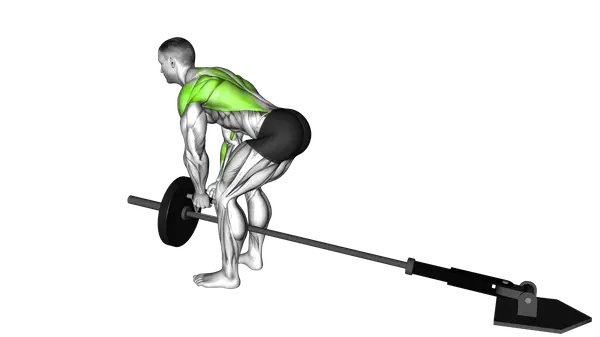
The Lever Bent Over Row with V-Bar is a plate-loaded rowing exercise that builds back thickness with a close, controlled pulling motion.

Lever Bent Over Row With V Bar (Plate Loaded)
Muscles Worked: Lever Bent Over Row With V Bar (Plate Loaded)
The Lever Bent Over Row With V Bar mainly trains your back, especially the lats, which pull your upper arms down and back as you row the handle toward your torso. Your biceps and forearms help you hold the handle and finish each rep, while your rear delts support the pull and keep your upper arms moving smoothly. Because the machine fixes the path, you can focus on driving your elbows back and loading the target muscles hard. Exercise choice changes which muscles get the most work, so this row variation is useful when you want a stable pull that lets your lats do more of the job.
Built for progress
Take the guesswork out of training
Get a personalized workout plan built around your goal, equipment and schedule. Train smarter, track every rep and keep moving forward, one workout at a time.






Technique and form
How to perform the Lever Bent Over Row With V Bar (Plate Loaded)
- Adjust the lever row machine seat to align the chest pad with your lower chest and set the V-bar handle in position with appropriate weight plates loaded.
- Step onto the machine platform, lean forward, and position your chest against the pad while gripping the V-bar with palms facing each other.
- Extend your arms fully without locking your elbows, maintaining a neutral spine with your chest pressed firmly against the support pad.
- Engage your core and retract your shoulder blades slightly to establish a strong base position, exhaling to prepare for the exertion phase.
- Inhale deeply, then exhale as you pull the V-bar toward your torso by driving your elbows back and slightly outward, keeping your forearms perpendicular to the ground.
- At the top of the movement, squeeze your back muscles while keeping your torso stable against the pad, maintaining a neutral spine position throughout.
- Hold the contracted position momentarily, focusing on the sensation in your middle and upper back muscles.
- Inhale as you slowly return the V-bar to the starting position with controlled movement, fully extending your arms without letting the weight stack touch down completely.
Important information
- Keep your chest firmly pressed against the support pad throughout the entire movement to prevent unwanted torso movement.
- Avoid excessive momentum or jerking motions—control the weight through the full range of motion to maximize muscle engagement.
- Make sure your elbows travel backward, not outward to the sides, to properly engage the lats and middle back muscles.
- If you experience lower back discomfort, reduce the weight and ensure the chest pad is properly positioned to support your torso.
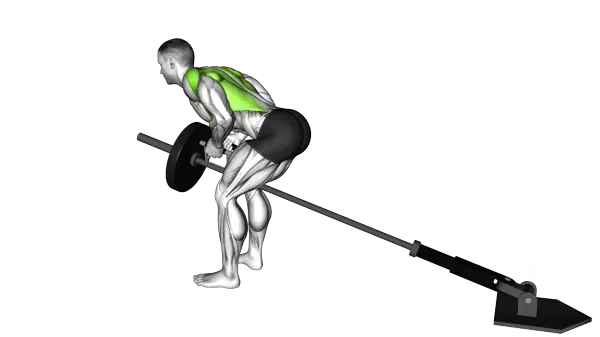
Is the Lever Bent Over Row With V Bar (Plate Loaded) good for muscle growth?
Yes. The Lever Bent Over Row With V Bar is a strong muscle-building exercise for your lats because it lets you row heavy in a fixed path, stay consistent rep to rep, and keep tension on your upper back and arms. Research on resistance training shows that the exercise you choose changes where the growth stimulus lands, which is why picking a row that matches your build and lets you feel your lats working matters.
- Stable setup for harder sets — The machine gives you more support than a free-weight row, so you can push close to failure without spending as much effort on balance. That usually means cleaner reps and more useful work for your lats instead of wasting energy trying to control the load.
- Neutral grip can feel stronger — The V bar keeps your hands close and palms facing each other, which many lifters find easier on the wrists and shoulders. That often helps you pull through a longer, smoother range and keep your elbows tight to your sides for better lat focus.
- Easy to overload — Plate-loaded machines make progress simple: add a small plate, beat last week's reps, or slow the lowering phase. If you want a similar pattern with a wider hand position, compare it with the Lever Bent Over Row (Plate Loaded).
- Great partner to free weights — This row fits well after heavier lifts because it builds your back without the same lower-back demand as the Barbell Bent Over Row. Exercise selection affects training results, so using both can help you cover slightly different strength curves and weak points.
Programming for muscle growth
Do 3-5 sets of 6-10 reps with 90-150 seconds rest. Use it 1-2 times per week. Stay in the lower rep range when the goal is strength with size, and aim to add a little weight or 1 rep over time. On your last 1-2 sets, stop with 0-2 reps left in the tank so the lats get a strong growth signal without your form falling apart.
Lever Bent Over Row With V Bar (Plate Loaded) Variations
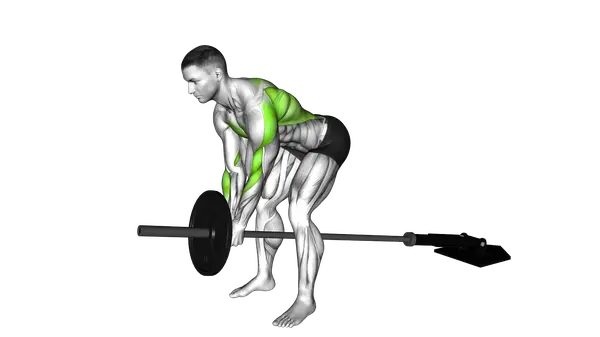
Alternative Exercises
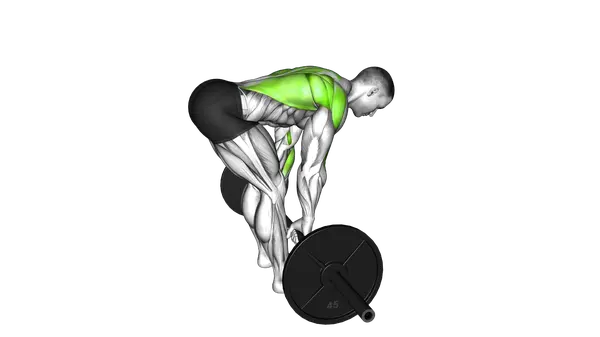
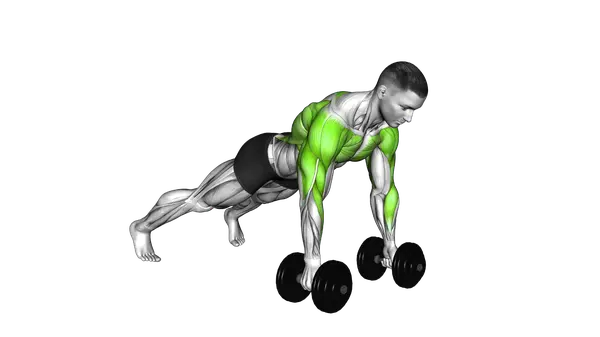
FAQ - Lever Bent Over Row With V Bar (Plate Loaded)
The exercise primarily targets the latissimus dorsi (lats) and trapezius muscles, while also engaging the rhomboids and rear deltoids. Your biceps and forearms work as secondary movers, while your core muscles activate as stabilizers throughout the movement.
The V-bar positions your hands in a neutral grip (palms facing each other), which reduces wrist strain and creates more ergonomic shoulder positioning. This grip often allows for heavier loading potential and may optimize muscle activation patterns while minimizing rotational forces on the shoulder joint.
Stand facing the cable machine with the ankle attachment secured, maintain a slight bend in your supporting leg, and keep your core engaged throughout the movement. Focus on driving the movement from your glutes rather than your lower back, and avoid arching or rounding your spine.
For optimal results, include the Bodyweight Single Leg Deadlift 1-3 times weekly, performing 2-3 sets of 8-12 repetitions per leg. This frequency provides enough stimulus for strength development while allowing adequate recovery, especially if you're also doing other posterior chain exercises.
Avoid using momentum by swinging your torso, rounding your lower back, or lifting your chest during the pull. Don't overload the weight at the expense of full range of motion, and ensure you're pulling with your back muscles rather than primarily your arms.
Lever Bent Over Row With V Bar (Plate Loaded)
Thank you for your feedback!
Thank you for your feedback!