Medicine Ball Lying Leg Raise
Reviewed by Tim Renting, Physiotherapist
Medicine Ball Lying Leg Raises challenge your core by adding external resistance, increasing tension on the lower abs while improving control and stability.


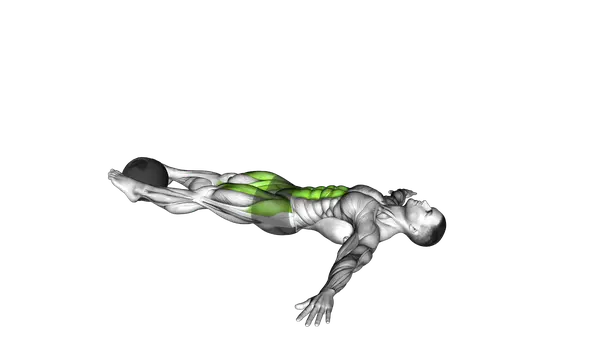
Medicine Ball Lying Leg Raise
Muscles Worked: Medicine Ball Lying Leg Raise
The Medicine Ball Lying Leg Raise mainly works your abs because they have to brace hard while your legs lift and lower. Your hip flexors help raise your legs, but your abs do the important job of stopping your lower back from tipping and taking over. Holding a medicine ball adds load, so your midsection has to stay tighter through the whole rep. If you do it well, you should feel your abs working more than your hips, which fits what we know about strength training building the trained muscles over time.
Built for progress
Take the guesswork out of training
Get a personalized workout plan built around your goal, equipment and schedule. Train smarter, track every rep and keep moving forward, one workout at a time.






Technique and form
How to perform the Medicine Ball Lying Leg Raise
- Lie flat on your back on a mat with legs extended and arms resting at your sides, palms facing down for stability.
- Place a medicine ball between your feet, squeezing it firmly with your ankles and inner thighs to maintain a secure grip throughout the exercise.
- Engage your core by drawing your navel toward your spine and slightly tucking your pelvis to ensure your lower back stays in contact with the floor.
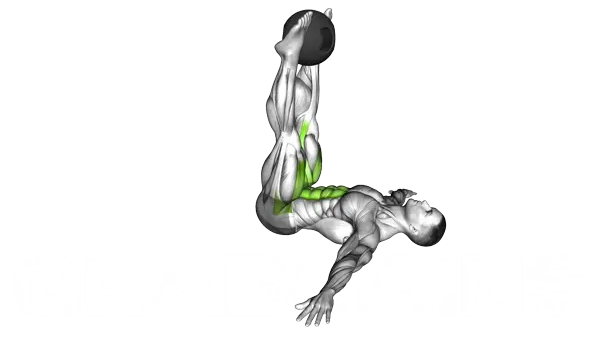
- Inhale and slowly raise your legs with the medicine ball until they form approximately a 90-degree angle with your torso, keeping your legs as straight as possible.
- Pause briefly at the top position while maintaining core engagement and ensuring your lower back remains pressed into the mat.
- Exhale as you lower your legs in a controlled manner, resisting the urge to let gravity take over by engaging your abdominal muscles throughout the descent.
- Stop just before your heels touch the ground, maintaining tension in your core and avoiding any arching in your lower back.
- Immediately begin your next repetition without resting at the bottom, breathing rhythmically and keeping your upper body relaxed but stable.
Important information
- If you feel strain in your lower back, bend your knees slightly or reduce the weight of the medicine ball until your core strength improves.
- Keep your head and shoulders flat against the mat throughout the exercise to avoid neck strain.
- Focus on using your abdominals to control the movement rather than momentum or hip flexors.
- For beginners, start with a lightweight medicine ball (2-4 lbs) and progress to heavier weights as your core strength develops.
Is the Medicine Ball Lying Leg Raise good for muscle growth?
Yes. The Medicine Ball Lying Leg Raise can help build stronger, thicker abs because it adds resistance to a basic leg raise and keeps tension on your midsection through both the lift and the lowering phase. Resistance training is a proven way to improve muscle size and strength when you apply it consistently and progress it over time.
- Added load makes the abs work harder — A regular Lying Leg Raise can get too easy fast. Adding a medicine ball increases the challenge, so your abs have to brace harder to keep your lower back from arching as your legs move.
- The lowering phase matters — The hardest part for most people is lowering the legs without losing position. That slow lowering keeps tension on the abs longer, which is useful for muscle growth when the set is hard enough.
- Exercise-specific progress counts — Muscles adapt to the movement you train, not just the body part in general. Research on exercise-specific growth shows the exact exercise you choose affects where and how you improve, which is a good reason to keep this move in if your goal is stronger lower abs and better trunk control.
- Easy to progress without heavy spinal loading — You can make this harder by using a heavier ball, slowing the lowering, or pausing near the bottom. That gives you a clear path for progressive overload without needing a big compound lift like a hanging leg raise.
Programming for muscle growth
Do 3-4 sets of 10-20 reps with 45-75 seconds rest, 2-3 times per week. Use a load that makes the last 3-5 reps tough while you still keep your lower back flat to the floor. If your hips give out before your abs, shorten the range a little and slow the lowering until your abs stay in control.
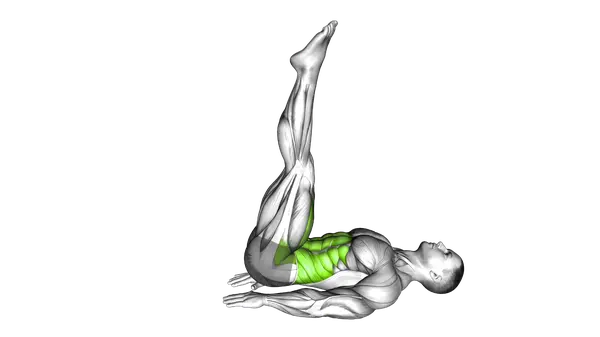
Alternative Exercises
FAQ - Medicine Ball Lying Leg Raise
The exercise primarily targets the lower rectus abdominis and hip flexors, while also engaging the entire core musculature including the transverse abdominis. Your obliques and lower back muscles also work as stabilizers throughout the movement.
Beginners should start with lighter weights and perform the movements separately before combining them. Advanced lifters can increase the weight, add a pause at the top of the press, or perform the exercise from a standing position to increase core engagement and overall difficulty.
The most common mistakes include flattening your lower back too aggressively or over-arching excessively instead of maintaining a small natural lumbar arch, letting your hips shift or rotate out of position, rushing through the movement, and losing upper-back tightness. Focus on keeping a stable, natural spine, moving with control, and maintaining full-body tension rather than forcing your back into an unnaturally flat position.
Incorporate this exercise 2-3 times weekly with at least 24 hours between sessions to allow your core muscles to recover. Start with 2-3 sets of 10-15 repetitions, adjusting based on your fitness level and goals.
When performed correctly, this exercise can strengthen the core muscles that support your spine, potentially alleviating some types of back pain. However, if you have existing back issues, consult with a healthcare professional before attempting this movement, and always prioritize proper form over repetition count.
Reviewed by

Physiotherapist
Highlights Physiotherapist at GrabGains: Brings specialized clinical expertise to verify exercise content and ensure safe, effective movement guidance across the platform. Licensed Physiotherapist: Registered in the Dutch BIG Register (BIG: 59930315504) as a…
Medicine Ball Lying Leg Raise
Thank you for your feedback!
Thank you for your feedback!