One Leg Floor Calf Raise
The One Leg Floor Calf Raise builds lower-leg strength, balance and ankle control using your bodyweight with minimal setup.

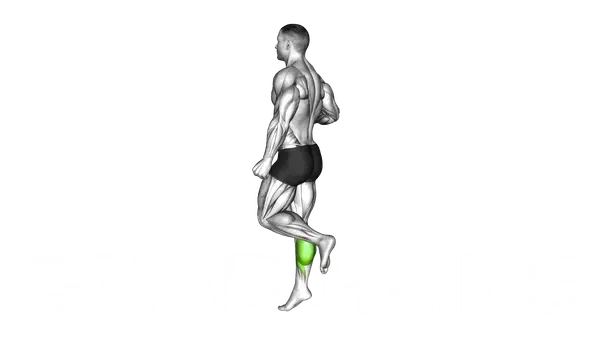
One Leg Floor Calf Raise
Muscles Worked: One Leg Floor Calf Raise
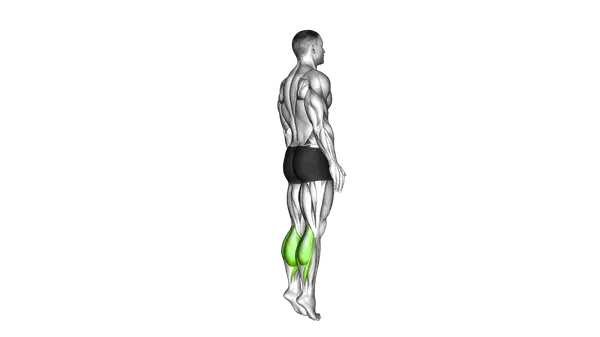
The One Leg Floor Calf Raise mainly works your legs, with the calf on the working side doing almost all of the lifting. Your calf pushes your heel up by driving through the ball of your foot, while your foot and ankle muscles help you stay steady so you do not wobble. Because you are on one leg, the working calf also has to control the lowering phase and keep your balance honest. You should feel a hard squeeze at the top and a stretch at the bottom, and higher weekly calf training volume may help support more growth over time (Kassiano et al., 2024).
Built for progress
Take the guesswork out of training
Get a personalized workout plan built around your goal, equipment and schedule. Train smarter, track every rep and keep moving forward, one workout at a time.






Technique and form
How to perform the One Leg Floor Calf Raise
- Stand on a flat surface with feet hip-width apart, then shift your weight to your right foot while lifting your left foot off the ground.
- Place your hands against a wall or hold onto a stable object at waist height for balance.
- Keep your core engaged and your standing leg straight but not locked, with your weight distributed across the ball of your foot.
- Exhale as you slowly rise onto the ball of your foot, lifting your heel as high as possible while maintaining balance.
- At the top position, squeeze your calf muscle and hold for a brief moment, ensuring your ankle remains stable.
- Inhale as you lower your heel back down toward the floor in a controlled manner until you feel a slight stretch in your calf.
- Maintain an upright posture throughout the exercise, avoiding leaning forward or allowing your hips to sag.
- Complete all repetitions on one leg before switching to the other leg, breathing rhythmically throughout the movement.
Important information
- Keep your standing knee soft but not bent to ensure the work stays in your calf muscle rather than your quadriceps.
- If balance is challenging, start with fingertip support on a wall or sturdy object and gradually reduce support as you build stability.
- Make sure your heel drops below the level of your toes at the bottom of the movement to achieve a full range of motion.
- If you experience any ankle pain or instability, modify by performing the exercise with both feet on the ground until you build more strength.
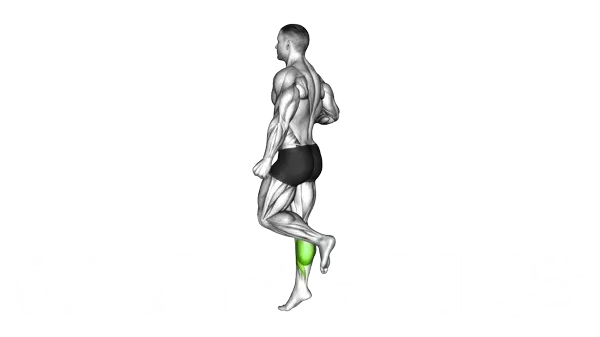
Is the One Leg Floor Calf Raise good for muscle growth?
Yes. The One Leg Floor Calf Raise can help build your calves, especially if bodyweight is challenging enough and you train it with enough total sets over the week. Calf research suggests that higher weekly calf-training volume can support more muscle growth, which is why single-leg bodyweight work can be useful when it helps you accumulate hard sets close to your limit (Kassiano et al., 2024).
- More load per leg — Using one leg instantly doubles the demand on the working calf compared with splitting your bodyweight across both legs. That makes this version more useful than a basic Bodyweight Standing Calf Raise when regular bodyweight reps feel too easy.
- Longer working sets — Calves usually handle a lot of reps well, so this exercise lets you keep tension on one side for longer without needing equipment. That is helpful when your goal is to make a light exercise hard enough to actually challenge the muscle.
- Balance makes the calf work harder — Standing on one foot forces the small foot and ankle muscles to help you stay stable. That does not replace heavy loading, but it can make each rep cleaner and stop you from bouncing through the easy part.
- Foot angle can shift the feel — Slightly changing toe position may change which part of the calf gets a bit more work, though the whole calf still trains. Research on calf training found foot positioning can influence growth between calf regions, so a small toe-in or toe-out change is worth testing if one stance feels better on your calves (Nunes et al., 2020).
Programming for muscle growth
Do 3-5 sets of 12-25 reps per leg with 45-75 seconds rest, 2-4 times per week. Use higher reps because bodyweight calf work is often limited by load, and take most sets to within 1-2 reps of failure so the calf actually gets a strong growth signal. Pause for 1 second at the top and lower slowly to make light resistance harder.
Alternative Exercises
FAQ - One Leg Floor Calf Raise
The One Leg Floor Calf Raise primarily targets the gastrocnemius (upper calf) and soleus (lower calf) muscles. It also engages smaller stabilizing muscles in the ankle and foot, making it more effective than two-legged variations for comprehensive calf development.
To make it easier, hold onto a wall or sturdy object for balance, or perform the exercise with both legs. For increased difficulty, hold a dumbbell in one hand, wear a weighted vest, or slow down the eccentric (lowering) phase to 3-5 seconds per repetition.
For muscle growth, perform 3-4 sets of 12-15 reps per leg with a full range of motion. For endurance, aim for 2-3 sets of 15-25 reps. Allow 1-2 minutes rest between sets and train calves 2-3 times weekly for best results.
A standard lying leg raise focuses on lifting the legs using the hip flexors and stabilizing with the core. Adding the hip lift shifts more tension to the abs by actively curling the pelvis off the floor, increasing abdominal contraction and reducing reliance on momentum.
Yes, this exercise significantly improves ankle stability by strengthening the supporting muscles around the joint. Regular practice can help prevent common lower leg injuries like Achilles tendonitis and ankle sprains, while also improving balance and proprioception for better athletic performance.
Scientific References
Nunes JP, Costa BDV, Kassiano W et al. · Journal of strength and conditioning research (2020)
Bigger Calves from Doing Higher Resistance Training Volume?
Kassiano W, Costa BDV, Kunevaliki G et al. · International journal of sports medicine (2024)
Sources are peer-reviewed academic publications from PubMed.
One Leg Floor Calf Raise
Thank you for your feedback!
Thank you for your feedback!