High Pulley Overhead Tricep Extension
Reviewed by Tim Renting, Physiotherapist
High Pulley Overhead Tricep Extension is a cable exercise that trains the back of the arms through a controlled overhead movement.

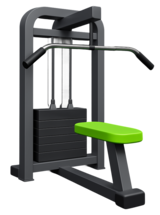
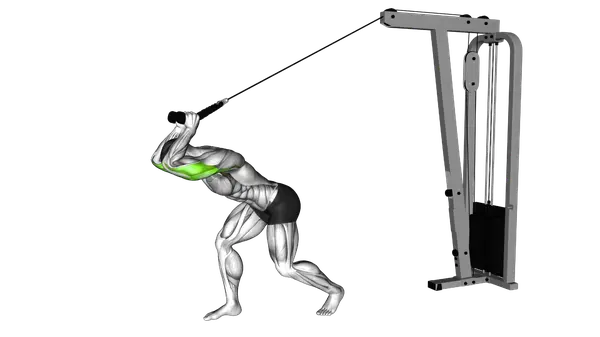
High Pulley Overhead Tricep Extension
Muscles Worked: High Pulley Overhead Tricep Extension
The High Pulley Overhead Tricep Extension mainly trains your arms, with the triceps doing almost all of the work by straightening your elbows against cable tension. Because your upper arms stay overhead, the long head of the triceps gets a bigger stretch and has to work hard through the full rep. Your shoulders and upper back help keep your arms in place so the movement stays strict. If you do it well, you should feel the back of your upper arms burning more than your chest or shoulders, and the overhead position may be especially useful for triceps growth (Maeo et al., 2023).
Built for progress
Take the guesswork out of training
Get a personalized workout plan built around your goal, equipment and schedule. Train smarter, track every rep and keep moving forward, one workout at a time.






Technique and form
How to perform the High Pulley Overhead Tricep Extension
- Face the cable machine and set the pulley attachment to the highest position with a rope or straight bar attachment, taking a step forward to create distance from the machine.
- Grasp the attachment with both hands, positioning your palms facing each other for rope or an overhand grip for a bar, and turn your back to the machine.
- Stand with feet shoulder-width apart, maintain a slight bend in your knees, engage your core, and keep your back straight throughout the movement.
- Position your upper arms parallel to the floor with elbows bent at approximately 90 degrees, holding the attachment close to your head.
- Exhale as you extend your arms overhead by straightening your elbows, focusing on contracting your triceps while keeping your upper arms stationary.
- At the top of the movement, your arms should be fully extended overhead with a slight bend in the elbows to avoid hyperextension.
- Inhale as you slowly lower the attachment back to the starting position by bending at the elbows, controlling the eccentric phase of the movement.
- Maintain tension in your triceps throughout the exercise, avoiding the temptation to let the weight stack touch down between repetitions.
Important information
- Keep your upper arms still and close to your head throughout the movement to isolate the triceps effectively.
- Avoid arching your lower back by maintaining a braced core and neutral spine position.
- If you experience elbow pain, consider using a rope attachment instead of a straight bar for a more natural wrist position.
- Adjust your distance from the cable machine to maintain constant tension on your triceps during the entire range of motion.
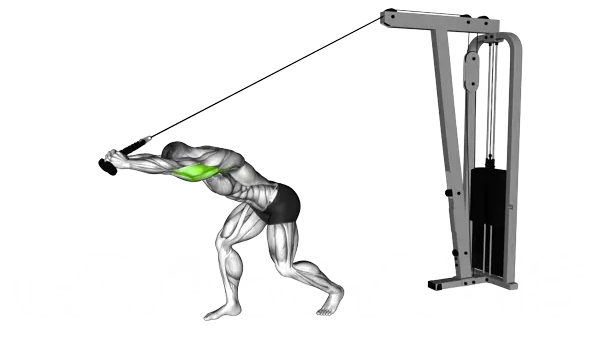
Is the High Pulley Overhead Tricep Extension good for muscle growth?
Yes. The High Pulley Overhead Tricep Extension is a strong muscle-building exercise for the triceps because the overhead arm position appears to grow the triceps more than elbow extension done with the arms by your sides (Maeo et al., 2023). It also keeps steady cable tension on the muscle, which makes it easy to get hard, clean reps without needing very heavy loads.
- Better long-head stimulus — Putting your arms overhead places the triceps in a stretched position at the start. In research on elbow extension training, the overhead setup led to clearly greater triceps growth than a neutral arm position, which is the biggest reason this variation stands out (Maeo et al., 2023)
- Smooth cable resistance — Cables keep tension on the triceps through most of the rep, so the muscle does not get much of a break at the top or bottom. That makes this a great pairing with heavier work like tricep-pushdown-cable
- Easy to train close to failure safely — Since this is an isolation move, you can push sets hard without the full-body fatigue you get from big presses. That helps you add quality triceps volume after compound work
- Handle choice can change comfort — Cable studies show different handle setups can change muscle activity during cable exercises, so a rope can be worth trying if it helps you keep your elbows in and finish the rep cleanly (Rendos et al., 2016). If that feels better, rotate it with cable-overhead-triceps-extension
Programming for muscle growth
Do 3-4 sets of 8-15 reps with 60-90 seconds rest, 1-3 times per week. Use a load that lets you lower the weight slowly, get a full stretch overhead, and finish each rep by fully straightening your elbows without letting them flare all over the place. This works best after your main pressing or arm work, where it adds triceps volume without beating up the rest of your body.
High Pulley Overhead Tricep Extension Variations
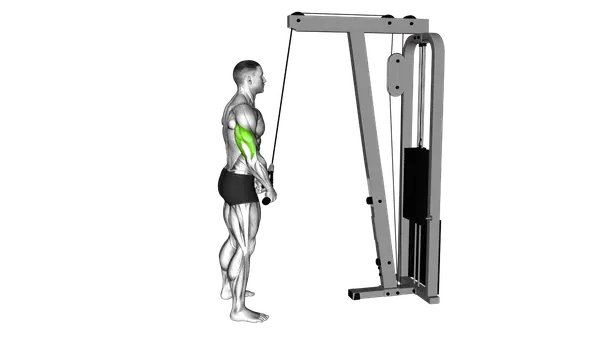
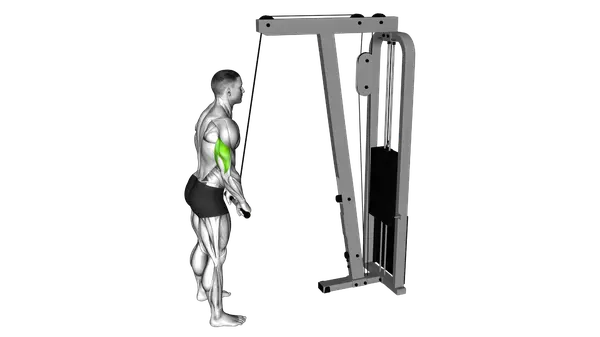
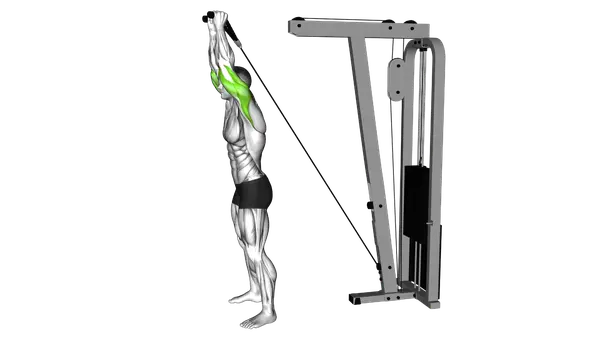
Alternative Exercises
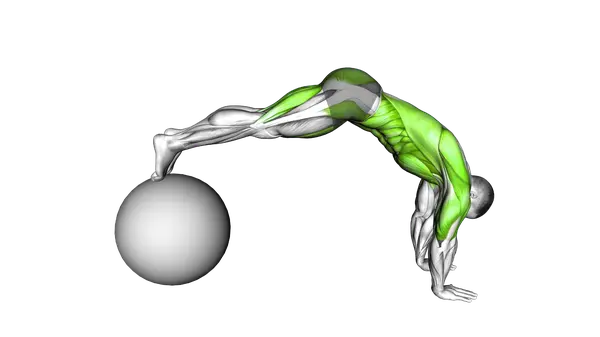
FAQ - High Pulley Overhead Tricep Extension
This exercise primarily targets the long head of the triceps brachii, which is the largest portion of the muscle responsible for the horseshoe appearance. While it isolates the triceps effectively, it minimally engages the shoulders and core as stabilizers during the movement.
Stand facing the cable machine with a staggered stance for stability, keep your upper arms close to your ears throughout the movement, and focus on extending only at the elbow joint while maintaining a stable torso. The movement should come solely from your elbows, not your shoulders or back.
To make it easier, reduce the weight and focus on controlled repetitions, or perform the exercise seated for added stability. For a greater challenge, increase the weight, slow down the eccentric (lowering) phase to 3-4 seconds, or progress to single-arm variations which require more core stability and prevent dominant arm compensation.
Incorporate this exercise 1-2 times weekly as part of your back or pull-focused training days. It works well as a main row when your lower back is fatigued from heavy deadlifts or bent-over variants, or as a second row after a heavier compound pull. Program 3-4 sets of 8-12 repetitions for hypertrophy, with 48-72 hours recovery between sessions that target the same muscle groups.
The most common mistake is rushing through the movement without focusing on the quality of the rolling motion. Other errors include using excessive tension rather than controlled movement, and failing to achieve full range of motion through all three planes of shoulder movement (flexion, depression, and retraction).
Workouts with High Pulley Overhead Tricep Extension
Scientific References
Maeo S, Wu Y, Huang M et al. · European journal of sport science (2023)
Rendos NK, Heredia Vargas HM, Alipio TC et al. · Journal of strength and conditioning research (2016)
Sources are peer-reviewed academic publications from PubMed.
Reviewed by

Physiotherapist
Highlights Physiotherapist at GrabGains: Brings specialized clinical expertise to verify exercise content and ensure safe, effective movement guidance across the platform. Licensed Physiotherapist: Registered in the Dutch BIG Register (BIG: 59930315504) as a…
High Pulley Overhead Tricep Extension
Thank you for your feedback!
Thank you for your feedback!