You walk into the gym thinking today might be the day you hit a clean PR. Warm-ups feel fine. Then the work sets start, and the bar feels unusually heavy. Your timing is off. Your legs have no snap. The session that looked great on paper suddenly feels like a grind.
Most athletes blame motivation, nutrition, or bad luck first. Sleep is usually lower on the list. That's a mistake.
The connection between sleep and performance is much tighter than is commonly understood. Sleep doesn't just decide whether you feel tired. It changes how well you recover, how sharp your reaction time is, how hard a session feels, and how much risk you take on when you try to force intensity through fatigue. Even one bad night can show up in ways that matter under a barbell, on a track, or in any session that depends on precision and repeatable output.
Built for progress
Take the guesswork out of training
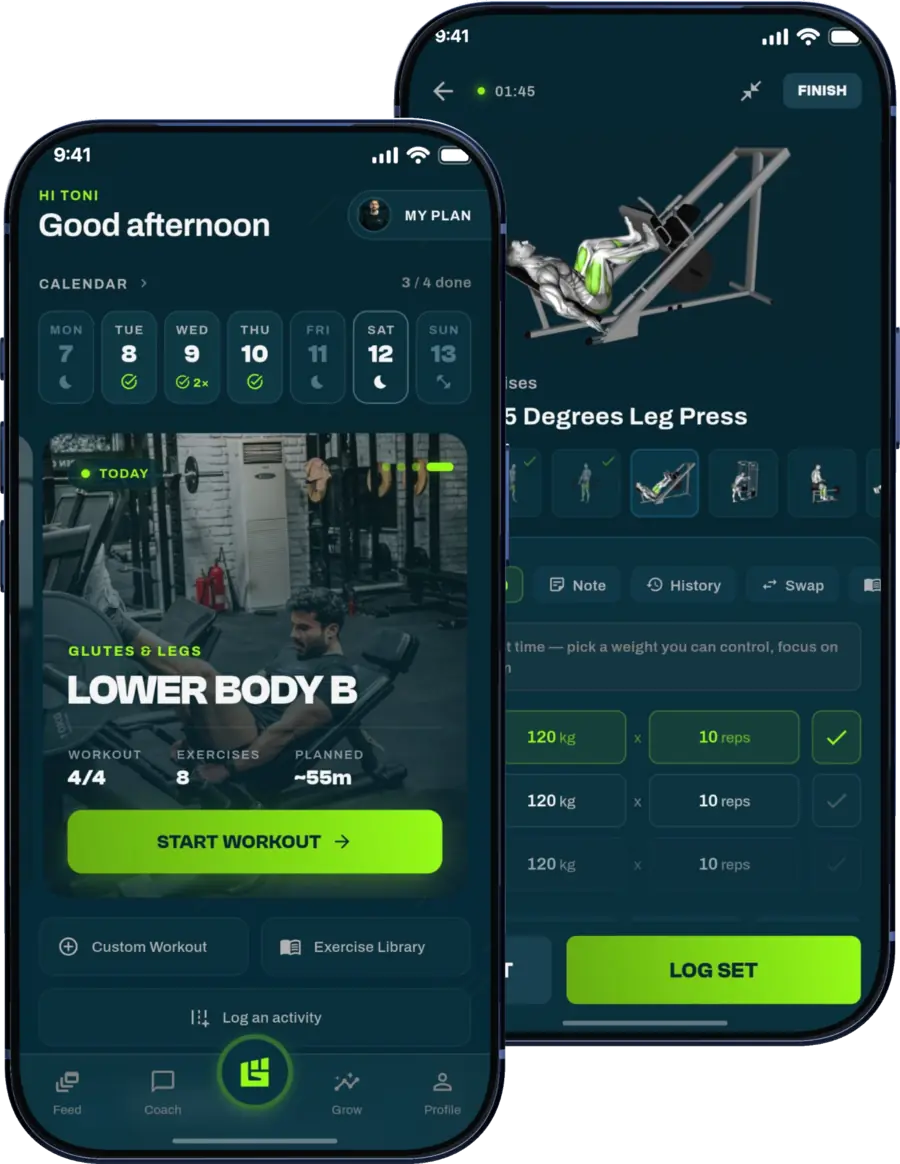
Get a personalized workout plan built around your goal, equipment and schedule. Train smarter, track every rep and keep moving forward, one workout at a time.






The usual advice is to “get more sleep.” That's not wrong. It's just incomplete. Serious training demands a more useful question: what kind of sleep loss affects what kind of performance, and what should you do about training the next day?
That's where most content stops short. Athletes don't need vague reminders. They need a playbook. If your sleep was short, fragmented, or just poor quality, you need to know whether to push, modify, or back off. You also need to know when a nap helps, when it doesn't, and why a rough night can wreck sprinting and skill work more than a simpler aerobic session.
Introduction you can't ignore a bad night's sleep
A bad workout after poor sleep isn't random. Your body is telling the truth before your ego catches up.
When sleep drops, your perception of effort climbs. Loads feel heavier at the same percentage. Paces that should feel controlled start to feel expensive. Technical lifts get sloppy faster. In field and court sports, timing and decision-making slip before most athletes even notice it happening.
That matters because many people still treat sleep like a passive block of time between “real” work. In practice, sleep is part of training. If you're trying to build strength, hold output across intervals, learn movement skill, or just stay healthy enough to train consistently, sleep is one of the biggest levers you have.
A lot of athletes also make the same mistake after a rough night. They run the planned workout anyway, judge themselves for underperforming, and stack stress on top of stress. That's not discipline. That's poor load management.
Sleep is not separate from your program. It changes what your program should be that day.
The practical goal isn't to become perfect. It's to get better at reading what sleep is doing to performance and responding like a smart coach would. Some mornings call for full intensity. Some call for reduced volume, simpler exercise choices, or an easier aerobic session. Some call for recovery work and getting out.
That shift matters more than chasing one “ideal” number. Yes, duration matters. But sleep quality, timing, and recent sleep pattern matter too. One short night affects training differently than several short nights in a row. A lifter, a HYROX athlete, and a beginner learning technique won't all pay the same price for poor sleep.
The science of sleep and athletic recovery
Sleep works like a nightly repair crew. While you're out, your body handles jobs that are hard to do well when you're awake and stressed. Tissue repair, nervous system downshifting, immune support, and brain recovery all depend on that window.
When athletes miss sleep, the cost isn't only feeling groggy. A review of athlete sleep research found that sleep loss increases sympathetic nervous system activity, reduces parasympathetic recovery, and worsens reaction time, attention, and decision-making speed. It also notes that even one night of complete sleep deprivation can measurably worsen reaction time, according to this review on sleep loss and athletic performance.

Your nervous system needs a downshift
Hard training pushes your system toward a fight-or-flight state. That's useful during the session. It's a problem when you stay there.
Good sleep helps shift you back toward the recovery side. That's where you restore readiness, settle inflammation, and regain the ability to produce force with coordination instead of just effort. If that downshift doesn't happen, athletes often describe the next day as feeling “wired but flat.” That's a useful coaching clue. You may be awake, but you're not recovered.
For a broader lifestyle view, this comprehensive guide on exercise and sleep gives a helpful overview of how training habits and sleep habits influence each other outside the gym.
Recovery is physical and cognitive
Recovery is often thought to mean sore muscles getting less sore. That's only part of it.
Sleep also helps restore the brain functions that matter in training: attention, timing, movement learning, and judgment under fatigue. That's why poor sleep often shows up first in missed reps, ugly bar paths, bad pacing, and slow reactions. If you coach athletes, you've seen this. They may still be willing to work hard, but their precision drops.
That's also why technical practice on poor sleep can be risky. You aren't just doing the same session with less enthusiasm. You're trying to execute demanding movement with a worse control system.
If you want the muscle side explained in more depth, this article on understanding muscle recovery for athletes pairs well with the sleep side of the equation.
Sleep debt changes the training response
One of the simplest mistakes in coaching is treating fatigue as one bucket. Sleep loss creates a specific kind of fatigue. It alters attention, readiness, and motor control at the same time.
That means the answer isn't always “push through.” Sometimes the right move is to keep training but change the demand. Swap a high-skill barbell lift for a machine variation. Drop the density of the session. Move from sharp intervals to steady aerobic work. Keep the habit, reduce the damage.
Practical rule: If the athlete looks coordinated, focused, and springy, train harder. If they look slow, irritable, and mechanically sloppy, recovery isn't finished yet.
How sleep loss affects strength endurance and skill
Poor sleep doesn't damage every quality in the same way. That's the first distinction athletes need to understand.
A rough night before an easy bike ride is not the same as a rough night before max-effort squats, repeated sprints, or technical Olympic lifts. The training stress might still be possible. The output and the risk profile are different.
A 2025 meta-analysis found that sleep deprivation raised perceived exertion overall, with total sleep deprivation showing a stronger negative effect on aerobic performance, while partial sleep deprivation more strongly harmed explosive power, maximal strength, speed, and skill control, based on this Frontiers meta-analysis on sleep deprivation and performance.

Strength and hypertrophy take a quiet hit
Many lifters assume they're fine if they can still complete the session. That's too shallow a test.
On partial sleep deprivation, you can often still show up and move weight. What changes is bar speed, crispness, force expression, and rep quality late in sets. Your effort rises faster, and your ability to repeat high-quality reps falls sooner. For hypertrophy work, that can mean you get through the workout but with worse execution and lower effective stimulus.
That's why partial sleep loss can be so deceptive. It doesn't always stop the session. It makes the session less productive.
Endurance gets more expensive
Aerobic work often remains more available than explosive work after short sleep, but that doesn't mean it feels normal.
The first change many endurance athletes notice is that the same pace feels harder. Breathing seems less settled. Decision-making around pacing gets worse. You may start too hard or fail to adjust well when the session turns uncomfortable. If sleep debt is severe, even steady-state work can feel surprisingly costly.
A simple coaching takeaway is this: on bad sleep, easy aerobic work is often easier to preserve than speed, power, or complex lifting. But if perceived effort is unusually high early, that's a sign to pull back.
Skill is usually the first thing to get messy
Skill-based work is where sleep debt often becomes obvious fastest.
Reaction time, attention, and decision speed suffer when sleep is restricted. In practical terms, that means missed catches, bad foot placement, slower reads, and poorer timing. In lifting, it can show up as inconsistent setup, rushing the descent, or losing position under fatigue. In group fitness or HYROX prep, transitions get sloppy and pacing errors multiply.
If the session demands split-second timing or precise technique, poor sleep should lower your ambition for that day.
One bad night versus several short nights
Athletes often ask whether one bad night ruins training. Usually, it depends on what you planned to train.
A single ugly night before a hard endurance session can matter. Several shorter nights in a row may be even more damaging for strength, speed, and skill-based work. That's the practical value of distinguishing total deprivation from partial deprivation. Most busy adults aren't pulling all-nighters. They're stacking modestly bad nights, then wondering why their explosive work feels off.
Here's a simple comparison coaches can use:
| Performance Metric | Impact of Sleep Deprivation |
|---|---|
| Strength | Partial sleep deprivation more strongly harms maximal strength and explosive output |
| Endurance | Total sleep deprivation has a stronger negative effect on aerobic performance |
| Speed | Partial sleep deprivation more strongly harms speed |
| Skill control | Partial sleep deprivation more strongly harms skill control |
| Perceived exertion | Sleep deprivation raises RPE overall |
This is why generic advice fails. “Sleep more” doesn't tell you what to do with today's workout. A better question is: what quality am I asking for today, and is my current sleep good enough to support it?
The athlete's guide to high-performance sleep
High-performance sleep starts with basics, but the order matters. Most athletes waste time looking for hacks before they've nailed the repeatable habits that move the needle.
The first target is duration. The Sleep Foundation recommends 7 to 9 hours of sleep for most athletes, with elite athletes encouraged to aim for at least 9 hours, and the Gatorade Sports Science Institute summary notes that strategic naps of 20 to 90 minutes can improve sprint performance and alertness in this sleep guidance for athletes.

Start with the two biggest levers
If your schedule is chaotic, narrow the focus.
- Protect time in bed: If you need to wake early for training or work, the first fix is usually an earlier bedtime, not more caffeine.
- Keep wake time stable: Going to sleep at random hours and trying to “catch” sleep later tends to leave athletes feeling uneven.
Consistency isn't glamorous, but it's powerful. A regular sleep-wake rhythm reduces the number of nights where you feel tired but somehow still can't fall asleep on time.
Build an environment that helps you switch off
Sleep quality isn't just about minutes. It's also about how easy it is for your body to settle.
A useful checklist looks like this:
- Cool, dark, quiet room: Most athletes sleep better when the bedroom feels like a recovery space, not an extension of the living room.
- Reduce pre-bed stimulation: Hard training, work stress, bright screens, and endless scrolling all make it harder to downshift.
- Keep the last stretch of the night clean: Alcohol, big meals, and late caffeine often show up as fragmented sleep, not just trouble falling asleep.
If you want a more detailed framework, this deep dive into sleep quality is useful for separating sleep duration from sleep efficiency and continuity.
Use naps like a tool, not a crutch
Naps work best when they solve a specific problem. They're not a replacement for poor nightly habits.
Short naps can help on days when early training, travel, or work cuts into sleep. Longer naps can be useful when sleep debt is meaningful and you have the schedule flexibility to wake up without rushing straight into another demand. If you want a practical breakdown of timing and setup, this 20-minute power nap guide is a solid reference.
A nap should support the night, not steal from it.
What usually works and what usually doesn't
Athletes often do better with a few clear rules than with a massive list.
What tends to work
- A repeatable wind-down routine: Same order, same cues, minimal decision-making.
- Planning tomorrow earlier: Don't solve your schedule in bed.
- Matching training times to reality when possible: If you always train at dawn, your bedtime has to respect that.
What usually fails
- Saving sleep for the weekend
- Using caffeine to cover chronic under-recovery
- Treating poor sleep as a motivation problem
High-performance sleep is less about perfection than about reducing chaos. Most athletes improve fast when they stop improvising their nights.
How to adapt your training based on your sleep
You wake up after five broken hours, your resting mood is off, and the session on the plan says heavy squats plus sprints. That is the moment where good athletes separate discipline from stubbornness.
Training still needs to happen. The question is what quality you can train today without turning one bad night into two bad sessions.
Poor sleep does not lower every performance trait in the same way. Max strength, repeated efforts, pacing, reaction time, and technical execution can all shift differently. In the gym, that means a sleep-deprived athlete might still handle some useful volume on simple movements but struggle with heavy singles, sprint timing, or anything that depends on sharp coordination. Coaches who ignore that distinction usually misread the day.
In a 2021 study on athletes, sleeping at least 8 hours per night was associated with a reduced risk of injury and illness in this Frontiers study on athlete sleep, injury, and illness. Short sleep is not just a recovery issue. It changes the risk profile of the session.

A simple decision framework
Use a three-level filter.
Green day: Sleep was good, motivation is normal, warm-ups feel crisp. Run the planned session.
Yellow day: Sleep was short or fragmented, but you do not feel wrecked. Keep the session goal, then trim one variable. Reduce load, reduce total sets, or extend rest periods. Do not slash everything at once unless the warm-up confirms you need to.
Red day: Sleep was poor and you feel flat, irritable, slow, or uncoordinated. Strip out high-skill, high-speed, and high-risk work first. Keep training, but make it simpler and safer.
If you have stacked several yellow or red days in a row, the priority changes. Preserve movement quality, keep some training rhythm, and stop chasing peak output until recovery catches up.
What to change first
Start with the pieces that demand precision.
After poor sleep, heavy barbell lifts, maximal jumps, sprint work, and complex conditioning are usually the first things I modify. They ask for timing, intent, and neural sharpness that may not be there that day. Simpler strength work often survives better. Machines, dumbbells, split-stance work, sleds, carries, easy aerobic intervals, and controlled accessory volume let you keep the training effect without forcing a bad fit.
Here is the practical order:
| Keep if possible | Cut first when sleep is poor |
|---|---|
| Easy aerobic work | Max-effort lifts |
| Simple strength accessories | Technical barbell work |
| Mobility and recovery circuits | Sprint sessions |
| Low-skill conditioning | High-speed change-of-direction work |
That table matters because strength and endurance do not always need the same adjustment. If the athlete is sleep-restricted but mechanically stable, a lower-risk strength session with submaximal loads can still work. If pacing and concentration are drifting, long intervals or repeated hard efforts often become sloppy fast. Skill sessions deserve the strictest filter. Poor sleep tends to show up there first.
A good rule is to protect the adaptation and change the expression. If the goal was lower-body strength, swap heavy back squats for belt squats or split squats. If the goal was conditioning, trade aggressive intervals for steady threshold work or zone 2. If the goal was speed or skill, consider technique rehearsal at lower intensity or move it to the next good-sleep day.
How an adaptive app can help
Most athletes know they should adjust. Fewer do it well when they are tired, annoyed, and attached to the original plan.
A tool like GrabGains can fit here because it can organize training around your goal, your recent performance, and your recovery signals instead of treating every Tuesday like the same Tuesday. That matters on yellow and red days. The decision becomes less emotional and more repeatable.
Small inputs can drive useful changes. Sleep quality, perceived readiness, bar speed trends, soreness, and session ratings can all point the program toward a lower-risk version of the day. That is the kind of adjustment good coaches already make by eye. An app can help automate it when you train alone or need more consistency.
Recovery habits can support that process too. Some athletes build a better pre-bed routine with simple sensory cues such as dim light, reduced screen exposure, and calming scents. If that is useful for you, this guide on essential oils for better sleep gives practical options without turning sleep into a chemistry project.
If poor sleep and under-recovery have started to feel chronic, it also helps to address persistent fatigue and performance drop before you stack more intensity on top of it.
Common sleep challenges and practical solutions
Perfect sleep routines are easy to write and hard to live. Busy professionals, parents, and student athletes often need a version that survives real schedules.
The first rule is not to panic over one bad night. Athletes often make the next day worse by overreacting. They pound caffeine, force a maximal session, stay up late again, and turn one poor night into a three-day problem.
Early training after a late night
If you slept poorly and still need to train early, reduce the session's complexity before you reduce your self-respect.
Use a shorter warm-up with extra movement prep. Pick simple movements. Aim for quality work, not heroics. If the body wakes up and the session improves, great. If not, get useful work done and leave.
Weekend catch-up and the reality of sleep debt
Catching up on rest can help you feel more human, but it doesn't erase a week of poor habits.
That's why the better strategy is to protect consistency across the week rather than count on a giant rebound over the weekend. Athletes who swing between short weekdays and long weekends often feel like their body clock never fully settles.
Caffeine, alcohol, and other common sabotage points
Most adults already know caffeine can affect sleep. The practical problem is timing and denial. Many people say caffeine doesn't affect them, then lie awake feeling “tired but not sleepy.” Alcohol creates a different issue. It can make bedtime easier while making the night itself worse.
A few practical fixes help:
- Set a caffeine cutoff: Earlier is usually better if sleep has been shaky.
- Be honest about alcohol: Falling asleep fast is not the same as sleeping well.
- Use calming cues deliberately: Some people do well with breath work, dim lighting, stretching, or scent-based cues. If that helps you wind down, this guide to essential oils for better sleep offers ideas you can test without overcomplicating things.
Don't let one rough night rewrite the week
Athletes often carry poor sleep into training with a catastrophizing mindset. That hurts twice. First in recovery, then in execution.
The better frame is simple: one poor night means train smarter today and return to baseline tonight. It doesn't mean your progress is gone. It doesn't mean you're weak. It means recovery management matters.
One bad night should change the day's plan, not your confidence.
Conclusion turning sleep into your competitive edge
Sleep is not passive downtime. It's part of the training process.
If you care about strength, endurance, skill, recovery, and staying healthy enough to train consistently, sleep deserves the same respect you give programming and nutrition. Poor sleep changes reaction time, effort, movement quality, and risk. Good sleep improves the conditions that let training work.
The biggest shift is practical. Stop thinking of sleep as background health advice and start treating it like a performance variable. Some sessions should go exactly as planned. Others should change because your recovery status changed. That adjustment isn't weakness. It's what good coaching looks like.
Start with one move you can sustain. Go to bed earlier three nights this week. Set a caffeine cutoff. Use naps strategically instead of randomly. Modify tomorrow's training if tonight goes badly.
Small corrections done consistently beat perfect intentions that never survive real life.
If you want a training system that can adapt to real recovery instead of pretending every day is the same, GrabGains is built for that kind of decision-making. It helps organize goal-based workouts, track performance, and support smarter adjustments when sleep, stress, and readiness shift from day to day.
Get inspired and motivated