Build habits: the psychology behind fitness consistency
Unlock the psychology behind fitness consistency. Learn why motivation fails. Build lasting habits using identity & smart design. Get actionable tips. You know the pattern. You start strong, buy new gear, save a workout split, maybe even tell a few friends that this time you're serious. Then life gets noisy. A late meeting turns into a missed lift. One bad week becomes no routine at all. After that, it's easy to assume the problem is discipline.
Usually, it isn't.
The psychology behind fitness consistency has less to do with hype and more to do with repeatable behavior. People rarely fail because they don't care enough. They fail because they build fitness around feelings that change by the hour instead of systems that still work when they're tired, busy, bored, or thrown off schedule.
If you understand the mental side of consistency, your workouts stop feeling random. You start seeing why some routines stick, why others collapse, and how to build one that matches your life instead of fighting it.


Why most fitness resolutions fail
Most fitness resolutions are built on a bad assumption. The assumption is that if you feel motivated enough at the beginning, you'll keep going.
That works for a few workouts. It doesn't work for months.
Motivation is emotional fuel. It rises fast when the goal is fresh. It also drops fast when the work gets repetitive, results come slowly, or your schedule changes. If your whole plan depends on wanting to train every day, your plan is fragile from the start.
Built for progress
Take the guesswork out of training
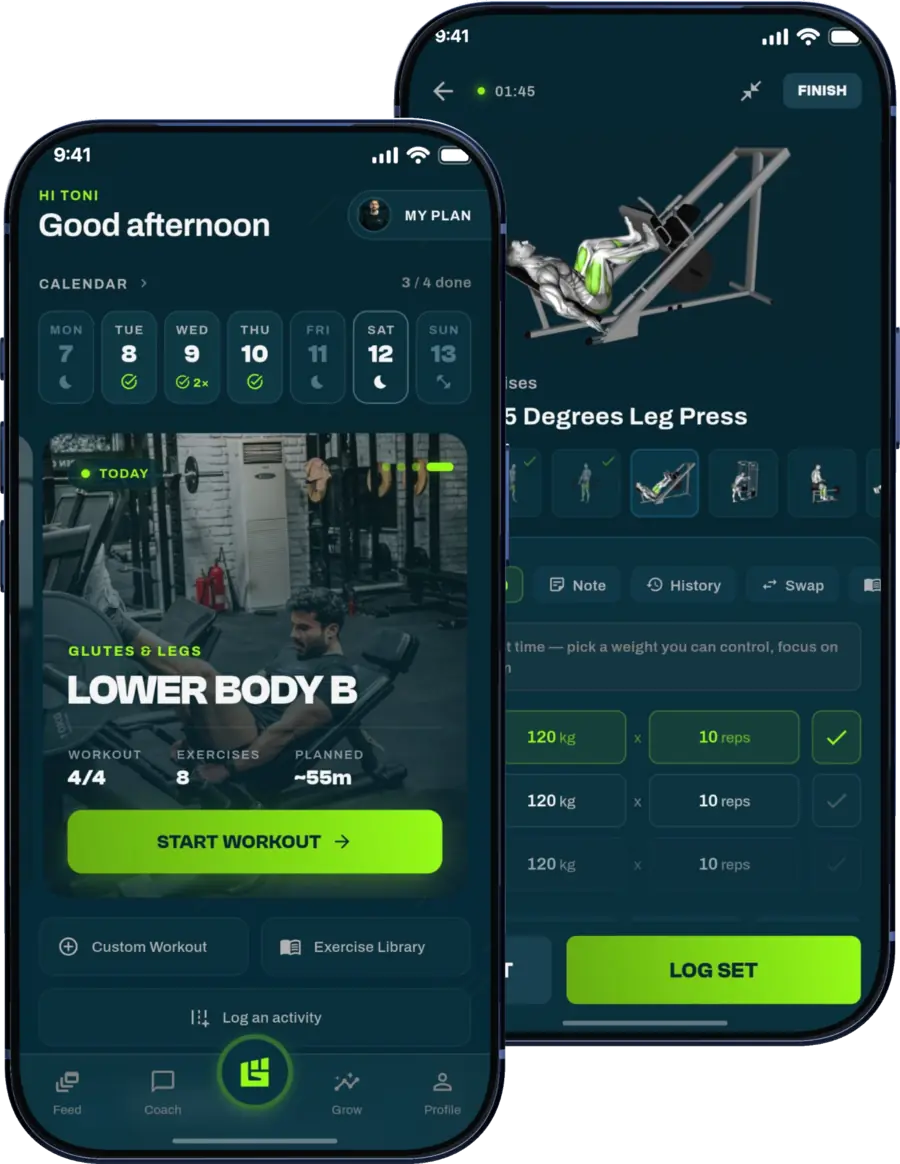
Get a personalized workout plan built around your goal, equipment and schedule. Train smarter, track every rep and keep moving forward, one workout at a time.






The real problem isn't laziness
People often call themselves inconsistent when what they really have is an inconsistent system. They choose a routine that's too ambitious, too inconvenient, or too disconnected from real life. Then they treat the collapse as a character flaw.
That mindset makes everything harder because shame drains energy that could have gone into adjusting the plan.
A more useful way to think about it is this:
- Willpower is unreliable: It changes with stress, sleep, work, travel, and mood.
- Habits need structure: Your brain follows repeated cues more easily than repeated pep talks.
- Consistency is a skill: Like exercise itself, it improves when you practice it the right way.
Stop asking, “How do I stay motivated?” Start asking, “How do I make training easier to repeat?”
Why fitness feels harder than it should
Exercise isn't just physical. It asks for planning, time, decision-making, and emotional effort. If every workout starts with a debate in your head, you're spending mental energy before the session even begins.
That's why two people with the same goal can get very different results. One person keeps negotiating with themselves every day. The other removes the negotiation.
The second person isn't always tougher. They often just have better cues, better timing, and fewer points of friction.
For a beginner, that might mean a short guided session after work instead of a perfect one-hour program. For a strength athlete, it might mean a fixed training slot and a logbook that makes progress visible. For a HYROX athlete, it might mean a plan that balances structure with enough variety to keep training enjoyable.
The psychology behind fitness consistency starts there. You don't need a stronger inner speech. You need a setup your brain can follow repeatedly.
Your brain on autopilot how habits outlast motivation
A workout habit doesn't begin as a habit. At first, it's a decision.
You think about it, weigh how tired you feel, wonder whether today matters, and maybe bargain your way into doing half the session. That's normal. Early on, exercise takes attention.
With repetition, that mental load can shrink. A widely cited finding is that repeated behaviors become automatic after an average of about 66 days, with a broader observed range of 18 to 254 days depending on the person and behavior. In fitness, that matters because starting a workout takes less mental effort once the behavior is repeated consistently. The same source also notes that motivation-based fitness attempts commonly collapse within 2 to 8 weeks because automaticity hasn't formed yet, as explained in this discussion of why consistency beats motivation in long-term fitness success.
The habit loop in plain English
Most habits follow a simple loop:
- Cue
- Routine
- Reward
The cue tells your brain it's time. The routine is the workout itself. The reward is the payoff that helps your brain remember, “This was worth doing.”
A cue can be simple. Same alarm. Same lunch break. Same shoes by the door. Same app reminder at the same hour.
The routine doesn't need to be dramatic. It just needs to happen. Even a short session counts if it reinforces the pattern.
The reward is what closes the loop. That could be a calmer mood, a sense of completion, a checked-off session, or a progress graph that shows you're building momentum.

Why autopilot matters more than excitement
Think about learning to drive. At first, every step feels deliberate. Mirrors, pedals, speed, steering, traffic. Later, many of those actions happen with much less conscious effort.
Fitness works similarly. Early workouts feel heavier mentally than they should because your brain hasn't learned the pattern yet. People often misread that effort as a sign that the routine isn't right for them. Sometimes it's just a sign that the routine is still new.
That's one reason simple daily behavior systems matter. If you want more ideas on turning repeated actions into momentum, this guide can help you start your success journey today.
How to build a loop that actually sticks
Don't try to make yourself love discipline. Build a loop that reduces the amount of thinking required.
Use this model:
| Part | What to choose | Fitness example |
|---|---|---|
| Cue | A consistent trigger | After brushing your teeth, after work, right before lunch |
| Routine | A repeatable session | A walk, a strength workout, a mobility block |
| Reward | Immediate reinforcement | Marking it complete, seeing progress, feeling more energized |
A few practical rules help:
- Keep the cue obvious: If your workout starts “whenever I have time,” your cue is weak.
- Shrink the routine when needed: A shorter session protects the habit better than skipping.
- Make the reward visible: Completion matters more when you can see a streak, trend, or training history.
Practical rule: Make starting the workout so familiar that your brain recognizes it before your excuses do.
When people say they want more discipline, what they often want is less daily resistance. Habit formation gives you that. It turns fitness from a repeated debate into a repeated action.
Finding your fuel the real secret to long-term motivation
Habits help you start. Enjoyment helps you stay.
That's where a lot of fitness advice gets things backward. It treats motivation like a speech you give yourself. In reality, long-term motivation is often a signal. It tells you whether the activity fits your preferences, your goals, and your sense of competence.
In a one-year study of novice exercisers, the strongest predictor of regular attendance was enjoyment, with an odds ratio of 1.84 (95% CI: 1.35 to 2.50; p ≤ 0.001). Self-efficacy followed at OR = 1.73, and social support at OR = 1.16. Regular exercise at 3, 6, and 12 months was also linked to higher enjoyment, self-efficacy, and social support, while customer satisfaction was not associated with attendance, according to this study of exercise attendance and adherence factors.
Extrinsic reasons get you moving, intrinsic reasons keep you coming back
Extrinsic motivation is about outcomes outside the activity. You want to look better at an event. You want to hit a number on the scale. You want to prove something.
Those reasons can start the engine. They usually don't carry the whole trip.
Intrinsic motivation is different. It comes from the experience itself. You like feeling stronger. You enjoy improving your split times. You like the rhythm of training. You feel proud when your technique improves.
That difference matters because consistency gets tested on ordinary days, not dramatic ones. On ordinary days, you're much more likely to train when the process itself has value.
A better question than what's optimal
A lot of people ask, “What's the most effective workout?”
A better question is, “What kind of training can I repeat without resentment?”
For one person, that's barbell strength work. For another, it's circuits, running, HYROX prep, machines, classes, or a structured home routine. A plan can be technically smart and psychologically wrong if you hate doing it.
Here's a simple way to identify your fuel:
- Notice what you look forward to: Not what looks impressive online. What you would do on a busy week.
- Track competence, not just appearance: Getting better is motivating. Visible skill growth creates momentum.
- Test before you commit: Try styles of training long enough to judge the experience, not just the first impression.
The strongest routine is rarely the one that looks hardest. It's the one you can enjoy enough to keep repeating.
Make motivation easier to sustain
People often think enjoyment means workouts need to be easy or entertaining. That isn't the point. Hard training can be enjoyable when it matches your personality and gives you a clear sense of progress.
That's why progress tracking matters. When you can see that your lifts are moving, your endurance is improving, or your volume is consistent, motivation becomes less abstract. These essential tools for progress tracking can help turn effort into something concrete you can review and learn from.
For beginners, enjoyment may come from feeling capable instead of confused. For strength athletes, it may come from small performance wins. For HYROX athletes, it may come from the mix of grit, pacing, and measurable improvement.
If you want long-term adherence, don't just chase what should work. Build around what feels meaningful enough to repeat.
Architecting your environment for automatic fitness
Environment beats intention more often than people want to admit.
You can care strongly about training and still skip it if your setup keeps making the behavior hard. If your shoes are buried in a closet, your workouts aren't planned, your training time changes every day, and every session starts with “What should I do today?” then your environment is asking for hesitation.
Consistency improves when the path to training has fewer obstacles.

Friction is the hidden reason routines break
In behavior change, friction means anything that makes the desired action harder to start. It can be physical, mental, or logistical.
A few common examples:
- Decision friction: You haven't chosen the workout yet.
- Setup friction: Your gear isn't ready, your space is cluttered, or the gym trip feels complicated.
- Schedule friction: Training time shifts constantly, so the cue never gets solid.
- Travel friction: A good routine disappears because your plan only works in one setting.
Each friction point seems small on its own. Together, they create enough resistance to break consistency.
Time consistency matters more than perfect timing
Many people spend too much effort searching for the ideal workout hour. Morning versus evening. Fasted versus fed. Before work versus after work.
For adherence, the more useful question is whether your training happens at a consistent time. A PubMed-indexed study found that people who kept physical activity at a consistent time of day reported greater moderate-to-vigorous physical activity, and the relationship held regardless of the specific clock time, as shown in this research on temporal consistency and physical activity adherence.
That means your best time is often the time you can repeat.
If 6 a.m. looks disciplined but never lasts, it isn't your best time. The best time is the slot your life can support.
How to design a lower-friction setup
You don't need a perfect home gym or a flawless calendar. You need fewer excuses between intention and action.
Try this approach:
| Friction point | Higher-friction version | Lower-friction version |
|---|---|---|
| Workout choice | Pick a session on the spot | Follow a pre-planned routine |
| Gear | Search for clothes and accessories | Pack them the night before |
| Location | Commute every time | Keep a home option ready too |
| Scheduling | Train “when free” | Block one regular time slot |
If you're deciding between home training and the gym, it can help to compare both through the lens of real-life adherence rather than ideal conditions. This guide to your 2026 fitness path is useful for thinking through that choice.
For people who want one place to organize movement options, GrabGains exercises include goal-based training support, exercise guidance, and tools that fit gym, home, and travel contexts. That kind of setup can reduce decision fatigue because you're not rebuilding the plan every week.
Environment design sounds less exciting than motivation. It works better because it respects how behavior happens.
From setbacks to comebacks building a resilient fitness identity
Missing one workout is normal. Turning one missed workout into a full relapse is the main risk.
Streak culture can, however, present a problem. Streaks can feel motivating because people don't want to lose progress. But a broken streak can also trigger the what-the-hell effect, where one slip gets interpreted as total failure. When that happens, people don't just miss a day. They abandon the identity they were trying to build.
That's the dangerous part.

Why all-or-nothing thinking feels convincing
Perfectionism sounds disciplined, but in practice it makes behavior brittle.
If your internal rule is “I never miss,” then any disruption becomes a threat. Travel, illness, deadlines, family demands, and bad sleep all start to feel like proof that you've failed. That pressure creates shame, and shame often drives avoidance.
Recent coverage of workout streak psychology notes that streaks work through loss aversion, but a broken streak can trigger the what-the-hell effect. It also argues that the most effective consistency strategies include a reset rule, flexible targets, and reward structures that support continuation after interruption, as discussed in this piece on workout streak consistency science.
Build an identity that survives imperfect weeks
A resilient fitness identity sounds different from a fragile one.
Fragile identity: “I'm someone who stays on a perfect streak.”
Resilient identity: “I'm someone who returns to training quickly.”
That shift matters because it changes what counts as success. Instead of measuring yourself by flawless execution, you measure yourself by your response to disruption.
A resilient exerciser expects interruptions and already knows what to do next.
- Miss a day: Resume at the next planned session.
- Miss a week: Restart with reduced volume.
- Feel ashamed: Treat the gap as data, not evidence of failure.
One missed workout doesn't break consistency. The refusal to restart does.
Use reset rules instead of guilt
The best recovery strategy is simple enough to use when you're frustrated.
Try one of these reset rules:
- Never miss twice if you can help it A disrupted day is an event. Two missed sessions in a row can become a pattern.
- Reduce, don't erase If full training feels heavy, do the light version. Mobility, walking, one lift, one circuit. Protect the identity.
- Review the cause without drama Ask what got in the way. Time? Energy? Planning? Then adjust the system.
This is the heart of the psychology behind fitness consistency. Not perfection. Recovery skill.
The people who last in fitness aren't the ones who avoid disruption forever. They're the ones who get interrupted, adapt, and continue.
Your blueprint for unbreakable consistency
The same psychology shows up differently depending on who you are, how you train, and what your days look like. A beginner doesn't need the same consistency strategy as a HYROX athlete. A busy professional faces different mental friction than someone whose schedule is wide open.
The principles stay steady. The application changes.

The busy professional
Your main enemy isn't laziness. It's cognitive overload.
When your workday is packed, fitness needs a low-friction entry point. Put training in the calendar like a meeting. Keep a shorter backup session for chaotic days. Remove as many choices as possible before the day starts.
Useful rules for this type:
- Anchor to an existing transition: Right after work, right before lunch, or immediately after waking.
- Use minimum sessions: A shorter planned workout is better than an ideal workout that keeps getting postponed.
- Protect continuity during travel: Keep a plan that works with limited equipment.
The strength or hypertrophy athlete
You probably stay motivated when performance is visible. If you can see load, reps, exercise quality, and progression, training feels meaningful. If progress gets blurry, consistency usually follows.
This athlete does well with clear logs, repeatable structure, and specific markers of improvement. Tools like a 1RM calculator, movement videos, and adaptive fitness routines fit this psychology because they reinforce competence and remove guesswork.
If you enjoy comparing methods and consistency habits across training setups, these Strive Workout Log consistency tips add practical perspective.
The HYROX athlete
You need both structure and variety.
Too little structure, and sessions feel random. Too little variation, and the plan becomes mentally stale. This type tends to stay engaged when training has a clear event-related purpose but still mixes skill demands, engine work, and progression.
The key is to connect hard training to identity without tying identity to perfection. Missing one simulation session doesn't make you less committed. Returning well does.
The beginner or comeback athlete
Your first job is not to maximize intensity. It's to build trust.
You need sessions that feel clear, achievable, and repeatable. Confusion kills consistency fast. That's why guided exercise demos, straightforward plans, and visible progress matter so much early on.
For this group, confidence grows when each workout answers three questions:
- What am I doing today
- How do I do it correctly
- How do I know I'm improving
When those answers are easy to find, training feels less intimidating and more doable.
One system beats endless motivation
People who stay consistent usually don't have some rare mental advantage. They rely on a system that supports habit formation, makes training enjoyable enough to sustain, reduces environmental friction, and includes a plan for setbacks.
That's why the psychology behind fitness consistency matters so much. It turns fitness from a personality test into a design problem.
Solve the design problem, and consistency gets much easier.
If you want a simpler way to put these principles into practice, GrabGains offers adaptive workout planning, exercise guidance, progress tracking, and tools for different training goals so you can build a routine that fits your schedule and keep adjusting it as real life changes.
Get inspired and motivated