How to build a fitness routine you actually stick to
Struggling with consistency? Learn how to build a fitness routine you actually stick to with practical steps for goal-setting, habit formation, and tracking. Most fitness advice fails at the exact moment real life shows up.
It tells you to lock in the perfect week, pick the perfect split, find the perfect level of motivation, and then act like your job, kids, travel, fatigue, and bad days won't interfere. That advice sounds disciplined. In practice, it sets people up to quit.
A routine that only works when everything goes right isn't a routine. It's a fragile plan.
If you want to learn how to build a fitness routine you adhere to, stop chasing the version of fitness that looks impressive on paper and start building one that survives ordinary weeks. The goal isn't to win Monday. The goal is to keep going when Thursday gets messy.
Why most fitness routines fail before they start
The biggest mistake I see isn't laziness. It's overdesign.
People decide they're going to train hard, eat clean, wake up early, do cardio, lift weights, stretch, hit step goals, and never miss. They try to fix everything in one move. For a week or two, adrenaline carries them. Then work runs late, they miss a session, and the whole plan collapses under its own weight.
That isn't a motivation problem. It's a systems problem.
Built for progress
Take the guesswork out of training
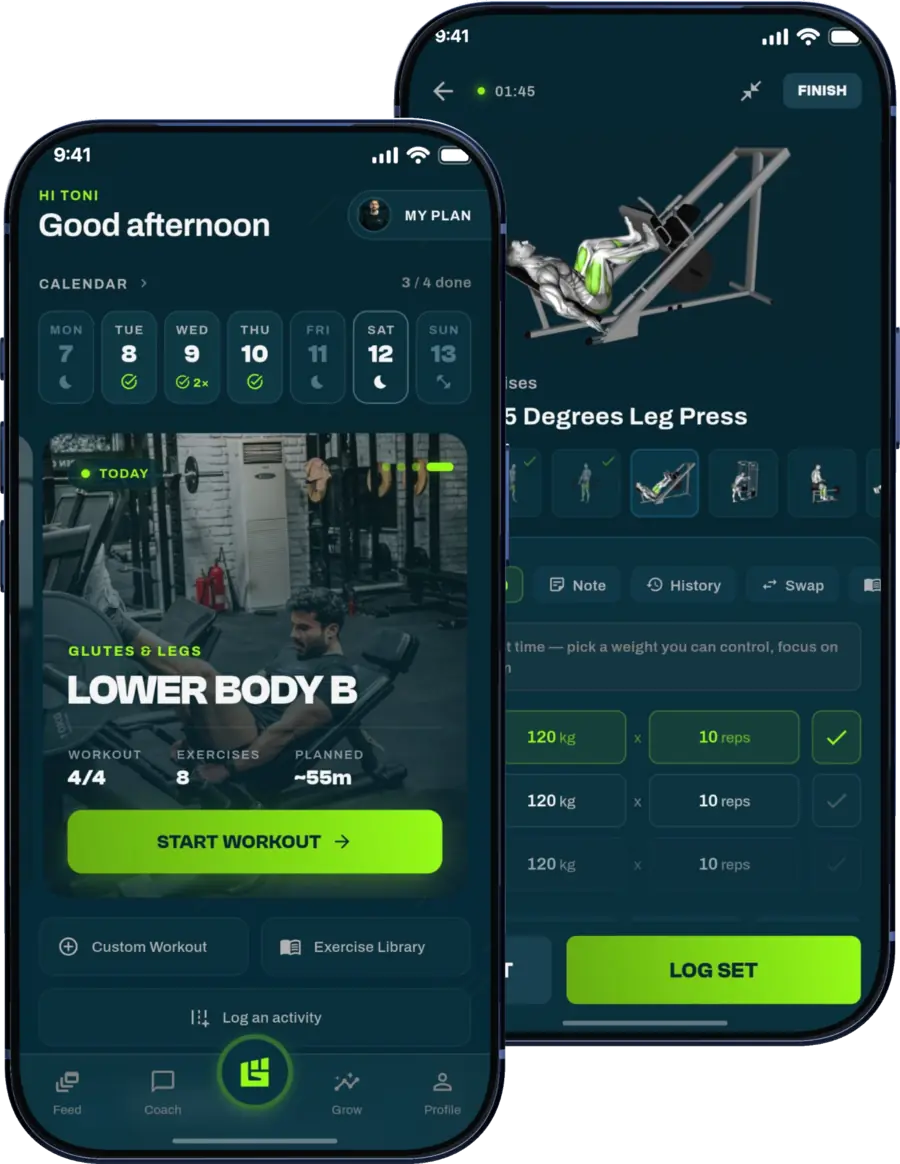
Get a personalized workout plan built around your goal, equipment and schedule. Train smarter, track every rep and keep moving forward, one workout at a time.






The all-or-nothing trap
Most failed routines start with a hidden assumption. If the week isn't ideal, the plan is ruined. That mindset makes one missed workout feel like failure instead of a normal adjustment.
UCLA Health recommends starting with a realistic plan, such as exercising a couple of days per week, and notes that a new habit can take several weeks of consistent effort to feel established in its exercise planning guidance. That's the opposite of the usual "go all in" advice.
A routine should be judged by how well it handles disruption, not by how good it looks in a fresh notebook.
Aggressive plans feel productive because they're dramatic. Practical plans work because they're repeatable.
Perfect weeks don't build consistent people
The people who stay active long term usually aren't the ones with the most intense plan. They're the ones with the fewest decision points. They know what to do on a good day, a busy day, and a low-energy day.
What doesn't work:
- Oversized weekly targets that depend on ideal energy and free time
- Rigid scheduling with no backup option when one workout gets missed
- Punishment thinking where one off day leads to guilt and then avoidance
- Bored routines built from exercises people think they should do, not ones they'll repeat
What does work looks less exciting at first:
- A small starting dose you can complete
- A fixed rhythm that reduces guesswork
- Fallback sessions for chaotic days
- Enough variety to avoid mental dropout without changing everything constantly
The real target is continuity
Busy adults don't need another pep talk about commitment. They need a plan with shock absorbers.
If you've failed before, that's useful information. It usually means the routine asked too much, too soon, and had no way to adapt once life got inconvenient. Build for continuity first. Once that holds, progress gets much easier.
Define your why to set realistic fitness goals
Individuals pick goals that sound good from a distance. "Get in shape." "Lose weight." "Be more fit." Those aren't useless, but they don't help much on a tired Tuesday when you'd rather skip the workout.
A goal has to mean something in your real life. If it doesn't connect to how you want to feel, function, or perform, it won't hold up under stress.
Start with a reason you can feel
Your "why" doesn't need to be profound. It needs to be specific enough to guide choices.
A busy professional might want enough energy to get through the day without feeling cooked by mid-afternoon. A new parent might want better stamina for carrying a child, sleeping poorly, and still functioning. Someone else might want to feel stronger, improve posture, or train toward a local event.
That kind of goal gives your routine direction. It also filters out nonsense. If your real goal is more energy and consistency, then a punishing six-day training plan isn't disciplined. It's off target.

Use SMART without turning it into corporate homework
The SMART framework helps if you keep it practical.
Specific
Name the outcome clearly. "I want to exercise more" is vague. "I want to walk after work and do two strength sessions each week" is usable.
Measurable
Pick something you can verify. That might be workouts completed, walks logged, or strength sessions performed consistently.
Achievable
Often, individuals make a critical error at this step. A goal only counts as achievable if it fits your current schedule, energy, and training history. If you've done nothing for months, don't build around an advanced routine.
Relevant
The goal should match your actual life. If you hate long gym sessions, don't make your success depend on them. If your back gets cranky from sitting all day, your routine should support movement quality and strength, not just calorie burn.
Time-bound
Give the goal a review point. Not because transformation happens on a magic date, but because deadlines force honesty. You need a moment to ask, "Is this working, and can I keep doing it?"
Outcome goals versus process goals
This is the split that matters most.
Outcome goals are things like changing your body composition, completing a race, or improving strength. Those are fine, but they move slowly. If you rely on them for motivation, you'll drift.
Process goals are the behaviors that create the outcome.
- Outcome goal might be feeling stronger and more capable
- Process goal might be completing strength training on set days each week
- Outcome goal might be having better energy
- Process goal might be walking consistently and training at a manageable volume
Practical rule: Build your week around process goals. Let outcome goals sit in the background as direction, not daily judgment.
A better way to write your goal
Try this simple structure:
- Who you are now
Busy, inconsistent, restarting, short on time, low on energy - What matters most
Health, performance, confidence, stamina, stress relief - What you'll do
The repeatable actions you'll schedule - How you'll know it's working
Visible consistency, better performance, improved day-to-day capacity
Example:
| Vague goal | Better goal |
|---|---|
| Get fit | Train twice a week and walk regularly so I have more energy for work and home life |
| Lose weight | Build a repeatable training routine I can maintain through busy weeks |
| Get stronger | Complete regular strength sessions and progressively improve lifts over time |
A useful goal doesn't impress anyone. It gives you a compass. That's enough.
Design your time-efficient workout program
Many individuals don't need a harder program. They need a clearer one.
If your schedule is packed, your training plan has to do two things well. It has to cover the basics, and it has to be simple enough that you won't renegotiate it every day. That starts with the minimum effective dose.
Build around the minimum that still moves you forward
Public health guidance summarized by HelpGuide recommends at least 150 minutes of moderate aerobic activity per week or 75 minutes of vigorous activity, plus 2 strength sessions weekly, with sessions of at least 10 minutes and strength work commonly using 8 to 12 reps per exercise in the working sets, as described in this minimum-dose training overview.
That matters because it gives you a floor. Not a fantasy plan. A floor.
If you only have short windows, you can still train effectively. If your week is volatile, you can still anchor it with a few essential sessions. That's how routines become durable.
Pick exercises you don't dread
The best weekly plan is one you'll repeat. That means choosing movements and formats you can tolerate consistently.
For cardio, that might be brisk walking, cycling, rowing, intervals, or a short conditioning circuit. For strength, keep it boring in a good way. Squat pattern, hinge, push, pull, carry, core. Repeat them often enough to improve.
If you're training early and tend to feel flat, practical prep matters too. Some people use coffee. Others prefer a supplement and want help sorting ingredients, timing, and stimulants. In that case, VitzAi's guide to pre-workouts is a useful starting point for understanding the trade-offs before you buy anything.
Sample weekly fitness templates
You don't need a custom athlete split to get moving. Start with a template that fits your life, then keep it stable long enough to learn from it.
| Goal | Monday | Tuesday | Wednesday | Thursday | Friday | Weekend |
|---|---|---|---|---|---|---|
| General health | Brisk walk or moderate cardio | Full-body strength | Rest or light walk | Moderate cardio | Full-body strength | Optional recreational activity |
| Beginner strength | Full-body strength | Walk or mobility | Rest | Full-body strength | Easy cardio | Optional walk or recovery |
| Time-crunched professional | 10 to 20 minute cardio | Short full-body strength | Rest | 10 to 20 minute cardio | Short full-body strength | One flexible session or extra walking |
Keep the schedule stable and progress one variable at a time
The mistake is changing everything at once. More exercises, more days, more intensity, more complexity. That creates friction fast.
A better method is simple:
- Lock your weekly rhythm first
Choose the days and session types you can repeat. - Track a few key variables
For strength, log sets, reps, and load. For cardio, log time, distance, or effort. - Change one thing when the current dose feels sustainable
Add a little time, a little load, or one extra set. Don't overhaul the plan.
If you want a practical starting point for shorter sessions, this science-backed 30-minute workout is a good example of how to keep training efficient without turning it into random exercise.
What a time-efficient plan actually looks like
A sustainable plan usually feels almost too modest at first. That's fine.
You're not trying to prove how serious you are. You're trying to build a weekly structure that survives deadlines, poor sleep, and the occasional messy day. The flashy version gets applause. The repeatable version gets results.
Master the art of habit formation for fitness
A routine built for your best week will fall apart the first time work runs late, your kid gets sick, or your motivation disappears.
Habit formation matters because it gives your training a floor. You stop asking, "Do I feel like working out?" and start asking, "What version of today's session fits the day I have?"

Attach training to real life, not ideal life
The American Psychological Association notes that habits stick more reliably when the behavior is tied to a consistent cue and repeated in a stable context, as explained in this guide to building healthier habits. That matters in fitness because a routine needs a clear trigger before it becomes automatic.
Use cues that already exist in your day:
- After your first coffee, do your walk
- After school drop-off, go straight to the gym
- After shutting your laptop, start your home session
- After brushing your teeth, do mobility work or your warm-up
Tie the workout to something that already happens. Don't tie it to a vague intention like "later tonight." Vague plans die in busy weeks.
Build a minimum version you can still complete on bad days
This is the part people skip. Then they act surprised when one missed session turns into two weeks off.
Every routine needs two versions:
| Situation | What counts |
|---|---|
| Normal day | Full planned workout |
| Chaotic day | Short fallback session |
A fallback session might be 10 minutes of brisk walking, two sets of goblet squats and push-ups, or a short bike ride. The point is not to chase fitness gains with tiny workouts. The point is to protect the pattern of showing up.
Clients who keep the habit usually accept this trade-off early. Some days are for progress. Some days are for maintenance. Both matter.
Reduce friction before you need willpower
Willpower is unreliable at 6 a.m., after a long commute, or at the end of a stressful day. Setup matters more.
Make the start of the session easy:
- Put training clothes and shoes where you can see them
- Decide the workout before the day starts
- Keep home equipment accessible instead of packed away
- Use the same warm-up each time so you don't waste energy thinking
- Remove extra steps, including long commutes for sessions that could be done at home
If you use wearable reminders or step goals as part of your routine, small details help there too. Even something simple like changing the band can make a device feel more wearable day to day. You can upgrade your Fitbit Luxe style if that helps you keep it on consistently.
Repetition builds identity faster than intensity
People stick with training when it starts to feel like part of who they are, not a temporary project.
That identity comes from repeated evidence. You trained on a low-energy Tuesday. You did the short version during a busy Friday. You kept your gym slot even when the session was average. Those are the reps that matter mentally.
If you're trying to build lasting gym consistency, protect the cue, the timing, and the fallback option as seriously as you protect the workout itself.
Let AI handle some of the adjustment
A resilient routine needs feedback, but it doesn't need constant overthinking. This is one place AI tools help.
GrabGains can log what you completed, adjust the next session when life cuts training time short, and keep the habit alive without forcing you to rewrite your whole plan every time a week gets messy. That matters because missed sessions often become identity problems. People start thinking they are off track, when they really just needed the plan to adapt faster.
The goal is simple. Keep the routine alive long enough for consistency to feel normal.
Track your progress to stay motivated
Motivation is unreliable. A record is not.
Clients who skip tracking usually say they want freedom. What they usually have is fog. After two or three uneven weeks, they cannot tell whether the plan is working, whether they are improving, or whether they just had a bad stretch. That uncertainty kills adherence faster than a hard workout ever will.
A useful log solves a simple problem. It gives you evidence on days when your brain is making a case for quitting.
What to track if you want the habit to last
Tracking works when it stays simple enough to survive busy weeks. If your system takes ten minutes after every session, you will stop using it. If it only captures body weight and mirror checks, you will miss the signals that matter.
Record the basics:
- Strength work
Exercises, sets, reps, load, and a quick note on effort - Cardio
Time, distance, pace, or general intensity - Attendance
Which planned sessions you completed, shortened, or moved - Recovery notes
Sleep, soreness, energy, stress, and anything that affected performance
That last category matters more than people expect. A workout log should show what happened, not just what was prescribed. If every Thursday session is cut short because work runs late, the issue is the slot, not your discipline.
Measure progress in ways that keep you training
Body composition changes are slow. Performance and consistency show up sooner, and they are better indicators of whether the routine is built to last.
Use process wins as proof that the system is holding:
| Process win | Why it matters |
|---|---|
| You completed the planned number of sessions | Adherence predicts results better than random hard efforts |
| You added a rep, a little load, or better control | The program is progressing |
| You showed up and did a shorter session on a rough day | The routine can survive real life |
| You noticed boredom or fatigue early and adjusted | You caught a problem before it turned into skipped weeks |
I tell clients this all the time. The log is not there to flatter you. It is there to keep you honest.
Use tools you will actually keep using
A notebook works. A notes app works. A calendar with check marks works.
The best tool is the one that fits your life with the least friction. Some people want a quick paper log in the gym. Others do better with an app that keeps workouts, trends, and missed-session patterns in one place. If you want a practical framework, this guide on how to track workout progress breaks down what to record without turning the habit into homework.
Wearables can help too, especially for step count, general activity, and workout consistency. Comfort matters here. If the device annoys you, you stop wearing it, and the data disappears with it. If you wear a Fitbit Luxe and want something more practical or more polished, you can upgrade your Fitbit Luxe style so you're more likely to keep it on and use the data.
Good tracking makes adjustment faster
Tracking is not just about motivation. It is about course correction.
Patterns show up quickly when you log accurately. Missed sessions on the same day point to a scheduling problem. Flat lifts plus poor sleep notes point to recovery trouble. Repeated low-effort sessions might mean the plan is too aggressive for your current week.
This is also where AI earns its place. GrabGains can track completed workouts, flag patterns you would miss, and help adjust the next session when your week goes sideways. That matters because resilient routines are not built on perfect execution. They are built on fast, practical adjustments that keep the habit alive.
Troubleshoot issues and adapt your plan with AI
The hardest part of fitness isn't starting. It's recovering quickly when the plan gets disrupted.
Travel happens. Deadlines blow up your schedule. Sleep tanks. Motivation dips. A workout gets missed, then another one, and suddenly people feel like they're starting over. That's where rigid plans fail.
Guidance focused on ideal weekly structure often leaves a big gap for busy adults. The practical challenge is maintaining continuity during irregular weeks, and that usually requires built-in flexibility such as fallback workouts, alternate days, or auto-adjustment for missed sessions, which is the core issue described in this discussion of resilient routine design.

Solve the common failure points before they happen
Most routine breakdowns are predictable.
When travel kills your normal plan
Don't try to recreate your full gym week in a hotel. Use a fallback workout with bodyweight movements, bands, or a short conditioning session. The goal is continuity.
When motivation is low
Lower the entry cost. Commit to the warm-up or the first block only. Once people start moving, resistance usually drops.
When boredom shows up
Keep the structure and swap a few movements. Don't throw out the whole routine because one exercise got stale.
When you miss a workout
Don't stack punishment sessions into the next few days. Resume the schedule cleanly or shift one session forward. The routine should bend, not snap.
Why adaptive tools matter
AI becomes useful when it solves a real problem instead of just adding noise.
A good adaptive platform can adjust your routine based on missed days, available equipment, performance trends, and the time you have. Instead of manually rebuilding your week every time life interferes, the system can give you a next best option that still fits your broader goal.
GrabGains does that by building personalized workouts around goals, schedule, equipment, and fitness level, then updating the plan based on logged training and performance. For busy people, the practical value is straightforward. You don't need to invent a new program every time your week changes. The system can keep training moving with real-time tracking, offline access, exercise guidance, and schedule-aware adjustments.
Use a decision tree, not emotion
When clients stay consistent, they usually have simple rules for bad weeks.
Try this:
- If you have your full time window, do the planned workout
- If time gets cut, do the shortened version
- If equipment is limited, switch to the fallback variation
- If energy is poor, reduce volume but keep the appointment
- If you miss a day, restart from the next scheduled session
That approach removes drama. You stop asking, "Is the week ruined?" and start asking, "What's the appropriate version of training today?"
For plateaus, the same principle applies. Don't panic and overhaul everything. First check consistency, recovery, and whether progression has been tracked. If you're working through a stall related to body-composition goals, Maximum Health Products' weight loss guide is a practical read on adjusting without going to extremes.
A resilient routine isn't the most ambitious one. It's the one that keeps functioning when life gets inconvenient.
If you want a routine that adjusts to real life instead of falling apart when your schedule changes, take a look at GrabGains. It helps you build goal-based workouts, track progress, and adapt your training when time, energy, or equipment changes from week to week.
Get inspired and motivated