Why Unrealistic Fitness Goals Hurt Progress & How to Fix It
Learn why unrealistic fitness goals hurt progress and lead to burnout. Discover how to set smarter, sustainable goals for real, lasting results in 2026. You start strong. New shoes, a fresh plan, maybe a hard deadline tied to a vacation, race, reunion, or New Year reset. For a week or two, motivation carries everything.
Then real life shows up. Work runs late. Sleep slips. Your legs stay sore. You miss one workout, then try to make up for it by doubling the next one. Instead of feeling more in control, you feel behind.
That's the pattern behind why unrealistic fitness goals hurt progress. The problem usually isn't laziness or lack of discipline. It's that the goal creates a plan your body, schedule, and recovery capacity can't support long enough to produce adaptation. When effort outruns recovery, progress stalls. When expectations outrun reality, motivation collapses.
The fix isn't to think smaller. It's to think more clearly. Ambition works when the structure is right.


The all-or-nothing trap why good intentions fail
Most failed fitness plans begin with an emotional decision, not a training decision. Someone goes from inconsistent movement to a daily high-intensity schedule. Or they decide they'll lose weight fast, train six days a week, cut out entire food groups, and never miss a session. That feels committed. In practice, it often creates a brittle system that breaks on the first stressful week.
A significant portion of the population isn't starting from an ideal baseline. The World Health Organization reports that 31% of adults and 80% of adolescents worldwide do not meet recommended physical-activity levels, which makes gradual, sustainable goal setting more realistic than extreme plans from day one (WHO physical activity fact sheet).
Why intensity feels productive at first
Aggressive plans create a short burst of momentum because they feel decisive. You see a full calendar and assume that more effort must mean faster progress. But the body doesn't adapt to intention. It adapts to training it can recover from repeatedly.
Built for progress
Take the guesswork out of training
Get a personalized workout plan built around your goal, equipment and schedule. Train smarter, track every rep and keep moving forward, one workout at a time.






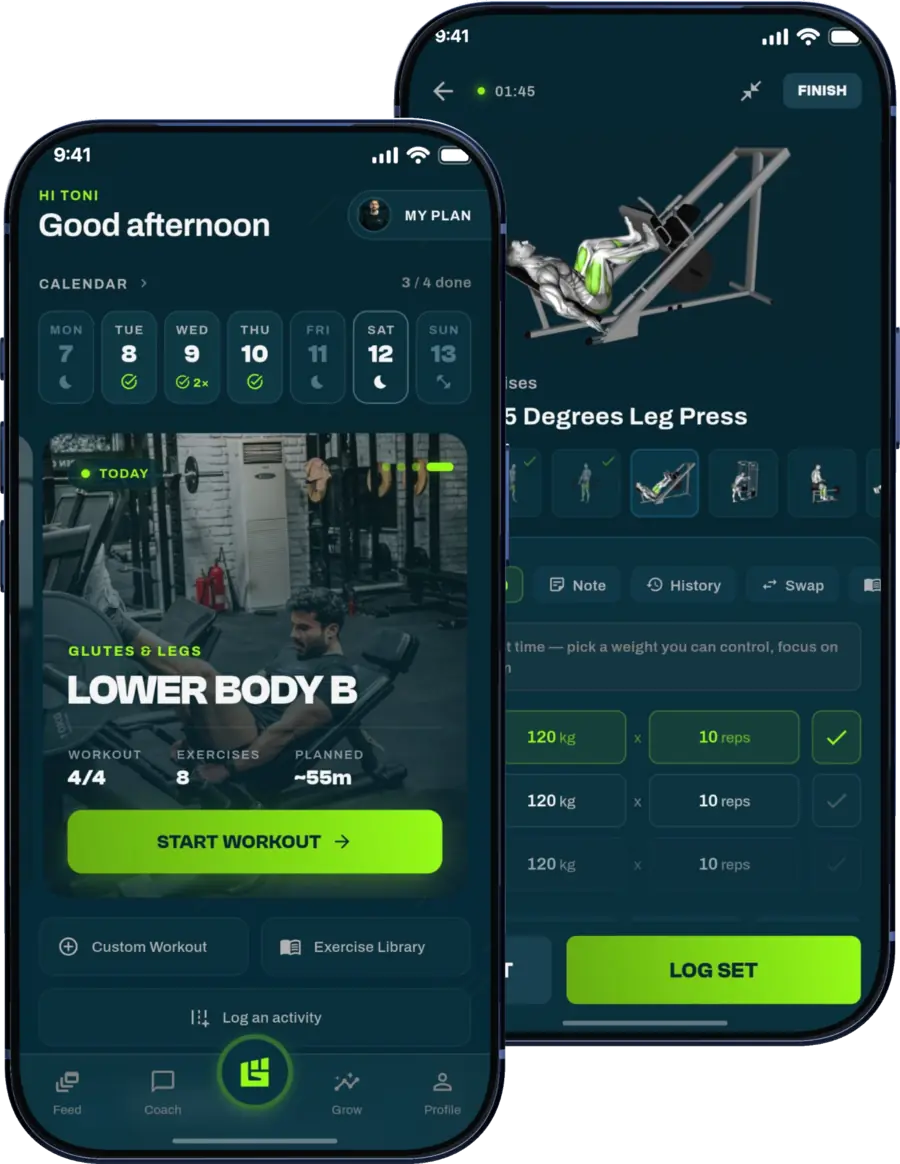
A plan also has to fit your actual life, not your fantasy week.
Practical rule: If your plan only works when nothing goes wrong, it isn't a strong plan.
What works better than the reset mentality
A durable fitness goal leaves room for imperfect weeks. It tells you what to do when energy is high, when time is short, and when recovery is limited. That's how habits survive long enough to matter.
Useful starting points often look like this:
- Set a floor, not just a ceiling: Define the minimum version of success for busy days.
- Match training to your current base: If you've been inactive, earn volume gradually.
- Plan for friction: Travel, poor sleep, family demands, and work stress aren't exceptions. They're normal.
If you're restarting after a long break, injury risk deserves just as much attention as motivation. This New Year injury prevention advice is a helpful reminder that enthusiasm needs a progression plan, especially when your body hasn't been training consistently.
The downward spiral of unrealistic goals
An unrealistic goal rarely fails all at once. It fails in a sequence.
First, the target is too aggressive for your current capacity. Then the plan becomes too demanding to execute consistently. You miss sessions, feel behind, and respond by pushing harder. That extra push creates more fatigue, worse performance, and more frustration. Eventually, many people stop not because they don't care, but because the process starts to feel punishing.
A simple way to visualize that cycle:

The psychology of missing impossible targets
People often assume big goals create commitment. Sometimes they do. But there's an important difference between structured ambition and fantasy. In an NIH-supported study, people with extremely high weight-loss goals were more likely to drop out than those with moderate goals (OR 1.20) while those aiming for more than 10% weight loss in a structured way were 60% less likely to drop out than those with smaller goals, and they lost 5.21 kg more on average by 24 weeks (NIH-supported goal-setting study).
That's the key distinction. Ambition isn't the enemy. Poor calibration is.
A good goal stretches you. A bad goal makes every normal delay feel like failure.
The physiology behind the crash
The body keeps a running tab on stress. Hard sessions, poor sleep, work strain, and under-recovery all draw from the same account. If you keep adding withdrawals without enough deposits, your performance drops even if your motivation stays high.
I often explain recovery debt like a credit card balance. You can ignore it for a little while, but interest shows up fast. Workouts feel heavier, soreness lasts longer, and small aches stop resolving between sessions.
That's why sustainable training strategies matter more than heroic effort. They keep you in a zone where training creates adaptation instead of accumulated breakdown.
Missing one workout doesn't ruin progress. Turning one missed workout into a three-day punishment session often does.
What the loop usually looks like in real life
- Week one: Motivation is high, so volume and intensity jump too quickly.
- Week two: Fatigue rises, performance doesn't match expectations, and confidence dips.
- Week three: Sessions get skipped or modified out of necessity, not strategy.
- Week four: Guilt replaces momentum, and the plan starts to feel like proof you're failing.
That loop is predictable. It's also avoidable when the goal matches your actual recovery bandwidth.
Are your fitness goals working against you
A lot of people don't realize their goals are the problem because they're still working hard. They assume more discipline will fix what's really a poor setup. The clearer question is this: does your goal create steady training, or does it create constant strain?
Use this as a quick self-check:

Seven red flags to notice early
- You dread workouts regularly: Occasional reluctance is normal. Ongoing dread usually means the plan is asking too much.
- You feel guilty for resting: Recovery starts to feel like weakness instead of part of training.
- You're always trying to catch up: Missed sessions lead to crammed schedules and panic decisions.
- You stay sore all the time: Constant soreness isn't proof of effectiveness.
- Pain gets ignored: You keep pushing through warning signs because the deadline feels urgent.
- Your goal is vague but demanding: “Get fit fast” creates pressure without direction.
- Your life has to shrink around training: Social plans, sleep, and work all get sacrificed to keep up.
Social media can distort the standard
A lot of unrealistic goals don't start in the gym. They start on a screen. Appearance-driven fitness content pushes people to judge progress against polished, selective, and often unhelpful standards.
A controlled study found that fitness content with appearance-relevant cues significantly reduced body esteem (β = -0.30, p < 0.001), while performance-focused fitness images did not differ significantly from neutral travel images (controlled study on appearance-focused fitness content).
That matters in practice. If your goal is shaped by how someone else looks in ideal lighting, you're more likely to chase rapid visual change and overlook stronger markers of progress like better movement quality, improved work capacity, or more consistent training.
Shift your question from “Do I look different yet?” to “Can I do more, recover better, and stay more consistent than last month?”
The blueprint for goals that actually work
The most useful framework here is SMART. Not because it sounds tidy, but because it forces a fuzzy goal into a plan you can execute. Expert guidance also recommends SMART goals to help prevent overtraining syndrome, noting that inadequate rest and poorly defined objectives can interfere with muscle repair and growth, while a structured plan supports adaptation (SMART goal guidance for preventing overtraining).

Specific and measurable
“Get in shape” sounds motivating, but it doesn't tell you what to do on Tuesday at 6 p.m.
A specific goal names the behavior. A measurable goal tells you how you'll know you're following through.
| Weak goal | Stronger goal |
|---|---|
| Get fit | Complete three strength sessions each week |
| Do more cardio | Walk daily and complete two planned conditioning sessions |
| Build muscle | Follow a structured hypertrophy routine and log each workout |
Specific goals reduce decision fatigue. Measurable goals keep emotion from becoming your only feedback system.
Achievable and relevant
Achievable doesn't mean easy. It means the goal fits your current training age, schedule, equipment, and recovery. Relevant means the goal matters to your life, not just your ego.
A parent with a demanding job may need four well-designed weekly sessions, not seven. A beginner may need movement quality and consistency before chasing high-volume training blocks. Someone training for a HYROX-style event needs a different mix of strength and conditioning than someone focused on joint-friendly fat loss.
Coach's filter: If the plan looks impressive but isn't repeatable for the next month, it isn't achievable.
Time-bound without becoming self-destructive
A deadline creates focus. A bad deadline creates panic. The right time frame gives you urgency without forcing shortcuts.
A practical example:
- Vague version: I want to transform my body fast.
- SMART version: For the next four weeks, I'll complete three 30-minute strength workouts per week, hit my step goal most days, and log sleep and energy after each session.
That kind of goal works because it controls the behaviors that drive change. It also leaves room to review and adjust instead of grinding through a plan that's clearly failing.
How to build a sustainable fitness system
Goals matter, but systems decide whether goals survive contact with real life. A goal tells you where you want to go. A system tells you what happens when work gets busy, sleep drops, motivation fades, or a session gets missed.
The strongest fitness systems don't depend on perfect weeks. They depend on rules that keep training moving under imperfect conditions.
Track the right signals
If the scale or mirror is your only scoreboard, you'll make bad decisions when those signals move slowly. Better markers include workout completion, performance trends, session difficulty, energy, sleep quality, and how your joints feel.
That changes your response. Instead of saying, “I'm not seeing enough change, so I need to do more,” you can say, “My performance is flat and my recovery is poor, so I need to adjust load, volume, or rest.”
Protect recovery like it's part of the program
A lot of people treat recovery as optional because it doesn't feel productive in the moment. That's backward. Recovery is where the training effect gets built.
Three habits usually help most:
- Keep rest built in: Don't wait until exhaustion forces it.
- Support adaptation with nutrition and sleep: Hard training with poor recovery support is just extra stress.
- Use lighter weeks when needed: Pulling back briefly often prevents a much longer stall.
For readers focused on body composition, this practical guide to sustainable weight management aligns well with the same principle. Sustainable change comes from repeatable behaviors, not repeated overcorrections.
Never try to catch up by force
One of the biggest mistakes I see is the “I missed two workouts, so now I need to crush this week” mindset. That's where small disruptions turn into setbacks. Guidance on this issue is clear: trying to “catch up” by dramatically increasing volume or intensity raises injury risk and creates recovery debt that can stall progress for weeks (guidance on catch-up training and recovery debt).
A better rule is simple. Don't catch up. Resume.
If you need support turning that rule into a plan, tools built around truly personalized workout planning can help match training to the time, equipment, and recovery capacity you have that week.
Train smarter with AI-personalized planning
Manual planning breaks down for a simple reason. Your body doesn't train in a vacuum. Sleep changes, stress changes, schedule changes, and performance changes. A static program can't respond to that unless someone adjusts it well and adjusts it often.
That's where AI-driven planning becomes useful. Instead of asking you to guess whether you should push harder, hold steady, or back off, adaptive systems can use your logged performance, session difficulty, and schedule constraints to recalibrate training demand. That makes goal setting less emotional and more responsive.
For busy people, that matters. A good adaptive system helps prevent the classic mistakes: doing too much too soon, ignoring recovery trends, and treating every low-energy day like a motivation problem. It can also make coaching more accessible when paired with tools such as an online coaching platform that supports accountability and communication.
One example is GrabGains, which builds adaptive routines around a user's goals, fitness level, available equipment, and schedule, then updates training over time based on performance. If you're comparing digital options, this Guide to AI vs free fitness solutions is a practical place to sort out what adaptive planning changes versus a fixed template.
The key advantage isn't novelty. It's calibration. The right plan gives you enough challenge to improve, enough recovery to adapt, and enough flexibility to keep going when life gets messy.
If your current plan keeps swinging between overdoing it and starting over, it's time for a smarter setup. GrabGains helps you build adaptive training around your real schedule, goals, and recovery so progress stays sustainable instead of all-or-nothing.
Get inspired and motivated