Why discipline beats motivation: build lasting habits
Motivation fades. Discover why discipline beats motivation for lasting success. Get actionable strategies to build a routine that truly lasts. You know the cycle. A new training block starts, your energy is high, and you tell yourself this time will be different. You buy better shoes, save a few workouts, clean up your meals for three days, and map out a full week of training.
Then work gets busy. Sleep drops. Your schedule shifts. One missed session becomes three, and suddenly the plan that felt exciting feels heavy.
That's not a character flaw. It's what happens when you build your training around a feeling instead of a system. Motivation helps you start, but it doesn't carry you through stress, travel, bad weather, low energy, or ordinary weekdays when nothing feels exciting.
That's why discipline beats motivation in real fitness practice. Not because discipline sounds tougher, but because it gives you something motivation never can. A repeatable way to act when your mood stops cooperating.


The Motivation Trap Why Good Intentions Arent Enough
People don't struggle because they don't care about fitness. They struggle because caring and doing are not the same thing. You can want results and still miss workouts if your plan depends on feeling ready every day.
The extent of that gap is often underestimated. A WHO-backed study highlighted that insufficient physical activity is projected to affect 35% of the global population by 2030 if current trends continue, which shows that good intentions alone don't reliably create consistent behavior (Mendi summary of the WHO-backed findings).
Motivation feels strong at the start
Early motivation is loud. It pushes people into all-or-nothing thinking. They try to train hard six days a week, overhaul nutrition overnight, and expect momentum to carry them.
Built for progress
Take the guesswork out of training
Get a personalized workout plan built around your goal, equipment and schedule. Train smarter, track every rep and keep moving forward, one workout at a time.






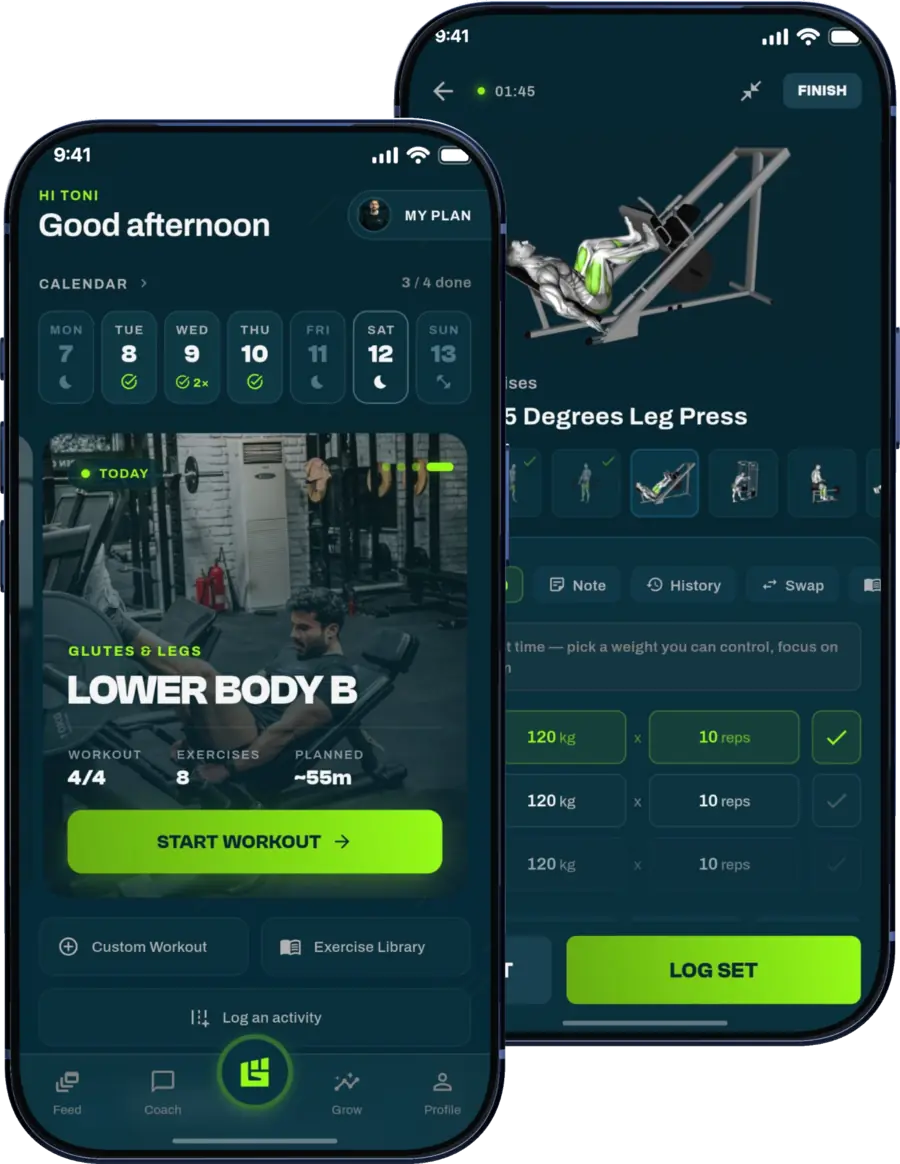
That approach usually breaks down fast. The plan is too ambitious for real life, so one disruption knocks the whole thing over.
Coach's rule: If your routine only works on your most motivated week, it isn't a routine. It's a mood.
Real life exposes weak systems
Fitness gets tested on inconvenient days. Cold mornings. Late meetings. Poor sleep. Travel. Family obligations. If your plan has no structure for those days, motivation won't save it.
Runners know this well. Weather alone can disrupt consistency if you don't prepare for it. Practical adjustments like layering, warming up longer, and planning your route matter more than hype, which is why resources like Swift Running cold weather advice are useful. They help turn good intentions into an actual plan.
What works is simpler. Pick training times you can repeat. Lower friction. Decide in advance what happens when the day gets messy. Discipline starts there.
Discipline vs Motivation The Steady Engine and The Unreliable Spark
Motivation is a spark. Discipline is an engine.
A spark can help you start a fire, but it burns out quickly. An engine keeps moving because it's built to run. That's the cleanest way to understand why discipline beats motivation in training.

Motivation depends on emotion. Discipline depends on commitment. When people say they need to “get motivated again,” what they usually mean is that they never built a process that survives an off day.
A useful definition comes from Alan Stein Jr.’s explanation of discipline and motivation. Discipline means doing what needs to be done even when you don't feel like doing it. In training, that might mean starting your warm-up when your day has been chaotic, or doing the shorter session instead of skipping the session.
Why repetition matters more than excitement
The point of discipline isn't to white-knuckle every workout forever. The point is to repeat the action long enough that it becomes easier to do consistently.
A major review in the European Journal of Social Psychology found that habit formation took 66 days on average, with a range of 18 to 254 days depending on the person and behavior (Lifehack summary of the review). That matters because the early phase of training is less about crushing sessions and more about repeating the same cue in the same context until the behavior starts to feel automatic.
Motivation vs. Discipline at a Glance
| Characteristic | Motivation | Discipline |
|---|---|---|
| Primary driver | Emotion, excitement, urgency | Commitment, structure, repetition |
| Reliability | Changes day to day | Holds up on good and bad days |
| Response to obstacles | Often collapses when life gets messy | Adjusts and keeps moving |
| Best use | Starting action | Sustaining action |
| Long-term effect | Inconsistent bursts | Habit and routine |
Discipline isn't the opposite of enthusiasm. It's what keeps progress alive after enthusiasm fades.
If you train long enough, you stop asking, “Do I feel ready?” and start asking, “What does today's version of the plan look like?” That shift changes everything.
The Psychology of Building a Disciplined Mindset
Discipline isn't just about behavior. It changes the way you think about training. Once you stop negotiating with yourself every day, your mind gets quieter and your follow-through gets stronger.
It cuts decision fatigue
Every extra decision creates friction. Should I go before work or after? Lift or run? Full workout or quick circuit? Gym or home?
Disciplined people don't remove all flexibility, but they reduce unnecessary choices. Their training slot is already picked. Their session type is already planned. Their backup option is already decided if time gets tight.
That matters for busy adults. Most missed workouts aren't caused by laziness. They're caused by too many small decisions stacked on top of a full day.
It builds self-trust
Confidence in fitness doesn't come from consuming more content. It comes from evidence. You keep a promise to yourself, then you do it again, and after enough repeats you stop seeing yourself as someone who “tries to work out” and start seeing yourself as someone who trains.
That identity shift is protective. It helps you stay steady when progress feels slow. It also helps you avoid the burnout cycle of going too hard, falling off, and starting over. If that pattern sounds familiar, these insights on workout burnout are worth reading because they show how consistency often breaks when effort stops matching recovery and real-life demands.
It reduces procrastination
Research on self-discipline found that trait self-discipline significantly negatively predicted general procrastination, with β = −0.23, t = −4.53, p < 0.001, and that a self-discipline prime reduced procrastination compared with control. The mechanism was autonomous motivation, which mediated the effect (PMC article on self-discipline and procrastination).
In practical terms, discipline helps you move before your brain starts bargaining. You don't sit around waiting for the perfect mood. You begin the session, and action creates momentum.
The most useful mindset shift is this. Discipline isn't restriction. It's relief from the daily argument about whether you'll show up.
Two Fitness Journeys One by Motivation One by Discipline
The difference between motivation and discipline gets obvious when you watch it play out over time.

The motivation-first trainee
One person starts every month with urgency. New playlist. New split. New challenge. They feel fired up, so they train hard right away. If they miss one workout, they decide the week is ruined.
They chase intensity instead of continuity. One week is excellent. The next week disappears under meetings, social plans, and fatigue. Because there's no stable system underneath the excitement, the plan keeps changing.
This person often says they “just need to get back on track.” But they were never on a track. They were riding waves of emotion.
A motivation-first approach usually looks like this:
- Big starts: aggressive schedules that don't match work, recovery, or current fitness
- Constant switching: new programs before the old one has time to work
- Skip logic: one missed day turns into a full stop
- Mood-based effort: hard sessions on high-energy days, nothing on low-energy days
The discipline-builder
The second person doesn't rely on excitement. They pick a realistic schedule and protect it. They know which days they train, what the session is, and what the reduced version looks like if the day goes sideways.
They still have low-energy days. They still miss workouts sometimes. The difference is that they don't treat disruption like failure. They adjust, then continue.
Field note: The disciplined athlete isn't the one who never struggles. It's the one who has a plan for struggling.
This person also respects progression. They don't test themselves every session. They accumulate good sessions over weeks and months. That's how strength, muscle, work capacity, and skill build.
What the long game looks like
After enough time, the contrast becomes sharp.
The motivation-first trainee feels busy but inconsistent. They remember their best weeks, but their average month doesn't support their goals. Training feels emotional. Progress feels random.
The discipline-builder gets fewer dramatic highs, but a lot more usable progress. Their training survives work deadlines, poor sleep, travel, and imperfect weeks because the system bends instead of breaking.
That's the practical answer to why discipline beats motivation. Motivation creates starts. Discipline creates continuity. In fitness, continuity wins.
How to Build Unbreakable Workout Discipline Step by Step
Discipline gets easier when you stop treating it like a personality trait and start building it like a training plan. Good systems reduce friction, narrow choices, and make the next workout obvious.

Start smaller than your ego wants
Individuals often begin too ambitiously. They set a schedule they can hold for five energetic days, not five normal weeks.
Start with a floor you can protect:
- Pick a minimum plan: two or three training slots you can repeat.
- Shrink the entry point: your goal can be “start the warm-up” instead of “crush a full session.”
- Keep the cue stable: same time block, same location, same first action.
Small doesn't mean weak. Small means repeatable.
Put training into the calendar
If your workouts live in your head, they compete with everything else. Put them where your meetings go.
Use fixed training windows when possible. If your schedule changes often, assign categories instead of exact times. For example, one lower-body session early week, one upper-body session midweek, one conditioning or full-body session by the weekend. That gives you structure without forcing rigidity.
Build a rule for bad days
A system fails when it has only one setting. You need a version of the plan for high-energy days, average days, and rough days.
Try a simple fallback ladder:
- Best case: do the full session as written.
- Busy case: cut accessory work and keep the main lifts.
- Exhausted case: do a short technique session, mobility block, or easy zone-based conditioning.
Many people hold a misconception about discipline. They think discipline means doing the hardest version no matter what. In practice, discipline means staying consistent without turning training into punishment.
Track what proves consistency
You don't need complex spreadsheets to stay accountable. Track a few things that tell the truth:
- Sessions completed: not planned, completed
- Main lift performance: reps, load, effort
- Recovery notes: sleep, stress, soreness
- Streak protection: how quickly you return after a missed day
What gets measured gets clarified. You start seeing whether the issue is programming, recovery, scheduling, or just poor planning.
Use adaptive tools to lower friction
Rigid plans often break when life changes. Recent digital-coaching research has emphasized that adherence improves when workout plans are adaptive, using personalized feedback loops and adjustments for sleep, stress, and readiness rather than demanding identical output every day (analysis of adaptive digital coaching and discipline).
That's where technology can help. Instead of relying on memory, guesswork, or random saved workouts, some people do better with structured platforms that organize the plan, exercise selection, and tracking in one place. AI-powered fitness programs can support that by giving you goal-based routines, exercise guidance, and a clearer next step when your schedule or readiness shifts. Used well, tools like that don't replace discipline. They remove friction so discipline is easier to practice.
Systems beat mood. The best training plan is the one you can still execute on a Wednesday when work ran late and your energy is average.
Stop Waiting for Motivation and Start Building Your System
Motivation is welcome. It makes the first week feel easy. It can give you a push into action. But it's a poor manager of long-term training because it disappears exactly when life gets crowded.
Discipline is different. It turns fitness into something scheduled, adjusted, tracked, and repeated. That's why discipline beats motivation for people who want results that last longer than a short burst of enthusiasm.
Busy adults already understand this in other parts of life. They don't pay bills, show up to work, or meet deadlines only when inspired. Training should work the same way. If your calendar is overloaded, learning how to prioritize and work smarter helps because time management and training consistency are tightly linked.
The next step isn't to wait for another surge of energy. It's to build a setup that keeps moving on ordinary days. Make your plan realistic. Protect your training slots. Lower the barrier to starting. Keep the routine alive after a missed session.
If you want another practical layer on top of that, this guide to building lasting gym consistency in 2026 gives you more ways to turn training into a repeatable part of your week.
Frequently Asked Questions About Discipline and Motivation
Is discipline the same as habit
Not exactly. Discipline is the repeated follow-through. Habit is what develops when that follow-through becomes more automatic. Discipline gets you through the early stage when the behavior still feels effortful.
Does motivation matter at all
Yes. Motivation is useful for starting. It can help you begin a program, sign up for a gym, or commit to a goal. The mistake is expecting it to carry the whole process. Use motivation to launch, then hand the job over to structure.
What should I do after missing a workout
Don't compensate with guilt or an extreme session. Return to the next planned workout as quickly as possible. Missing one day isn't the problem. Turning one miss into a week off is the problem.
How do I stay consistent with a variable schedule
Use anchors instead of perfect timing. Define how many sessions you need in a week, what their priority order is, and what your shorter backup version looks like. That makes consistency possible even when your days aren't identical.
Can systems outside fitness help with discipline
Yes. Scheduling, batching, and reducing small decisions help in any routine-based work. Even content creators use repeatable publishing systems to stay consistent, which is why guides like ClipCreator.ai's Shorts scheduling strategies are useful examples of the same principle. Consistency improves when the process is planned before motivation fades.
If you're ready to stop restarting and start building a training system you can follow, take a look at GrabGains. It's built for people who want clearer structure, adaptive planning, and a practical way to stay consistent when life doesn't run on perfect conditions.
Get inspired and motivated