The science behind workout fatigue: optimize training
Unpack the science behind workout fatigue to optimize your training. Learn how to push harder & recover faster for peak performance in 2026. You know the feeling. The warm-up moved well, the first working sets felt solid, and then something changed. The bar slows down, your legs feel heavy, your focus gets foggy, and your brain starts negotiating with you before the set is even over.
Often, all of that is labeled as “being tired.” That's too simple to be useful.
The science behind workout fatigue gives you a better lens. Fatigue isn't one thing, and it isn't just a test of toughness. It's a signal made up of changes in your brain, nerves, muscles, fuel supply, and perception. When you understand what kind of fatigue is showing up, you can make smarter choices about load, rest, nutrition, pacing, and recovery instead of guessing.
That matters whether you lift before work, train for HYROX on tight time, or just want workouts that build momentum instead of wrecking the rest of your week.


Why Pushing Through Is Not Always the Answer
A hard workout should feel hard. But hard and useless are not the same thing.
Sometimes pushing through is exactly what builds progress. Other times it turns a productive session into junk volume, sloppy reps, or recovery debt that spills into the next few days. The difference usually comes down to whether fatigue is still giving you a training stimulus or whether it's already cutting into performance quality.
Researchers no longer treat fatigue as a single state of “exhaustion.” Modern definitions separate performance fatigability, which is the measurable drop in output, from perceived fatigability, which is how tired or strained the effort feels, as described in this review on fatigue science and performance fatigability. That's why two athletes can do the same workout and have very different experiences. One sees a clear drop in speed or force. The other mainly feels that the work has become mentally expensive.
Built for progress
Take the guesswork out of training
Get a personalized workout plan built around your goal, equipment and schedule. Train smarter, track every rep and keep moving forward, one workout at a time.






What lifters often get wrong
A lot of gym culture still treats fatigue like a character issue. If the set slows down, you're told to dig deeper. If motivation fades, you're told to toughen up.
That mindset misses the point. Fatigue is often a protective signal, not a moral failing. Your body may be managing local muscle stress, nervous system strain, low fuel availability, or accumulated workload from earlier in the week.
Practical rule: If your output is falling faster than the workout requires, treat that as information, not weakness.
A better question than can I push through
Instead of asking only whether you can continue, ask:
- Is technique still stable: If your movement quality is falling apart, more reps may train compensation instead of skill.
- Is the target adaptation still there: A strength set that turns into a grind-fest may stop being a strength set.
- Will today's cost hurt the next session: One dramatic workout can interfere with several good ones.
Good coaching begins, not with endless motivation, but with pattern recognition.
Once you stop treating every form of fatigue the same way, training gets clearer. You can separate effort from effectiveness, and that's where consistent progress usually starts.
The Two Sides of Fatigue Central vs Peripheral
One of the most useful ideas in exercise science is that fatigue has two main sources. The signal from the brain can drop off, or the muscle itself can become less able to keep producing force. Both can happen in the same workout.
Consider a factory. The control room sends instructions, and the machines on the floor do the work. If the control room reduces output, production slows. If the machines are short on materials or start malfunctioning, production also slows. You still see the same result from the outside, but the fix is different.

What central fatigue feels like
Central fatigue refers to reduced motor-cortical drive from the brain, while peripheral fatigue involves local muscular factors such as ATP resynthesis limits, as outlined in this review on central and peripheral fatigue in exercise.
In plain language, central fatigue often shows up as:
- Low drive: You know what to do, but you can't generate much snap or intent.
- Mental drag: Focus is poor, warm-ups feel off, and effort feels high early.
- Motivation changes: You feel done before the muscles are fully done.
This is why sleep, stress, and emotional load matter. If your brain is under strain, training can feel heavy before the first hard set really starts.
What peripheral fatigue feels like
Peripheral fatigue is more local. The muscle is the bottleneck.
You'll usually notice it as the classic “burn,” reduced force, slowing reps, or a muscle that just won't keep contracting the way it did at the start of the set. In a squat session, that might feel like quads turning to cement. In repeated sled work, it might feel like the legs keep moving but lose pop.
A quick comparison helps:
| Type | Main bottleneck | Common feeling in training | Common response |
|---|---|---|---|
| Central fatigue | Brain-to-muscle drive | Flat, foggy, unmotivated, unusually high effort | More recovery, lower stress, sometimes less session density |
| Peripheral fatigue | Local muscle function | Burn, force drop, muscle-specific failure | Rest timing, fuel support, exercise order, pacing |
A workout can fail in your head, in the muscle, or in both at once. You train better when you learn which one showed up.
How to respond in real life
If you feel mentally flat across your whole body, don't automatically add stimulants and force the plan. You may need a lighter day, fewer top sets, or simpler work.
If one muscle group is the clear limiter, the answer may be more specific. Longer rest periods, a different rep range, or changing exercise order can solve the problem better than just “trying harder.”
That's the practical value of the science. It turns fatigue from a vague feeling into a problem you can diagnose.
Your Body's Energy Systems and Why They Matter
Not every workout creates fatigue the same way because not every workout uses energy the same way. Your body is always making ATP, the energy currency that powers muscle contraction, but it doesn't rely on one single pathway.
The easiest way to think about it is fuel access. Some systems give you energy fast but run out quickly. Others are slower but can support longer efforts. That's why a heavy single, a hard set of ten, and a long run all create very different kinds of fatigue.

The fast system for explosive work
For very short, intense efforts, fatigue is strongly linked to phosphocreatine depletion. According to this overview of exercise fatigue and metabolic demands, short-duration high-intensity work is limited by rapid CrP depletion, while longer submaximal exercise shifts toward depleted muscle glycogen and falling blood glucose.
That short-burst system is what helps with:
- heavy singles
- jumps
- short sprints
- explosive reps with long rest
When this system gets taxed, you don't usually feel the same steady burn you'd feel in a longer set. Instead, power just disappears. The bar loses speed. The sprint loses snap. The second or third explosive effort doesn't look like the first.
The middle gear for repeated hard efforts
When a set lasts longer or repeated efforts are packed close together, your body leans more on glycolytic energy production. In such scenarios, hard intervals, repeated sled pushes, long sets, and circuits often get ugly.
Two things tend to confuse people here.
First, the burn doesn't mean lactate itself is the villain. Lactate is better understood as a marker that the muscle environment has shifted. Second, if rest periods are too short, your body doesn't fully restore what it needs between efforts, so each round starts from a worse place than the one before.
That's why a ten-rep set feels different from a near-max single. It's not just “more reps.” It's a different fatigue problem.
The long-haul system for endurance work
During prolonged submaximal work, the issue moves toward fuel availability. Muscle glycogen drops. Blood glucose can fall. Pacing matters more. Nutrition matters more.
If you've ever felt okay early in a long session and then strangely empty later, that's often what you're running into. The engine is still on, but the available fuel is getting limited.
A simple training map looks like this:
| Workout type | Main demand | Common fatigue issue | Practical adjustment |
|---|---|---|---|
| Explosive lifts or sprints | Rapid power output | CrP depletion | Use enough rest to preserve speed |
| Long sets or repeated intervals | High sustained intensity | Metabolite buildup and incomplete recovery | Manage work-to-rest ratio |
| Long endurance sessions | Sustainable output over time | Glycogen depletion and falling blood glucose | Fuel and pace appropriately |
So what should you do with this
Match your strategy to the session.
If your goal is speed and power, protect quality with longer rest and fewer junk reps. If your workout is built around repeated efforts, control interval design so every round doesn't become random suffering. If your sessions run long, think seriously about carbohydrate timing and pacing.
If you use caffeine as part of your pre-workout routine, dosage and timing matter more when you're trying to support focus and effort without turning every session into overreach. A practical explainer on how much caffeine before workout training can help you think through that decision.
Your body isn't failing when different workouts tire you in different ways. It's using different engines, and each engine runs into its own limit.
How Fatigue Shows Up and How to Measure It
You don't need a lab to notice fatigue. You need a way to pay attention that's more precise than “I felt bad today.”
Start with two buckets. One is subjective, meaning what the session feels like. The other is objective, meaning what your performance does. The sweet spot is using both.
Subjective signs that matter
A simple tool is RPE, or rating of perceived exertion. You don't need to overcomplicate it. Ask yourself how hard the set felt, how much focus it required, and whether effort rose faster than expected.
Useful signals include:
- The warm-up test: If weights that are usually easy already feel sticky, note it.
- Mental readiness: If you're struggling to lock in before the main work starts, central fatigue may be part of the picture.
- Rep honesty: If the set felt like a grinder even before the target rep range ended, don't ignore that.
Some of the best training decisions come from noticing fatigue early, not from proving you can ignore it.
Objective signs you can track
Now look at output. Did bar speed drop hard? Did you lose reps at the same load? Did pace fall apart at an effort that is usually manageable? Did your intervals become uneven?
A powerful concept here is fatigue resistance. In cycling research summarized by Outside, elite professionals could hold near-peak sprint ability after 3,000 kJ of work, while less accomplished riders showed marked drops after about 1,500 kJ, which points to a measurable twofold difference in performance under fatigue according to this summary of fatigue resistance research in athletes.
That matters even if you never touch a bike. Fitness isn't only what you can do fresh. It's also what you can still do after work accumulates.
Build your own tracking system
You don't need dozens of metrics. Pick a few and use them consistently.
- For lifters: Track load, reps completed, and whether rep speed noticeably falls.
- For runners or HYROX athletes: Watch pace, heart rate response, and whether effort climbs at the same output.
- For mixed training: Compare how well you repeat quality later in the session.
If you want more individualized endurance guidance, threshold testing can help create personalized training zones instead of relying on generic estimates.
The goal isn't to become obsessed with data. It's to stop treating every rough session like a mystery.
Training Smarter by Programming Around Fatigue
Good programming doesn't try to eliminate fatigue. It places fatigue where it creates adaptation and limits it where it destroys quality.
That's why “train harder” is incomplete advice. A hard set can be useful. A hard week can be useful. But if fatigue spills over so much that your technique, output, and motivation all crater, the plan is no longer serving the goal.

When training to failure helps
Failure training has a place. It can expose a muscle to a strong local stimulus, especially in safer exercises where technique breakdown has lower cost. Think machine work, cable work, or isolation lifts near the end of a session.
But context matters. A synthesis on exercise, fatigue, and training intensity notes that moderate-intensity programs often show the most consistent improvements in energy and vitality, and that the value of pushing to failure depends on balancing the local muscle stimulus against the recovery cost across the week.
That's the key idea. Failure isn't automatically smart just because it feels productive.
When failure creates more cost than benefit
Failure gets expensive when:
- Technique is complex: Heavy compounds punish sloppy reps.
- You need repeated performance: HYROX prep, sports practice, and dense weekly schedules don't reward one heroic set that wrecks the next sessions.
- Recovery is already tight: Busy workweeks, poor sleep, or calorie deficits reduce your margin.
A useful rule is to save your highest-fatigue strategies for exercises and phases where you can recover from them.
Coach's lens: Don't judge a session only by how hard it felt. Judge it by whether it improved the next week of training.
What smart programming looks like
Programming around fatigue often means manipulating a few levers:
- Exercise order Put the highest-skill or highest-priority lifts first, while coordination and force output are still high.
- Rest intervals If power or strength is the goal, protect output with enough rest. Short rest makes a different workout.
- Weekly distribution Spread hard stressors so the same muscles, joints, and energy systems aren't getting hammered back to back.
- Autoregulation Keep the plan, but adjust the dose. This is where adjusting workouts based on signals becomes useful. If readiness is down, you might cut a top set, lower load, or swap a demanding variation for a simpler one.
A simple decision framework
Use this quick filter before forcing the plan:
| Situation | Better call |
|---|---|
| Bar speed is down but technique is crisp | Reduce load slightly or trim volume |
| Technique is breaking down | Stop the set or switch exercise |
| Whole-body flatness is high | Lower intensity and keep the session moving |
| Only one muscle group is cooked | Adjust exercise order, rest, or local volume next time |
The strongest athletes aren't the ones who ignore fatigue the longest. They're usually the ones who place it carefully.
The Other Half of Training Strategic Recovery
Training creates the problem your body has to solve. Recovery is where that solution gets built.
If fatigue is a mix of central and peripheral factors, recovery has to address both. A review on central and peripheral mechanisms of fatigue describes fatigue as a multi-system issue involving altered neurotransmitter balance at the central level and impaired calcium release plus oxidative effects on muscle proteins at the peripheral level. That's why recovery isn't just about sore muscles. It also affects drive, focus, and force production.

Sleep restores more than mood
Sleep supports the brain side of training. If central fatigue has built up, poor sleep often shows up as low motivation, dull focus, and heavier-than-normal warm-ups.
That's why athletes often misread a bad session. They think they need more discipline when what they really needed was actual recovery.
Nutrition and hydration support muscle function
Food handles a different part of the problem. Carbohydrate helps restore fuel availability after hard or long sessions. Protein provides the building blocks for repair and adaptation. Hydration supports blood flow and the cellular environment that lets muscle keep functioning well.
If you train often, recovery nutrition stops being an optional add-on. It becomes part of the program itself.
For athletes who like having specific tools on hand, some people also look at targeted recovery support for riders alongside the basics. The basics still matter most: sleep, hydration, enough food, and sensible planning.
Active recovery and easier sessions still count
Recovery isn't always lying still. Sometimes the smartest move is light movement, easier aerobic work, or mobility work that keeps you moving without adding major stress.
If you want a deeper look at what happens between hard sessions, this breakdown on the science of muscle recovery connects tissue repair, byproduct clearance, and rebuilding in a practical way.
Recovery is not time away from training. It's the part that lets training keep working.
The athletes who improve steadily usually don't just train hard. They recover on purpose.
From Science to Software How Technology Mitigates Fatigue
Once you understand fatigue, the next challenge is applying that understanding consistently. That's harder than it sounds.
It's easy to identify an obviously bad day. Fewer can catch the early pattern. Maybe bar speed is slipping a little. Maybe repeat efforts are fading faster than usual. Maybe motivation is dropping at the same time weekly workload has climbed. Those are coachable signals, but they're easy to miss when life is busy.
Software can help in this regard. A good adaptive system can track performance trends, compare current output against prior sessions, and flag when fatigue is starting to interfere with the intended training effect. Instead of asking you to guess whether to push, hold, or back off, it can support the same decisions a thoughtful coach would make.
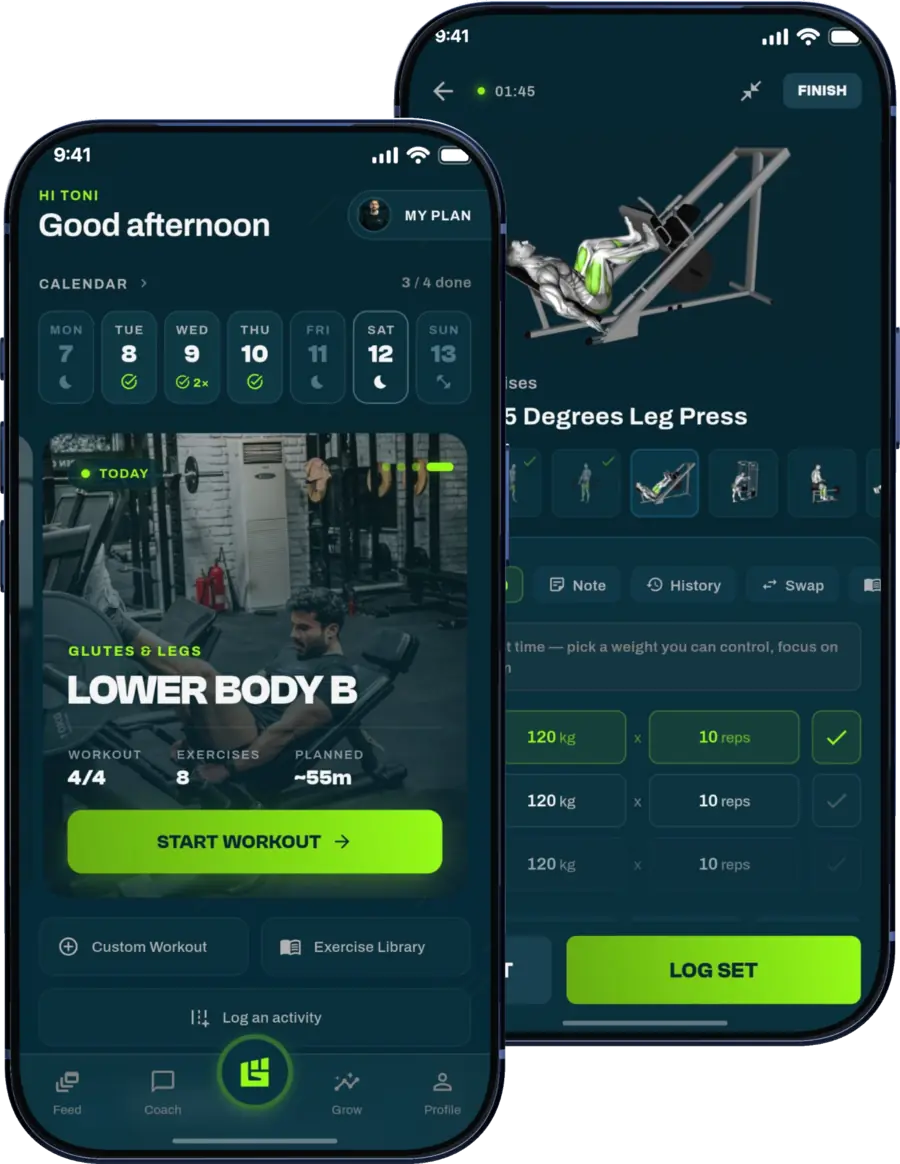
One example is GrabGains workouts, which uses personalized planning, progress tracking, exercise guidance, and adaptive updates based on performance over time. In practice, that means your plan doesn't have to stay static when your readiness changes.
That's the bridge from theory to action. The science behind workout fatigue tells you why performance changes. Smart tools help you respond before one rough session becomes a rough training block.
If you want a simpler way to apply fatigue science without manually adjusting every workout, GrabGains gives you a structured way to track performance, adapt training, and keep progress moving when life, recovery, and readiness change from week to week.
Get inspired and motivated