Übungsvergleich
Romanian Deadlift vs Stiff Leg Deadlift: When to Use Each
The Romanian deadlift (RDL) and stiff-leg deadlift (SLDL) are hip hinge exercises for the hamstrings and glutes that differ mainly in knee angle. The RDL holds a slight, fixed bend in the knees and pushes the hips back, while the SLDL keeps the knees close to straight and usually lowers the weight further. That single change alters hamstring length, how much load can be used, and how much flexibility the exercise requires.
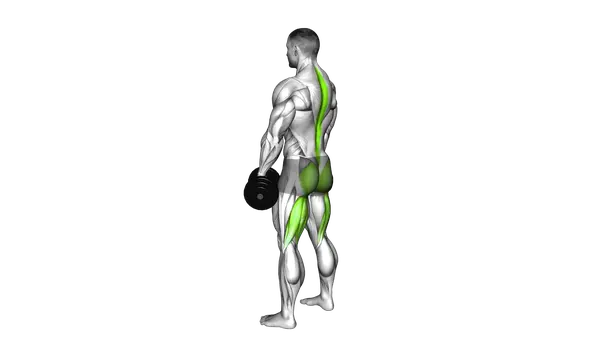
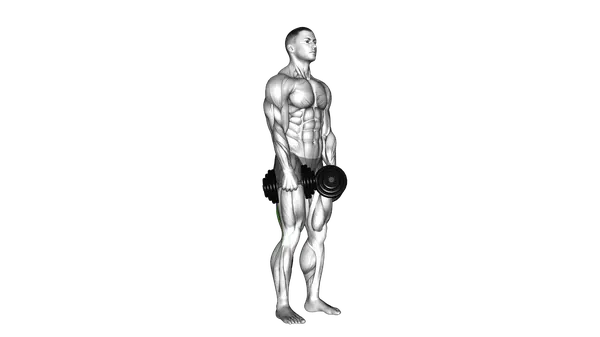
Dumbbell Romanian Deadlift vs Dumbbell Stiff Leg Deadlift
Auf einen Blick
| Merkmal | Dumbbell Romanian Deadlift | Dumbbell Stiff Leg Deadlift |
|---|---|---|
| Primäre Muskeln | Gesäßmuskeln, Beinbeuger, Unterer Rücken | Beinbeuger, Gesäßmuskeln, Unterer Rücken |
| Sekundäre Muskeln | Unterer Rücken, Trapezmuskel, Breiter Rücken, Bauchmuskeln | Unterer Rücken, Breiter Rücken, Bauchmuskeln, Trapezmuskel |
| Ausrüstung | Kurzhantel | Kurzhantel |
| Schwierigkeit | Fortgeschritten | Fortgeschritten |
| Typ | Merhgelenkig | Merhgelenkig |
| Kraftrichtung | Beine | Beine |
01
Setup and technique differences
The Dumbbell Romanian Deadlift starts from a standing position with the dumbbells in front of the thighs. The knees unlock into a slight bend that stays constant, the hips travel backward, and the dumbbells slide down the front of the legs. The descent ends when the hips can no longer move back without the lower back rounding, which for most lifters is around mid-shin.
The Dumbbell Stiff Leg Deadlift keeps the knees straight or very close to straight for the whole repetition. The hips move back less and the torso pivots forward over them, so the dumbbells travel lower, often toward the feet or the floor. Definitions vary between coaches and studies, but the consistent distinction is knee angle: a fixed slight bend in the RDL and near-full extension in the SLDL.
02
How knee angle changes hamstring and glute demand
The hamstrings cross both the hip and the knee, so straightening the knee lengthens them. At the same torso angle, the straighter knees of the SLDL place the hamstrings under more stretch than the RDL. The slight knee bend of the RDL reduces that stretch at the knee but allows the hips to travel further back, which keeps the dumbbells closer to the body.
Muscle activity does not follow the simple rule that straighter legs mean more hamstring work. In competitive bodybuilders lifting 80% of their one-repetition maximum with a barbell, the stiff-leg version produced greater gluteus maximus excitation during the lifting phase, while the Romanian version produced greater semitendinosus excitation, with no difference in the biceps femoris [1]. A likely explanation is that the SLDL relies entirely on hip extension to move the load, since the knees contribute no movement.
03
What the research shows for each lift
The RDL places high force on the hamstrings at long muscle lengths. A musculoskeletal modeling study found that the bilateral RDL produced greater peak force in the biceps femoris long head (1.6 times body weight) and semimembranosus (1.9 times body weight) than the six other resistance exercises tested and every running speed, including maximal sprinting [2]. The RDL and the single-leg hamstring bridge also produced greater peak hamstring stretch than any other task in that study [2]. An earlier EMG comparison of the leg curl, good morning, glute-ham raise and RDL found hamstring activity was highest in the RDL and the glute-ham raise [3].
The SLDL has direct training evidence as well. Nine weeks of SLDL training in untrained adults increased one-repetition maximum by about 34% and produced selective growth of the semimembranosus of about 11% [4]. Both lifts load the hamstrings heavily and produce measurable adaptation, so the choice between them depends mainly on loading, flexibility and back tolerance.
04
Loading, depth and progression
The RDL usually allows heavier dumbbells. The hips-back position keeps the weights close to the legs and over the midfoot, and the slight knee bend provides enough range to reach a useful depth before the hamstrings run out of length. This makes the RDL well suited to moderate and lower repetition ranges and steady load increases.
The SLDL is limited earlier by hamstring flexibility. With straight knees, the dumbbells tend to drift forward as they descend, which increases the demand on the lower back and makes the bottom position harder to control under heavy load. The SLDL is therefore typically loaded lighter and performed with a slower lowering phase, as a stretch-focused accessory rather than a main strength lift. With heavy dumbbells, grip often fails before the hamstrings in either lift, and lifting straps remove that limitation.
05
Lower back stress and flexibility requirements
Both lifts require the spinal erectors to hold the spine in position while the hips flex and extend. A systematic review of deadlift EMG studies found that the RDL is associated with lower erector spinae activation than biceps femoris and semitendinosus activation, whereas across deadlift variations as a whole, erector spinae activation exceeded biceps femoris activation [5].
The SLDL raises the flexibility demand. Lifters with limited hamstring extensibility reach end range sooner, and lowering the dumbbells further at that point is only possible by rounding the lower back. Some traditional SLDL instruction accepts that rounding to reach the floor; for general strength and hypertrophy training, stopping at the deepest position that keeps a neutral spine is the more conservative option. Lifters with lower back sensitivity or tight hamstrings generally tolerate the RDL better.
Das Fazit
The Dumbbell Romanian Deadlift is the better default for most lifters. It allows heavier loading, is easier to perform with a neutral spine, and has strong evidence for high hamstring force at long muscle lengths [2]. The Dumbbell Stiff Leg Deadlift is the better choice when the goal is maximal hamstring stretch with lighter loads, and when hamstring flexibility allows a full range without lower back rounding. Because each version shifts emphasis slightly between the hamstrings and glutes [1], using the RDL as the main hinge and the SLDL as a lighter accessory, or rotating between them across training blocks, is a sound approach.
Was ist dein Fitnessziel?
Wähle eines aus und die App baut dein Programm darum herum, um deine Ausrüstung und um die Tage, an denen du trainieren kannst.
Gut zu wissen
Häufige Fragen
Not clearly. Straight knees place the hamstrings under more stretch, but EMG research found that the Romanian deadlift produced more semitendinosus activity while the stiff-leg version produced more gluteus maximus activity. Both exercises build the hamstrings when trained consistently with progressive load.
The knees should unlock into a slight bend at the start and hold that angle for the entire repetition. If the knees keep bending as the dumbbells descend, the movement shifts toward a conventional deadlift and the hamstrings are lengthened less.
Only if the floor can be reached with a neutral spine. Most lifters run out of hamstring length before that point, and going lower requires rounding the lower back. Stopping at the deepest neutral-spine position keeps the work on the hamstrings and glutes.
Wissenschaftliche Quellen
-
[1]
An Electromyographic Analysis of Romanian, Step-Romanian, and Stiff-Leg Deadlift: Implication for Resistance Training.
Coratella G, Tornatore G, Longo S et al. · International journal of environmental research and public health (2022)
-
[2]
Hamstring force and stretch during progressively increasing running speeds and the eccentric phase of resistance training exercises commonly used for injury prevention and rehabilitation.
Breed R, Hulm S, Hickey JT et al. · British journal of sports medicine (2026)
-
[3]
Muscle activation during various hamstring exercises.
McAllister MJ, Hammond KG, Schilling BK et al. · Journal of strength and conditioning research (2014)
-
[4]
Robustness of hamstring muscle activation strategies following selective hypertrophy induced by Nordic hamstring curl and stiff-leg deadlift exercises.
Morin T, Caillet AH, Nordez A et al. · Journal of applied physiology (Bethesda, Md. : 1985) (2025)
-
[5]
Electromyographic activity in deadlift exercise and its variants. A systematic review.
Martín-Fuentes I, Oliva-Lozano JM, Muyor JM · PloS one (2020)
Die Quellen sind begutachtete wissenschaftliche Publikationen von PubMed.
Übungen


































Weitere Übungsvergleiche
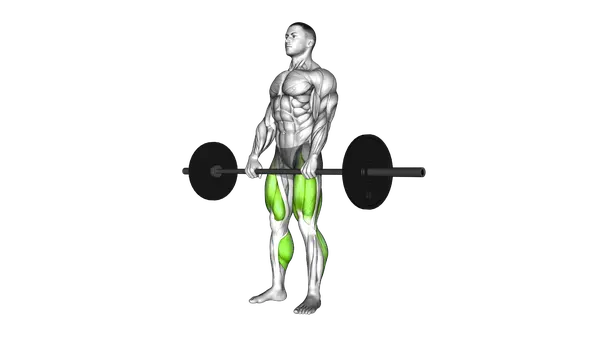
Deadlift vs Romanian Deadlift: They're Not the Same Exercise
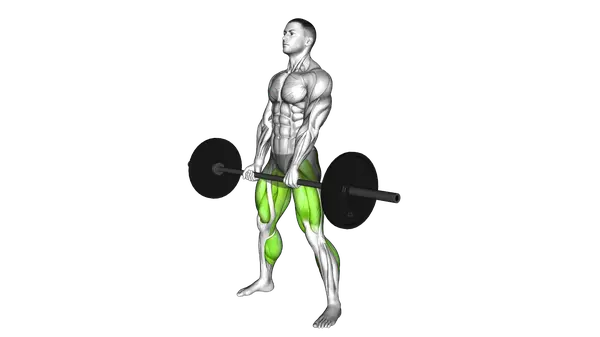
Sumo Deadlift vs Conventional Deadlift: Which Style Is Right for You?
Leg Curl vs Romanian Deadlift: Two Ways to Train Your Hamstrings
Front Squat vs Back Squat: Where Should the Bar Go?
Hip Thrust vs Glute Bridge: Which Builds Better Glutes?
Squat vs Bulgarian Split Squat: Which One Should You Prioritize?