Exercise comparison
Split Squat vs Bulgarian Split Squat: What the Bench Changes
The split squat and the Bulgarian split squat use the same staggered stance, but the Bulgarian version rests the rear foot on a bench. That single change shifts more of the load onto the front leg, raises hamstring and hip extensor demand, and makes balance harder. The flat-footed dumbbell split squat is easier to learn and to load, which makes it the usual starting point.
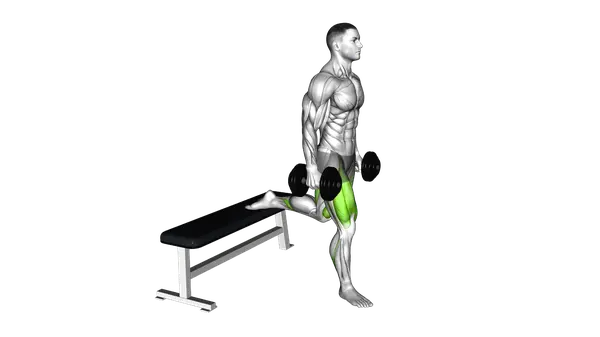
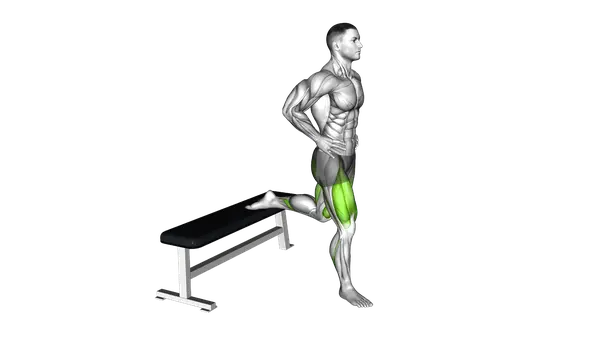
Dumbbell Single Leg Split Squat vs Bulgarian Split Squat
At a Glance
| Feature | Dumbbell Single Leg Split Squat | Bulgarian Split Squat |
|---|---|---|
| Primary muscles | Quads, Glutes | Quads, Glutes |
| Secondary muscles | Hamstrings | Hamstrings, Adductors, Erector Spinae |
| Equipment | Dumbbell | Bodyweight exercises |
| Difficulty | Intermediate | Intermediate |
| Type | Compound | Compound |
| Force | Leg | Leg |
01
Setup: the rear foot is the only change
In the dumbbell split squat, both feet stay on the floor in a long staggered stance, with a dumbbell in each hand at the sides. The body lowers straight down until the rear knee nearly touches the floor, then the front leg drives back up. The rear foot stays on the ball of the foot and helps with balance.
The Bulgarian split squat, also called the rear-foot-elevated split squat, uses the same stance with the top of the rear foot resting on a bench at roughly knee height. Elevating the rear foot removes most of the support the back leg can give and places the rear hip in a stretched, extended position. The dumbbell position and the vertical path of the hips stay the same.
02
Muscle emphasis: similar quads and glutes, more hamstrings
Both exercises use the quadriceps and gluteus maximus of the front leg as prime movers. When the split squat and the rear-foot-elevated split squat were each performed to failure at the same relative load, peak gluteus maximus and vastus lateralis activity did not differ between them [1].
The clearest difference is in the hamstrings. The elevated version produced higher biceps femoris activity than the floor split squat (76.1% versus 62.3% of maximal voluntary isometric contraction) and a higher hamstring-to-quadriceps activation ratio [1]. A second study using identical loads for both exercises found the same pattern, with biceps femoris activity higher in the elevated version during both the lowering and lifting phases [2].
03
How elevation shifts the load onto the front leg
With the rear foot on the floor, the back leg can push and share part of the work, particularly as the front leg fatigues. Elevating the rear foot largely removes that option. In a force-plate study of the rear-foot-elevated split squat, the front foot produced about 84% of total vertical force, and the rear foot contributed little beyond the weight of the leg itself [3].
The elevated rear leg also adds resistance: it generates a moment that acts against hip extension of the front leg, which increases the load the front hip extensors must overcome [4]. With the same external load, peak vertical force was higher in the elevated version than in the floor split squat [2]. This is why most lifters use noticeably lighter dumbbells for the Bulgarian split squat.
04
Balance, mobility and stance length
The floor split squat has a wider base of support, so balance rarely limits a set. This makes it the more practical version for beginners, for learning an upright torso and a controlled knee path, and for higher-rep sets where fatigue would otherwise break down form.
The Bulgarian split squat demands more single-leg balance and holds the rear hip in extension with the knee bent, which stretches the rectus femoris and hip flexors of the back leg. Lifters with limited hip-flexor length often need a lower bench. Stance length also changes the emphasis: in the split squat, longer steps increased hip extensor activity with a limited effect on the knee extensors, and a step roughly equal to leg length was identified as the most suitable default for strength training [5].
05
Split squat vs squat
The split squat is also often compared with the bilateral back squat. In an EMG study, split squats and rear-foot-elevated split squats loaded at 50% of the back squat load produced muscle activity similar to the back squat, with differences limited to the biceps femoris [2]. Each working leg receives a comparable stimulus with about half the external load on the body.
The back squat remains the better tool for maximal loading and for strength expressed in a two-legged lift. Split squat variations reduce the load the spine must support, train single-leg stability and expose side-to-side strength differences, which is why many programs include both.
The Bottom Line
Use the dumbbell split squat to learn the pattern, to train with heavier dumbbells and to accumulate quad and glute volume with little balance demand. Use the Bulgarian split squat when the goal is a higher load on the front leg with lighter dumbbells, more hamstring co-activation and a greater demand on the front hip extensors. Progress to the Bulgarian version once the floor split squat can be performed to full depth with a stable torso and consistent balance. Lifters with limited hip-flexor mobility get very similar quad and glute training from the floor version.
What is your fitness goal?
Pick one and the app builds your program around it, your equipment and the days you can train.
Good to know
Common Questions
Yes. Elevating the rear foot removes most of the support from the back leg, so the front leg carries nearly all of the load and balance is more demanding. Most lifters use lighter dumbbells for the Bulgarian split squat than for a floor split squat.
Studies comparing the two at the same relative load found similar gluteus maximus activity, with higher hamstring activity in the Bulgarian version. Glute emphasis in either exercise increases with a longer stance and a slight forward lean of the torso.
For building the quads and glutes, split squats cover most of what a bilateral squat provides, with roughly half the external load per working leg. For maximal strength in the barbell squat itself, the two-legged lift is more specific, so many programs use both.
Scientific References
-
[1]
Muscle Activation in Unilateral Barbell Exercises: Implications for Strength Training and Rehabilitation.
Mausehund L, Skard AE, Krosshaug T · Journal of strength and conditioning research (2019)
-
[2]
Muscle Activity in Single- vs. Double-Leg Squats.
DeForest BA, Cantrell GS, Schilling BK · International journal of exercise science (2014)
-
[3]
Is the Rear Foot Elevated Split Squat Unilateral? An Investigation Into the Kinetic and Kinematic Demands.
Helme M, Emmonds S, Low C · Journal of strength and conditioning research (2022)
-
[4]
Rear Leg-derived Moment Contributes to Resistance Against Hip Extension in Bulgarian Split Squats.
Arakawa H, Nakashima H, Li X et al. · International journal of exercise science (2025)
-
[5]
Effects of step lengths on biomechanical characteristics of lower extremity during split squat movement.
Song Q, Ma M, Liu H et al. · Frontiers in bioengineering and biotechnology (2023)
Sources are peer-reviewed academic publications from PubMed.
Exercises


































More Exercise Comparisons
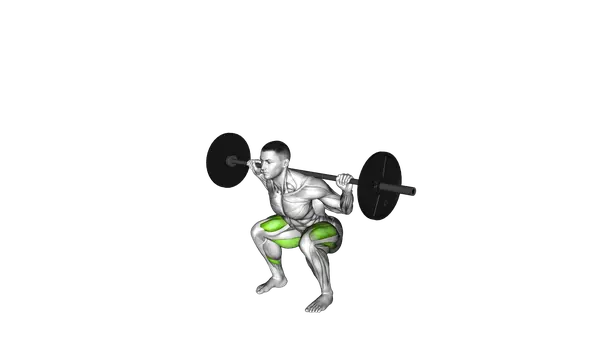
Squat vs Bulgarian Split Squat: Which One Should You Prioritize?
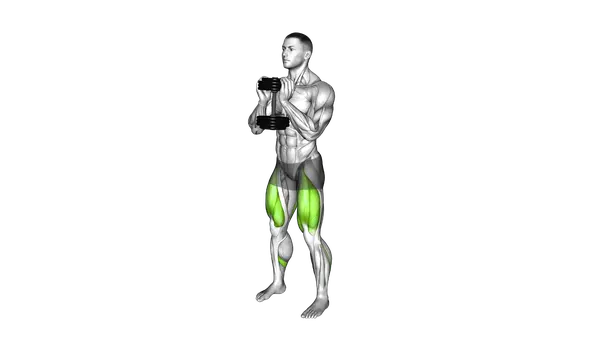
Goblet Squat vs Bulgarian Split Squat: Two Legs or One
Front Squat vs Back Squat: Where Should the Bar Go?
Squat vs Leg Press: Do You Really Need Both?
Goblet Squat vs Back Squat: Load Limits and When to Switch
Leg Extensions vs Squats: Can a Machine Replace the King?