Crunch
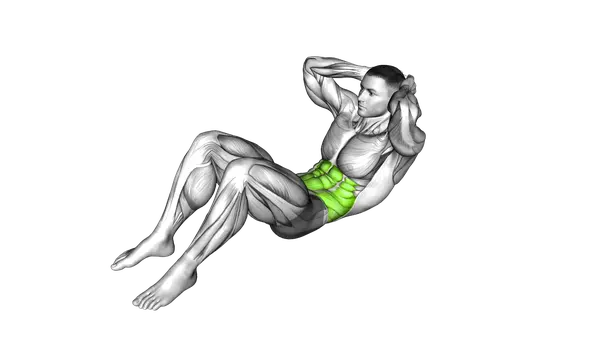
Shoulder blades off the floor, lower back down, chin slightly tucked. Exhale on the way up.
30-day challenge
A 30-day ab challenge trains the abdominal muscles with a fixed plan of exercises and repetitions for one month. The plan on this page rotates seven exercises over three workouts, with a rest day after every three training days and a test on day 1 and day 30. The sections below cover technique, variations, realistic results and the role of body fat.
Last updated:
Short answer
A 30-day ab challenge improves abdominal muscular endurance. In a six-week trial, seven ab exercises on five days a week raised curl-up scores to 47, against 32 in the control group. Belly fat and waist size did not change. Visible abs depend on body fat, which falls through an energy deficit, not through ab exercises.
A 30-day ab challenge is a month-long plan of abdominal exercises with a set number of repetitions per day that rises over time. This version uses three workouts: A (crunch, reverse crunch, dead bug), B (bicycle crunch, lying leg raise, hollow hold) and C (mountain climber, crunch, hollow hold). The workouts rotate in seven rounds, and each round is slightly harder than the one before.
The plan suits beginners and people who want a structured block of core work alongside other training. A session takes about 5 to 15 minutes, depending on the round. People with back complaints or a medical condition, and anyone who is pregnant or has recently given birth, should consult a doctor or physiotherapist before starting.
The chart lists the workout for each day: sets × repetitions per exercise, rest on days 4, 8, 12, 16, 20, 24 and 28, and a test on day 1 and day 30. Rounds 1 and 2 use two sets per exercise; from round 3 a third set is added and the numbers return to the starting level, after which they rise again by 2 repetitions or 5 seconds per round.
The structure follows the principle of progressive overload: the ACSM (American College of Sports Medicine) position stand states that progressive protocols are needed for continued adaptation, and for muscular endurance it recommends more than 15 repetitions per set with rest periods under 90 seconds [1]. The final rounds reach that range. A controlled trial used a similar setup: seven abdominal exercises, two sets of 10 repetitions, five days a week for six weeks [2].
| Day | Workout | Note |
|---|---|---|
| 1 | Test: crunches, then hollow hold | Write down both results |
| 2 | Crunch 2 × 10, reverse crunch 2 × 8, dead bug 2 × 6 per side | Round 1: 2 sets |
| 3 | Bicycle crunch 2 × 8 per side, lying leg raise 2 × 8, hollow hold 2 × 15 s | Round 1 |
| 4 | Rest | No ab training |
| 5 | Mountain climber 2 × 10 per side, crunch 2 × 10, hollow hold 2 × 15 s | Round 1 |
| 6 | Crunch 2 × 12, reverse crunch 2 × 10, dead bug 2 × 8 per side | Round 2: +2 reps, +5 s |
| 7 | Bicycle crunch 2 × 10 per side, lying leg raise 2 × 10, hollow hold 2 × 20 s | Round 2 |
| 8 | Rest | No ab training |
| 9 | Mountain climber 2 × 12 per side, crunch 2 × 12, hollow hold 2 × 20 s | Round 2 |
| 10 | Crunch 3 × 10, reverse crunch 3 × 8, dead bug 3 × 6 per side | Round 3: third set, round 1 numbers |
| 11 | Bicycle crunch 3 × 8 per side, lying leg raise 3 × 8, hollow hold 3 × 15 s | Round 3 |
| 12 | Rest | No ab training |
| 13 | Mountain climber 3 × 10 per side, crunch 3 × 10, hollow hold 3 × 15 s | Round 3 |
| 14 | Crunch 3 × 12, reverse crunch 3 × 10, dead bug 3 × 8 per side | Round 4: +2 reps, +5 s |
| 15 | Bicycle crunch 3 × 10 per side, lying leg raise 3 × 10, hollow hold 3 × 20 s | Round 4 |
| 16 | Rest | No ab training |
| 17 | Mountain climber 3 × 12 per side, crunch 3 × 12, hollow hold 3 × 20 s | Round 4 |
| 18 | Crunch 3 × 14, reverse crunch 3 × 12, dead bug 3 × 10 per side | Round 5: +2 reps, +5 s |
| 19 | Bicycle crunch 3 × 12 per side, lying leg raise 3 × 12, hollow hold 3 × 25 s | Round 5 |
| 20 | Rest | No ab training |
| 21 | Mountain climber 3 × 14 per side, crunch 3 × 14, hollow hold 3 × 25 s | Round 5 |
| 22 | Crunch 3 × 16, reverse crunch 3 × 14, dead bug 3 × 12 per side | Round 6: +2 reps, +5 s |
| 23 | Bicycle crunch 3 × 14 per side, lying leg raise 3 × 14, hollow hold 3 × 30 s | Round 6 |
| 24 | Rest | No ab training |
| 25 | Mountain climber 3 × 16 per side, crunch 3 × 16, hollow hold 3 × 30 s | Round 6 |
| 26 | Crunch 3 × 18, reverse crunch 3 × 16, dead bug 3 × 14 per side | Round 7: +2 reps, +5 s |
| 27 | Bicycle crunch 3 × 16 per side, lying leg raise 3 × 16, hollow hold 3 × 35 s | Round 7 |
| 28 | Rest | No ab training |
| 29 | Mountain climber 3 × 18 per side, crunch 3 × 18, hollow hold 3 × 35 s | Round 7 |
| 30 | Test: crunches, then hollow hold | Compare with day 1 |
Pick one and the app builds your program around it, your equipment and the days you can train.
Each exercise in the plan loads the abdominal muscles in a different way: by bending the spine, by lifting the pelvis or legs, or by keeping the trunk still while the arms and legs move. In the crunch, only the shoulder blades leave the floor and the lower back stays down; pulling on the head with the hands is a frequent error.
The dead bug and the hollow hold train the trunk to resist extension: the lower back stays pressed into the floor while the limbs move or stay extended. When the lower back lifts, the range is too large for the current level of strength.
The hollow hold becomes easier with bent knees and the arms beside the body, and harder with the arms extended overhead.
 Crunch Floor
View exercise →
Crunch Floor
View exercise →
 Reverse Crunch
View exercise →
Reverse Crunch
View exercise →
 Bicycle Crunch
View exercise →
Bicycle Crunch
View exercise →
 Lying Leg Raise
View exercise →
Lying Leg Raise
View exercise →
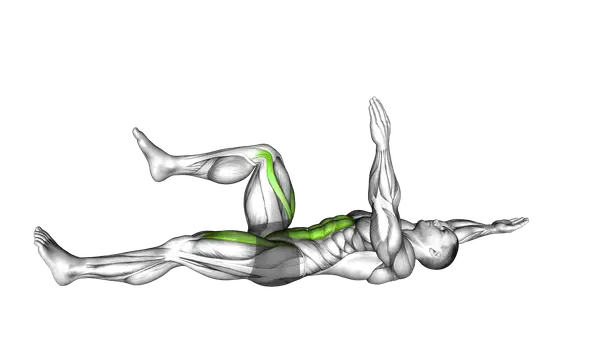 Dead Bug
View exercise →
Dead Bug
View exercise →
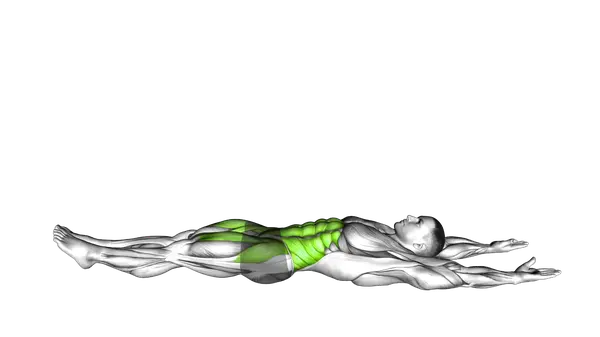 Hollow Hold
View exercise →
Hollow Hold
View exercise →
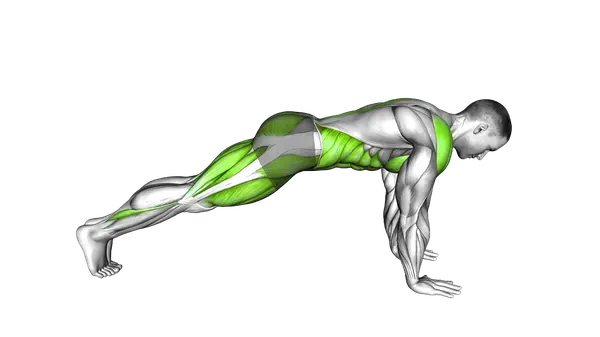 Mountain Climber
View exercise →
Mountain Climber
View exercise →
Shoulder blades off the floor, lower back down, chin slightly tucked. Exhale on the way up.
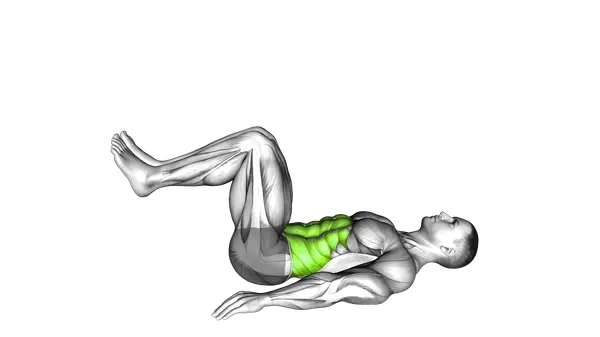
Knees bent at 90 degrees; curl the pelvis off the floor toward the ribs without swinging the legs.
Arms vertical, knees above the hips. Lower the opposite arm and leg slowly while the lower back stays on the floor.
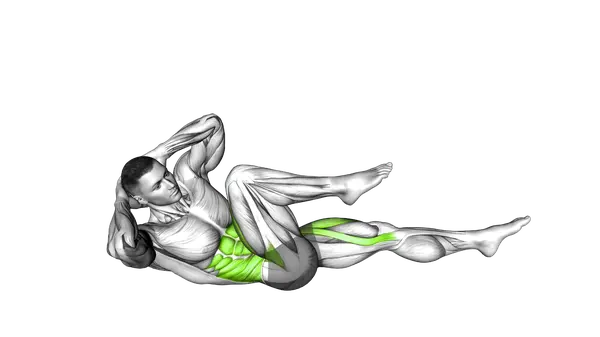
Rotate the shoulder toward the opposite knee; the movement comes from the trunk, not from pulling on the neck.
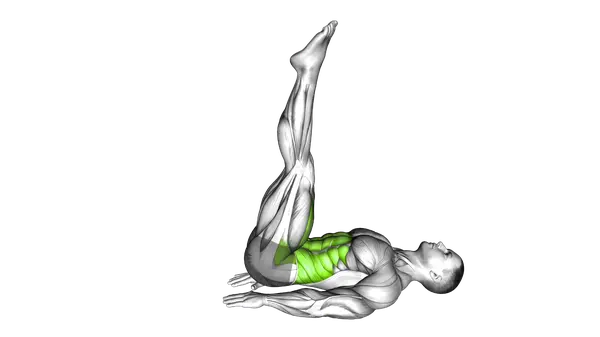
Legs straight or slightly bent, lowered only as far as the lower back stays flat. The hip flexors lift the legs; the abdominal muscles keep the pelvis still.
Shoulders and legs off the floor, lower back pressed down, body in a shallow curve.
High plank with the hands under the shoulders; drive the knees forward in turn without lifting the hips.
Every exercise in the plan can be adjusted by changing the lever or the range of motion. Easier versions bend the knees, shorten the range or move one limb at a time: a dead bug with only the legs moving, a leg raise with bent knees, a hollow hold with the arms beside the body.
Harder versions lengthen the lever, combine movements or add load. The V-up lifts the straight legs and the upper body at the same time, and flutter kicks keep the legs off the floor for the entire set. A small weight on the chest makes the crunch adjustable like other strength exercises; ACSM advises a load increase of 2–10% once one or two repetitions more than the target are possible [1].
The realistic result after 30 days is better abdominal endurance: more crunches in one set and a longer hollow hold on the day 30 test. In the six-week trial with seven abdominal exercises, the training group completed 47 curl-ups on average at the end, against 32 in the control group [2].
Trunk muscle strength also improves with core training. A meta-analysis of 16 intervention studies found a large effect of core strength training on trunk muscle strength, but only small to medium effects on broader measures of physical fitness and athletic performance [3]. A stronger core therefore does not automatically make someone faster or stronger in other exercises.
No, an ab challenge does not burn fat on the stomach specifically. In the six-week trial, the abdominal exercise group showed no change in body weight, body fat percentage, abdominal fat, waist circumference or abdominal skinfolds compared with the control group, with diet kept constant [2].
Other research points the same way. When 11 young adults trained one leg with very high repetitions for 12 weeks, total fat mass fell by 5.1%, but the fat loss occurred in the arms and trunk rather than in the trained leg [4].
One small trial did report a local effect: in 16 overweight men, sessions that combined treadmill running with loaded crunches and torso rotations, four days a week for ten weeks, reduced trunk fat by 697 g more than running alone, while total fat loss was similar in both groups [5]. That workload is far larger than a 30-day ab challenge.
Abs become visible when the layer of fat over the abdominal muscles is thin enough, so visibility depends mainly on body fat percentage, and body fat falls through an energy deficit. The ACSM position stand on weight loss concludes that resistance training does not enhance weight loss by itself but may increase fat-free mass and fat loss, and that 150 to 250 minutes of moderate activity per week produces only modest weight loss [6].
Full-body strength training does lower body fat over time: a meta-analysis of randomized trials found a reduction of 1.46 percentage points in body fat and 0.55 kg in fat mass compared with no exercise [7]. How much energy training uses is covered in calories burned during strength training.
How to lose fat while keeping muscle in the weeks before summer is described in the summer shred guide.
After day 30, abdominal exercises work best as part of a full training week. A systematic review of EMG (electromyography) studies found the highest activity of the rectus abdominis, external oblique and erector spinae during free-weight exercises, not during isolated core exercises [8].
The WHO recommends muscle-strengthening activity that involves all major muscle groups on two or more days a week [9]. Ready-made workout routines cover that, and two or three short core sessions a week continue the progression from the challenge.
For static core work, the 30-day plank challenge follows the same structure with holds instead of repetitions.
Good to know
They work for abdominal endurance and strength: more repetitions and longer holds after a month of structured training. They do not work for losing belly fat. In a six-week trial with seven ab exercises on five days a week, curl-up scores rose while waist circumference and abdominal fat stayed the same.
Only if body fat is already low. The abdominal muscles get stronger in 30 days, but whether they are visible depends on the layer of fat over them. Losing that fat takes an energy deficit over a longer period; abdominal exercises alone did not reduce belly fat in controlled trials.
Daily ab training is possible at low volume, but this plan includes a rest day after every three training days, so the muscles recover between rounds. Persistent pain in the lower back or neck during crunches or leg raises is a reason to stop and have the technique checked.
No single exercise covers every function of the abdominal muscles. Crunches bend the spine, leg raises and reverse crunches move the pelvis, and dead bugs and hollow holds resist extension. In EMG studies, free-weight exercises produced the highest activity of several trunk muscles, which is why full-body strength training complements ab work.
This plan starts at two sets of 6 to 10 repetitions per exercise and ends, after seven rounds, at three sets of 14 to 18; those numbers are a design choice. The right starting point is a number that can be completed with clean form and the lower back under control.
No. All seven exercises use body weight only and fit on a mat at home. A small weight for the crunch becomes useful after the challenge, when bodyweight exercises no longer provide enough resistance for further progress. A firm, non-slip surface is enough for every workout in the chart.
Both challenges train the same muscle groups. Doing them on the same days doubles the load on the abdominal muscles; alternating them, or doing the plank challenge after the ab challenge, keeps the volume manageable. Combining the ab challenge with a push-up or squat challenge is simpler, because those train other muscle groups.
Rest days give the muscles time to recover so that the next round can start at a slightly higher level. The plan places a rest day after every three training days and gets harder only once per round of three workouts, following the principle that load should rise in small steps.
Sources

































