30-day challenge
30-Day Push-Up Challenge: Chart, Starting Test and Progression
The 30-day push-up challenge on this page starts with a test of how many strict push-ups you can do in one set. Every training day after that is a percentage of that number, so the same chart works for someone who manages 8 push-ups and for someone who manages 40. The plan has 18 training days, 12 rest days and tests on days 1, 15 and 30.
Last updated:
Short answer
A 30-day push-up challenge works best when the daily target is based on a starting test instead of a fixed number. Do one set of as many strict push-ups as possible, then train four days a week with sets of 40 to 65% of that maximum, and retest on day 15 and day 30.
- training days
- 18
- rest days
- 12
- of your max per set
- 40–65%
What is a 30-day push-up challenge?
A 30-day push-up challenge is a training plan in which the number of push-ups rises step by step over one month. Many versions prescribe the same fixed numbers for everyone, which makes them too easy for some people and too hard for others.
The chart on this page scales to the individual. A starting test sets the maximum, and every session is a number of sets at a percentage of that maximum. This applies progressive overload: the training demand increases over time, which the American College of Sports Medicine (ACSM) describes as necessary for further adaptation [1]. With body weight as a fixed load, progression comes from more repetitions, more sets and, later, harder variants.
The plan trains one movement pattern: horizontal pressing with the chest, front shoulders and triceps. It is a focused block within strength training, not a replacement for a complete programme.
Who is the push-up challenge suitable for?
The challenge suits healthy adults who can do at least a few push-ups with correct form, or who start with an easier variant. It is less suitable for people with shoulder, elbow or wrist complaints. People with a medical condition or a recent injury, and pregnant women, should consult a doctor or physiotherapist before starting.
The plan has four training days per week. ACSM recommends 2–3 training days per week for novices and 3–4 for intermediate trainees [1]. Someone without training experience can add an extra rest day after each pair of training days; the 18 sessions then take about six weeks.
What is your fitness goal?
Pick one and the app builds your program around it, your equipment and the days you can train.
How do you do the starting test?
The starting test is one set of as many push-ups as possible with strict form, after a short warm-up. The set ends at the first repetition that does not meet the standard: chest lowered to about a fist's height above the floor, arms fully extended at the top and the body in a straight line from head to heels.
The test result is the maximum for days 2–14; the retest on day 15 replaces it for days 16–29. Percentages are rounded down. With fewer than 8 strict push-ups, the test and the whole plan are done with an easier variant, because the sets would otherwise be only two or three repetitions long.
| Max in test | 40% | 50% | 60% | 65% |
|---|---|---|---|---|
| 8 | 3 | 4 | 4 | 5 |
| 12 | 4 | 6 | 7 | 7 |
| 16 | 6 | 8 | 9 | 10 |
| 20 | 8 | 10 | 12 | 13 |
| 30 | 12 | 15 | 18 | 19 |
| 40 | 16 | 20 | 24 | 26 |
30-day push-up challenge chart
The chart lists all 30 days. Each training day shows the number of sets and the percentage of the most recent test; rest days contain no push-ups. Rest between sets is 1–2 minutes, the interval ACSM recommends for training aimed at muscle growth [1].
Volume rises from 1.6 times the maximum per session in the first week to 3 times the maximum on day 26. The retest on day 15 adjusts the targets to the new level, so the load stays relative to current capacity. The last sets of a session may come close to failure. A repetition that no longer meets the standard ends the set.
| Day | Target | Note |
|---|---|---|
| 1 | Test: 1 set, max reps | Strict form; this number is your max |
| 2 | 4 × 40% | 1–2 min rest between sets |
| 3 | Rest | No push-ups |
| 4 | 4 × 45% | Same rest interval |
| 5 | 5 × 40% | One extra set |
| 6 | Rest | No push-ups |
| 7 | Rest | No push-ups |
| 8 | 4 × 50% | Higher reps per set |
| 9 | 5 × 45% | Five sets |
| 10 | Rest | No push-ups |
| 11 | 4 × 55% | Last set may be hard |
| 12 | 5 × 50% | Highest volume of week 2 |
| 13 | Rest | No push-ups |
| 14 | Rest | Two rest days before the retest |
| 15 | Retest: 1 set, max reps | New max for days 16–29 |
| 16 | 4 × 45% | Based on the new max |
| 17 | Rest | No push-ups |
| 18 | 4 × 50% | 1–2 min rest between sets |
| 19 | 5 × 50% | Five sets |
| 20 | Rest | No push-ups |
| 21 | Rest | No push-ups |
| 22 | 4 × 60% | Higher reps per set |
| 23 | 5 × 55% | Five sets |
| 24 | Rest | No push-ups |
| 25 | 4 × 65% | Heaviest sets of the plan |
| 26 | 5 × 60% | Highest volume of the plan |
| 27 | Rest | No push-ups |
| 28 | 3 × 50% | Light session |
| 29 | Rest | Rest before the final test |
| 30 | Final test: 1 set, max reps | Compare with day 1 |
How do you do a push-up with correct form?
A correct push-up starts in a high plank: hands slightly wider than shoulder width, directly under the shoulders, legs extended and the body in one line from head to heels. The trunk stays tense so the hips neither sag nor rise.
During the lowering phase the elbows point diagonally backwards rather than straight out to the sides. The chest descends to about a fist's height above the floor, then the arms push the body back up until the elbows are extended. The head stays in line with the spine.
Common errors are sagging hips, half repetitions and a head that reaches the floor before the chest. Training repetitions must meet the same standard as the test, so that day 1 and day 30 can be compared.
Easier and harder push-up variants
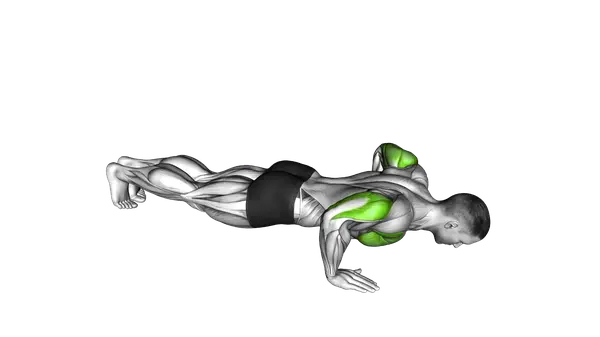
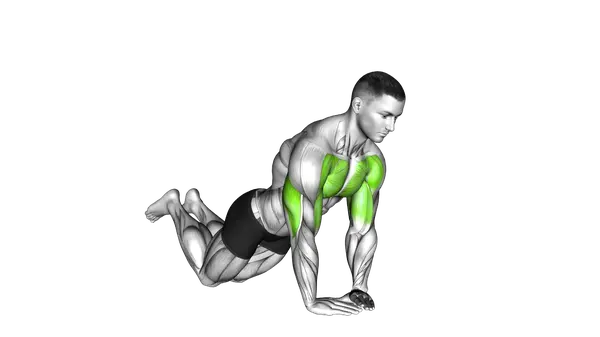
In a force-plate study of 23 recreationally active adults, push-ups with the hands elevated and push-ups from the knees produced lower ground reaction forces than a standard push-up [2]. Easier options are push-ups with the hands on a bench or table, knee push-ups and the diamond push-up on knees, which combines the knee position with a narrow hand position.
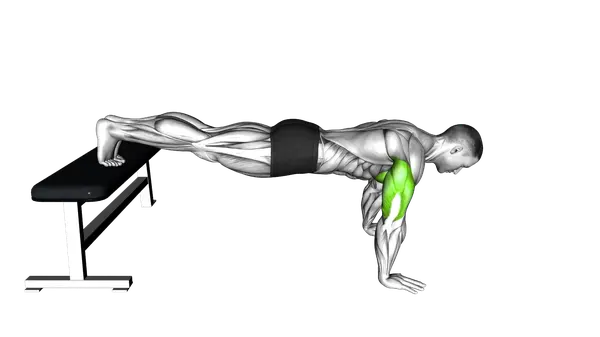
The decline push-up places the feet on a box or bench. In the same study, push-ups with the feet elevated produced higher forces than every other variant tested [2].
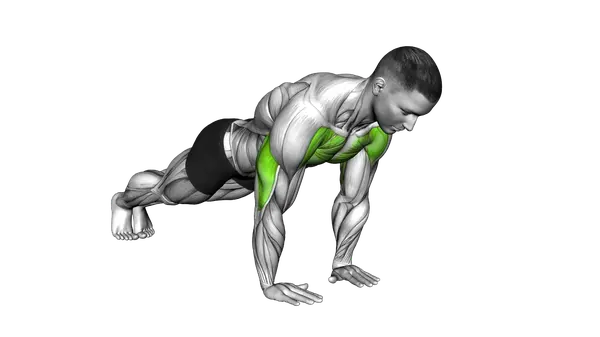
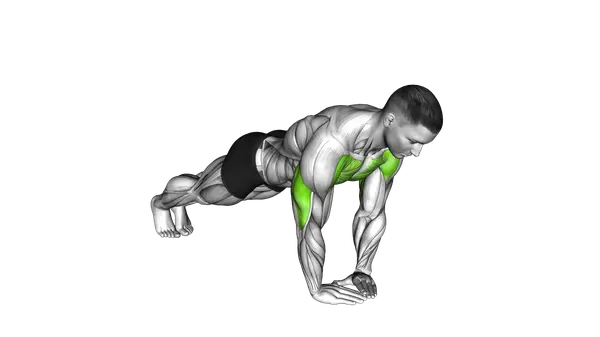
In the diamond push-up the hands are close together under the chest. In a study of 40 adults, a narrow hand position produced more electrical muscle activity (EMG) in the pectoralis major and triceps than a wide hand position [3].
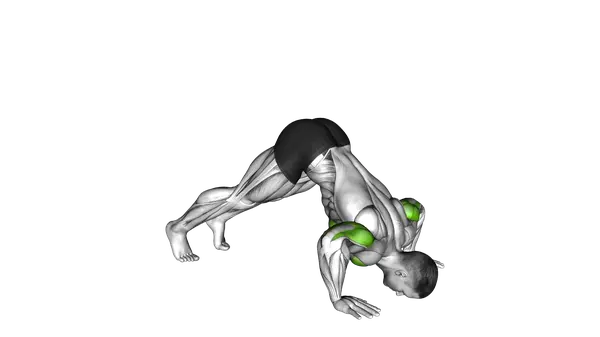
The pike push-up is done with the hips raised high, so the body forms an inverted V. The pressing direction moves closer to overhead, which shifts the exercise toward the shoulders. When switching variants, a new starting test sets the maximum for that variant.
What results are realistic after 30 days?
In 30 days, more repetitions and a measurable gain in strength are realistic; measurable muscle growth is less likely. In a study of 23 moderately trained men, four weeks of progressive push-up training, three sessions per week, increased the one-repetition maximum (1RM) on the bench press, as did bench press training, while muscle thickness did not change significantly in either group [4].
Longer studies do show muscle growth. In 18 young men, eight weeks of push-ups twice a week, adjusted (for example on the knees) to a load equal to 40% of the bench press 1RM, increased pectoralis major and triceps thickness as much as bench pressing at 40% 1RM; bench press 1RM rose from 61.1 to 64.2 kg [5]. In a study of 30 experienced university students, five weeks of push-ups with an elastic band at a 6-repetition maximum (6RM) produced strength gains similar to the 6RM bench press [6].
A 30-day challenge is shorter than most of these studies, so the gain in the final test mainly reflects strength and repetition capacity.
Is doing 100 push-ups a day a good idea?
Doing 100 push-ups a day is a popular version of the challenge, but no study has tested it as a protocol. It has two weaknesses: there are no rest days, and the target stays the same once it has been reached. ACSM recommends 2 to 5 training days per week, depending on training experience [1].
For someone who can do 30 push-ups in a row, 100 repetitions spread over many short sets means sets that end far from failure. In a study of knee extensions at 30% of 1RM, low-load sets stopped well short of failure did not significantly increase quadriceps size (2.8%), whereas the same load taken to failure did (7.8%) [7].
How close to failure a set should end is covered in training to failure and muscle growth. A fixed daily number can work as a habit; for gains in strength or muscle size, rising demands with rest days match the evidence better.
Is push-up capacity linked to health?
In one cohort, higher push-up capacity was associated with fewer cardiovascular events. Among 1,104 male firefighters followed for 10 years, men who completed more than 40 push-ups had an incidence rate ratio of 0.04 for cardiovascular events compared with men who managed fewer than 10 [8]. That corresponds to about 96% fewer events, based on 37 events in total.
The study shows an association, not cause and effect, and included only active men in one occupation. The authors describe push-up capacity as a possible simple measure of functional status [8]; the study does not show that training push-ups lowers the risk.
The World Health Organization (WHO) recommends muscle-strengthening activities of at least moderate intensity that involve all major muscle groups on two or more days a week [9]. Push-ups cover the chest, shoulders and triceps; legs, back and trunk need other exercises.
What should you do after day 30?
The final test on day 30 sets the new maximum. If it is clearly higher than on day 1, the chart can be repeated with the new number. Once sets regularly exceed 15 repetitions, the training shifts toward what ACSM describes as local muscular endurance; for muscle growth, ACSM emphasises loads that allow 6 to 12 repetitions [1]. A harder variant brings the repetitions back into that range.
A logical next step is a workout routine that trains all major muscle groups at least twice a week, with push-ups or the bench press as the pressing exercise.
Good to know
Frequently asked questions about the push-up challenge
Push-ups can be done daily, but training every day without rest days does not match common recommendations. ACSM advises 2 to 3 training days per week for beginners, 3 to 4 for intermediate and 4 to 5 for advanced trainees. The chart on this page uses four training days and three rest days in most weeks.
Start with push-ups with the hands on a table, kitchen counter or wall. Raising the hands reduces the force the arms have to produce. Do the starting test with that variant and follow the chart; once more than 15 repetitions are possible, a lower surface or knee push-ups are the next step.
Yes, when the sets are hard enough. In an eight-week study, push-ups adjusted to a load of 40% of the bench press maximum increased chest and triceps thickness as much as bench pressing with the same load. In a four-week study, strength increased but muscle thickness did not change measurably.
Push-ups mainly train the pectoralis major, the front of the shoulders (anterior deltoids) and the triceps. The trunk muscles work to keep the body in a straight line. A narrow hand position produces more chest and triceps activity than a wide hand position, as measured with EMG.
One to two minutes between sets suits this challenge. That is the rest interval ACSM gives for training aimed at muscle growth. On test days, a proper warm-up and a rested start matter most, because the test consists of a single maximal set.
Yes. The chart is based on each person's own starting test, so it works regardless of sex or starting level. In a force-plate study of push-up variants, men and women responded the same way to the different variants. With fewer than 8 strict push-ups, an easier variant is the starting point.
Yes. The percentages only make sense when the test and the training use the same variant. When switching from knee push-ups to standard push-ups, or from standard push-ups to decline push-ups, a new starting test sets the maximum for that variant and the chart starts again from day 2.
Sources
- American College of Sports Medicine. American College of Sports Medicine position stand. Progression models in resistance training for healthy adults. Med Sci Sports Exerc. 2009;41(3):687-708.
- Ebben WP, Wurm B, VanderZanden TL, et al. Kinetic analysis of several variations of push-ups. J Strength Cond Res. 2011;25(10):2891-2894.
- Cogley RM, Archambault TA, Fibeger JF, et al. Comparison of muscle activation using various hand positions during the push-up exercise. J Strength Cond Res. 2005;19(3):628-633.
- Kotarsky CJ, Christensen BK, Miller JS, et al. Effect of Progressive Calisthenic Push-up Training on Muscle Strength and Thickness. J Strength Cond Res. 2018;32(3):651-659.
- Kikuchi N, Nakazato K. Low-load bench press and push-up induce similar muscle hypertrophy and strength gain. J Exerc Sci Fit. 2017;15(1):37-42.
- Calatayud J, Borreani S, Colado JC, et al. Bench press and push-up at comparable levels of muscle activity results in similar strength gains. J Strength Cond Res. 2015;29(1):246-253.
- Lasevicius T, Schoenfeld BJ, Silva-Batista C, et al. Muscle Failure Promotes Greater Muscle Hypertrophy in Low-Load but Not in High-Load Resistance Training. J Strength Cond Res. 2022;36(2):346-351.
- Yang J, Christophi CA, Farioli A, et al. Association Between Push-up Exercise Capacity and Future Cardiovascular Events Among Active Adult Men. JAMA Netw Open. 2019;2(2):e188341.
- Bull FC, Al-Ansari SS, Biddle S, et al. World Health Organization 2020 guidelines on physical activity and sedentary behaviour. Br J Sports Med. 2020;54(24):1451-1462.

































