30-day challenge
30-Day Squat Challenge: Chart, Variants and Progression
The 30-day squat challenge on this page combines bodyweight squats with variants such as sumo squats, lunges, jump squats and Bulgarian split squats. The first two weeks add repetitions; the last two weeks make the exercises harder instead. The plan has 18 training days and 12 rest days, with a test on day 1 and on day 30.
Last updated:
Short answer
A 30-day squat challenge works best with rest days and a progression that moves from more repetitions to harder variants. The chart below has 18 training days and 12 rest days, starts at 3 sets of 15 bodyweight squats and ends with tempo squats and Bulgarian split squats. Squats build muscle when sets end close to failure.
- training days
- 18
- rest days
- 12
- squats on day 15
- 100
What is a 30-day squat challenge?
A 30-day squat challenge is a plan in which the number or difficulty of squats increases over one month. Many popular versions add repetitions every day until a high daily number is reached, without rest days.
This plan follows the principle of progressive overload: the training demand rises over time, which the American College of Sports Medicine (ACSM) describes as necessary for further adaptation [1]. For loaded exercises, ACSM recommends increasing the load by 2–10% once one or two repetitions more than the target are possible [1]. Body weight cannot be increased that way, so the plan raises the repetitions in the first two weeks and switches to harder variants in the last two.
Who is the squat challenge suitable for?
The challenge suits beginners and people returning to training who can squat with body weight to at least parallel depth without pain. People with a medical condition, knee or hip complaints, and pregnant women should consult a doctor or physiotherapist before starting.
The plan has four training days per week and never more than two in a row. ACSM recommends 2–3 training days per week for novices and 3–4 for intermediate trainees [1]. Someone without training experience can add an extra rest day after each pair of training days; the 18 sessions then take about six weeks.
What is your fitness goal?
Pick one and the app builds your program around it, your equipment and the days you can train.
30-day squat challenge chart
The chart lists all 30 days with the exercise, sets and repetitions. Rest between sets is 1–2 minutes, the interval ACSM recommends for training aimed at muscle growth [1]. 'Squats' means bodyweight squats; 'per leg' means the repetitions are done on each side.
Total volume rises from 45 repetitions on day 2 to 100 on day 15. From day 16 the number of repetitions drops while the difficulty rises: tempo squats with a slow lowering phase and a pause, Bulgarian split squats and jump squats. With more than 50 squats in the starting test, the tempo (3 seconds down, 1 second pause) can be used on all squat days from day 2; with fewer than 20, the repetitions are halved.
| Day | Target | Note |
|---|---|---|
| 1 | Test: 1 set, max squats | Stop when depth or form breaks down |
| 2 | 3 × 15 squats | 1–2 min rest between sets |
| 3 | Rest | No squats |
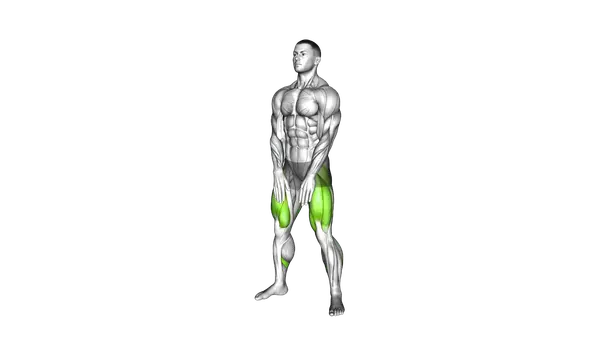
| 4 | 3 × 12 sumo squats | Wide stance, fingertips to the floor |
| 5 | 4 × 15 squats | One extra set |
| 6 | Rest | No squats |
| 7 | Rest | No squats |
| 8 | 4 × 18 squats | More reps per set |
| 9 | 3 × 10 forward lunges per leg | Alternate legs or complete one side first |
| 10 | Rest | No squats |
| 11 | 4 × 20 squats | 80 reps in total |
| 12 | 3 × 10 jump squats | Land softly, reset between reps |
| 13 | Rest | No squats |
| 14 | Rest | No squats |
| 15 | 5 × 20 squats | 100 reps in total |
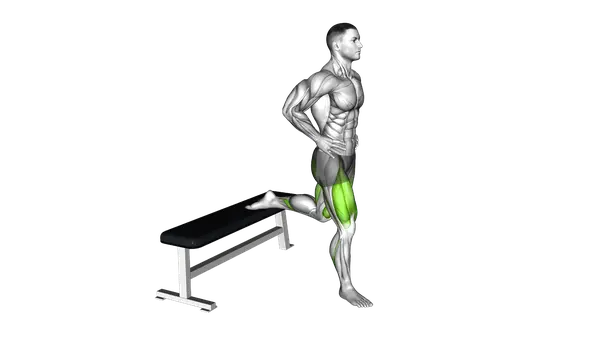
| 16 | 3 × 8 Bulgarian split squats per leg | Rear foot on a bench or chair |
| 17 | Rest | No squats |
| 18 | 4 × 12 tempo squats | 3 s down, 1 s pause at the bottom |
| 19 | 3 × 15 sumo squats | Slow lowering phase |
| 20 | Rest | No squats |
| 21 | Rest | No squats |
| 22 | 4 × 15 tempo squats | 3 s down, 1 s pause at the bottom |
| 23 | 3 × 10 Bulgarian split squats per leg | Same depth on both legs |
| 24 | Rest | No squats |
| 25 | 4 × 10 jump squats | Land softly, reset between reps |
| 26 | 5 × 12 tempo squats | Highest tempo volume |
| 27 | Rest | No squats |
| 28 | 3 × 12 Bulgarian split squats per leg | Last variant day |
| 29 | Rest | Rest before the final test |
| 30 | Final test: 1 set, max squats | Compare with day 1 |
How do you do a bodyweight squat correctly?
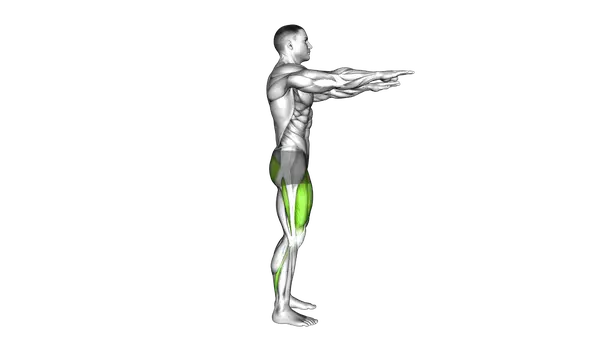
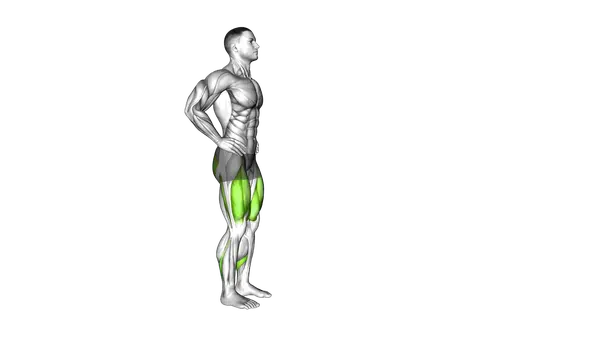
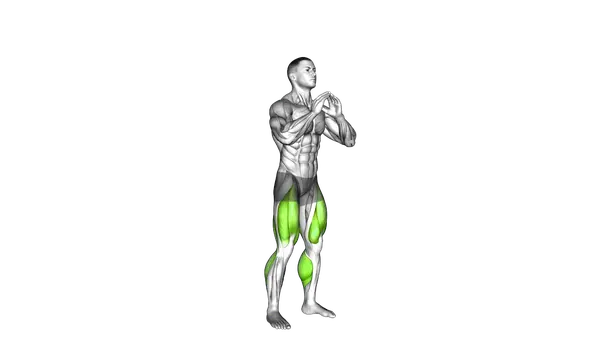
A correct bodyweight squat starts with the feet about shoulder width apart and the toes turned slightly outward. The hips move back and down while the knees travel forward in the direction of the toes. The heels stay on the floor and the chest stays upright.
Depth affects which muscles grow. In a 10-week study of 17 men doing loaded squats, full squats increased the volume of the gluteus maximus by 6.7% and of the adductors by 6.2%, against 2.2% and 2.7% with half squats; the knee extensors grew similarly in both groups [2]. In this challenge, a repetition counts when the thighs reach at least parallel to the floor.
Common errors are lifting heels, knees collapsing inward and a rounding lower back at the bottom. If full depth is not yet possible without these errors, squatting to a chair or box keeps the depth consistent.
Easier and harder squat variants
Easier variants reduce depth or add support, such as squatting to a chair or holding a door frame. The sumo squat with floor touch uses a wide stance with the toes turned out and the fingertips touching the floor at the bottom, which gives a clear depth target.
The forward lunge puts more load on the front leg in each repetition and adds a balance component. It prepares for single-leg squats.
The Bulgarian split squat places the rear foot on a bench, so the front leg carries most of the body weight. In a six-week study of 13 sedentary young women, a progressive bodyweight programme that moved from two-legged to single-legged exercises increased leg strength and muscle thickness, with no significant difference from barbell back squats at 60–80% of the one-repetition maximum (1RM) [3].
The jump squat adds a jump at the top of each repetition. ACSM describes fast movements with light loads, 0–60% of 1RM for lower-body exercises, as one route to training power [1]. Soft landings and a full reset between repetitions keep each jump controlled.
Do bodyweight squats build muscle?
Bodyweight squats build muscle when the sets end close to failure. A meta-analysis of 21 studies in which all sets were taken to failure found similar muscle growth with low loads (60% of 1RM or less) and high loads, while 1RM strength increased more with high loads [4].
With low loads, effort matters more than with heavy loads. In an eight-week study, knee extensions at 30% of 1RM taken to failure increased quadriceps size by 7.8%, whereas the same load stopped well before failure gave 2.8%, which was not significant; at 80% of 1RM, going to failure added nothing [5]. A series of meta-regressions also found that muscle growth increased as sets ended closer to failure [6].
For a squat challenge this means that repetitions which stay easy until the end of the set contribute little to muscle growth. The harder variants in the second half of the plan bring the sets closer to failure without endless repetitions.
What results are realistic after 30 days?
After 30 days, more repetitions in the final test, better depth and somewhat more leg strength are realistic; a clear change in muscle size or body fat is not. In the six-week study of sedentary young women, the progressive bodyweight programme increased strength and muscle thickness, but body fat percentage did not change (24.2% before, 24.0% after); in the barbell group it fell [3].
Most studies that measure muscle growth last six weeks or longer; the meta-analysis on low and high loads only included studies of at least six weeks [4]. A 30-day challenge is therefore a starting point, and the long-term result depends on the training that follows.
Is doing 100 squats a day a good idea?
Doing 100 squats a day is a popular challenge, but it has not been tested as a protocol. It lacks rest days and progression: the target stays at 100 once it has been reached. ACSM recommends 2 to 5 training days per week, depending on training experience [1].
For someone who can already do 40 or 50 squats in a row, 100 repetitions spread over the day are sets that end far from failure. With low loads, such sets produced no significant muscle growth in the study by Lasevicius and colleagues [5]. The plan on this page contains 100 squats once, on day 15, and then raises the difficulty instead of the number.
The World Health Organization (WHO) recommends muscle-strengthening activities that involve all major muscle groups on two or more days a week, and also advises limiting sedentary time [7]. Squats cover the legs and hips; the upper body and trunk need other exercises.
When should you switch to loaded squats?
Loaded squats make sense once bodyweight sets need more than about 15 repetitions to become demanding, or when the goal is maximum strength. ACSM classifies sets of more than 15 repetitions as local muscular endurance training and emphasises 6–12 repetitions for muscle growth [1]; heavy loads also produced greater 1RM gains than light loads [4].
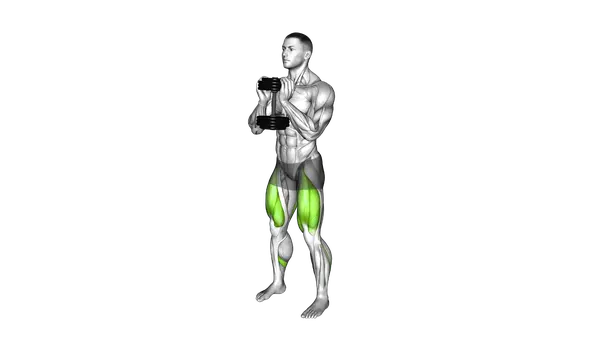
The dumbbell goblet squat is a common next step. The dumbbell is held at the chest, which keeps the torso upright, and the weight can be increased in small steps.
The barbell squat allows the heaviest loads. ACSM's guideline of raising the load by 2–10% once one or two extra repetitions are possible can then be applied directly [1].
What should you do after day 30?
After the final test there are three options: repeat the plan with the tempo on all squat days, continue with loaded squats, or move to a complete workout routine that also trains the upper body and trunk. The comparison between day 1 and day 30 shows how much the repetition capacity has changed and which option fits.
Good to know
Frequently asked questions about the squat challenge
Squats can be done daily, but common recommendations include rest days. ACSM advises 2 to 3 training days per week for beginners, 3 to 4 for intermediate and 4 to 5 for advanced trainees. The chart on this page has four training days per week and never more than two training days in a row.
Squats mainly train the quadriceps, the gluteus maximus and the adductors on the inner thigh. In a study with loaded full squats, these muscles grew, while the hamstrings and the rectus femoris, one of the four quadriceps muscles, did not change in volume. The calves and trunk muscles stabilise the movement.
Squats can increase the size of the gluteus maximus, especially with full depth. In a 10-week study with loaded squats, gluteus maximus volume increased by 6.7% with full squats and by 2.2% with half squats. Bodyweight squats only produce comparable effects when the sets end close to failure.
For this challenge, at least until the thighs are parallel to the floor, with the heels down, a neutral lower back and the knees in line with the toes. In a study with loaded squats, full squats produced more growth of the gluteus maximus and adductors than half squats did.
A squat challenge alone has little measurable effect on body fat in the short term. In a six-week study of sedentary young women, a progressive bodyweight programme did not change body fat percentage (24.2% before, 24.0% after), whereas barbell squat training lowered it. The study was small, with 13 participants.
Jump squats and regular squats train different qualities. Jump squats are a power exercise: a fast movement with a light load, a type of training ACSM describes for improving power. Regular and tempo squats are easier to bring close to failure with controlled form, so the chart uses jump squats on two days only.
One to two minutes between sets suits this challenge; that is the interval ACSM recommends for training aimed at muscle growth. For explosive exercises such as jump squats, ACSM's power recommendations use longer rest of 3 to 5 minutes between sets, so that every repetition can be performed at full speed.
Sources
- American College of Sports Medicine. American College of Sports Medicine position stand. Progression models in resistance training for healthy adults. Med Sci Sports Exerc. 2009;41(3):687-708.
- Kubo K, Ikebukuro T, Yata H. Effects of squat training with different depths on lower limb muscle volumes. Eur J Appl Physiol. 2019;119(9):1933-1942.
- Wei W, Zhu J, Ren S, et al. Effects of progressive body-weight versus barbell back squat training on strength, hypertrophy and body fat among sedentary young women. Sci Rep. 2023;13(1):13505.
- Schoenfeld BJ, Grgic J, Ogborn D, et al. Strength and Hypertrophy Adaptations Between Low- vs. High-Load Resistance Training: A Systematic Review and Meta-analysis. J Strength Cond Res. 2017;31(12):3508-3523.
- Lasevicius T, Schoenfeld BJ, Silva-Batista C, et al. Muscle Failure Promotes Greater Muscle Hypertrophy in Low-Load but Not in High-Load Resistance Training. J Strength Cond Res. 2022;36(2):346-351.
- Robinson ZP, Pelland JC, Remmert JF, et al. Exploring the Dose-Response Relationship Between Estimated Resistance Training Proximity to Failure, Strength Gain, and Muscle Hypertrophy: A Series of Meta-Regressions. Sports Med. 2024;54(9):2209-2231.
- Bull FC, Al-Ansari SS, Biddle S, et al. World Health Organization 2020 guidelines on physical activity and sedentary behaviour. Br J Sports Med. 2020;54(24):1451-1462.

































