30-day challenge
30-day plank challenge: chart, form and realistic results
A 30-day plank challenge raises the time spent in a front plank in small steps over one month. The chart on this page starts with three 20-second holds and ends with four 60-second holds, with four rest days, four side-plank days and a test on day 1 and day 30. The sections below cover form, variations, typical plank times and realistic results.
Last updated:
Short answer
A 30-day plank challenge reliably improves one thing: how long you can hold a plank. In studies, core training produces large gains in trunk muscle strength and also improves balance and jumping. It does not burn belly fat locally: in a controlled trial, six weeks of abdominal exercises changed neither abdominal fat nor waist circumference.
- days, 4 of them rest
- 30
- per set, day 2 to day 19
- 20→60 s
- mean maximal plank, adults
- 145 s
What is a 30-day plank challenge?
A 30-day plank challenge is a short program in which the front plank, a hold on the forearms and toes with the body in a straight line, is held a little longer every few days. It needs no equipment and takes a few minutes a day. Isometric muscle actions, in which a muscle produces force without changing length, are one of the three types of muscle action the ACSM (American College of Sports Medicine) includes in strength programs [1].
The challenge suits beginners and people who train regularly but rarely do core work. The chart assumes a first hold of at least 20 seconds; below that, the same chart works with a knee plank. People with high blood pressure, heart disease or back complaints, and anyone who is pregnant, should consult a doctor or physiotherapist before starting.
30-day plank challenge chart
The chart gives one target per day: front plank sets in seconds, side planks on days 4, 10, 17 and 23, rest on days 7, 14, 21 and 27, and a maximal hold on day 1 and day 30. Total holding time rises from 60 seconds on day 2 to 240 seconds on day 26. Single sets stop at 60 seconds; after that, the chart adds a fourth set.
The steps follow the principle of progressive overload. The ACSM position stand states that progressive protocols are needed to keep stimulating adaptation and advises raising the load only once the current workload can be exceeded; for muscular endurance it recommends short rest periods of under 90 seconds [1]. The chart applies that logic to time: 5 seconds more per set, and a repeat day whenever a set ends early because the form breaks.
| Day | Target | Note |
|---|---|---|
| 1 | Test: 1 front plank, as long as possible | Stop when the hips sag or rise; write down the time |
| 2 | 3 × 20 s front plank | 30–60 s rest between sets |
| 3 | 3 × 25 s front plank | +5 s per set |
| 4 | 2 × 15 s side plank per side | Side-plank day |
| 5 | 3 × 30 s front plank | +5 s per set |
| 6 | 3 × 30 s front plank | Repeat |
| 7 | Rest | No planks |
| 8 | 3 × 35 s front plank | +5 s per set |
| 9 | 3 × 40 s front plank | +5 s per set |
| 10 | 2 × 20 s side plank per side | Side-plank day |
| 11 | 3 × 40 s front plank | Repeat |
| 12 | 3 × 45 s front plank | +5 s per set |
| 13 | 3 × 50 s front plank | +5 s per set |
| 14 | Rest | No planks |
| 15 | 3 × 50 s front plank | Repeat after the rest day |
| 16 | 3 × 55 s front plank | +5 s per set |
| 17 | 2 × 25 s side plank per side | Side-plank day |
| 18 | 3 × 55 s front plank | Repeat |
| 19 | 3 × 60 s front plank | +5 s per set |
| 20 | 3 × 60 s front plank | Repeat |
| 21 | Rest | No planks |
| 22 | 4 × 45 s front plank | Fourth set, shorter sets |
| 23 | 2 × 30 s side plank per side | Side-plank day |
| 24 | 4 × 50 s front plank | +5 s per set |
| 25 | 4 × 55 s front plank | +5 s per set |
| 26 | 4 × 60 s front plank | +5 s per set |
| 27 | Rest | No planks |
| 28 | 4 × 60 s front plank | Repeat |
| 29 | 1 × 30 s front plank | Light day before the test |
| 30 | Test: 1 front plank, as long as possible | Compare with day 1 |
What is your fitness goal?
Pick one and the app builds your program around it, your equipment and the days you can train.
How do you do a plank with correct form?
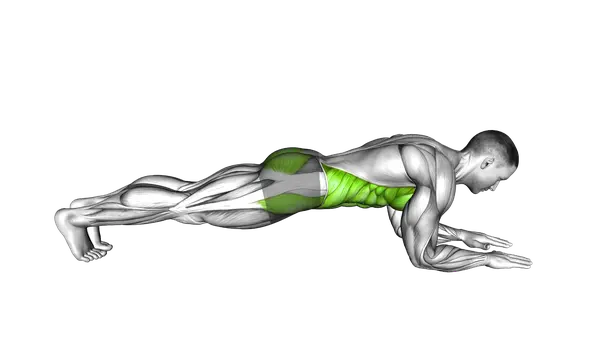
A correct plank keeps the body in a straight line from head to heels, with the forearms on the floor and the elbows directly under the shoulders. The abdominal muscles and glutes stay tensed, the neck stays neutral with the gaze on the floor, and breathing continues throughout the hold. Step-by-step technique and common mistakes are on the front elbow plank page.
A set ends when the hips sag toward the floor or rise into an inverted V, because both positions take load off the trunk muscles. The plank works more than the abdominal wall: in an EMG (electromyography) study of planks held to exhaustion, the gluteus maximus showed the greatest fatigue of the muscles measured [2].
Long holds raise blood pressure. In 62 healthy adults with an average age of 27, a plank held to fatigue pushed diastolic pressure above the ACSM safety limit of 115 mmHg in 97% of participants after about 50 seconds; no adverse events occurred [3]. The chart therefore uses several submaximal sets on most days instead of one hold to exhaustion.
Easier and harder plank variations
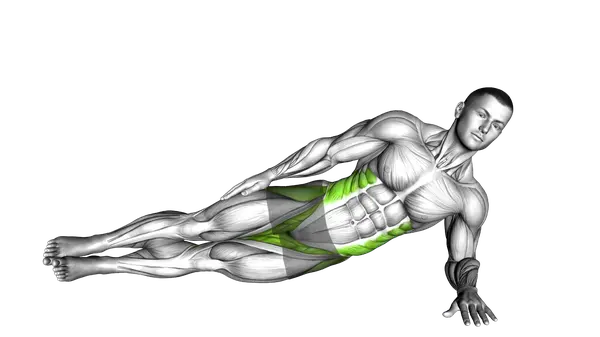
An easier variation shortens the lever: a knee plank reduces the length of body the trunk has to hold, and an incline plank with the forearms on a bench puts less body weight on the arms. The side plank changes the emphasis instead: in an EMG comparison of eight plank variants, the side plank on the floor and with the feet in suspension straps produced the highest activity in the lumbar erector spinae, the muscles along the lower spine [4].
A harder variation lengthens the lever or makes the support unstable. A plank with the elbows placed further forward and the pelvis tilted backward significantly increased activity of the upper rectus abdominis, the lower abdominal stabilizers and the external oblique compared with a standard plank, with the long lever contributing most [5]. Planks with the feet in suspension straps also produced higher abdominal activity than the stable version [4].
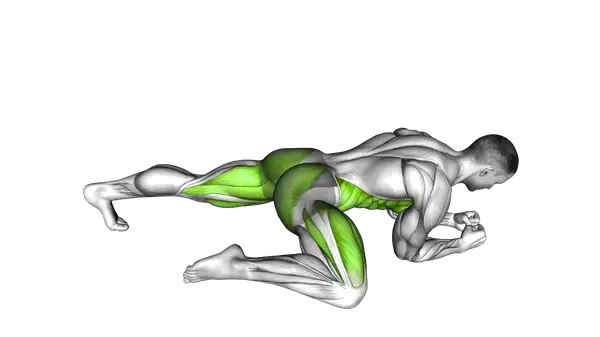
Dynamic variations add movement to the hold. The spiderman plank brings one knee toward the elbow on the same side, which adds hip flexion and forces the trunk to resist rotation while the body stays level.
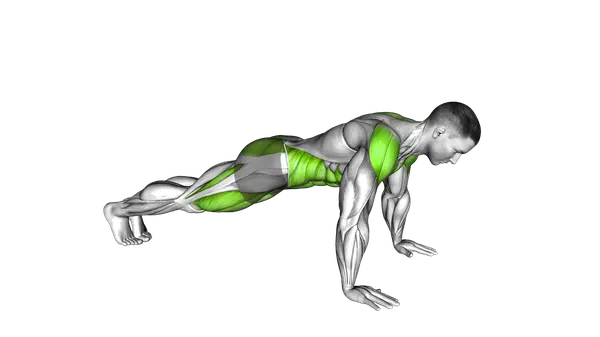
The front plank to toe tap moves one foot out to the side and back while the hips stay level, so the base of support shrinks with every tap. Once four sets of 60 seconds are steady, a harder variation is the next step rather than ever longer holds.
How long should you be able to hold a plank?
Average maximal plank times in studies range from about 80 to 145 seconds, depending on age and training status. In 120 adults aged 20 to 79, the mean was 145 seconds; younger participants held longer than older ones, and plank time was longer with more physical activity and shorter with a higher BMI and waist circumference [6].
Training status matters as well: in a group of 60 adults, people who did resistance training held the plank for 112 seconds on average and sedentary people for 81 seconds [2]. Both studies used a single hold until form failure, the same format as the tests on day 1 and day 30 of the chart.
| Group | Mean hold | Study |
|---|---|---|
| Adults aged 20–79 (n = 120) | 145 s | Bohannon 2018 |
| Resistance-trained adults (n = 30) | 112 s | Ikezaki 2021 |
| Sedentary adults (n = 30) | 81 s | Ikezaki 2021 |
Does a plank challenge work?
A plank challenge works for trunk muscle endurance, the quality it trains directly. No study has tested a 30-day plank challenge as such, but research on core training points in a clear direction. A meta-analysis of 16 intervention studies in trained people aged 16 to 44 found a large effect of core strength training on trunk muscle strength, and only small to medium effects on measures of physical fitness and athletic performance [7].
A second meta-analysis of programs lasting at least four weeks reported improvements in balance and in vertical and horizontal jumping after core training [8]. In 30 days, the realistic result is a longer maximal hold on the day 30 test and a steadier position, measured against the day 1 time.
Does a plank challenge burn belly fat?
No, a plank challenge does not reduce fat on the stomach specifically. In a randomized trial, 24 sedentary adults did seven abdominal exercises on five days a week for six weeks while keeping their diet the same: body weight, body fat percentage, abdominal fat, waist circumference and abdominal skinfolds did not change, while abdominal endurance did improve [9].
A flat stomach depends on the amount of body fat, and body fat falls through an energy deficit from diet and total activity. A plank held for a few minutes a day uses little energy. The summer shred guide covers how to lose fat while keeping muscle.
What to do after the 30-day plank challenge?
After day 30, the plank works best as one part of a full training week rather than as a daily goal on its own. The WHO recommends muscle-strengthening activity at moderate or greater intensity that involves all major muscle groups on two or more days a week [10]; a plank trains the trunk, not the legs, back or chest.
A practical follow-up is two or three short core sessions a week with harder variations, combined with full-body strength training. The strength training guide explains how such a program is built.
For more core work, the 30-day ab challenge adds dynamic exercises such as crunches, leg raises and dead bugs to the static holds.
Good to know
Frequently asked questions about the plank challenge
Yes, provided the starting point fits. The chart begins with three holds of 20 seconds and adds 5 seconds per set in small steps, with a repeat day whenever the form breaks. Anyone who cannot hold 20 seconds with a straight body line can follow the same chart on the knees and switch to the full plank later.
The chart on this page starts with three sets of 20 seconds, which is a design choice. The right starting point is a time that can be held with a straight line from head to heels. Average maximal holds in studies range from about 80 to 145 seconds, so a first test is often below those values.
Short daily sessions are common in plank challenges, and the chart trains on 26 of 30 days with a few minutes of holding time. It still includes four rest days and a light day before the final test. Persistent pain in the lower back or shoulders is a reason to stop and have the technique or the complaint checked.
For training, several shorter sets allow more total time with good form than one hold to exhaustion. The chart uses 30 to 60 seconds of rest between sets, in line with the short rest periods recommended for muscular endurance. A single maximal hold is mainly useful as a test, so it appears only on day 1 and day 30.
The front plank mainly trains the rectus abdominis, the obliques and the deeper abdominal muscles that keep the spine still. The glutes, the muscles along the spine and the shoulders also work to hold the straight line. The side plank shifts more of the load to the obliques and the muscles of the lower back.
The most likely result is a longer maximal hold on day 30 than on day 1, plus a steadier position. Core training studies show large gains in trunk muscle strength. Visible changes to the stomach are unlikely within 30 days, because they depend on body fat rather than on abdominal exercise.
Yes. The plank challenge takes a few minutes a day and combines well with a push-up or squat challenge, because those train other muscle groups. Combined with an ab challenge, the same muscles get twice the work; in that case, alternating the two on separate days keeps the total volume manageable.
End the set when the form breaks, rest, and complete the remaining sets as well as possible. On the next training day, repeat the same target instead of moving on. Falling a few days behind the chart is normal; the day numbers are a guide, not a deadline.
Sources
- American College of Sports Medicine. American College of Sports Medicine position stand. Progression models in resistance training for healthy adults. Med Sci Sports Exerc. 2009;41(3):687-708.
- Ikezaki F, Krueger E, de Souza Guerino Macedo C. Performance, reliability and fatigue in prone bridge test and supine unilateral bridge test. J Bodyw Mov Ther. 2021;26:238-245.
- Jones MD, Tan E, Woo J, et al. Acute blood pressure responses to plank and wall sit isometric exercise in adults. J Hypertens. 2026;44(2):288-294.
- Calatayud J, Casaña J, Martín F, et al. Progression of Core Stability Exercises Based on the Extent of Muscle Activity. Am J Phys Med Rehabil. 2017;96(10):694-699.
- Schoenfeld BJ, Contreras B, Tiryaki-Sonmez G, et al. An electromyographic comparison of a modified version of the plank with a long lever and posterior tilt versus the traditional plank exercise. Sports Biomech. 2014;13(3):296-306.
- Bohannon RW, Steffl M, Glenney SS, et al. The prone bridge test: Performance, validity, and reliability among older and younger adults. J Bodyw Mov Ther. 2018;22(2):385-389.
- Prieske O, Muehlbauer T, Granacher U. The Role of Trunk Muscle Strength for Physical Fitness and Athletic Performance in Trained Individuals: A Systematic Review and Meta-Analysis. Sports Med. 2016;46(3):401-419.
- Rodríguez-Perea Á, Reyes-Ferrada W, Jerez-Mayorga D, et al. Core training and performance: a systematic review with meta-analysis. Biol Sport. 2023;40(4):975-992.
- Vispute SS, Smith JD, LeCheminant JD, et al. The effect of abdominal exercise on abdominal fat. J Strength Cond Res. 2011;25(9):2559-2564.
- Bull FC, Al-Ansari SS, Biddle S, et al. World Health Organization 2020 guidelines on physical activity and sedentary behaviour. Br J Sports Med. 2020;54(24):1451-1462.

































