Übungsvergleich
Dumbbell vs Cable Lateral Raise: Best Way to Build Side Delts?
Dumbbell and cable lateral raises train the same muscle, the lateral (side) deltoid, with the same movement: raising the arm out to the side. The difference is the resistance profile. A dumbbell loads the shoulder most when the arm is horizontal and hardly at all when it hangs by the side, while a low cable already pulls on the arm at the start of the rep. A 2025 study compared both versions directly for muscle growth.
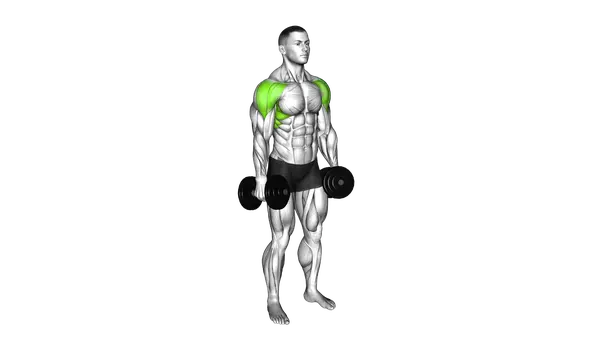
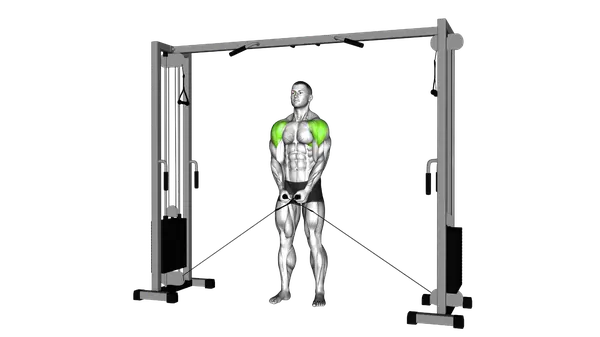
Dumbbell Lateral Raise vs Crossed Cable Lateral Raise
Auf einen Blick
| Merkmal | Dumbbell Lateral Raise | Crossed Cable Lateral Raise |
|---|---|---|
| Primäre Muskeln | Seitliche schultern | Seitliche schultern |
| Sekundäre Muskeln | Trapezius Descendens | Vordere Schultern, Hintere Schultern, Trapezmuskel |
| Ausrüstung | Kurzhantel | Kabel |
| Schwierigkeit | Anfänger | Fortgeschritten |
| Typ | Isoliert | Isoliert |
| Kraftrichtung | — | Zug |
01
Where each version is hardest
With a dumbbell, gravity pulls straight down. The torque on the shoulder is close to zero while the arm hangs by the side and reaches its maximum when the arm is parallel to the floor, so the bottom part of each rep is light.
With a cable set low and pulling across the body, the line of pull is closer to perpendicular to the arm at the start of the rep, so the deltoid is loaded from the first part of the movement. Where the cable is hardest depends on the pulley height and on where you stand. This is mechanics: it describes where the exercise is difficult, not which version builds more muscle.
02
What the research shows on muscle growth
In an 8-week study, 24 resistance-trained participants trained one arm with cable lateral raises and the other with dumbbell lateral raises: five sets to momentary failure, twice a week. Lateral deltoid thickness increased by 3.3–4.6%, and the analysis supported no difference between the two versions [1]. The extra tension a cable provides at the bottom of the movement did not lead to more growth in this study.
The movement itself is what targets the side delts. In a systematic review of 33 studies, abduction exercises such as the lateral raise produced the highest activation of the middle deltoid [2].
03
Arm rotation
How the arm is rotated changes which muscles work hardest, with either equipment. In 10 competitive bodybuilders, the middle deltoid was more active with the arm in a neutral position than with the arm rotated outward (thumb pointing up). Rotating the arm inward increased activity in the upper trapezius and the rear deltoid [3].
A systematic review ranked lateral raises with inward rotation highest for middle-deltoid activation [2]. Both a neutral and a slightly inward-rotated arm therefore work the side delts; rotating the arm outward shifts work away from them.
04
Control and momentum
Both versions can be done strictly or with momentum. With dumbbells, swinging the torso makes the already light bottom part even easier, so a controlled tempo matters. A cable keeps pulling the arm back toward the start throughout the rep, which makes it harder to drop the weight on the way down. No study has measured how much lifters cheat on either version, so this difference is practical rather than proven.
05
Practicality
Dumbbells need no setup and train both arms at once. Cable lateral raises are usually done one arm at a time, which takes longer per set and needs a free cable station; the crossed version with two cables trains both sides together but needs two pulleys. For muscle growth, training one side at a time or both together made no difference in a meta-analysis of 9 studies [4].
Das Fazit
Both versions build the side delts equally well: in a direct 8-week comparison, muscle growth did not differ [1]. Choose the cable version if you want resistance at the bottom of the movement or find it easier to control. Choose dumbbells when no cable station is free or when you want to train both arms at once. Rotating between them is a matter of preference, not a requirement.
Was ist dein Fitnessziel?
Wähle eines aus und die App baut dein Programm darum herum, um deine Ausrüstung und um die Tage, an denen du trainieren kannst.
Gut zu wissen
Häufige Fragen
Not for muscle growth. In a comparison of 24 resistance-trained participants over 8 weeks, with one arm on cables and the other on dumbbells, lateral deltoid thickness increased similarly with both (Larsen et al., 2025). The cable changes where the exercise is hardest, not how much the muscle grows.
There is no single target weight. In the study comparing cable and dumbbell lateral raises, every set was taken to momentary failure and both versions produced similar growth (Larsen et al., 2025). A weight that allows controlled reps up to shoulder height without swinging the torso is enough.
Most guides stop at about shoulder height, where the arm is parallel to the floor. Above that point, the shoulder blade rotates upward and the upper trapezius takes over more of the work. No study has shown that raising the arm higher builds more side-delt muscle.
Wissenschaftliche Quellen
-
[1]
Dumbbell versus cable lateral raises for lateral deltoid hypertrophy: an experimental study.
Larsen S, Wolf M, Schoenfeld BJ et al. · Frontiers in physiology (2025)
-
[2]
Activation of the three deltoid muscle portions during common strengthening exercises: A systematic review.
Rabello R, Bertozzi F, Hauschild de Freitas IL et al. · Journal of bodywork and movement therapies (2024)
-
[3]
An Electromyographic Analysis of Lateral Raise Variations and Frontal Raise in Competitive Bodybuilders.
Coratella G, Tornatore G, Longo S et al. · International journal of environmental research and public health (2020)
-
[4]
Comparison of Muscle Growth and Dynamic Strength Adaptations Induced by Unilateral and Bilateral Resistance Training: A Systematic Review and Meta-analysis.
Kassiano W, Nunes JP, Costa B et al. · Sports medicine (Auckland, N.Z.) (2025)
Die Quellen sind begutachtete wissenschaftliche Publikationen von PubMed.