How to Train When the Gym Is Busy
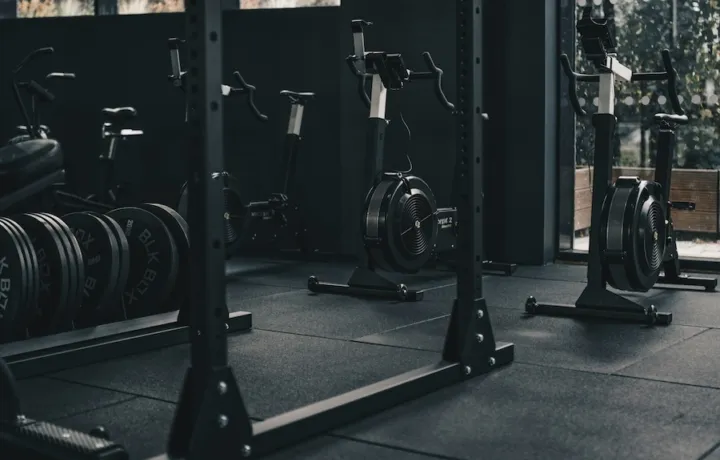
Learn how to train when the gym is busy with proven swaps, supersets, and timing tricks. Keep your workout on track and progress intact. You arrive at the gym after work, ready to train, and find every squat rack occupied. The bench you planned to use has a queue, the cable station is surrounded, and ten minutes disappear while you wait for one piece of equipment. By the time it becomes available, your session has lost its rhythm.
That situation doesn't mean the workout has failed. Training when the gym is busy is a planning problem, not a motivation problem. If you know how to swap movements, reorder priorities, pair non-competing exercises, and move sessions to quieter periods, you can keep the intended training stimulus without treating one machine as sacred. A clear logging habit matters just as much, because every useful substitution should leave a record you can build on next time.
When Every Rack Is Taken
Monday evening crowds create a particular kind of frustration. You have a written plan, but the first exercise needs a rack, the second needs a bench, and the third needs a cable station. You wait, check your phone, ask whether someone is using the rack, then repeat the process at another station. The session becomes a series of interruptions rather than a deliberate progression.
The answer isn't to abandon structure. It's to define the session by movement goals, target muscles, and progression, not by a single item of equipment. A squat pattern can live in a rack, on a leg press, or in a split squat. A horizontal press can use a barbell, dumbbells, or a machine, provided the replacement still serves the outcome you're training.
For readers building a broader strength routine, this guide to how to structure barbell training is useful background. Barbell work still has a place, especially when technical skill or competition specificity matters, but a busy floor requires a second layer of decision-making.
Built for progress
Take the guesswork out of training
Get a personalized workout plan built around your goal, equipment and schedule. Train smarter, track every rep and keep moving forward, one workout at a time.






Practical rule: Walk in with a primary exercise and a prepared alternative. Waiting should be an option, not your default plan.
The four tools are straightforward:
- Swap the exercise when another movement preserves the pattern and target.
- Reorder the session when a priority movement or its equivalent is available now.
- Use supersets when two movements can share time without undermining performance.
- Shift the workout time when your schedule gives you any flexibility.
Log the change as you make it. That way, a crowded Monday doesn't erase the training history you need for progressive overload.
When Gyms Are Actually Busy
Gym congestion follows patterns, so you don't have to guess every time you walk through the doors. A UK gym-attendance report found that Tuesday is generally the busiest day, with the highest weekday traffic between 5:00 and 7:00 p.m. Smaller spikes appear around 12:00–1:00 p.m., 6:00–7:00 a.m., and 9:00–10:00 a.m., while February was identified as the busiest month and the busiest single day was the second Tuesday in March. The attendance patterns are documented in the PureGym UK gym report.
A separate analysis of 323,875 gym check-ins found that 4:00–7:00 p.m. represented 30% of weekly visits, with 5:00 p.m. accounting for 26,346 entries, or 8.1% of total visits. The 6:00–9:00 a.m. period contributed 19.5%, the 11:00 a.m.–1:00 p.m. period contributed 18.2%, and attendance after 10:00 p.m. was below 3%, according to this gym check-in analysis.
Turn attendance patterns into a plan
If you train between 5:00 and 7:00 p.m., assume popular racks, benches, and machines may involve waiting. Put your highest-priority movement first when its station is free, but keep an equivalent alternative ready before you need it. A professional training after work shouldn't depend on one exact machine being vacant.
Early morning, midday, and late evening sessions may move more smoothly, but quieter doesn't mean every station will be open. Equipment clustering can still create a bottleneck in one zone while another area has plenty of space. Plan by zone as well as by clock:
- Rack zone: Have a dumbbell, landmine, or split-stance alternative.
- Cable zone: Keep a dumbbell or chest-supported row available.
- Machine zone: Prepare a free-weight or bodyweight version.
- Open floor: Use movements that need little setup when every station is contested.
The useful conclusion isn't that one time is always superior. It's that your program should describe the movement and outcome, while equipment remains flexible. That mindset makes a crowded gym predictable rather than personal.
The Swap Rule That Protects Progress
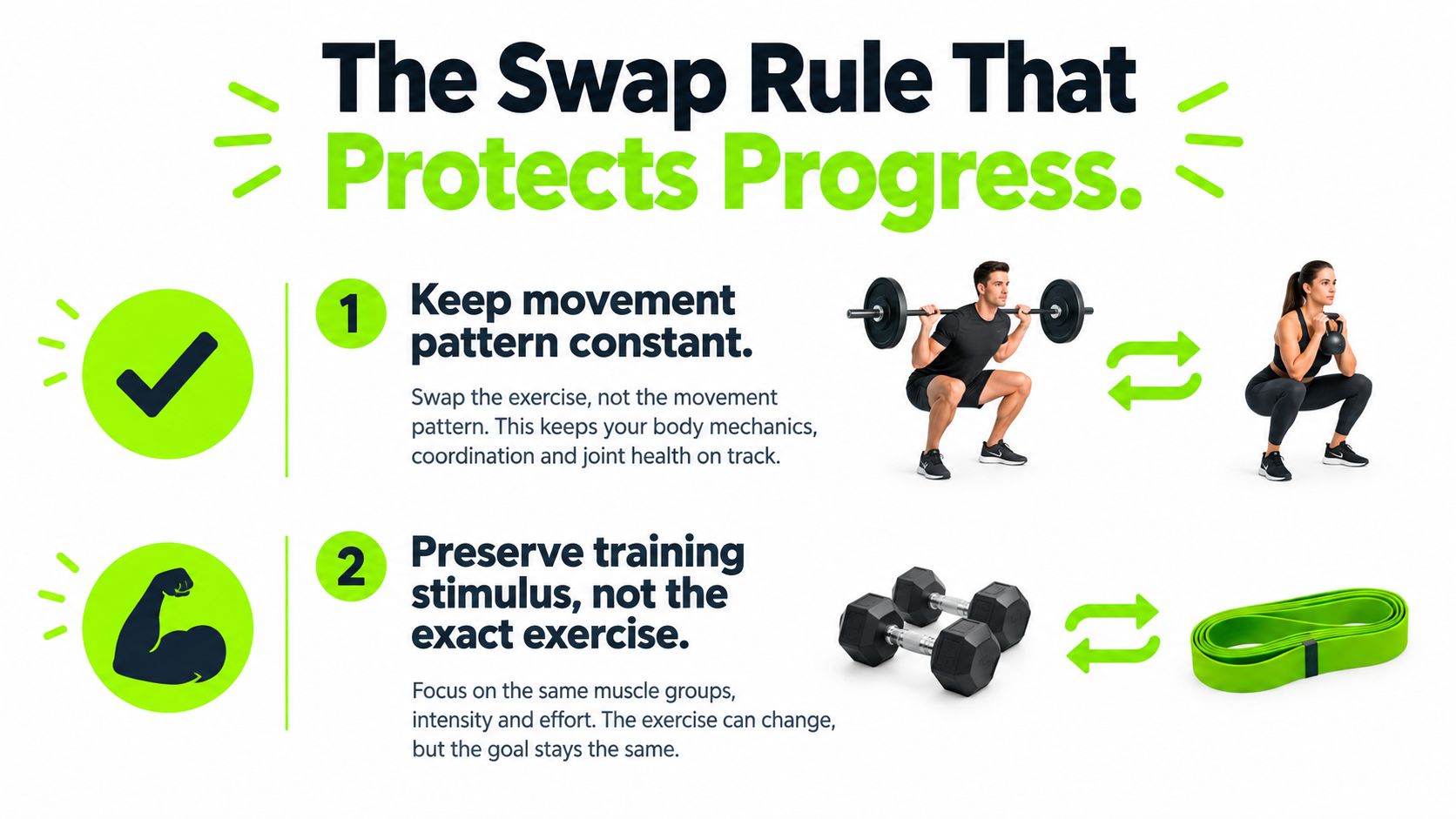
When a preferred machine is occupied, preserve the training stimulus, not the exact exercise. Keep the movement pattern, primary target muscle, approximate range of motion, effort level, and progression rule as consistent as possible. The implement, grip, angle, and stability demands can change when the gym forces your hand.
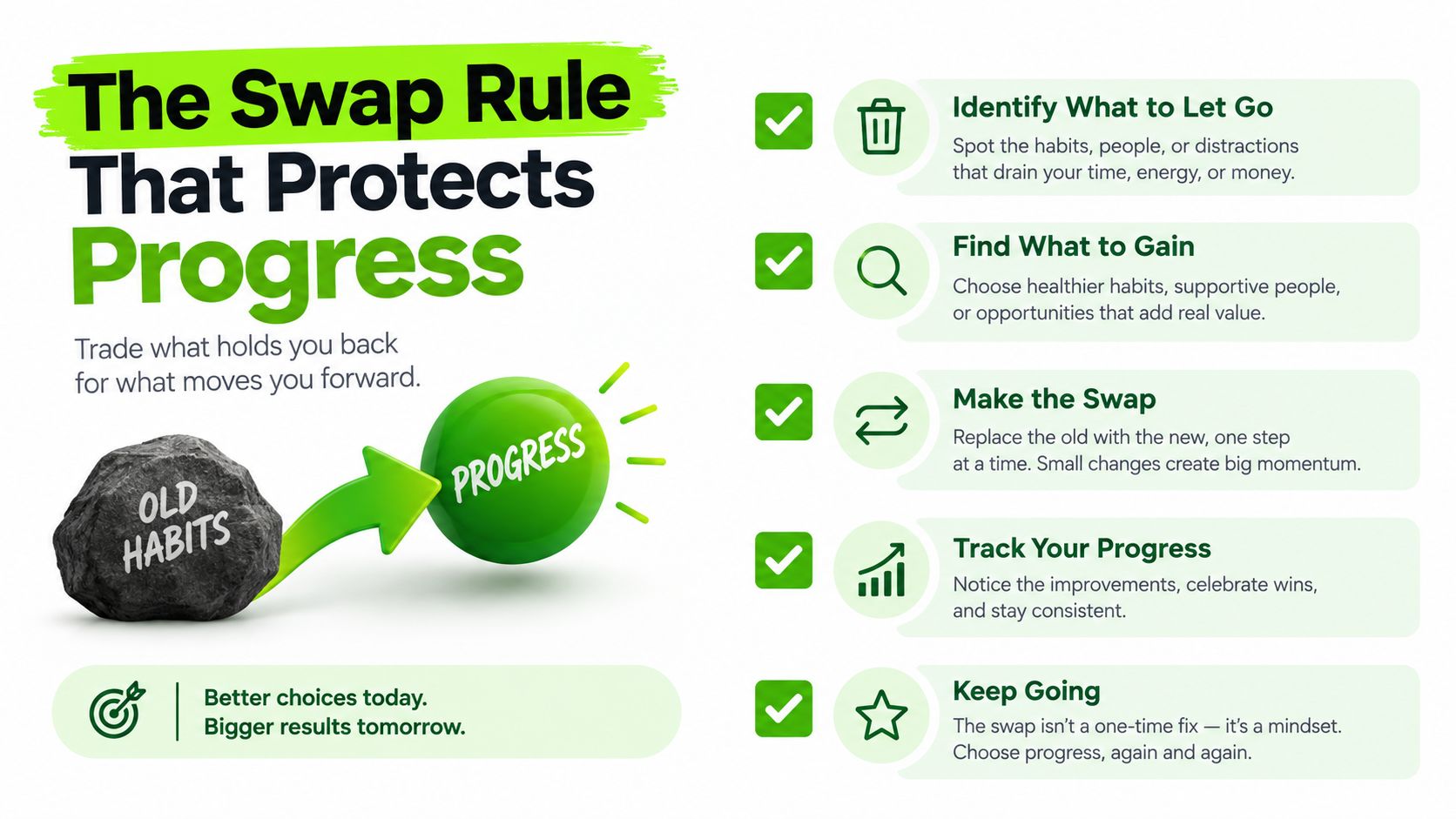
Start with the question, “What adaptation am I training today?” The answer determines how strict the replacement needs to be.
For muscle growth
A leg press can become a Bulgarian split squat or goblet squat. A cable row can become a chest-supported dumbbell row. A barbell press can become a dumbbell press or landmine press. Each option changes the equipment and may change the balance or loading, but it can still train the intended muscle group through a comparable pattern.
Use a load that lets you complete the planned repetition range with roughly 1–3 repetitions in reserve, then progress the substitute using the same rep-or-load target. Record it as its own exercise, because a dumbbell row and a cable row don't produce identical performance numbers even when they train related muscles.
Research summarized in time-efficient resistance-training literature supports bodyweight, bands, free weights, and machines as viable tools when loading and effort are appropriate, and equipment type isn't consistently decisive for outcomes in healthy adults. The review of resistance-training methods supports choosing the available implement when it preserves the intended work.
For strength and technical practice
The rule becomes more specific when the goal is skill with a particular lift. Dumbbell bench presses can maintain pressing strength and muscle stimulus, but they don't fully replace barbell bench-press practice. A leg press trains the legs, but it doesn't reproduce barbell-squat coordination.
Use this hierarchy:
- Preserve event-specific skill when the lift is central to competition or technical development.
- Preserve the movement pattern and target muscle when general strength or hypertrophy is the priority.
- Preserve effort and progression so the replacement remains measurable.
- Postpone the original lift when no reasonable alternative protects the day's main outcome.
That distinction prevents two common errors. One is waiting so long that the session loses useful training time. The other is choosing a completely different exercise and pretending the result is interchangeable.
Swap, Reorder, Superset, or Shift Time
A busy gym gives you four practical decisions, and the right one depends on the bottleneck in front of you. Swapping is the cleanest choice when a comparable movement is available. Reordering helps when your priority station is occupied but another useful option is open. Supersets reduce idle time when paired movements don't compete heavily. Time-shifting removes the bottleneck before the workout begins.
| Situation | Best move | Why |
|---|---|---|
| Your machine is occupied, but a similar pattern is available | Swap | You preserve the target muscle, effort, and progression without waiting |
| Your priority lift is blocked, but its alternative is free | Reorder | You complete the important pattern while you're fresh |
| Two non-competing exercises need different stations | Superset | You use recovery time productively and reduce idle periods |
| You can train before work, at lunch, or later at night | Shift time | You reduce predictable crowding instead of managing it mid-session |
Exercise order deserves special attention. Research indicates that movements performed early generally allow more repetitions, so the lift most important for strength or skill should normally come first. A study summarized in the Brazilian Journal of Sport Medicine supports prioritizing the available version of that movement.
For general muscle growth, the decision is less rigid. A systematic review found no meaningful hypertrophy difference between placing multi-joint exercises before single-joint exercises and reversing that order, with an effect size of 0.03 and p = 0.862, as reported in the exercise-order meta-analysis. That supports moving a blocked exercise later rather than discarding it, provided you understand that later exercises may feel weaker.
Choose the move that protects the day's priority, not the move that preserves your original spreadsheet.
Running Supersets in a Crowded Gym
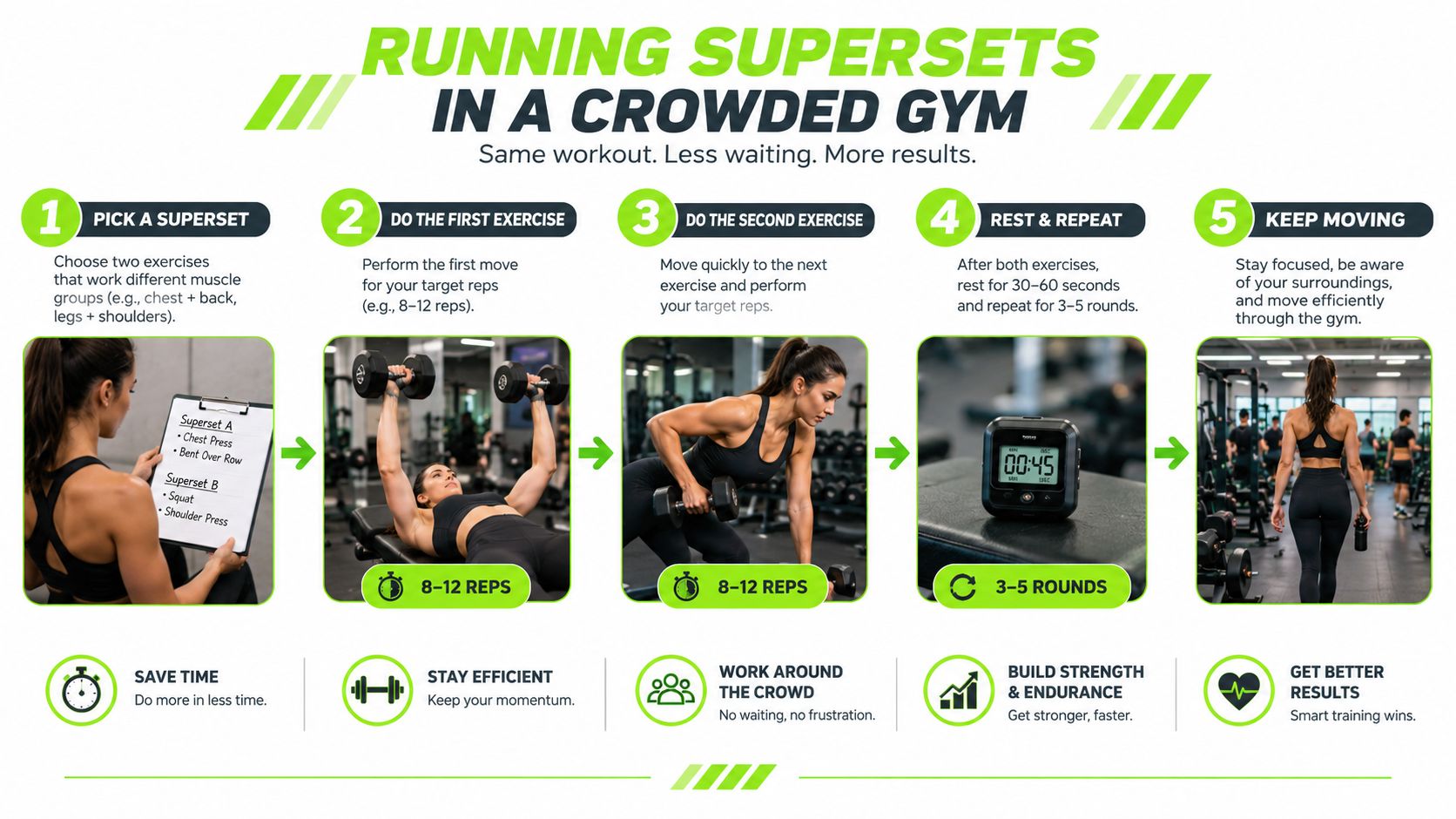
Supersets work best when the exercises use different prime movers or separate stations. Pair a press with a row, or a leg movement with an upper-body movement. The first exercise challenges one pattern while the paired movement gives those muscles time to recover, allowing you to keep working without monopolizing one rack or machine.
Avoid pairing two exercises that heavily fatigue the same muscles when performance matters. A heavy bench press followed immediately by a demanding shoulder press may turn both exercises into compromised efforts. A bench press paired with a row usually creates a more useful division of work.
Use a simple structure
- Complete the first exercise with the programmed load and repetitions.
- Move to the non-competing exercise without claiming a second crowded station unnecessarily.
- Rest about two minutes after completing both exercises.
- Repeat the pairing for the planned sets.
- Record completed sets, repetitions, and load for both movements.
Track volume rather than judging the session by elapsed time. A faster workout isn't automatically better if you casually reduce repetitions or load. The value of a superset comes from maintaining productive work while reducing dead time.
A 2024 controlled comparison across six exercises found broadly similar muscle-thickness and strength changes between supersets and traditional training, with effect sizes of 0.54 for muscle-thickness changes and 0.28 for strength changes, as reported in the controlled superset comparison. A 2025 systematic review and meta-analysis also found similar total repetitions, volume load, strength gains, and hypertrophy versus traditional sets, while one controlled comparison completed sessions in roughly 36% less time according to the superset meta-analysis.
Supersets aren't the right tool for every lift. Near-maximal loading, technical precision work, and maximal neural performance need fresh attention. Use traditional rest for those sets, then apply supersets to accessory work. A circuit-training workspace can help organize paired or sequential movements when the session calls for them.
Logging Swaps So Progress Survives Them
A substitution only preserves progress when its performance has a separate record. If the cable row is unavailable and you use a dumbbell row, log the exact exercise, load, repetitions, sets, and effort. Writing “row” hides meaningful differences and leaves you guessing when the same bottleneck appears again.
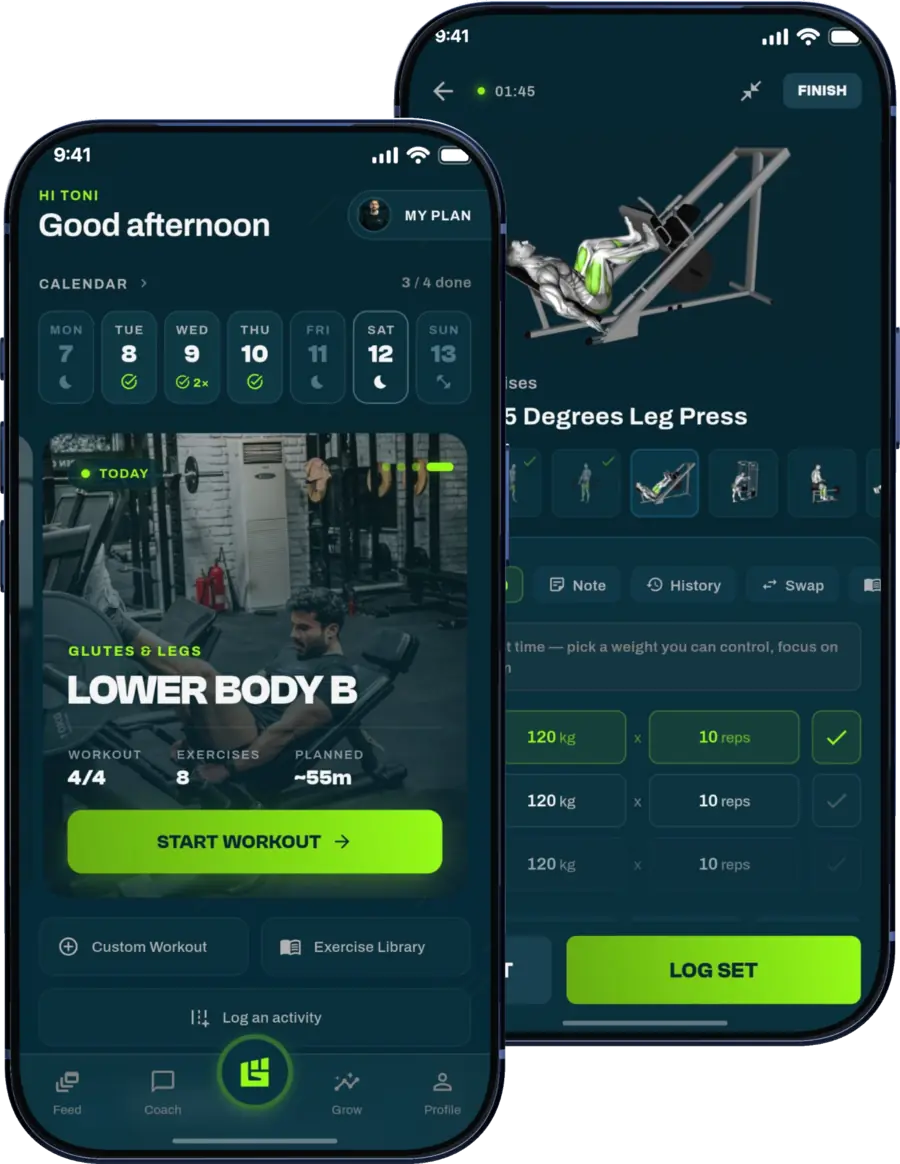
Use the workout tracker to log each substitution separately. GrabGains lets you swap exercises during a workout and filter its library by muscle group, equipment, and type. Filtering narrows the choice to a pulling movement with dumbbells or a lower-body exercise suited to the open floor, so you spend less of your rest period searching.
Keep the progression trail intact
The tracker's history keeps results attached to each exercise. Filter the exercise library to find a workable replacement, then use history to review that movement's previous load, repetitions, and sets. This creates a parallel progression trail instead of forcing an unfamiliar substitute into the original exercise's record.
Use this five-step workflow:
- Filter first: Select the target muscle, available equipment, and exercise type.
- Check the pattern: Confirm that the choice still serves the day's movement goal.
- Set the target: Keep the planned rep range and choose an appropriate effort level.
- Log separately: Record the substitute under its own exercise name rather than merging unlike movements.
- Progress deliberately: Review its history and add repetitions or load when it meets the progression rule.
Smart Workouts adjust weights, repetitions, and progression over time, while the user controls exercises, planning, and intensity. Log the substitute, then build on its own history. That habit lets a crowded gym change the exercise without erasing the outcome you are training to improve.
When the Wait Is the Wrong Choice
Many trainees treat the original exercise as fixed, even when the only thing preserving it is standing beside an occupied machine. That approach ignores the hidden cost of congestion. Average visit duration increased across value-priced, mid-range, and high-end gyms between Q1 2022 and Q1 2025, with value gyms rising from 72.4 to 74.0 minutes, according to recent fitness-space foot-traffic data.
The problem isn't only that equipment is unavailable. Popular stations often cluster in one zone, so you can lose time waiting while nearby dumbbells, benches, or open floor remain usable. A longer visit can also force you to rush the final exercises, skip conditioning, or leave before completing the work that matters.
Use a stopping rule
If the station is occupied and an available alternative trains the same movement pattern and primary muscle group at a similar effort level, take the swap and continue. Don't spend your attention negotiating over a machine when the training outcome is still available elsewhere.
Postpone the original exercise when the replacement changes the day's purpose. If your priority is barbell-specific skill and the only open option is a substantially different movement, keep the technical lift for later or move it to a quieter session. A poor substitute can be worse than a controlled delay when specificity matters.
The same judgment applies to preparation. Caffeine may help some people feel more alert, but it won't solve a badly managed session or make a poor substitution appropriate. If you're unsure whether pre-workout fits your routine, this practical NZ Supps pre-workout advice offers context. Treat supplements as a secondary choice. Your primary performance tool is a plan that doesn't depend on one vacant station.
Stop waiting when the intended stimulus is available elsewhere. Keep waiting only when the original movement itself is the outcome.
Your Busy-Gym Training Plan
Use this playbook before and during your next packed session:
- Identify the bottleneck. Decide whether the problem is a rack, bench, cable station, machine, or time window.
- Protect the priority. Perform the most important strength or technical movement first when it's available. If it isn't, use the closest appropriate alternative.
- Pick the right move. Swap for a comparable pattern, reorder around open equipment, superset non-competing work, or shift the session to a quieter period.
- Filter quickly. Search by muscle group, equipment, and exercise type rather than improvising from memory.
- Keep the target stable. Preserve the rep range, effort level, range of motion, and progression rule.
- Log the exact exercise. Track the substitute separately so next week's decision starts with real data.
You can organize the week around changing availability with a flexible training plan, then adjust individual movements when the gym floor doesn't match the schedule.
Does this work during early-morning or late-evening sessions?
Yes. Shorter waits may move the bottleneck from racks to a specific machine, class area, or limited dumbbell range. Keep the same decision rule, but notice which zone slows you down instead of assuming every off-peak session will be empty.
What if a packed floor causes gym anxiety?
Make the plan your focus, not the room. Arrive knowing your first movement, backup exercise, and logging method. A crowded gym becomes easier to work through when you don't have to invent the next step beside an occupied machine. For more strategies, see this guide to gym anxiety.
The Monday session from the opening scene doesn't need to end with ten lost minutes and a shortened workout. Walk in with a bottleneck plan, swap when the stimulus is protected, and keep the record alive.
GrabGains helps you manage busy-gym training with adaptable workout planning, exercise-library filters, live exercise swaps, and linked training history. Visit GrabGains to build a session that can keep moving when the equipment doesn't.
Get inspired and motivated