Supersets workout plan: Maximize gains fast with efficient pairings
Explore a supersets workout plan that maximizes muscle growth in less time with smart pairings and practical tips. A supersets workout plan is all about efficiency. It’s a training method where you perform two different exercises back-to-back with minimal rest in between. If you're on a tight schedule but refuse to compromise on results, this is how you get it done.


What is a supersets workout plan
Imagine crushing a powerful, muscle-building workout in the time it usually takes you to get through just your first few exercises. That's the magic of a well-designed superset plan. By pairing exercises, you slash the downtime in your session, creating a more intense and productive training environment.
This guide isn't just about saving time; it's about training smarter. We'll cut through the gym noise and show you exactly how this method can give your routine a serious upgrade. The idea is simple: move from one exercise straight into the next, and only take your rest after the pair is complete.
Built for progress
Take the guesswork out of training
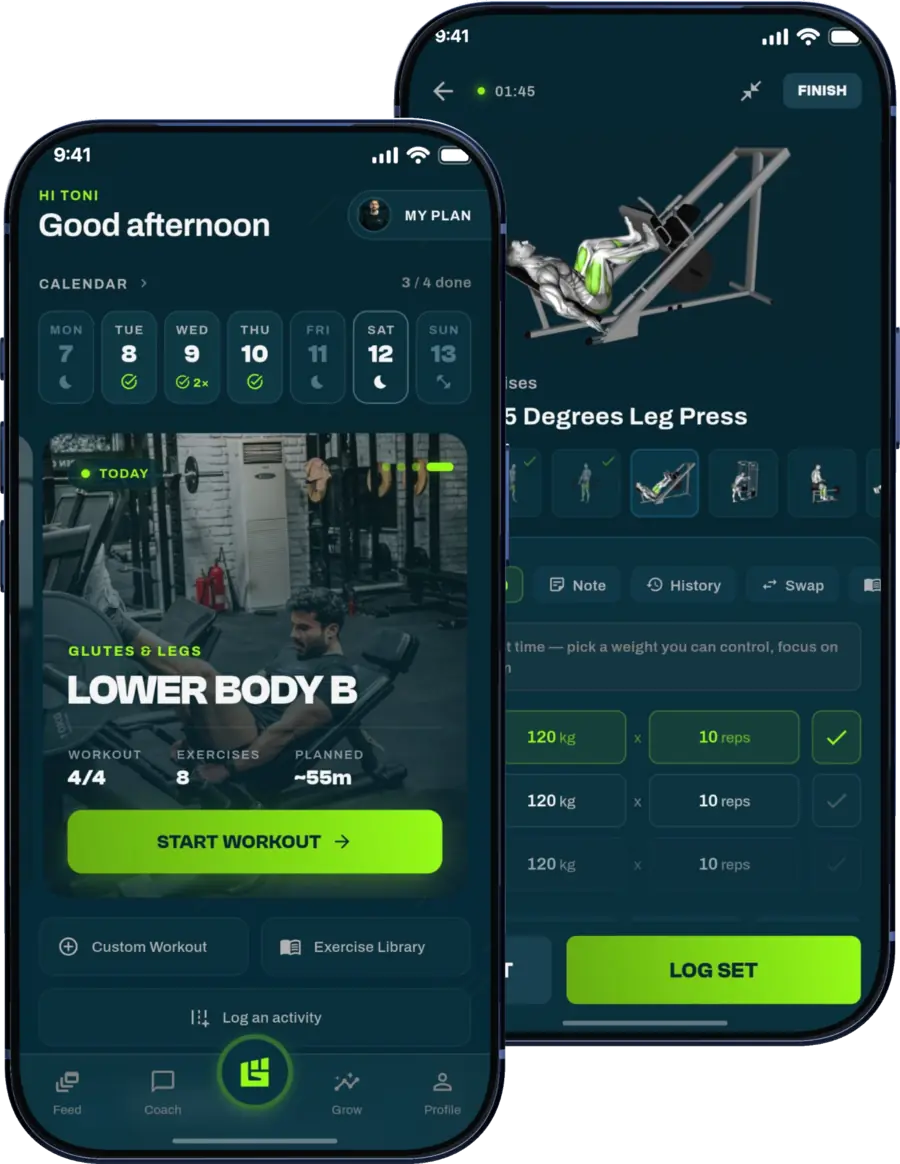
Get a personalized workout plan built around your goal, equipment and schedule. Train smarter, track every rep and keep moving forward, one workout at a time.






Different approaches to supersets
There are a few ways to structure a superset, and each one brings something different to the table. The right choice depends entirely on your goals, whether that’s building sheer size, raw strength, or boosting your conditioning. Getting a handle on these variations is the first step to building a plan that actually works for you.
You can mix and match a few types of supersets:
- Antagonist Supersets: This is where you pair exercises that work opposing muscle groups, like biceps and triceps (think bicep curls followed immediately by tricep pushdowns). This method is brilliant because it can actually enhance your performance on the second exercise.
- Agonist Supersets: Here, you perform two different exercises for the same muscle group back-to-back, like a bench press followed by cable flys. This is a seriously intense technique that creates a ton of metabolic stress and muscle fatigue—perfect for hypertrophy.
- Upper/Lower Supersets: This involves combining an upper-body move with a lower-body one. It's a fantastic way to structure a full-body workout that keeps your heart rate jacked up without completely frying one muscle group too early.
One of the biggest wins with supersets is the increased training density—you’re packing more volume into less time. Studies have shown this can slash workout duration by nearly 40% without sacrificing the total number of reps you perform.
Laying the groundwork for your routine
Whether you're a busy professional squeezing in a workout or a dedicated lifter trying to bust through a plateau, supersets offer a practical, effective solution. The principles are straightforward, but it's the application that delivers the results. If you want to dig deeper into the fundamentals, our guide on how to build muscle fast is a great place to start.
This guide will give you the foundation you need to build your own effective supersets workout plan and start achieving serious results more efficiently.
The science behind why superset training works
Supersets feel brutal for a good reason—they’re a clever way to manipulate your body’s physiology and create a powerful stimulus for muscle growth and endurance. This isn't just a gym hack to save time; it's a method grounded in science that creates the perfect storm for your muscles to adapt and get stronger.
By jumping from one exercise to another with little to no rest, you’re sending a flood of signals throughout your body. The real magic of a superset workout plan is how it amplifies these signals, pushing you far beyond what traditional straight sets can accomplish in the same timeframe.
The power of metabolic stress
One of the main drivers of muscle growth, or hypertrophy, is something called metabolic stress. When you perform back-to-back exercises, you burn through your muscle cells' energy stores and don't give them a chance to fully recover. This process leads to a rapid buildup of metabolic byproducts like lactate.
That buildup is exactly what causes the "burn" you feel during an intense set. But it's more than just a feeling—it’s a critical signal telling your body to kickstart muscle repair and growth. Your body responds to this intense stress by releasing anabolic hormones, increasing cell swelling (the "pump"), and firing up muscle-building pathways. You can learn more about how to systematically increase this stress in our guide to progressive overload for consistent gains.
Key Takeaway: The minimal rest in a superset workout creates massive amounts of metabolic stress. This stress acts as a potent trigger for hypertrophy, essentially forcing your muscles to adapt by growing bigger and stronger to handle future demands.
Unlocking strength with reciprocal inhibition
Another fascinating thing happens during supersets, especially when you pair opposing muscle groups. It's a neurological trick called reciprocal inhibition. Simply put, when you contract one muscle (the agonist), your central nervous system tells the opposing muscle (the antagonist) to chill out and relax.
Think about a bicep curl—for your bicep to contract, your triceps have to relax. By immediately following that curl with a triceps extension, your triceps can actually contract more forcefully because they were just in a relaxed, primed state.
- Biceps & Triceps: Pairing bicep curls with tricep pushdowns allows for a stronger, more powerful triceps contraction.
- Quads & Hamstrings: Following leg extensions with hamstring curls can improve the quality and force of the hamstring contraction.
- Chest & Back: Hitting dumbbell bench presses right before bent-over rows can lead to a more effective and powerful pull.
This neurological sleight of hand can lead to better strength output and muscle activation in the second exercise. It’s a smart way to squeeze more out of every single rep.
Backed by modern research
Supersets aren't some new fitness fad. The concept has been a game-changer since bodybuilding pioneer Joe Weider popularized it way back in the 1940s. Fast forward to today, and modern science is finally catching up to what old-school lifters knew all along.
A landmark systematic review confirmed that supersets can slash your training session duration by about 37% compared to traditional straight sets, all while keeping the total workout volume nearly identical. That means a 60-minute slog can be knocked out in just 38 minutes without sacrificing your gains. For more on this, check out the research on superset efficiency.
How to design your perfect supersets workout plan
Alright, you get the science behind supersets. Now for the fun part: building your own routine. This is where the real progress happens, but it’s more than just mashing two exercises together and hoping for the best.
Designing a smart superset plan is all about strategy. The right pairings will crank up your results, whether you’re chasing muscle size, better endurance, or the functional strength needed for a HYROX race. The goal is to pick exercises that let you keep the intensity high without burning out too fast. It's about giving one muscle a quick breather while you hammer another.
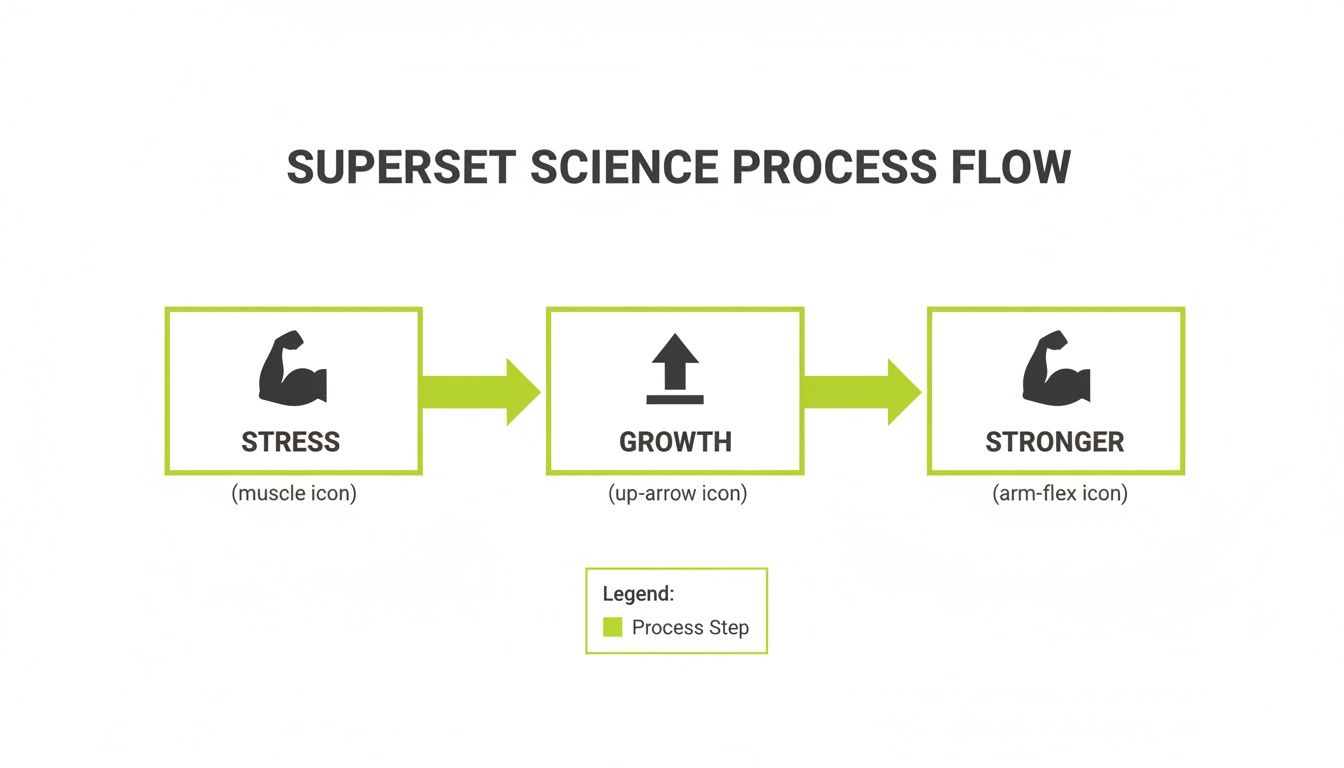
This process is simple but powerful. The stress from your workout is the trigger, leading directly to muscle growth and, ultimately, a stronger you.
Smart principles for pairing exercises
The art of the superset is all in the pairing. Get it right, and it feels tough but doable. Get it wrong, and your form falls apart, and you just don't get the same results. The trick is to minimize how much the two movements overlap, both in terms of muscles used and neural fatigue.
Here are the most effective ways to pair up your exercises:
- Push with Pull (Antagonist): This is the classic for a reason. You pair a pushing movement (like a Bench Press) with a pulling one (like a Bent-Over Row). Since you're working opposing muscle groups, one gets to rest while the other works. This lets you go all out on both lifts. This is a core concept in our comprehensive push-pull-legs training guide.
- Upper Body with Lower Body: Talk about efficiency. Pairing an upper-body move like a Dumbbell Shoulder Press with a lower-body one like Goblet Squats creates a massive metabolic demand. It’s fantastic for full-body workouts and conditioning because there's almost zero muscle overlap.
- Isolation with Compound (Post-Exhaust): This one is pure bodybuilding gold. You hit a major compound lift first, then immediately follow it with an isolation exercise for the same muscle. Think Barbell Squats straight into Leg Extensions. This technique pushes the target muscle way past its normal failure point, sparking serious growth.
The whole point of these strategies is to make sure fatigue from your first exercise doesn't wreck your performance on the second. It’s about working smarter to squeeze every last drop of effort out of your gym time.
Building your routine: sets and reps
Once you've got your pairs figured out, it's time to dial in your sets and reps. This is how you fine-tune the workout to hit your specific goals. Don't just pick numbers out of a hat—the reps you do determine the kind of results you'll see.
Too many people use a one-size-fits-all approach. Your rep scheme should be a direct reflection of what you're trying to build.
Rep ranges for different goals
- For Hypertrophy (Muscle Growth): Aim for 3-4 supersets with 8-12 reps for each exercise. This is the sweet spot for creating the mechanical tension and metabolic stress that triggers muscle growth. Take 60-90 seconds of rest between supersets.
- For Strength-Endurance: You'll want to do 3-4 supersets with 12-15+ reps per exercise. Pushing into higher rep ranges trains your muscles to sustain force for longer. Keep rest periods tight—around 45-60 seconds—to keep your heart rate up.
- For Functional Fitness (e.g., HYROX): Here, a mix is best. You could do a heavy compound lift for 5-8 reps, then immediately superset it with a functional move like Kettlebell Swings for 15-20 reps. This builds raw strength and the work capacity you need for grueling events.
Smart superset pairings for every goal
To take the guesswork out of it, here are some proven combinations you can plug right into your routine. This table breaks down effective exercise pairings by goal, helping you build a customized superset workout that actually works.
| Superset Type | Primary Muscle Group | Exercise 1 (Compound) | Exercise 2 (Isolation/Antagonist) | Best For |
|---|---|---|---|---|
| Antagonist | Chest & Back | Dumbbell Bench Press | Seated Cable Row | Hypertrophy & Strength |
| Antagonist | Quads & Hamstrings | Leg Press | Lying Leg Curl | Hypertrophy |
| Antagonist | Biceps & Triceps | Barbell Bicep Curl | Triceps Rope Pushdown | Arm Growth |
| Upper/Lower | Full Body | Overhead Press | Goblet Squat | Conditioning & Time |
| Upper/Lower | Full Body | Pull-Ups | Walking Lunges | Functional Fitness |
| Post-Exhaustion | Shoulders | Dumbbell Shoulder Press | Lateral Raise | Hypertrophy |
| Post-Exhaustion | Chest | Incline Bench Press | Cable Fly | Hypertrophy |
At the end of the day, the "perfect" plan is the one that aligns with your goals, fits your schedule, and uses the gear you have. Use these principles and examples as a starting point to build a killer superset routine that gets you the results you're after.
Sample superset workout plans for any schedule
Theory is great, but putting it into practice is what actually builds muscle. To help you hit the ground running, I’ve laid out three complete, ready-to-use weekly workout plans. These aren't just random lists of exercises—they're strategically designed schedules you can follow right away or tweak to fit your needs.
Each plan is built for a specific goal and schedule. Whether you're short on time, chasing maximum muscle growth, or training for raw functional performance, you'll find a routine that fits. Think of these as proven templates for success.
The time-efficient 3-day full body plan
Perfect for beginners or anyone with a packed schedule, this full-body routine hits every major muscle group three times a week. The focus here is on big, compound movements paired intelligently to get the most out of your time without sacrificing results.
By pairing upper and lower body movements, you keep your heart rate up and muscles working without completely fatiguing one area.
Workout A (Monday)
- Superset 1: Goblet Squats & Dumbbell Bench Press
- Sets: 3
- Reps: 10-12 per exercise
- Rest: 60-90 seconds after the superset
- Superset 2: Dumbbell Romanian Deadlifts & Seated Cable Rows
- Sets: 3
- Reps: 10-12 per exercise
- Rest: 60-90 seconds after the superset
- Superset 3: Plank & Face Pulls
- Sets: 3
- Reps: Hold Plank for 45-60 seconds, 15-20 reps for Face Pulls
- Rest: 60 seconds after the superset
Workout B (Wednesday)
- Superset 1: Walking Lunges & Pull-Ups (or Lat Pulldowns)
- Sets: 3
- Reps: 10-12 per leg, 6-10 reps for Pull-Ups
- Rest: 90 seconds after the superset
- Superset 2: Leg Press & Dumbbell Shoulder Press
- Sets: 3
- Reps: 12-15 per exercise
- Rest: 90 seconds after the superset
- Superset 3: Barbell Curls & Triceps Pushdowns
- Sets: 3
- Reps: 10-12 per exercise
- Rest: 60 seconds after the superset
Workout C (Friday)
- Superset 1: Barbell Hip Thrusts & Push-Ups
- Sets: 3
- Reps: 10-12 reps for Hip Thrusts, Reps to failure for Push-Ups
- Rest: 60-90 seconds after the superset
- Superset 2: Leg Curls & Dumbbell Bent-Over Rows
- Sets: 3
- Reps: 12-15 reps for Leg Curls, 10-12 reps for Rows
- Rest: 60-90 seconds after the superset
- Superset 3: Lateral Raises & Russian Twists
- Sets: 3
- Reps: 12-15 per exercise
- Rest: 60 seconds after the superset
The 4-day hypertrophy upper/lower split
This plan is designed for one thing: maximizing muscle growth. By splitting your training into upper and lower body days, you can hammer each muscle group with more volume and intensity twice a week.
This split uses antagonist pairings, which lets you go heavy and maintain solid performance throughout the entire session.
Upper Body Day 1 (Push Focus)
- Superset 1: Incline Dumbbell Press & T-Bar Row
- Sets: 4
- Reps: 8-12 per exercise
- Rest: 90 seconds
- Superset 2: Seated Dumbbell Shoulder Press & Lat Pulldowns
- Sets: 3
- Reps: 10-12 per exercise
- Rest: 90 seconds
- Superset 3: Triceps Dips & Barbell Curls
- Sets: 3
- Reps: 10-15 per exercise
- Rest: 60 seconds
Lower Body Day 1 (Quad Focus)
- Superset 1: Barbell Back Squats & Lying Leg Curls
- Sets: 4
- Reps: 8-10 for Squats, 12-15 for Curls
- Rest: 120 seconds
- Superset 2: Leg Press & Dumbbell Romanian Deadlifts
- Sets: 3
- Reps: 10-12 per exercise
- Rest: 90 seconds
- Superset 3: Leg Extensions & Seated Calf Raises
- Sets: 3
- Reps: 15-20 for Extensions, 15-20 for Raises
- Rest: 60 seconds
The functional fitness 3-day plan
This one’s for the athletes. If you're training for events like HYROX or just want to build all-around functional strength and conditioning, this routine is your jam. It blends heavy compound lifts with explosive, endurance-based movements to forge a powerful and resilient physique.
The goal is simple: improve both your raw strength and your ability to keep working when things get tough.
The high-intensity nature of this plan offers a massive benefit when it comes to energy expenditure. Studies have shown that supersets lead to a significantly higher calorie burn and perceived intensity compared to traditional training. By keeping rest periods short, your heart rate stays elevated, torching more calories without needing to slog through endless cardio. You can dig into the research behind supersets and calorie expenditure if you want the nitty-gritty details.
Be warned: this plan is intense. If you're new to this style of training, our beginner workout plan can help you build the necessary foundation first.
Day 1: Strength & Power
- Superset 1: Deadlifts & Box Jumps
- Sets: 4
- Reps: 5 for Deadlifts, 5 for Box Jumps
- Rest: 2-3 minutes
- Superset 2: Pull-Ups & Kettlebell Swings
- Sets: 3
- Reps: Max reps for Pull-Ups, 20 for Swings
- Rest: 90 seconds
Day 2: Push & Endurance
- Superset 1: Overhead Press & Wall Balls
- Sets: 4
- Reps: 6-8 for Press, 15 for Wall Balls
- Rest: 2 minutes
- Superset 2: Dumbbell Bench Press & Sled Push
- Sets: 3
- Reps: 10 for Bench, 20 meters for Sled Push
- Rest: 90 seconds
Day 3: Pull & Conditioning
- Superset 1: Bent-Over Rows & Ski Erg
- Sets: 4
- Reps: 8 for Rows, 250 meters for Ski Erg
- Rest: 2 minutes
- Superset 2: Farmers Walk & Hanging Knee Raises
- Sets: 3
- Reps: 30 meters for Walk, 15-20 for Raises
- Rest: 90 seconds
Common superset mistakes to avoid
Supersets are all about intensity and efficiency. But when you move fast, it’s easy to get sloppy and sabotage your progress. The goal is to save time, sure, but rushing through a workout without a smart strategy is a fast track to plateaus or, even worse, injuries.
If you can sidestep a few common pitfalls, you’ll turn a potentially dangerous session into a brutally effective one. Knowing what not to do is just as important as knowing what to do.
Pairing the wrong exercises
This is the most frequent mistake I see. People pair exercises that completely fry their stability muscles or central nervous system, especially when combining two massive, neurologically demanding compound lifts.
Think about supersetting a heavy Barbell Back Squat with a Barbell Deadlift—it's a recipe for disaster. Both movements hammer your spinal erectors and CNS. By the time you stumble over to the deadlift platform, your core stability is shot. Your form crumbles, and the risk of a back injury skyrockets.
The Fix: Be smarter with your pairings. Choose combinations that let key muscle groups recover. A much safer and more effective approach is to pair a lower-body push with an upper-body pull, like Barbell Squats and Pull-Ups. This lets your lower back and legs get a breather while your lats go to work, keeping you safe and strong.
Sacrificing form for speed
In the rush to get to the next exercise, form is often the first casualty. I’ve seen it all: people using way too much momentum, cutting their range of motion in half, or losing all core tension just to finish the set faster.
Remember, the point of a superset is to increase work density, not to race the clock at the expense of good technique. Every single rep should be controlled and deliberate. When you sacrifice form, you take tension off the target muscle—making the exercise less effective—and open the door to sprains and strains. Good form is non-negotiable.
Ignoring gym logistics
This is a classic rookie error that can completely derail a great workout plan. You've planned the perfect superset: Leg Press and Lat Pulldowns. But the machines are on opposite ends of a packed gym. By the time you navigate through the crowd, your rest period is over, and someone’s already started their set on the machine you needed.
Suddenly, your superset is broken. Your heart rate drops, the metabolic stress you were aiming for is gone, and the whole session loses its punch. You have to think like a strategist.
- Solution 1: Pick exercises that use the same piece of equipment. Think Dumbbell Bench Press paired with Dumbbell Rows, both done on the same bench.
- Solution 2: Choose stations or machines that are right next to each other.
- Solution 3: Use a bodyweight exercise for your second movement. After a set of Barbell Rows, you can immediately drop down for Push-Ups without needing any extra gear.
Taking too little (or no) rest
While you want to keep the rest between the two exercises in your superset minimal (think 0-30 seconds), the rest between each completed superset is critical for recovery. Too many people make the mistake of jumping right back into their next superset with almost no break.
This just leads to a massive drop-off in performance. You won't be able to lift as heavy or hit your target reps, which kills your total workout volume—one of the main drivers of muscle growth. Give yourself 60-90 seconds of rest after each full superset. This allows your heart rate to come down a bit and gives your muscles a chance to partially recover.
How to progress your workouts and track gains
A superset plan that never changes will eventually stop working. To keep building muscle and getting stronger for the long haul, your workouts have to evolve right alongside you. This all comes down to a core training principle called progressive overload—the simple idea of consistently making your workouts a little bit harder over time.
With supersets, this isn't just about piling more plates on the bar. Progressive overload can look like a few different things, and each one provides a fresh stimulus for growth. You could lift heavier, sure, but you could also add one more rep to each set or even slice a few seconds off your rest time. The goal is always the same: nudge your limits just beyond where they were last time.
Smart progression strategies for supersets
Applying progressive overload to supersets isn't guesswork; it requires a plan. Here are a few dead-simple, practical ways to make sure you're consistently moving forward:
- Add a Rep: Did you hit 3 sets of 10 last week? Great. This week, aim for 3 sets of 11 with the same weight. Once you can nail 12 reps with crisp, perfect form, you've earned the right to go heavier.
- Increase the Load: When you hit the top of your target rep range (say, 12 reps), add a small amount of weight. Think 2.5-5 lbs for upper body lifts and 5-10 lbs for lower body lifts. Then, drop back down to the bottom of your rep range and start climbing again.
- Decrease Rest Time: If your main goal is conditioning or work capacity, try trimming 5-10 seconds from your rest period between supersets each week. This challenges your body's recovery systems and forces it to become more efficient.
Why tracking is non-negotiable
Here’s the hard truth: you can't progress what you don't measure. Writing down every workout: the exercises, weights, sets, and reps, is the only way to make smart, data-driven decisions about what to do next. Otherwise, you're just showing up and hoping for the best.
Recording your workouts turns each session into a piece of data. This data tells you exactly when you're ready to push harder and when you might need to adjust your approach to break through a plateau.
Research on supersets confirms they work for building muscle and strength, but it also shows why paying attention to the details matters. One study found that after 10 weeks, a superset group gained 5.2kg less on the lat pulldown compared to a traditional training group. This highlights a crucial point: you need to track your numbers to ensure every exercise and muscle group is actually progressing. Learn more about these research findings.
Ultimately, a training log gives you the objective feedback you need to know when to add weight, when to switch things up, and how to keep your superset plan effective. And if you’re serious about seeing those strength numbers climb, a tool like our one-rep max calculator can give you some powerful insights for your programming.
Frequently asked questions about superset training
When you first jump into supersets, a few questions always pop up. It's smart to get them answered so you can walk into the gym with a clear plan and the confidence to crush your workout. Let's clear up some of the most common ones I hear.
How long should I rest between supersets
This is the classic "it depends" answer, but for good reason. Your rest period is a tool, and you need to match it to your goal. There’s no single magic number.
For building muscle (hypertrophy), the sweet spot is usually 60-90 seconds of rest after you’ve finished both exercises. This gives you just enough time to catch your breath and hit the next set hard, but it’s short enough to keep that muscle-building metabolic stress high.
If you’re training for endurance or just general conditioning, you can tighten that up to 30-60 seconds. On the flip side, if you're doing strength-focused supersets with heavy, compound lifts, you'll need more time—think 2-3 minutes. Your nervous system needs that break to recover so you can maintain good form and push serious weight.
Can I do a full body superset workout
You absolutely can, and they are ridiculously efficient. This is my go-to recommendation for anyone who can only make it to the gym two or three times a week. The trick is pairing exercises that don't compete with each other.
The beauty of a full-body superset is pairing movements with zero muscular overlap. You keep your intensity and heart rate high, essentially getting a cardio session in while you lift weights.
Here are a couple of classic pairings that just work:
- A lower-body push like Goblet Squats with an upper-body pull like Dumbbell Rows.
- An upper-body push like Push-ups with a lower-body hinge like Kettlebell Swings.
This approach lets you hit everything in one session without any single muscle group tapping out too early.
Are supersets good for beginners
Yes, but with one massive condition: perfect form is non-negotiable. The faster pace of supersets can make it tempting to get sloppy, and that's where injuries happen.
A smart way to start is by pairing simple, stable movements. For example, combine a machine exercise with a bodyweight move, like a Leg Press superset with Bodyweight Lunges. This helps you get a feel for the intensity without having to worry as much about stability and technique.
The golden rule is this: earn the right to superset. Master each exercise on its own first. Once you can do both movements with great technique, then you’re ready to combine them. Never, ever trade form for speed.
Ready to stop guessing and start building a truly effective workout plan? GrabGains creates adaptive routines that evolve with you. Get personalized exercise pairings, track your progress, and train smarter. Download GrabGains on iOS or Android and get your intelligent training partner.
Get inspired and motivated