Übungsalternativen

Leg Extension Alternatives: 6 Exercises for the Quads

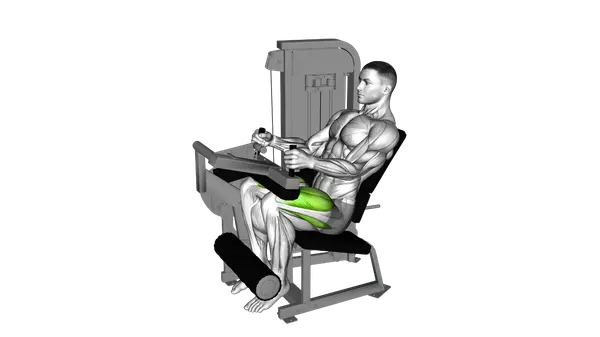
Leg extension alternatives replace a single-joint machine exercise that isolates the quadriceps through knee extension. Only another knee-extension exercise reproduces it closely, because squats and presses train the vasti well but load the rectus femoris far less. The right substitute depends on whether the goal is direct quadriceps isolation, overall thigh development, or training without a machine.

Veröffentlicht:

Was einen guten Ersatz ausmacht

The leg extension is an open-chain exercise: the foot moves freely while the knee straightens against a pad. Compared with squats and leg presses, it produces more rectus femoris activity, while those closed-chain lifts produce more vasti activity, and its quadriceps activity peaks near full knee extension [3].

The rectus femoris is the hardest part to replace. It crosses both the hip and the knee, so during squats and presses it lengthens at the hip while it shortens at the knee, which limits its contribution. Training studies reflect this: leg extension training increased rectus femoris volume by 13.2% versus 1.1% for the leg press, with similar vasti growth [1], and squat training at two depths produced no change in rectus femoris volume [5].

A close substitute therefore keeps knee extension as the main action and lets the quadriceps work near full extension. Compound exercises remain effective for the vasti, which make up most of the quadriceps, but a program without any knee-extension exercise leaves the rectus femoris largely untrained.

Lever Leg Extension

Beste Lever Leg Extension Alternativen

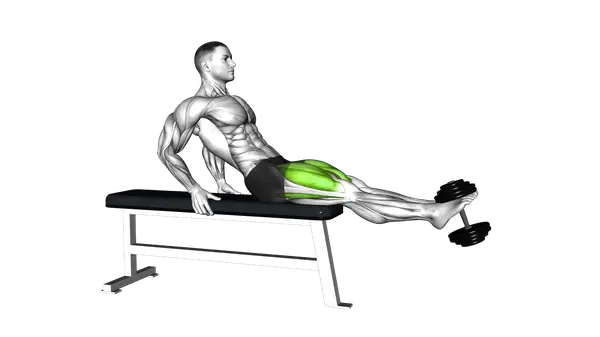
01 Dumbbell Sitting Leg Extension

Dumbbell Sitting Leg Extension

Quadrizeps · Kurzhantel · Fortgeschritten

Wichtigster Unterschied

This is the same knee-extension movement, performed seated on a bench with a dumbbell secured between the feet. Because gravity pulls straight down, resistance is highest when the shin is horizontal at full extension and close to zero when the shin hangs vertically, and the load is limited by how securely the feet can hold the dumbbell.

Wann du sie wählst

Choose this when no leg extension machine is available and direct rectus femoris work is the priority. Reclining the torso is a useful adjustment, since a 40-degree hip angle produced more rectus femoris growth than an upright 90-degree position in a leg extension study [4].


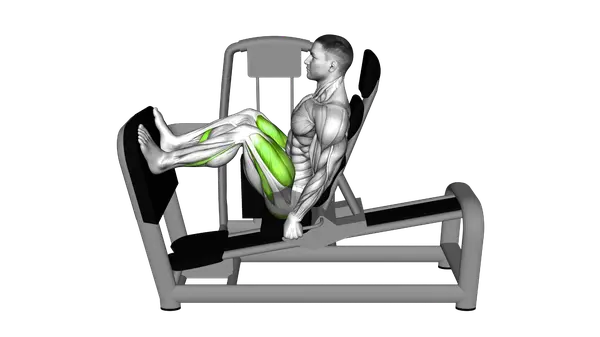
02 Lever Seated Leg Press

Lever Seated Leg Press

Quadrizeps, Beinbeuger, Gesäßmuskeln · Machine · Fortgeschritten

Wichtigster Unterschied

The leg press extends the hips and knees together, so it trains the glutes and adductors in addition to the quadriceps. In a direct comparison, it produced vasti and whole-quadriceps growth comparable to the leg extension, but almost no rectus femoris growth [1].

Wann du sie wählst

Choose this when overall quadriceps size is the goal and one machine should also cover the gluteus maximus and adductor magnus [1]. It also avoids the anterior cruciate ligament tension that the leg extension produces near full extension [3].

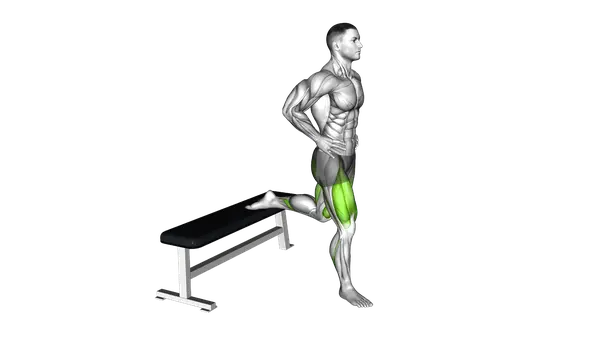
03 Bulgarian Split Squat

Bulgarian Split Squat

Gesäßmuskeln, Quadrizeps, Beinbeuger · Kurzhantel, Langhantel, Körpergewicht · Fortgeschritten

Wichtigster Unterschied

The Bulgarian split squat loads the front leg through a deep range of knee flexion, with the rear foot elevated on a bench. A shorter stance with the front knee traveling forward increases quadriceps demand, while a longer stance with more forward lean shifts work toward the glutes.

Wann du sie wählst

Choose this for quadriceps training with dumbbells or body weight only, especially when one leg is weaker than the other. Like other closed-chain exercises, it trains the vasti more than the rectus femoris [3], so it does not fully replace knee-extension work.

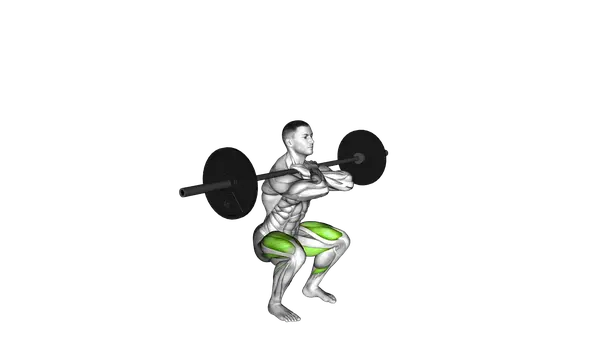
04 Barbell Front Squat

Barbell Front Squat

Quadrizeps, Gesäßmuskeln · Langhantel · Fortgeschritten

Wichtigster Unterschied

The front squat holds the bar on the front of the shoulders, which keeps the torso upright and requires deep knee flexion under heavy load. In a regional hypertrophy trial, Smith machine squats grew only the central vastus lateralis, while leg extensions grew all three measured regions of the rectus femoris [2].

Wann du sie wählst

Choose this when quadriceps training should also build heavy free-weight strength and glute development in one lift. It requires adequate ankle, hip, and upper-back mobility and a stable front-rack position, so it is less suitable for beginners than the goblet squat.

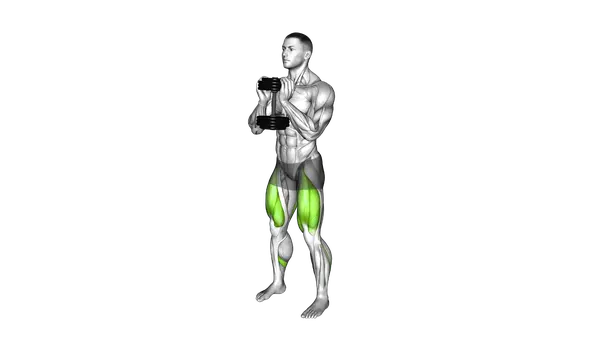
05 Dumbbell Goblet Squat

Dumbbell Goblet Squat

Quadrizeps, Gesäßmuskeln · Kurzhantel · Anfänger

Wichtigster Unterschied

The goblet squat holds one dumbbell at the chest, which counterbalances the body and allows a deep, upright squat. It trains the quadriceps, glutes, and adductors together, but squat training of this kind has not been shown to increase rectus femoris volume [5].

Wann du sie wählst

Choose this for home workouts, for beginners, or as a lighter quadriceps exercise that requires no machine. A slower lowering phase or a pause at the bottom increases difficulty when heavier dumbbells are not available.

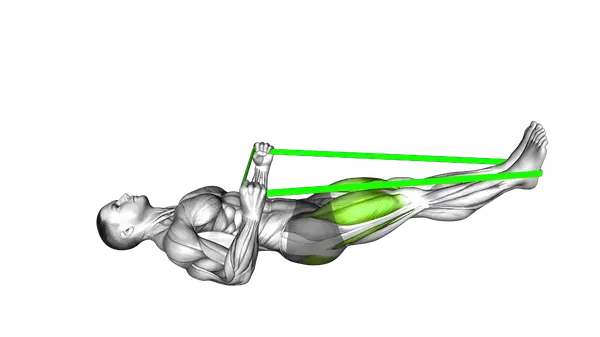
06 Resistance Band Lying Leg Press

Resistance Band Lying Leg Press

Quadrizeps, Gesäßmuskeln · Widerstandsband · Fortgeschritten

Wichtigster Unterschied

This band exercise is performed lying on the back, pressing the feet away against a looped band. Band tension rises as the knees straighten, so resistance is highest near full extension, the same region where quadriceps activity peaks in the leg extension [3].

Wann du sie wählst

Choose this for home, travel, or warm-up sets when no weights are available. Maximum resistance is limited, so it suits high repetitions better than heavy quadriceps training.

Zuhause trainieren

The dumbbell sitting leg extension is the only home option that keeps the knee-extension movement, and it needs only a bench or sturdy chair and one dumbbell. The Bulgarian split squat and goblet squat add compound quadriceps work with the same equipment, and the resistance band lying leg press works when no weights are available.

Das Fazit

The dumbbell sitting leg extension is the closest substitute because it keeps open-chain knee extension and direct rectus femoris loading. The leg press is the best machine alternative for overall quadriceps size, with vasti growth comparable to the leg extension plus glute and adductor growth, but it does not develop the rectus femoris [1]. Squats and split squats develop the vasti, glutes, and adductors effectively but leave the rectus femoris largely untrained, so a program that drops the leg extension should keep some form of knee-extension work. When open-chain knee extension has to be avoided, the leg press is the most practical replacement.

Was ist dein Fitnessziel?

Wähle eines aus und die App baut dein Programm darum herum, um deine Ausrüstung und um die Tage, an denen du trainieren kannst.

Gratis Download · 14 Tage Pro

Gut zu wissen

Häufige Fragen

What is the best alternative to the leg extension machine?

The dumbbell sitting leg extension is the closest alternative because it uses the same knee-extension movement. When a leg press is available, it produces comparable growth of the vasti muscles, although it trains the rectus femoris far less.

Can squats replace leg extensions?

Only partly. Squats train the vasti, glutes, and adductors well, but training studies show little to no growth of the rectus femoris, the quadriceps muscle that also crosses the hip. Leg extensions remain the most direct way to train that muscle.

How can I train the quads at home without a leg extension machine?

A dumbbell sitting leg extension on a bench or chair keeps the same knee-extension movement with one dumbbell. Bulgarian split squats and goblet squats add compound quadriceps work, and a resistance band lying leg press works when no weights are available.

Wissenschaftliche Quellen

  1. [1]
    Hypertrophic Effects of Single- versus Multi-Joint Exercise: A Direct Comparison between Knee Extension and Leg Press.

    Kinoshita M, Maeo S, Kobayashi Y et al. · Medicine and science in sports and exercise (2026)

  2. [2]
    The role of exercise selection in regional Muscle Hypertrophy: A randomized controlled trial.

    Zabaleta-Korta A, Fernández-Peña E, Torres-Unda J et al. · Journal of sports sciences (2021)

  3. [3]
    Biomechanics of the knee during closed kinetic chain and open kinetic chain exercises.

    Escamilla RF, Fleisig GS, Zheng N et al. · Medicine and science in sports and exercise (1998)

  4. [4]
    The effects of hip flexion angle on quadriceps femoris muscle hypertrophy in the leg extension exercise.

    Larsen S, Sandvik Kristiansen B, Swinton PA et al. · Journal of sports sciences (2025)

  5. [5]
    Effects of squat training with different depths on lower limb muscle volumes.

    Kubo K, Ikebukuro T, Yata H · European journal of applied physiology (2019)

Die Quellen sind begutachtete wissenschaftliche Publikationen von PubMed.