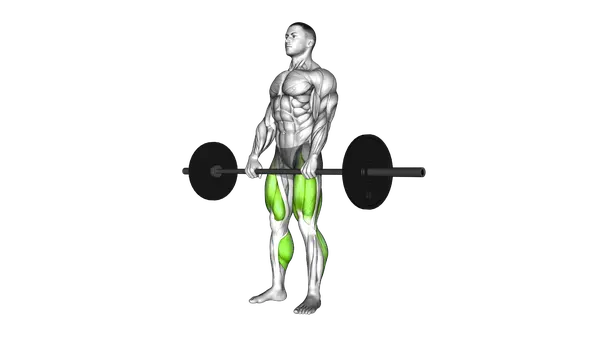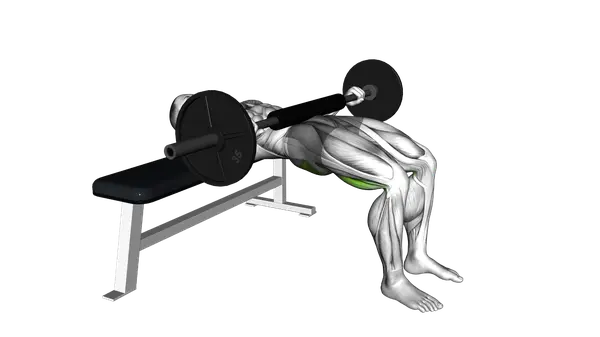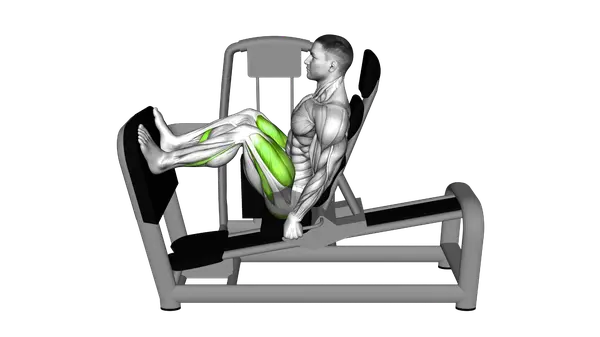
Übungsalternativen

Leg Press Alternatives: 6 Exercises for Quads and Glutes

Effective leg press alternatives train the quadriceps and glutes through combined knee and hip extension under heavy, progressive load. A substitute is needed when the machine is occupied or unavailable, when training at home, or when a free-weight lift with more carryover to standing movements is the goal. Free-weight options add balance and trunk demands that the seated machine removes, which changes both the training effect and the loads that can be used.

Veröffentlicht:

Was einen guten Ersatz ausmacht

The seated leg press extends the knees and hips together while the back and pelvis are supported, so the legs can be loaded heavily without balancing a bar or loading the spine. In a training study, the leg press increased the volume of the vasti, gluteus maximus, and adductor magnus, but not the rectus femoris, the quadriceps head that also crosses the hip [3].

A close substitute therefore needs a knee-dominant pattern with meaningful hip extension, a load that can be increased in small steps, and enough depth to involve the glutes. Foot placement on the leg press shifts emphasis: a high, wide stance increases hamstring activity, while turning the feet out has no measurable effect on muscle activity or knee forces [1].

Free-weight squats produce higher quadriceps and hamstring activity than the leg press, but also higher knee forces, and these forces rise with deeper knee flexion in both exercises [1]. Strength also transfers best to the exercise that was trained: squat training improved maximal squat strength more than leg press training did [2].

Lever Seated Leg Press

Beste Lever Seated Leg Press Alternativen

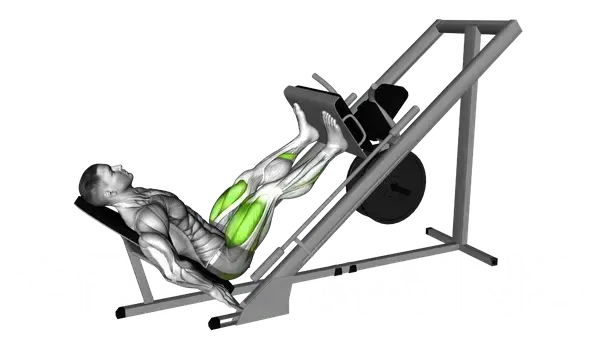
01 Sled 45 Degrees Leg Press

Sled 45 Degrees Leg Press

Quadrizeps, Beinbeuger, Gesäßmuskeln · Machine · Fortgeschritten

Wichtigster Unterschied

The 45-degree sled press uses the same movement with the body reclined and the sled traveling on an angled track. Muscle emphasis and foot-placement options are essentially the same as on the seated machine. Depth is limited by pelvic position: the lower back should stay against the pad, because rounding at the bottom shifts load onto the lumbar spine.

Wann du sie wählst

Choose this as a direct replacement when the seated machine is occupied or unavailable. It keeps the stable, supported setup that allows sets to be taken close to failure without balance or spinal-loading limits.


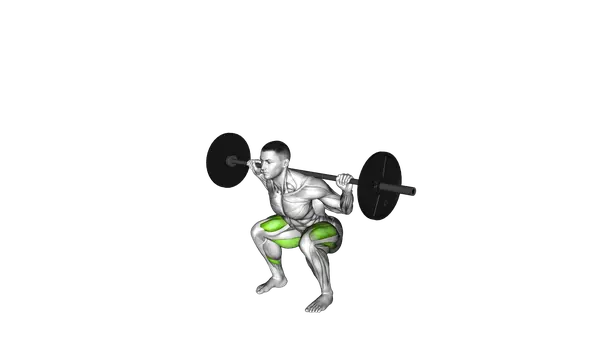
02 Barbell Squat

Barbell Squat

Quadrizeps, Gesäßmuskeln, Beinbeuger · Langhantel · Fortgeschritten

Wichtigster Unterschied

The back squat trains the same muscles without back support, so the trunk, spinal erectors, and balance contribute to every repetition. It produces higher quadriceps and hamstring activity than the leg press, along with generally greater tibiofemoral and patellofemoral compressive forces [1].

Wann du sie wählst

Choose this when strength in standing movements matters, since squat training improves maximal squat strength more than leg press training does [2]. It requires more technical practice than the machine and is less suitable when spinal loading or knee compression has to be limited.

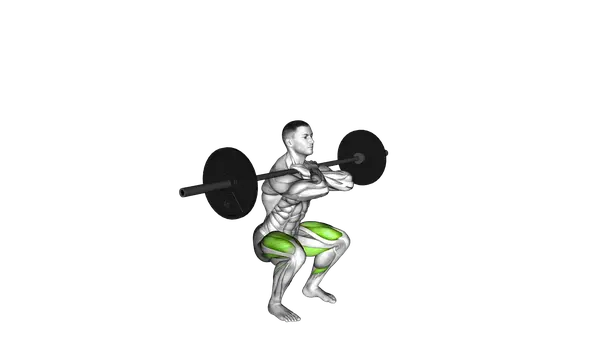
03 Barbell Front Squat

Barbell Front Squat

Quadrizeps, Gesäßmuskeln · Langhantel · Fortgeschritten

Wichtigster Unterschied

The front squat holds the bar on the front of the shoulders, which requires a more upright torso than the back squat. In trained lifters it recruited the leg muscles as effectively as the back squat while producing lower knee compressive forces and knee extensor moments [5].

Wann du sie wählst

Choose this when a barbell squat is wanted but knee joint load is a concern, or when an upright torso is easier to maintain. The usable load is lower than in the back squat because it depends on upper-back strength and a stable front-rack position.

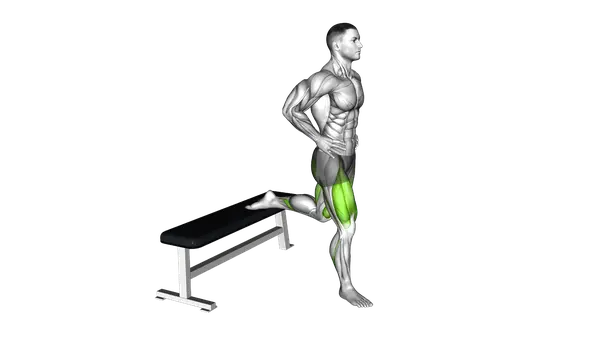
04 Bulgarian Split Squat

Bulgarian Split Squat

Gesäßmuskeln, Quadrizeps, Beinbeuger · Kurzhantel, Langhantel, Körpergewicht · Fortgeschritten

Wichtigster Unterschied

The Bulgarian split squat trains one leg at a time with the rear foot on a bench. Force-plate data show that the front leg produces about 84% of the total vertical force, which confirms it as a true single-leg exercise [4].

Wann du sie wählst

Choose this when only dumbbells are available, when side-to-side strength differences need attention, or when a demanding leg exercise is needed with light absolute loads. It requires more balance and hip control than the leg press, so the first sessions should use conservative loads.

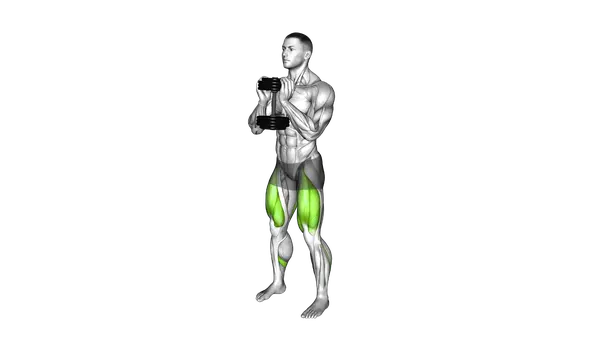
05 Dumbbell Goblet Squat

Dumbbell Goblet Squat

Quadrizeps, Gesäßmuskeln · Kurzhantel · Anfänger

Wichtigster Unterschied

The goblet squat holds one dumbbell vertically against the chest. The front-loaded weight acts as a counterbalance, which makes a deep, upright squat easier to learn than with a barbell, but the load is limited by the heaviest dumbbell that can be held at the chest.

Wann du sie wählst

Choose this for home training, for beginners learning the squat pattern, or for higher-repetition leg work without a machine. Once the dumbbell becomes too light for the target repetitions, a split squat or barbell squat provides more resistance.

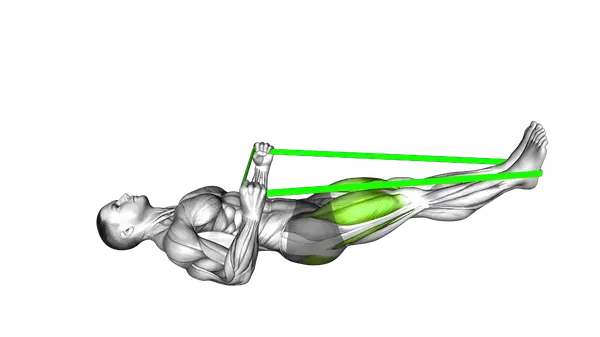
06 Resistance Band Lying Leg Press

Resistance Band Lying Leg Press

Quadrizeps, Gesäßmuskeln · Widerstandsband · Fortgeschritten

Wichtigster Unterschied

This version is performed lying on the back with a band looped around the feet, pressing the legs away from the body. Band tension increases as the band stretches, so resistance is lowest in the deep, flexed position and highest near full knee extension, the reverse of the machine, where knee forces rise with deeper knee flexion [1].

Wann du sie wählst

Choose this for home or travel training, warm-up sets, or high-repetition work. Bands cannot match machine loads, so this option maintains leg training rather than building maximal strength.

Zuhause trainieren

The dumbbell goblet squat, Bulgarian split squat, and resistance band lying leg press all work at home. The Bulgarian split squat is the most demanding of the three because most of the load falls on one leg, which compensates for the lighter dumbbells usually available outside a gym.

Das Fazit

The 45-degree sled leg press is the closest replacement because it keeps the same supported movement and loading potential. Without any leg press, the back squat is the strongest free-weight substitute, with higher muscle activity and better transfer to squat strength, at the cost of more spinal and knee loading [1][2]. The front squat suits lifters who want lower knee forces, and the Bulgarian split squat is the most effective option with dumbbells only. The goblet squat and band leg press are best treated as entry-level or home options.

Was ist dein Fitnessziel?

Wähle eines aus und die App baut dein Programm darum herum, um deine Ausrüstung und um die Tage, an denen du trainieren kannst.

Gratis Download · 14 Tage Pro

Gut zu wissen

Häufige Fragen

What is the best alternative to the leg press?

The 45-degree sled leg press is the closest alternative because it uses the same movement with a supported back. Without any leg press machine, the barbell back squat is the most effective free-weight substitute for the quadriceps and glutes.

Is the squat better than the leg press?

Neither is better in every respect. The squat produces higher quadriceps and hamstring activity and transfers better to standing strength, while the leg press allows heavy leg training with less balance demand and no spinal loading from a bar. Many programs include both.

What can replace the leg press at home?

The Bulgarian split squat is the most effective home replacement, because loading one leg at a time makes light dumbbells challenging. The goblet squat and the resistance band lying leg press are easier options for beginners or higher-repetition sets.
Wissenschaftliche Quellen

  1. [1]
    Effects of technique variations on knee biomechanics during the squat and leg press.
    Escamilla RF, Fleisig GS, Zheng N et al. · Medicine and science in sports and exercise (2001)

  2. [2]
    Strength, body composition, and functional outcomes in the squat versus leg press exercises.

    Rossi FE, Schoenfeld BJ, Ocetnik S et al. · The Journal of sports medicine and physical fitness (2018)

  3. [3]
    Hypertrophic Effects of Single- versus Multi-Joint Exercise: A Direct Comparison between Knee Extension and Leg Press.

    Kinoshita M, Maeo S, Kobayashi Y et al. · Medicine and science in sports and exercise (2026)

  4. [4]
    Is the Rear Foot Elevated Split Squat Unilateral? An Investigation Into the Kinetic and Kinematic Demands.

    Helme M, Emmonds S, Low C · Journal of strength and conditioning research (2022)

  5. [5]
    A biomechanical comparison of back and front squats in healthy trained individuals.

    Gullett JC, Tillman MD, Gutierrez GM et al. · Journal of strength and conditioning research (2009)

Die Quellen sind begutachtete wissenschaftliche Publikationen von PubMed.