Exercises that build power, control and chest strength through instability
Chest exercises with medicine ball
Medicine ball chest exercises add instability, coordination, and dynamic resistance to traditional upper-body movements. This makes them highly effective for developing power, stability, and functional strength across the chest and shoulders. These variations challenge your ability to control force while maintaining tension, offering a unique way to build stronger and more reactive pushing mechanics.

Single-Arm Medicine Ball Push-Up
The Single-Arm Medicine Ball Push-Up is a push-up variation that challenges strength, balance and control by using one arm.
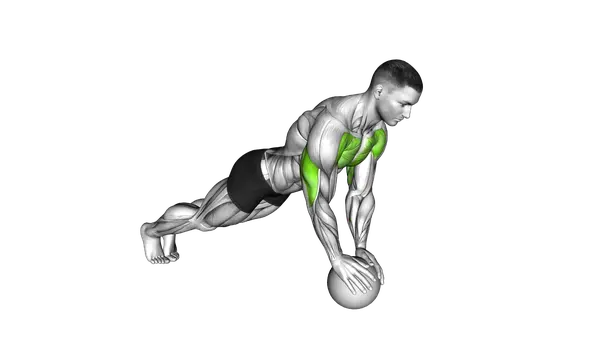
Two Arm Medicine Ball Push-Up
The Two Arm Medicine Ball Push-Up is a bodyweight exercise that builds chest, triceps and core strength while challenging stability.
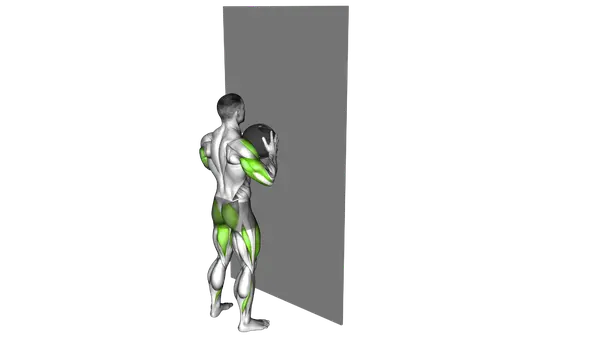
Wall balls
The Wall Balls are a full-body exercise that combines a squat and overhead throw to build leg strength, power, and coordination.
Why medicine balls improve stability, power and muscular activation
Benefits of training chest with a medicine ball
Medicine ball movements create an unstable contact point or dynamic load, forcing the chest, shoulders, core, and stabilizers to work harder. This enhances force control and improves muscular coordination. Whether used in push-up variations or explosive throws, medicine balls provide a versatile training stimulus that supports strength, athletic conditioning, and movement efficiency.
Key advantages:
- Improved chest activation through instability and uneven loading
- Increased core engagement during pressing patterns
- Effective for explosive strength and power-based training
- Joint-friendly resistance suitable for beginners and advanced athletes
- Versatile progressions for strength, HIIT, and functional training
How these movements fit into your weekly routine
When to use medicine ball chest exercises
Medicine ball chest exercises work well as accessory movements during push or upper-body days. They can serve as a warm-up to prime the shoulders and chest, as a stability-focused progression for push-ups, or as explosive power work in conditioning sessions. Most lifters incorporate medicine ball training one to three times per week, adjusting intensity depending on whether the goal is stability, hypertrophy, or power.
Key medicine ball chest exercises
Below are the five most valuable medicine ball chest exercises on this page. These movements combine instability, dynamic loading, and tension control to build chest strength and coordination.
- Single-arm medicine ball push-up: Adds unilateral instability to challenge the chest, triceps, and core, improving control and strength asymmetry.
- Two-arm medicine ball push-up: Increases instability through a centered contact point, enhancing chest activation and upper-body power.
- Wall balls: A dynamic movement that trains chest, shoulders, and full-body coordination through explosive throwing mechanics.
- Medicine ball chest throw: An explosive upper-body power drill that targets the chest and triceps while improving force production and speed.
- Medicine ball squeeze push-up: Combines chest pressing with isometric squeezing of the ball, increasing inner-chest activation and stability demands.
Exercise overview
| Exercise | Primary focus | Training goal |
|---|---|---|
| Single-arm medicine ball push-up | Chest + unilateral stability | Strength and control |
| Two-arm medicine ball push-up | Chest + core | Strength and hypertrophy |
| Wall balls | Chest + shoulders + conditioning | Power and endurance |
| Medicine ball chest throw | Chest + triceps | Explosive power |
| Medicine ball squeeze push-up | Inner chest + stability | Hypertrophy and control |
Placing these movements inside your program
How to integrate medicine ball chest exercises
Medicine ball chest exercises work well at the end of a strength session or as dynamic primers at the start of a workout. Stability-based variations pair well with regular push-up or bench-press training, while explosive throws fit naturally into HIIT or athletic conditioning sessions. Use moderate to high repetitions for stability exercises and lower reps for power-focused movements. Create your personal training program in the app tailored to your goals, fitness level, and schedule.
Frequently asked questions about chest exercises with medicine ball
Medicine ball movements add valuable instability and power training but do not fully replace pressing variations like barbell or dumbbell exercises. They are best used as complementary exercises for improving athleticism and control.
Training one to three times per week is effective depending on your goals. Stability exercises can be done frequently, while explosive power movements should be rotated to avoid fatigue.
Focus on technique, tension, and controlled movement paths. Use stability variations to challenge coordination and explosive movements to develop power. Adjust rep ranges based on whether your goal is stability, strength, or conditioning.
Medicine ball chest exercises primarily target the pectoralis major while also challenging the triceps, front delts, core, and stabilizing muscles. Instability-based variations increase chest activation, while explosive throws recruit the entire upper-body push chain.
Start with a light medicine ball that allows you to control the movement without losing form. For push-up variations, ball size affects difficulty more than weight. For throws, choose a weight that allows explosive movement without slowing you down.
Find related pages
Explore related exercises, workouts, and routines to expand your training and reach your goals more efficiently.