2 Day Workout Split for Strength and Muscle
A practical 2 day workout split with full-body and upper/lower plans, sets and reps, spacing, progression, and home swaps for busy lifters. Your calendar is already crowded. Work, family, and a run or sports practice may leave only two realistic windows for lifting. A 2 day workout split can still be a complete plan: train your whole body in both sessions, leave time to recover, and progress with good form instead of trying to cram a full bodybuilding week into marathon workouts.
This approach can build muscle and strength when you choose manageable exercises and repeat them consistently. The key is not to make both days identical or fill every spare minute with accessories. It's to cover the major movement patterns, get useful work done, and leave enough energy to do it again.
Who a 2 Day Workout Split Is For
Two lifting sessions fit a week that already has other demands. If your work schedule shifts, your family needs your time, or you're training for a sport, a plan built around two dependable sessions may be easier to maintain than one that assumes you can get to the gym often. Beginners can also use two days to learn the basic movements without turning every week into a test of scheduling discipline.
This setup works well for people who run, cycle, or train for HYROX and want strength work to support their sport rather than compete with it. You can develop strength and muscle while keeping room for sport-specific practice and recovery. Both sessions should train the whole body, so your legs, pushing muscles, pulling muscles, and trunk don't rely on a single weekly appointment.
The important distinction is what you cover, not how many days you show up. A chest-and-arms day followed by a leg day can leave other major muscle groups undertrained. In a 2025 survey of 235 adults, 55.7% reported muscle-strengthening activity on at least two days a week, while 26.8% met all three guideline elements: at least two days, moderate-or-greater intensity, and involvement of all major muscle groups (survey on muscle-strengthening activity and guideline adherence). The practical lesson is straightforward: two sessions count for more when they cover the whole body at a meaningful effort.
Built for progress
Take the guesswork out of training
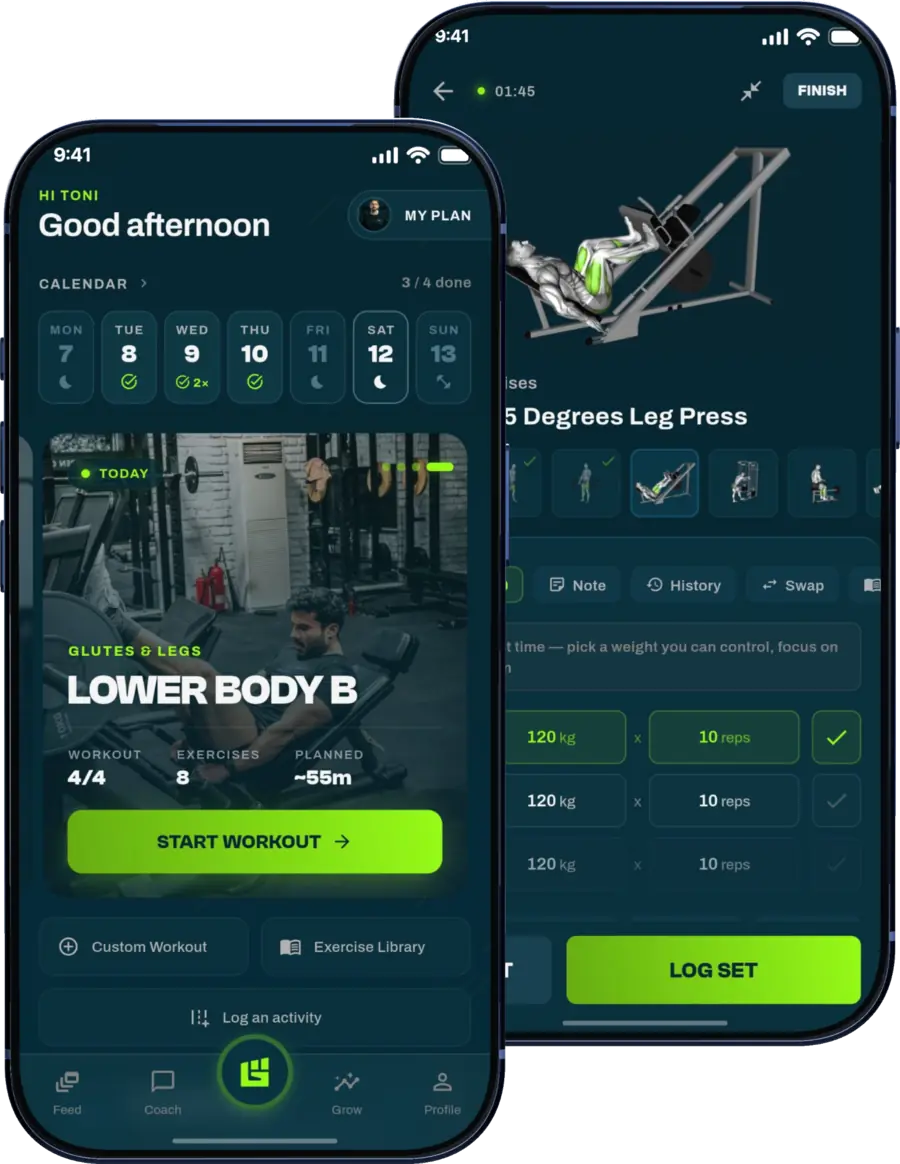
Get a personalized workout plan built around your goal, equipment and schedule. Train smarter, track every rep and keep moving forward, one workout at a time.






A realistic fit check
Ask yourself whether you can reliably protect two training windows and recover between them. If you can, and you're willing to make both workouts balanced, this split can support your goals without requiring a complicated weekly schedule. For general health, the World Health Organization's guidance calls for muscle-strengthening activities involving all major muscle groups on at least two days each week (WHO physical activity guidelines).
You should finish a well-built two-day plan knowing which movements train each part of your body, how to make progress without rushing, and what signs suggest the schedule is working for you. If your life can support two consistent sessions, the next decision is how to divide the exercises across them.
How a 2 Day Workout Split Covers the Body
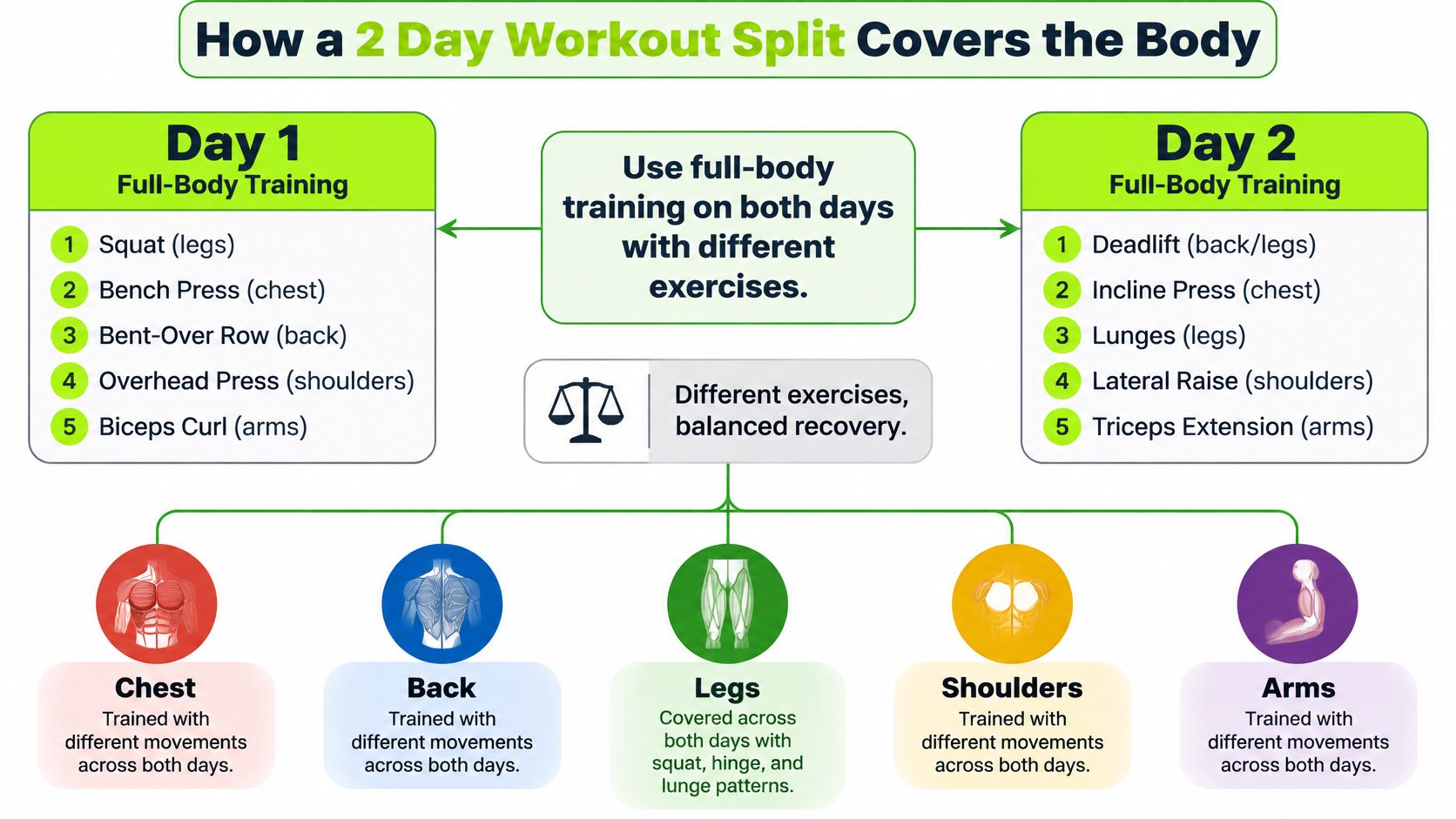
For a solid default, train the whole body in both sessions, using different exercises or different emphases. That gives each major muscle group regular practice without dedicating an entire session to only one area. A two-day structure can follow this pattern:
- Day A: Squat pattern, horizontal push, horizontal pull, hip-hinge accessory, and core work.
- Day B: Hip hinge, vertical push, vertical pull, single-leg exercise, and an arm movement.
This isn't a rule that every exercise must be heavy or every muscle needs several isolation movements. It's a way to make sure the basics are represented across the week. A squat and a split squat train the legs in different ways; a bench press and an overhead press give you distinct pushing patterns. Rows and pulldowns cover pulling work, while planks or another trunk exercise add direct core training.
Spread the work so sets stay productive
For muscle growth, a useful starting point is about 10 weekly sets per muscle group, divided into roughly five sets in each session. Beginners can start lower and build gradually as their technique and recovery improve. That's a starting point, not a requirement to perform the same number of sets for every muscle regardless of schedule or experience. The ACSM guidance on resistance training supports training on at least two non-consecutive days per week.
Splitting work across two sessions can help preserve set quality by reducing the amount of local fatigue that piles up in one workout. Training frequency alone doesn't meaningfully increase hypertrophy when weekly volume is equal, so the point isn't that two exposures magically create more growth. The practical benefit is that you can distribute the work and practice movements without needing frequent gym visits.
Space sessions with at least two rest days between them, such as Monday and Thursday. That schedule leaves room to recover before repeating full-body work, while giving your training week a dependable rhythm. For more guidance on choosing exercises and structuring strength sessions, explore weight training tools and guidance.
Full Body and Upper Lower 2 Day Plans
The full-body A/B plan is the recommended starting point for most lifters. Each day covers the main patterns, but the exercises vary so you don't have to repeat the same workout twice. Choose one listed variation for each movement based on your equipment and experience.
Full-body A/B 2 day workout split
| Day | Exercise pattern | Sets | Reps |
|---|---|---|---|
| A | Goblet squat or back squat | 2–3 | 8–12 |
| A | Bench press or push-up | 2–3 | 8–12 |
| A | Seated row or dumbbell row | 2–3 | 8–12 |
| A | Romanian deadlift | 2–3 | 8–12 |
| A | Plank | 2–3 | 20–45 seconds |
| B | Deadlift or another hip-hinge variation | 2–3 | 6–10 |
| B | Overhead press | 2–3 | 8–12 |
| B | Pull-up or lat pulldown | 2–3 | 8–12 |
| B | Split squat or lunge | 2–3 | 8–12 per leg |
| B | Arm exercise, such as a curl | 1–2 | 10–15 |
The table is a menu, not a demand to use the most challenging variation. Choose a load you can control and leave enough in reserve to maintain sound technique. For example, if your session is limited, use a simple squat variation, a press, a row, a hinge, and a core exercise before adding optional arm work.
Upper/lower as an alternative
An upper/lower plan may fit if your equipment or preferences make it easier to focus on one body region per session. Its trade-off is that each major region receives a dedicated workout on only one day, so the sessions can feel more concentrated. Keep the plan balanced and avoid turning either workout into an oversized list.
| Day | Exercise pattern | Sets | Reps |
|---|---|---|---|
| Upper | Bench press or push-up | 2–3 | 8–12 |
| Upper | Row | 2–3 | 8–12 |
| Upper | Overhead press | 2–3 | 8–12 |
| Upper | Pull-up or lat pulldown | 2–3 | 8–12 |
| Lower | Squat or leg press | 2–3 | 8–12 |
| Lower | Romanian deadlift or hinge | 2–3 | 8–12 |
| Lower | Split squat or lunge | 2–3 | 8–12 per leg |
| Lower | Calf raise or hamstring curl | 1–2 | 10–15 |
Trying to fit a large number of weekly sets for many muscles into two workouts can make sessions drag and weaken the quality of late exercises. Instead, use a minimum effective dose, prioritize compound movements, and rotate emphasis. Day A can lean slightly toward squat and push work; Day B can lean toward hinge and pull work. A workout planner app can help organize sessions around your available time. Depending on exercise choices and rest periods, expect a session to take roughly 45–75 minutes, then adjust the menu if you're consistently running short on time.
An 8 Week Example for Different Goals
Eight weeks is long enough to judge whether a two-day split is working and short enough to stay focused. Keep the same full-body A/B structure as your base, then tune two variables: how hard the main lifts feel and how much accessory work each day carries. Treat this as a working template you adjust as you go.
A simple eight-week progression
| Phase | Focus |
|---|---|
| Weeks 1–2 | Learn each movement with moderate weights and clean repetitions. Keep the exercise choices familiar and pay attention to technique. |
| Weeks 3–7 | Build the workload step by step, letting Day A and Day B advance at their own pace instead of forcing them to move together. |
| Week 8 | Use a lighter week, review how the sessions felt, and prepare the next block. |
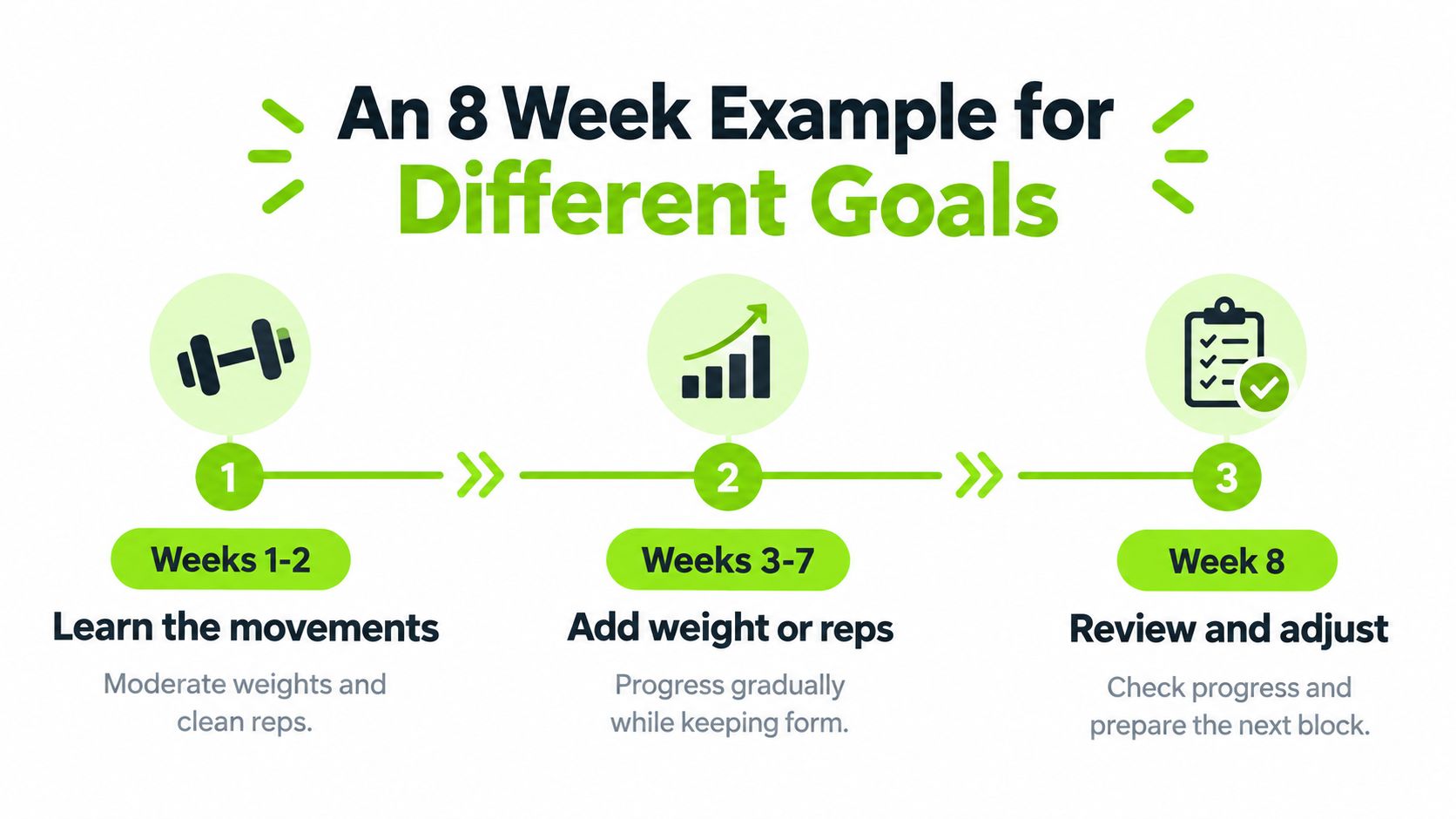
The block runs like a short season: practice, build, review. Skipping the practice phase to chase heavier numbers early is the most common way this plan goes wrong.
Adjust the emphasis without rebuilding the plan
Different goals turn the same two dials. For hypertrophy, keep most work in moderate rep ranges and build useful weekly sets while keeping both days lean enough to stay sharp. For strength, put the heavier compound lifts first in each session and follow with moderate-load accessories. As a working example, an experienced lifter might handle roughly 70–90% of one-repetition maximum on heavy sets, while a beginner sits nearer 60–70% until technique is consistent.
A practical strength arrangement is a squat, bench press, row, and Romanian deadlift on Day A, then a hinge variation, overhead press, split squat, and pull-up on Day B. Keep most sets shy of failure so the exercises at the end of the session still move well. For endurance or HYROX training, keep the same strength patterns and add a carry, step-up, or short conditioning finisher if it fits your recovery.
Beginners can run fewer exercises in the 8–12 repetition range, using a load that allows controlled repetitions from the first session. That range is a practical starting point in the ACSM progression model for resistance training. If nutrition is part of the block, find your ideal protein intake to set a daily target before week one starts.
How to Progress Sets Weight and Recovery
Progress on two days a week works like interest on a small savings account: the deposits are modest, so consistency matters more than size. Because each session carries a minimum effective dose rather than a marathon's worth of volume, your job is to nudge one variable at a time.
Start with load. When you finish every prescribed set at the top of its rep range with stable form, add weight at your next session. If the jump costs you control or repetitions, stay at the current load and build reps first. Small, repeatable increases beat ambitious jumps that stall within a fortnight.
Then judge each day on its own. Your Day A squat pattern might climb steadily while your Day B hinge needs another week of practice, or one workout may recover faster than the other. A date on the calendar is not a reason to raise both days at once.
Progression rule: Add a set only when you recover well between sessions and your working weights are still moving upward. If recovery or performance is slipping, keep the workload steady rather than adding more.
Warm up with a few easy minutes of movement, then run lighter sets of your first compound lift before reaching the working load. Between sets, rest long enough to repeat the effort with the same control: heavy multi-set compounds usually call for a few minutes, while accessories can use shorter rests. As the resistance-exercise guidance cited earlier indicates, longer rests serve heavier work.
Make small adjustments, not wholesale changes
For weak points, pick one or two accessories per session. Face pulls or rear-delt flyes support the upper back and shoulders; lateral raises, hamstring curls, calf raises, or a trunk drill like planks or dead bugs fill other gaps. Rotate them as needed. Cramming every option into one workout is how a two-day plan turns into the marathon session this split is designed to avoid.
Two weekly sessions make a sound starting frequency when both cover the major movement patterns, so begin with manageable sets and add training demands gradually. If you want help spotting whether one day has stalled, a weekly review from your AI coach can look at your logged performance and suggest whether to change load, reps, or sets. For a strength-focused starting estimate, you can also review the 1RM benchmarks proposed for Navilo Health.
Home Swaps Tracking and Moving Days
You don't need a full gym to preserve the structure of a two-day plan. Swap exercises one for one, keeping the movement pattern rather than chasing the exact equipment. A backpack or dumbbell can replace a barbell squat; a kettlebell or band can work for hip hinges; push-ups or floor presses can stand in for a bench press.
| Gym movement | Home alternative |
|---|---|
| Barbell squat | Backpack squat or dumbbell squat |
| Cable or barbell row | Backpack row or band row |
| Bench press | Push-up or floor press |
| Overhead press | Pike push-up or dumbbell press |
| Leg machine | Split squat or lunge |
| Deadlift variation | Kettlebell or band hip hinge |
Check that both days still include a squat or lunge, a hinge, horizontal and vertical pushing and pulling, and trunk work. If you're training for HYROX, maintain those strength patterns and add a carry or step-up where appropriate, rather than turning the workout into a race simulation.
Log each set with the load in kilograms and pounds, the repetitions completed, and a short note about whether your form stayed solid. Then compare Day A with its previous sessions and Day B with its own. A workout tracker can keep those records organized so you're not relying on memory to judge progress.
If a planned session moves, choose another day that still leaves at least two rest days before the next workout. Consider adding a third day later only if both current sessions feel easy, stay short, and you're recovering exceptionally well over several weeks. Until then, improve the plan you can sustain.
Build Your 2 Day Split with GrabGains
A useful plan starts with the week you have, not an ideal schedule that keeps falling apart. With GrabGains, you set how many days you train and how long each session can last. The app recommends a split and plans each workout around that time, with options suited to goals such as muscle growth, strength, endurance, or support for HYROX. You can move a workout to another day if your week changes, while keeping enough time between sessions to recover.
The exercise library includes form videos and instructions for choosing home or gym alternatives. Logging each set helps you track Day A and Day B separately, while a weekly review from the AI coach can help you assess whether to change weight, repetitions, or volume. Strength-focused trainees can also use the platform's 1RM calculator as a starting point for estimating loads.
Pick Monday and Thursday, or another pair of days with two rest days between them. Choose full-body A/B unless an upper/lower schedule better matches your equipment or preferences, then use the opening weeks to practice the movements before increasing the challenge.
Use GrabGains to set your training days and session length, build a two-day plan, and log your workouts as you progress. Choose your first two training days and start your next block with a plan you can repeat.
Get inspired and motivated