Strength Training for Women Over 50: A Safe Start
Discover practical strength training for women over 50 to boost bone health, balance, and confidence. Start with simple moves designed for your body. You've finished work, changed into comfortable clothes, and found the dumbbells you bought with good intentions. Then the questions start. Should you squat or stretch first? How heavy is heavy enough, and what should you do when you've slept badly?
Strength training for women over 50 doesn't need to start with a complicated routine or a test of willpower. It starts with manageable exercises, repeatable sessions, and a way to recognize progress that goes beyond the bathroom mirror.
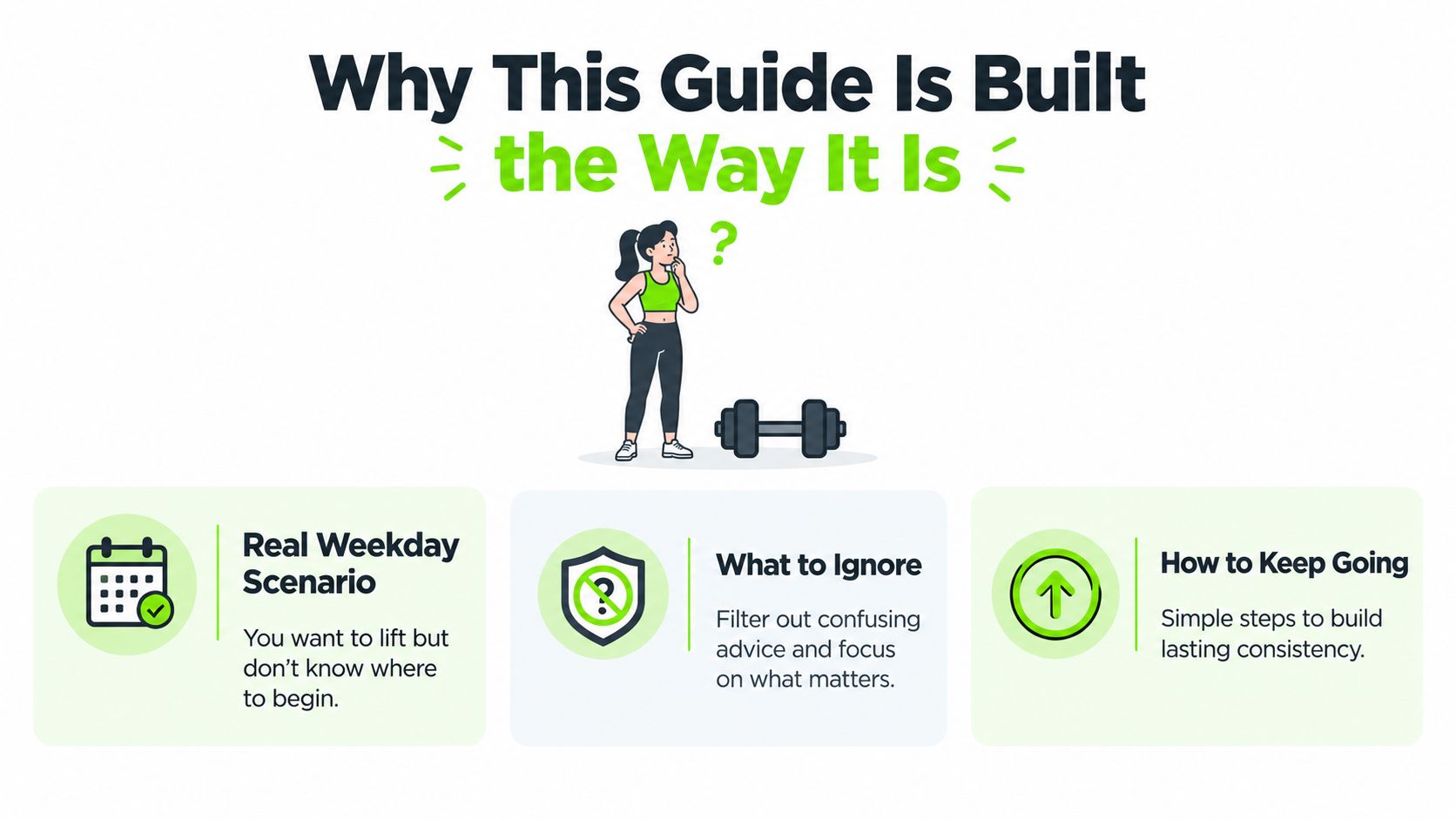
Why This Guide Is Built the Way It Is
Conflicting fitness advice can make a simple workout feel like an exam. One routine tells you to lift heavy immediately; another suggests avoiding anything challenging. Neither approach helps you choose what to do on an ordinary weekday when your energy, time, and equipment are limited.
A more useful starting point is manageable resistance, controlled movement, and a schedule you can repeat. You don't need to prove how strong you already are. You need a starting point that lets you practice and gradually do more.
Built for progress
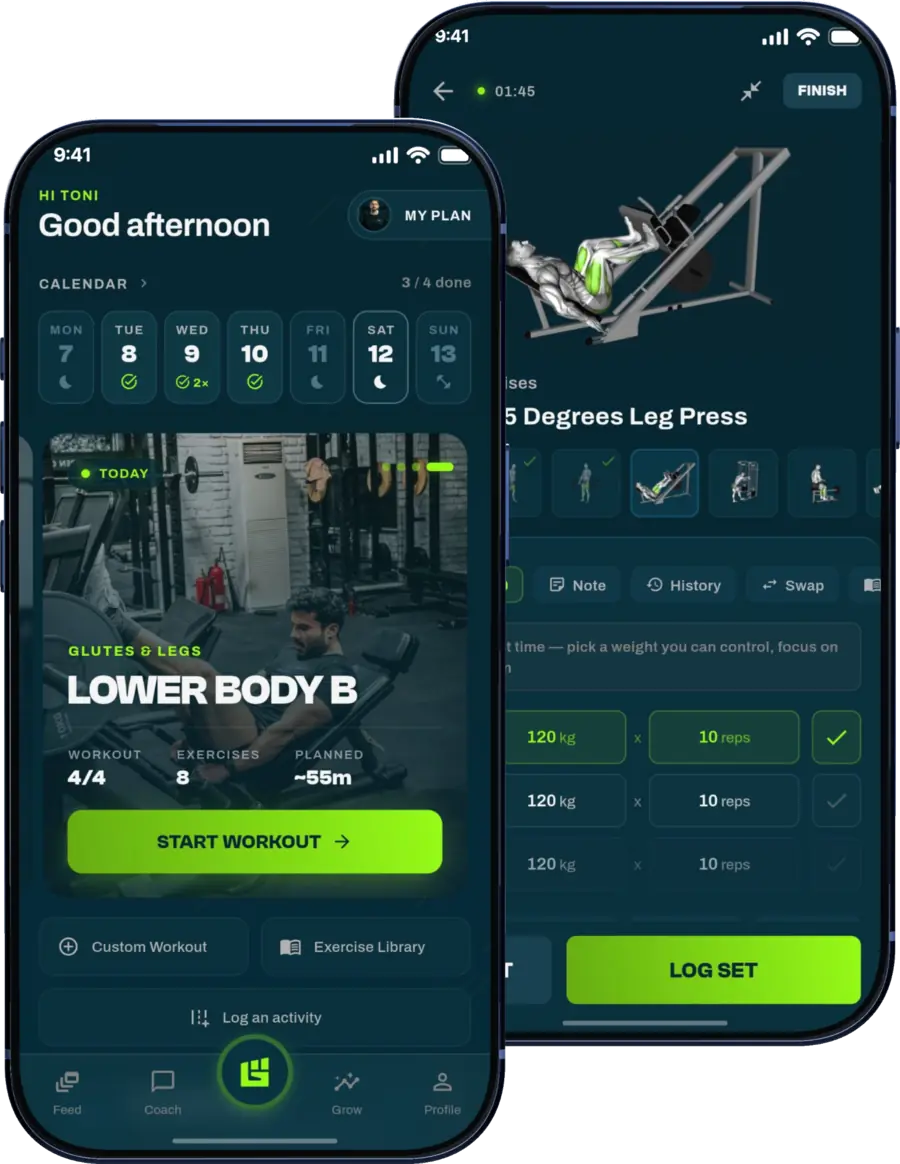
Take the guesswork out of training
Get a personalized workout plan built around your goal, equipment and schedule. Train smarter, track every rep and keep moving forward, one workout at a time.






Start with useful outcomes
Think about what you want strength to help you do. Perhaps you want to lift a suitcase without hesitation, get out of a low chair comfortably, or feel steadier while carrying shopping.
Those goals give your workouts a practical purpose. They also help you judge whether an exercise belongs in your routine: does it challenge a useful movement, and can you perform it with control?
The World Health Organization's physical activity guidelines recommend muscle-strengthening activity involving all major muscle groups on at least 2 days per week; for adults 65 and older, they also recommend varied activity emphasizing functional balance and strength on 3 or more days per week. That's a foundation for regular movement, not a demand to begin with exhausting workouts.
Separate strength from appearance
Getting stronger and gaining visible muscle aren't identical outcomes. You might handle resistance more confidently or move more effectively before noticing any change in your arms, legs, or waist.
A systematic review involving older women with sarcopenia found improvements in strength and physical performance without a significant improvement in skeletal-muscle-mass index. Those findings apply to that studied population, but they illustrate why the mirror alone is an incomplete progress check.
Judge your training by what you can do, not only by what you can see.
This distinction matters when motivation dips. If you're completing cleaner repetitions or using resistance that previously felt difficult, don't dismiss that progress because your clothes fit the same.
Keep your attention on a few practical priorities:
- Practice before pushing. Learn the movement with resistance you can control.
- Make attendance realistic. Choose training days that fit your actual responsibilities.
- Record the work. Write down the exercise, resistance, repetitions, and how the session felt.
- Stay flexible. Adjust the day's challenge rather than forcing yesterday's expectations onto today's body.
A useful plan has structure without rigidity. Your movement patterns can stay familiar while the resistance, exercise variation, or amount of work changes with your readiness.
Safety First and a 5-Minute Warm-Up You Can Reuse
The first safety skill isn't choosing the lightest dumbbell. It's recognizing whether you're controlling the movement or compensating to finish it. If a repetition requires a sudden jerk, a rushed descent, or a strained position, make the exercise easier.
The National Institute on Aging's guidance on strength training recommends building up slowly, warming up with lighter or no weight, listening to your body, and stopping if exercise causes pain. Use those principles as decisions you make during the workout, not just advice you read beforehand.
Rehearse before adding resistance
Use this warm-up sequence as a practical starting routine. Begin with 5 minutes of light walking or cycling, then rehearse the movements below and finish with one or two light sets of your first exercise. The movement preparation adds time beyond the initial cardio.
- Hip hinges. Soften your knees and send your hips backward, as though closing a drawer behind you. Keep your back in a comfortable, steady position.
- Bodyweight squats to a box. Sit toward a stable chair or box, then stand without dropping onto the seat. Use a height that lets you stay controlled.
- Arm circles. Move through a comfortable range rather than forcing your shoulders into a large circle.
- Band pull-aparts. Gently separate the band without shrugging or flaring your ribs. Choose a light band so the movement stays smooth.
- Practice sets. Rehearse your first loaded exercise with little resistance before using your working weight.
The walking or cycling gets you moving; the rehearsals let you check how your hips, shoulders, and main exercises feel that day. On a rushed morning, shorten the workout itself rather than skipping directly to challenging weights.
Use clear stop and adjustment signals
Keep breathing throughout each repetition. Let your spine stay in a comfortable, stable position, and choose a range of motion you can control without forcing depth.
Ease back when you notice:
- Pain during movement. Stop the painful repetition instead of trying to finish the set.
- Loss of balance. Add stable support or choose a seated variation.
- Technique changes. Reduce resistance if you're twisting, bouncing, or rushing.
- Unusual fatigue. Use a simpler session when even your warm-up feels demanding.
For additional warm-up ideas, AloeCure's injury prevention warm-up tips offer a supplementary resource. A stretching routine can also help organize flexibility work, but stretching and preparing to lift serve different purposes.
Why Strength Matters After 50
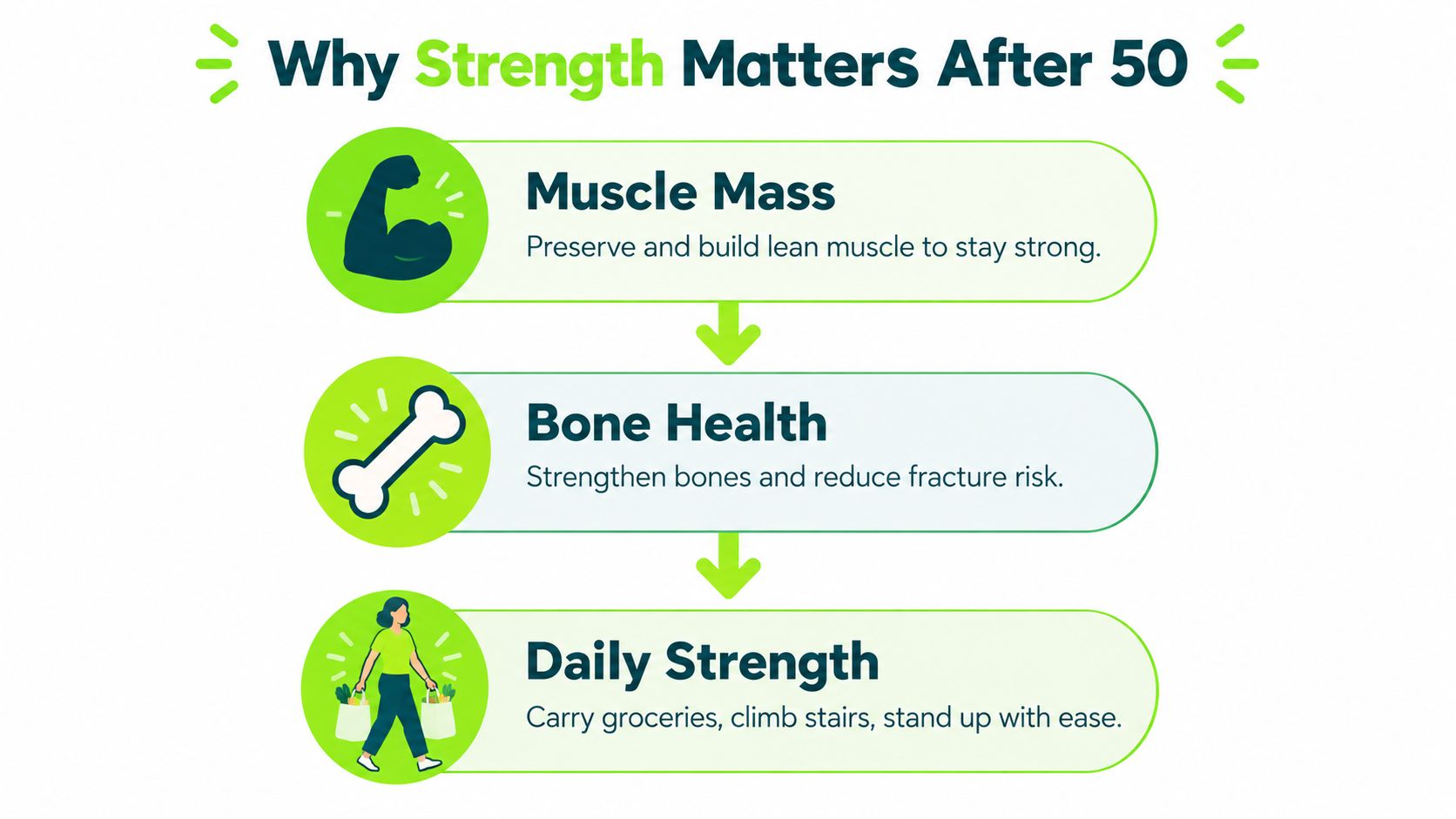
A grocery bag doesn't care whether you train at home or in a gym. Carrying it still requires you to grip, stabilize your trunk, and produce force through your legs and upper body.
That's the practical value of resistance training: you practice producing force in movements that have everyday counterparts. Squatting resembles sitting down and standing up; a row involves pulling; a carry challenges you to move while holding a load.
Muscle and bone need different expectations
Resistance training can support muscle maintenance and daily function, but bone-related programming needs more nuance than choosing heavier weights. A review of exercise in menopausal women identifies resistance and impact exercise as relevant to bone-mineral-density outcomes, while emphasizing the importance of suitable programming.
That doesn't mean jumping belongs in every beginner routine. With osteoporosis, joint sensitivity, pelvic-floor symptoms, or limited balance, don't treat impact activity as an automatic addition.
Menopause doesn't rule out progress
In a randomized trial published in 2012, 106 postmenopausal breast-cancer survivors completed a year-long resistance-and-impact program or a stretching-based comparison program; the resistance-and-impact group achieved significantly greater leg-press and bench-press strength improvements. This is evidence of meaningful adaptation in a specific population, not a promise of identical results for everyone.
Hormone-related reading can raise separate questions. Pause Medical's article on how TRT boosts muscle growth addresses a different topic; it shouldn't be read as evidence that hormone treatment is necessary to begin lifting.
Train for capability first. Your starting strength doesn't need to resemble anyone else's.
The Programming Framework That Keeps Progress Visible
Build your routine around movement patterns rather than a collection of unrelated exercises. Prioritize a squat or sit-to-stand, a hip hinge, a push, and a pull, then include suitable trunk stability, carrying, or additional upper-body work.
This makes the plan easier to adapt. A chair squat and a goblet squat aren't identical, but both can fill the squat role in your routine.
Choose effort you can control
The National Institute on Aging's exercise guide states that one set of 8–12 repetitions can be effective, while 2–3 sets may provide greater benefits; resistance should reach at least moderate effort. Think “challenging near the end,” not “so hard that technique falls apart.”
A repetition is a complete movement. A set is a group of repetitions performed before resting.
Practical rule: Finish the set while you still control the exercise, rather than continuing until the weight controls you.
Avoid choosing resistance solely because a chart says someone your age should lift it. Your experience, movement confidence, and available equipment matter more than an age label.
Adjust the session, not your commitment
Autoregulation means matching the day's training to your readiness. You keep the basic plan but adjust the resistance or amount of work when your warm-up tells you something has changed.
| How the exercise feels | A useful response |
|---|---|
| Smooth and manageable | Keep the planned resistance |
| Harder than expected, but controlled | Repeat the previous load or reduce it |
| Unstable or painful | Stop and change the exercise |
| Consistently comfortable | Consider a gradual progression |
A strength training app can keep the exercise choices and previous results accessible. Use that information to make a deliberate decision, rather than guessing what you did last time.
The objective isn't to increase something every workout. It's to build a record of repeatable work that eventually supports a greater challenge.
Two Eight to Twelve Week Sample Plans
Choose your template by equipment access, not by how ambitious you feel. Home training isn't a lesser option, and a gym membership doesn't mean you should begin with more demanding exercises.
The following are sample starting templates, not research protocols or fixed prescriptions. Their frequency follows a systematic review of resistance training in middle-aged and older women, which supports 2–3 full-body sessions weekly as a practical starting structure.
Sample weekly templates side by side
| Plan | Equipment needed | Sessions per week | Progression rule |
|---|---|---|---|
| Minimal-equipment plan | Resistance bands, dumbbells or a kettlebell, stable chair | Three, with rest days between | Add controlled repetitions, then resistance, then another set if recovery allows |
| Full-gym plan | Machines, cable station, dumbbells, optional barbells | Two or three, with rest days between | Build repetitions before increasing resistance or adding work |
For the minimal-equipment plan, schedule Monday, Wednesday, and Friday. Use a chair squat, dumbbell or kettlebell hinge, band row, wall or counter push-up, standing band pulldown, and a controlled carry.
For the full-gym plan, choose Monday and Thursday, or Monday, Wednesday, and Friday. Use a leg press or goblet squat, dumbbell hinge, seated cable row, chest-press machine, pulldown, and a supported trunk-stability exercise.
Apply the same starting dose
Use the set and repetition range established above for each exercise, beginning at the lower end of the set range. Rest until your breathing and concentration allow another controlled effort.
For a sample 8–12-week block, keep the movements familiar enough to compare performance. Progress repetitions first; increase resistance only when the top of your chosen range feels controlled, and add sets later rather than changing everything together.
Lila's perimenopause weight training advice offers complementary reading if that stage is relevant to you. Keep the practical priority simple: choose a plan that fits your week, then adapt its difficulty instead of repeatedly replacing the whole routine.
Substitutions and Regressions for Real-World Bodies
A barbell back squat isn't an entry requirement for strength training. If you move more comfortably with a dumbbell held in front of you, or by standing from a chair, that's a useful training choice.
A regression makes a movement more manageable. It might reduce resistance, add support, shorten the range, or simplify the setup.
Common swaps by movement pattern
“Joint-friendly” describes an option to try, not a guarantee that an exercise will suit everyone.
| Main lift | At-home option | Joint-friendly option |
|---|---|---|
| Barbell back squat | Goblet squat or chair sit-to-stand | Supported sit-to-stand from a higher seat |
| Barbell deadlift | Kettlebell hinge | Unloaded hinge with a dowel |
| Flat bench press | Dumbbell floor press | Incline press or wall push-up |
| Bent-over row | Resistance-band row | Seated row or chest-supported row |
| Overhead press | Light dumbbell press | Comfortable-angle incline press |
| Loaded carry | Carry available dumbbells | Lighter carry beside stable support |
Choose by what improves the movement. If holding a barbell makes squatting awkward, a goblet squat may simplify the setup; if the squat still feels uncontrolled, use the chair.
For hinges, practice sending your hips backward before adding a kettlebell. For pressing, try a floor press if limiting the lowering range feels more comfortable, or a wall push-up if getting onto the floor is inconvenient.
An easier variation performed well is a training decision, not a failed attempt.
Keep substitutions comparable
Don't compare the resistance on different exercises as though they're interchangeable. A seated machine row and a band row have different setups and resistance characteristics.
Record the variation, support, and range you used. That way, you can log every set and see your progress without mistaking a change of exercise for a sudden gain or loss of strength.
Recovery, Nutrition Anchors, and How to Track Progress
Your workout record needs context. A demanding workday, disrupted sleep, or lingering soreness can change how an otherwise familiar exercise feels.
The National Institute on Aging's exercise brochure recommends avoiding training the same muscle group on consecutive days. Preserve those recovery gaps rather than squeezing missed full-body sessions together.
Check readiness before you begin
Use a brief check-in rather than an elaborate scoring system:
- Sleep quality. Did you wake feeling reasonably rested, or was the night repeatedly interrupted?
- Muscle soreness. Is it mild enough to move normally, or are you changing how you sit, walk, or reach?
- Energy level. Do you feel ready to concentrate, or unusually drained?
- Warm-up resistance. Does your usual light weight feel noticeably harder than last time?
If readiness is lower, reduce the challenge. You could use a lighter resistance, leave out an additional set, or choose a supported variation.
Don't automatically cancel because you feel less energetic, but don't use the calendar as a reason to ignore poor movement. The warm-up is your opportunity to reassess.
Keep food and hydration straightforward
As practical meal-planning anchors, include a protein-containing food across your meals and keep water available around training. That might mean yogurt or a soy alternative at breakfast, beans or eggs at lunch, and fish, tofu, or another preferred protein food at dinner.
This isn't a precise nutrition prescription. It's a way to notice whether busy days leave you skipping meals or arriving at training without having eaten or drunk enough for comfort.
Avoid assuming that slow visual change means your program has failed or that you need a supplement. Review your training consistency, food habits, recovery, and measurements separately before changing everything.
Record progress beyond the load
Use a short log that you will maintain.
| What to record | Why it helps |
|---|---|
| Exercise and variation | Makes comparisons meaningful |
| Resistance and repetitions | Shows what you completed |
| Sets | Records total work |
| Comfort and technique | Adds context to the numbers |
| Sleep and energy | Helps explain harder sessions |
| Everyday capability | Connects training with your goals |
When using weights, record kilograms with pounds in brackets, if needed for your equipment. For bands, note the band and setup because color labels alone may not distinguish resistance consistently.
Keep aerobic activity in your week, too. The WHO's broader activity recommendations include 150–300 minutes of moderate-intensity aerobic activity, or 75–150 minutes of vigorous activity, alongside strengthening work. Resistance training doesn't need to replace walking, cycling, or other movement you enjoy.
Make the first week achievable
Pick the equipment template you can use without extra shopping. Put your training appointments in your calendar, keep the recovery gaps, and begin with the warm-up plus a squat, row, and press before expanding the routine.
At your early review, look for cleaner technique, more repeatable attendance, and exercises that feel less unfamiliar. Use those observations to decide whether to add resistance or another set.
A review of resistance training in postmenopausal women supports progressive exposure and appropriate training volume rather than assuming heavier loading is automatically better. Your next step should be something you can recover from and repeat, not something that merely looks impressive.
GrabGains lets you set your experience level and equipment, then uses your pre-session readiness rating to adjust suggested weights to how you feel that day. Visit GrabGains to explore an adaptive starting plan, record your sessions, and build strength around your real week.
Get inspired and motivated