Getting Back Into the Gym After a Break: A Practical Plan
Getting back into the gym after a break? Learn how to scale weights, ramp up over 4 weeks, and avoid soreness with a practical return plan. You're standing outside the gym with your bag, trying to remember what you used to lift. You want to get moving again, but you don't want your first session to leave you struggling with stairs for the rest of the week.
Getting back into the gym after a break works better when you separate rebuilding capacity from proving you've still got it. Start with manageable weights, fewer sets, and a plan you can adjust based on how you recover, not how strong you remember being.


Why you lose less than you think
The first warm-up can feel unfamiliar after time away. Your positioning needs attention, the weight feels awkward, and you're more aware of everyone around you than you used to be. None of that tells you how much progress you've permanently lost.
Muscle memory is a useful shorthand for the observation that previous training can leave you better prepared to rebuild. It isn't a promise that every part of your fitness returns together, or that you'll reach your old numbers by a particular date.
What retraining research actually shows
In a study of 30 older men, participants completed 12 weeks of resistance training, stopped for 12 weeks, then retrained. Strength and power declined by approximately 5% to 15% during the break, while less than 8 weeks of retraining restored their post-training maximum strength.
Built for progress
Take the guesswork out of training
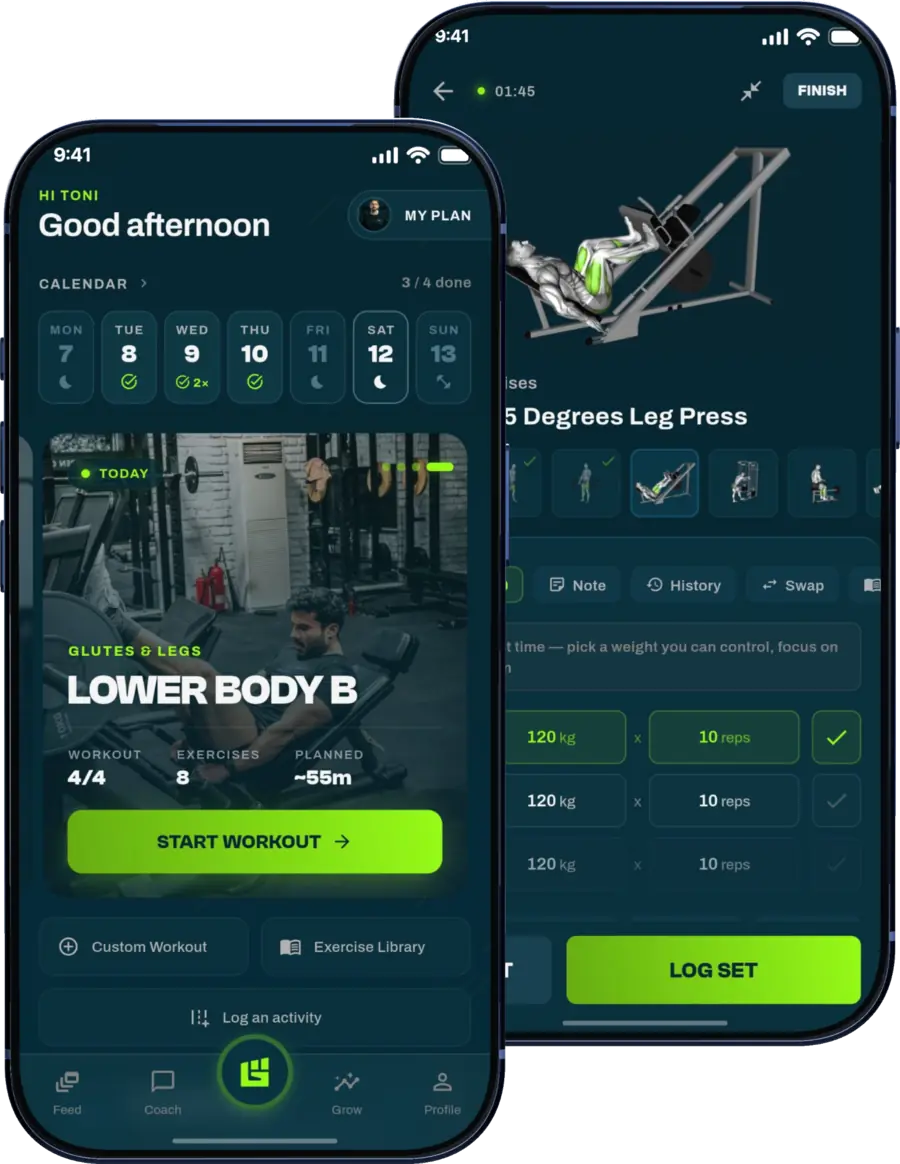
Get a personalized workout plan built around your goal, equipment and schedule. Train smarter, track every rep and keep moving forward, one workout at a time.






That's encouraging, but the context matters. These were older men following a supervised protocol, not a guarantee for every returning lifter. The useful takeaway is that their earlier training wasn't wasted.
A 2024 study of periodic resistance training offers another perspective: after a 10-week break, young, previously untrained adults made particularly rapid improvements during their first 5 weeks of retraining. Their final adaptations were similar to those of participants who trained continuously.
Your previous training is a foundation to rebuild from, not a weight prescription for your first session back.
Strength isn't the whole picture
You might remember how to squat and still struggle to recover between sets. You might move a familiar weight comfortably, then discover that your joints or overall fatigue don't tolerate the rest of the workout.
Keep these distinctions in mind:
- Movement familiarity: A lift may feel recognizable before you're ready to train it hard.
- Work capacity: Completing a set doesn't prove you can repeat your old workload.
- Recovery: Tendon tolerance, conditioning, and readiness for another session shouldn't be inferred from strength alone.
Treat the return as a rebuild rather than a restart from zero. That lets you respect your training history without asking your current body to perform like your past self immediately.
Assessing your fitness and scaling back your loads
Your starting point should come from your last repeatable training routine, not your best-ever lift. A personal record tells you what you achieved under particular conditions. Your normal working weights and sets are more useful for planning a return.
Check what you can repeat now
Before choosing exercises, answer these questions:
- Previous schedule: How often were you training before the break?
- Movement quality: Which lifts can you perform comfortably with controlled technique?
- Current conditioning: Can you walk, cycle, or run comfortably without turning an easy effort into a test?
- Old trouble spots: Where did you feel restricted, weak, or uncomfortable before stopping?
- Available capacity: Does your current schedule leave room for training and recovery?
Don't turn the assessment into a maximum-strength session. Use warm-up sets to check balance, range of motion, and control. If your technique changes noticeably as you add weight, you've already learned something useful: start lighter.
Choose a conservative working weight
Use these coaching rules of thumb, not validated predictions of exactly how much strength you've lost:
| Time away | Suggested starting weight | Starting volume |
|---|---|---|
| 2 to 4 weeks | About 70% to 80% of previous working weights | Fewer sets than your previous routine |
| 3 months or more | About 50% to 60% of previous working weights | About half your previous sets per muscle group |
These percentages refer to previous working weights, not your one-repetition maximum. They're starting estimates that you should lower further if repetitions feel strained or your form changes.
For breaks between those ranges, avoid inventing a precise formula. Consider how active you remained, why you stopped, and how the warm-up feels. Time away after illness or injury isn't equivalent to time away during an otherwise active holiday.
Research supports separating retained strength from full readiness. In a human training and detraining study, muscle thickness and cross-sectional area returned to baseline during 20 weeks without training, while strength remained about 60% above baseline. The researchers also cautioned that their findings weren't a rigorous test of muscle memory.
Set a target you can control
Choose a measurable target for the next 8 weeks, such as consistently completing your planned sessions. If you choose a load target, record it in kilograms (pounds) and keep technique part of the success criteria.
A flexible weekly target is more useful than a fragile promise to train on particular weekdays. Plan around the time you have now, not the routine you used to manage.
A 4-week ramp-up plan that respects soreness
Your first session back goes better than expected, so week two feels like the right time to add weight. That's the trap. The first month exists to find a workload you can recover from and repeat, session after session. One hard workout proves nothing; four weeks of sessions you bounce back from proves plenty.
Don't increase your workload just because the calendar flipped to a new week.
The staged approach below follows the conservative logic described in a systematic review of detraining and retained adaptations: reduce initial demand, monitor your response, and rebuild before chasing new performance.
Four-week ramp-up plan
| Week | Sessions per week | Load and volume | Progression check |
|---|---|---|---|
| 1 | About 2, non-consecutive | Use your scaled starting loads and roughly half your previous hard-set volume. Finish with 3 to 4 clean reps left. | Record soreness, technique, and readiness for the next session. |
| 2 | 2, with recovery between sessions | Repeat the baseline. Add a little load or some sets only if recovery supports it. No failure training. | Soreness settles within about 48 hours and weights feel stable. |
| 3 | 2 to 3, if manageable | Choose one variable to increase and hold the others steady. | Performance holds steady or improves without worsening symptoms. |
| 4 | 2 to 3 | Move volume closer to your usual baseline if earned. Keep loads below anything that disrupts technique. | Familiar weights feel easier and you're recovering between sessions. |
Treat this as a sample progression with room to repeat a week. A lifter returning after a long sedentary stretch may need to hold at week two twice. Someone back from a short interruption will often move through more comfortably.
If your previous routine no longer fits your equipment or availability, build a new plan in minutes instead of forcing the old split into a different life.
Know when to hold instead of adding
Use these signals to decide when to repeat or lighten a session:
- Soreness lasting past 3 days: Reduce the next session's demand. Chasing soreness is chasing fatigue.
- Same weights feeling heavier: If identical work gets harder across sessions, hold the load until the trend reverses.
- Sleep getting worse: Pair it with rising fatigue and treat both as a reason to reassess.
- Joint pain or altered mechanics: Stop or swap the movement.
- Motivation dropping: Check whether the workload is draining you before blaming discipline.
Progression rule: End each session feeling capable of training again soon. Emptying the tank is the failure, not the finish line.
For a programming benchmark, ACSM's resistance-training guidance recommends roughly 2 to 3 non-consecutive sessions, loads around 60% to 70% of one-repetition maximum, and typically 8 to 12 repetitions for people without recent training experience. It allows approximately 2% to 10% load increases once you exceed the repetition target by 1 to 2 reps across two consecutive sessions.
Use those numbers as a reference range. Nobody needs to test a maximum or reach those loads in week one, and the soreness signals above get the final say on whether you progress.
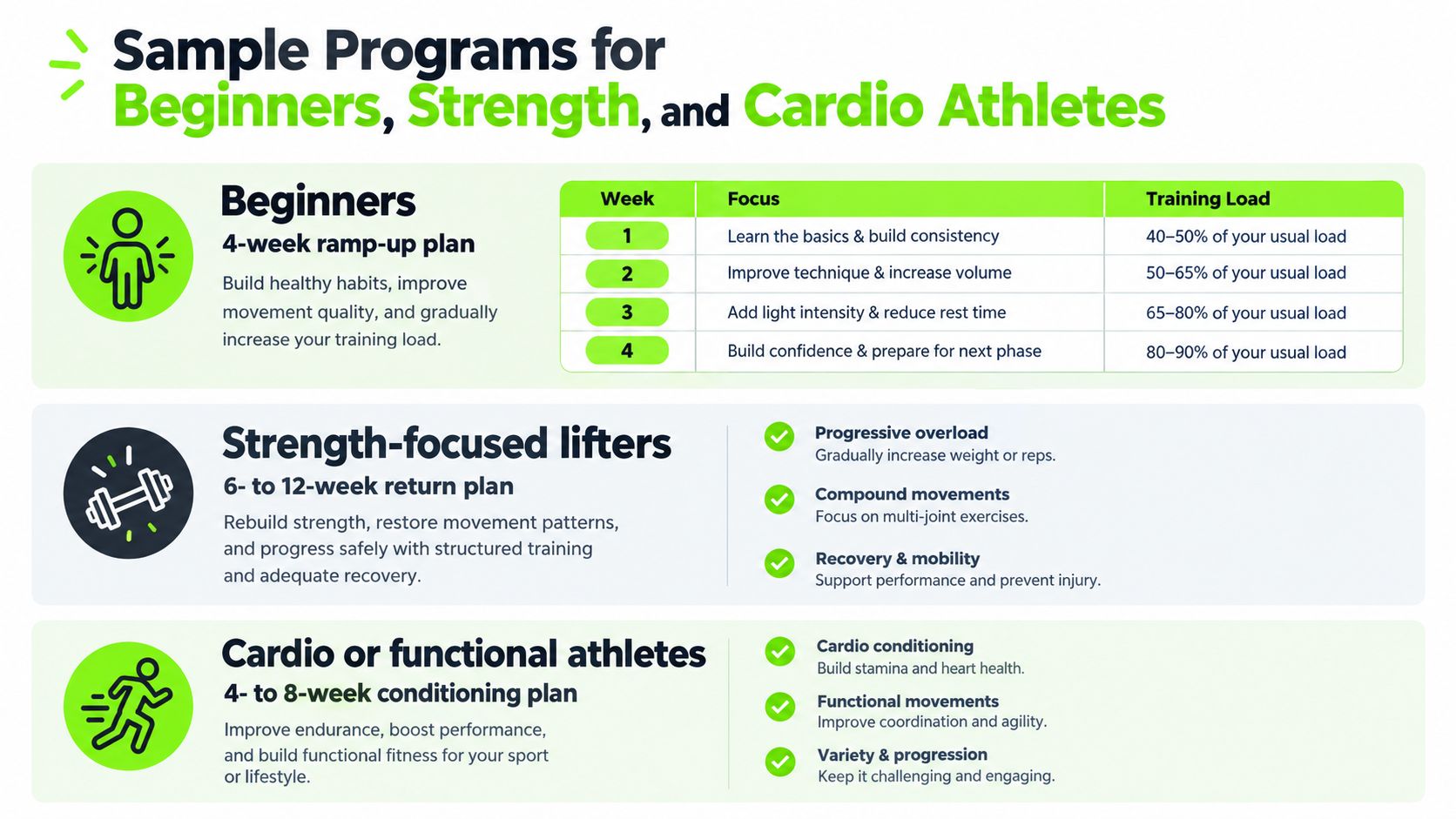
Sample programs for beginners, strength, and cardio athletes
Choose the track that matches your main goal. A returning runner doesn't need a bodybuilding split, and a strength-focused lifter doesn't need demanding circuits after every workout.
These are sample program structures, not researched promises about when you'll recover your previous performance. The timelines show how to organize the work while leaving room to repeat a phase.
Beginners
Use a 4-week ramp-up, then continue building consistency through an 8-week block. Follow the non-consecutive full-body structure established above rather than assigning a separate day to every muscle.
Choose an exercise for each major region:
- Hips and legs: A squat variation, leg press, or manageable hinge.
- Chest: A machine press, dumbbell press, or raised push-up.
- Back: A supported row or pulldown.
- Shoulders: A comfortable pressing variation.
- Trunk and lower back: Controlled bracing and a suitable back-extension or hinge movement.
Build toward 2 to 3 working sets per exercise as a sample program target, not a first-session minimum. If you're returning after a long break, use fewer sets initially and retain the repetitions in reserve described in the ramp-up plan.
Machines can reduce setup demands when confidence is low. Free weights offer useful practice if those are the movements you want to regain, but there's no need to make every exercise technically demanding.
Strength-focused lifters
Organize a 6- to 12-week return block around alternating lower-body and upper-body sessions. Continue the sequence whenever you next train rather than restarting it every Monday.
A lower-body session can center on a squat or hinge, followed by modest assistance work. An upper-body session can prioritize a press and pull, with extra work only if your recovery remains stable.
Start with the reduced loads already established. Increase weight only after you can complete the target repetitions with consistent form, rather than using an unexpectedly strong first set as permission to accelerate.
Extend the block by rebuilding sets before adding demanding accessories. Heavy lowering work, repeated failure sets, and extra conditioning all count toward the workload, even when they aren't your main lift.
Supplement decisions are secondary to that structure. If you're comparing products, Pumpernickel Health Foods' creatine formulations explained provides a separate resource without making supplementation part of the return plan.
Cardio or functional athletes
Use a 4- to 8-week conditioning block to reestablish manageable running, rowing, or cycling before combining hard efforts with loaded circuits. Begin with a duration you can finish comfortably and repeat without worsening symptoms.
As a conservative planning ceiling, build training time by no more than roughly 10% per week, but don't treat that figure as a guarantee of safe progression. Keep increases smaller, or repeat the workload, when the effort feels unexpectedly difficult.
Add short functional circuits only once the basic work feels repeatable. Use controlled squats, pushes, pulls, or carries without turning every session into a race.
You can track your walks and runs to compare duration, distance, and pace. Judge progress by a similar route feeling easier as well as by speed, and avoid increasing pace and duration together.
Recovery, mobility, and nutrition between sessions
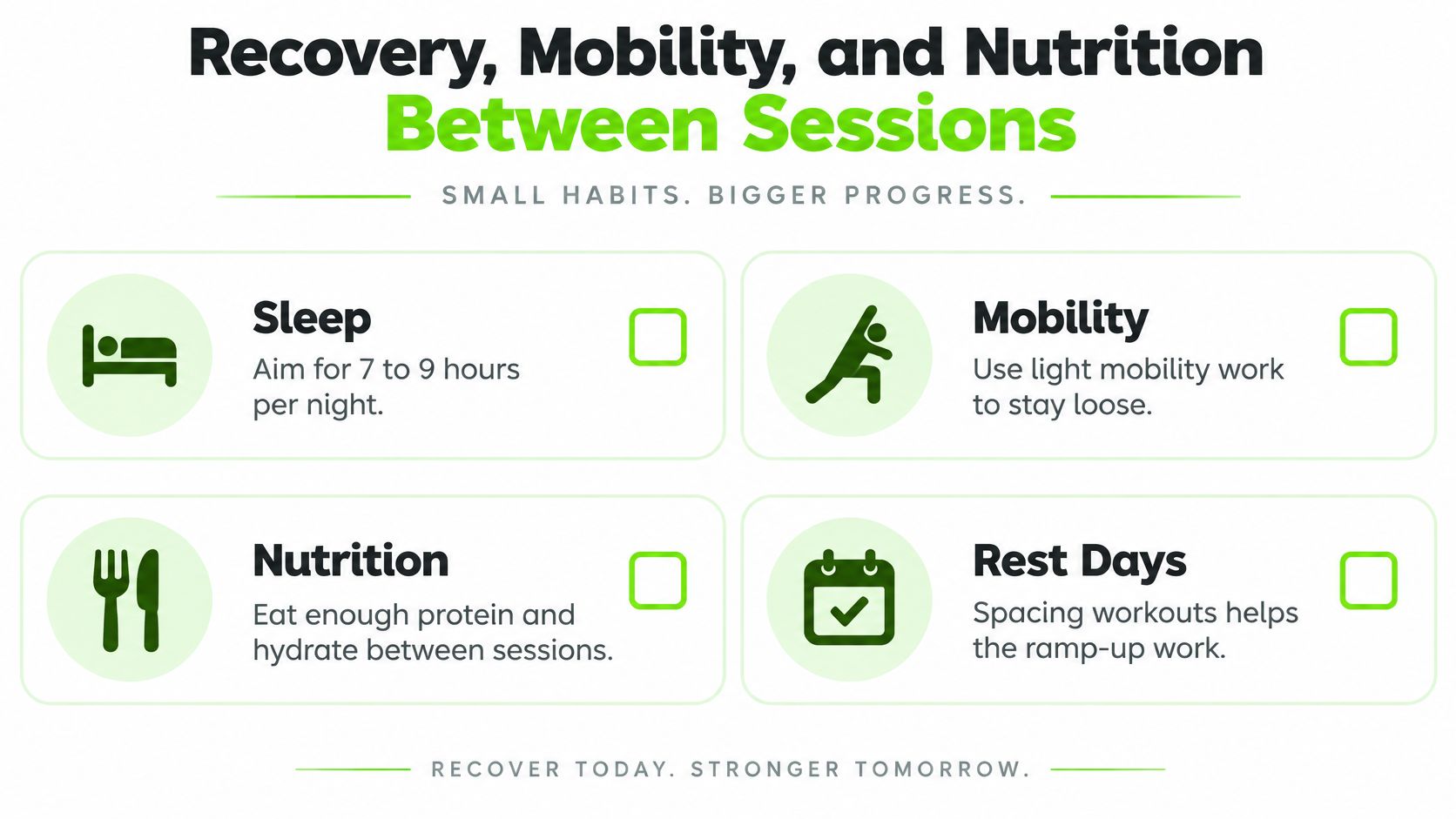
Recovery starts with leaving enough capacity after training to live normally. If the session makes sleep, eating, walking, and the next workout harder to manage, reducing the training dose is often more useful than adding recovery routines.
Make the basics repeatable
Aim for 7 to 9 hours of sleep as a practical nightly target. Protect a regular bedtime where possible, and pay attention when heavier training coincides with worse sleep rather than assuming you just need to push through.
Eat protein-containing foods across your meals and enough overall food to support your routine. Eggs, dairy, fish, meat, tofu, beans, and lentils can all fit; choose foods you'll prepare and eat consistently.
For additional reading about habits that support muscle repair after training, Lola offers a recovery resource. Keep the priority on manageable training, regular meals, hydration, and rest rather than an elaborate post-workout ritual.
Move without adding another hard workout
Before lifting, use comfortable movements for your hips, upper back, shoulders, and ankles, then practice the planned exercises with lighter loads. A structured mobility routine can help you organize that preparation without turning it into a separate workout.
On rest days, walk or cycle easily. Keep the effort light rather than using recovery days to compensate for training you think you missed.
Separate ordinary soreness from warning signs:
- Expected soreness: Delayed muscle tenderness that stays mild and improves with recovery.
- Stop signals: Sharp or constant pain, severe swelling, or pain that doesn't settle.
- Urgent warning signs: Unusually dark or bloody urine, especially alongside severe muscle symptoms.
Cleveland Clinic's delayed-onset muscle soreness guidance identifies sharp or constant pain, severe swelling, pain lasting more than a week, and dark or bloody urine as reasons for medical evaluation. Don't label these symptoms normal post-break soreness or try to train them away.
Scheduling your week and tracking progress
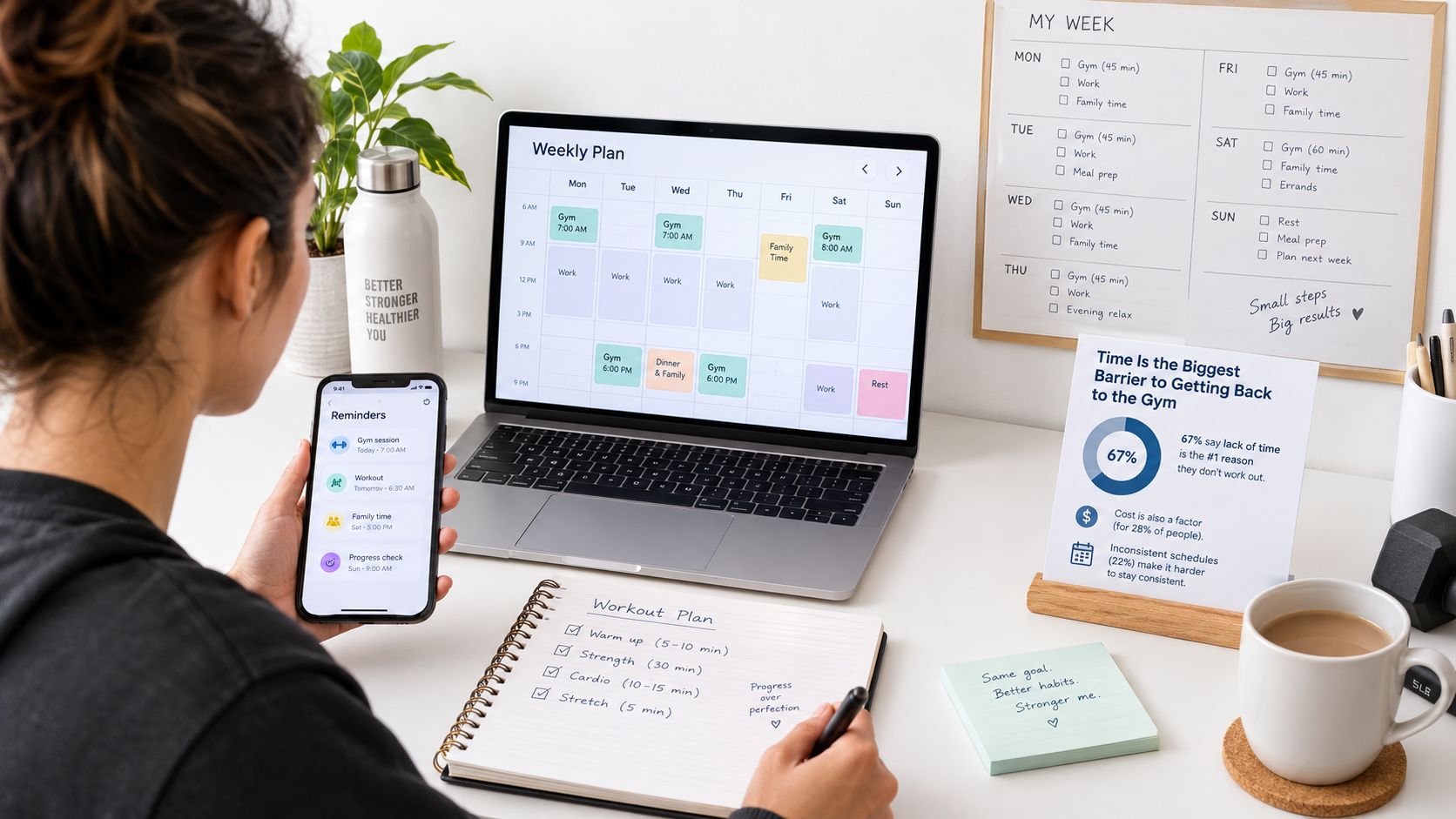
A plan can be physiologically sensible and still fail because it takes too much time, costs too much, or requires equipment you can't reliably access. Solve those problems before deciding you need more motivation.
In a 2025 physical-activity needs assessment, lack of time affected 45.0% of respondents. That finding supports a practical decision: make the routine fit your week rather than building it around an ideal schedule.
Set a floor and a target
Use one full-body session as your fallback floor, with two or three sessions as progressive weekly targets. The fallback isn't equivalent to completing the full plan, but it gives you a useful option when work or travel disrupts the week.
Keep a short alternative ready:
- Limited time: Prioritize a squat or hinge, a push, and a pull.
- No gym access: Use suitable bodyweight movements, resistance bands, or available dumbbells.
- Missed session: Continue with the next planned workout instead of doubling its sets.
- Unpredictable schedule: Decide where the next session fits after reviewing your actual commitments.
A missed workout changes the schedule. It doesn't create a debt you need to repay with extra volume.
Choose a record you'll use
A paper log is inexpensive and flexible. It records what you did, but finding older exercise entries requires looking back through your notes.
GrabGains is an app-based option: your training history stays linked to each exercise, so you can see what you lifted before your break. You can also rate how you feel before a session, and the suggested weights scale with that rating.
A fitness progress tracker can help you review the broader pattern, but the useful information is straightforward:
- Load and reps: What you completed with stable technique.
- Soreness duration: Whether you recovered before repeating the work.
- Sleep and readiness: How prepared you felt, not just whether you showed up.
- Session completion: Whether your schedule is realistic enough to sustain.
Choose paper or an app based on which you'll maintain. A detailed system you abandon is less useful than a simple record you update after each session.
Your next step back in the gym
Book the first two session slots this week, leaving recovery time between them. Before you leave home, write the movements, the starting loads from the break-length guide, and the week-one target from the ramp table.
Treat session one as calibration. You are finding the load that lets you repeat the session soon, while technique stays stable and soreness stays short-lived.
Prepare the session before you arrive
- Movements: familiar lifts only, no experiments.
- Loads: recent working history, adjusted for the length of your layoff.
- Stop point: end each set with clean reps still available; stop early if bar speed, range, or positions degrade.
- Afterward: record load, reps, soreness duration, and readiness before the next session.
If you want a fresh structure, build it from the same rules: break length sets the entry load, the four-week ramp sets progression, and soreness duration plus performance decide whether you repeat, add, or pull back.
Book the first session now and prepare its log. When you arrive, complete the first controlled set and write down exactly how it felt.
GrabGains offers adaptive workout planning, exercise demonstrations, and training-history tracking to help you organize your return without guessing at every session. Visit GrabGains to prepare a manageable routine, record your starting point, and adjust as your performance and recovery improve.
Get inspired and motivated