Weight Training for Women: A Practical Starter Guide
Weight Training for Women. Build a personalized weight training routine for women with beginner, strength, hypertrophy, home, and 8–12 week plans, plus. Forget the advice to lift light pink weights for endless reps if you want to look toned. That advice sounds safe, but it misses the point. Muscle doesn't know whether a program was marketed to women or men. It responds to tension, effort, and progression. If the load stays easy forever, your body has little reason to change.
Weight training for women works best when you treat confidence, schedule, and equipment as real programming decisions, not afterthoughts. You don't need a barbell on day one, a six-day split, or a complicated routine. You need movements you can control, weights that feel challenging by the final reps, and a plan you can repeat next week. Start there, and the details become much easier to manage.

What Weight Training Can Change
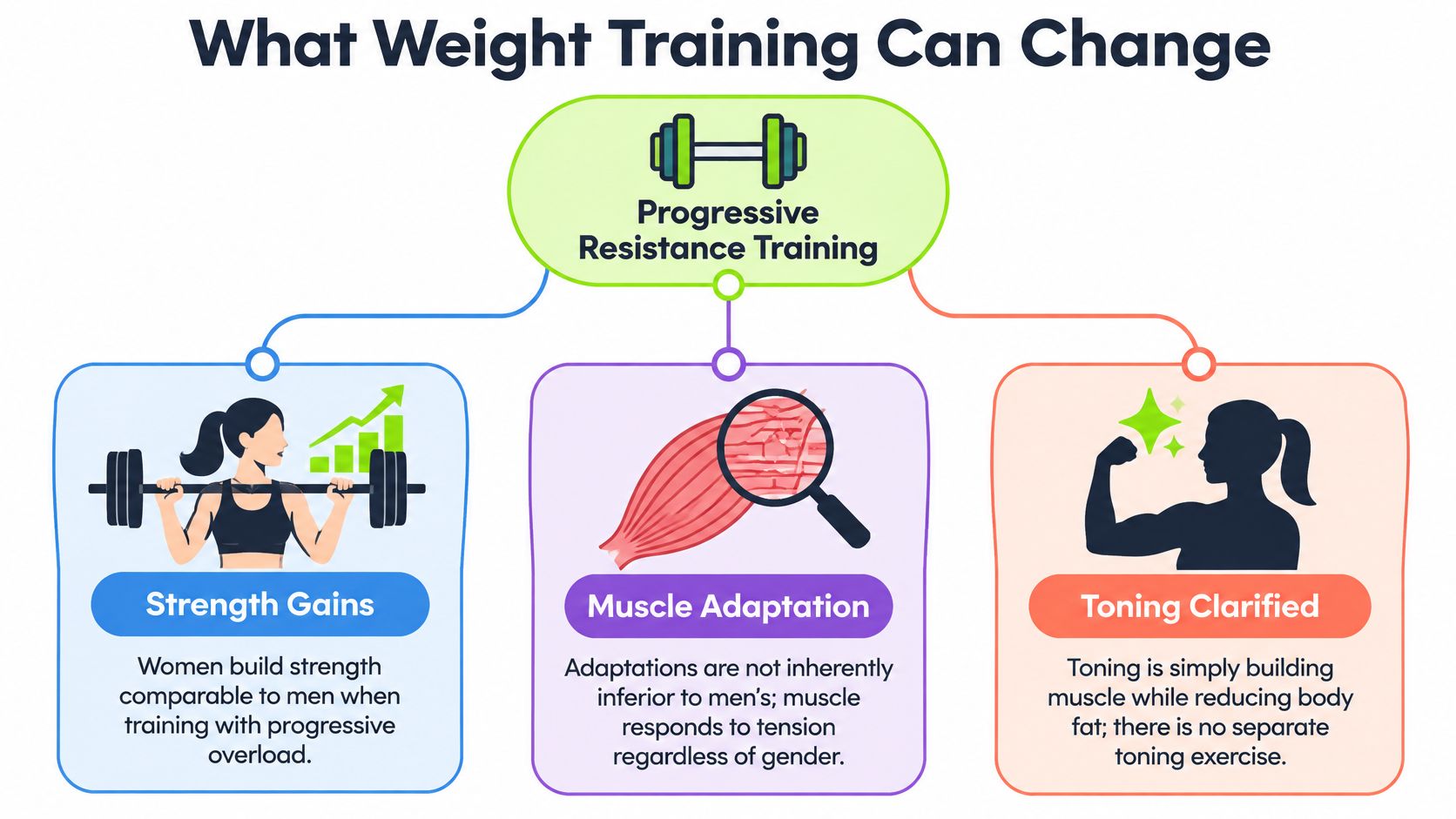
The most persistent myth in weight training for women is that lifting progressively heavier weights automatically produces a bulky body. It doesn't. Bulky isn't a training adaptation you stumble into by accident. Appearance depends on muscle size, body fat, nutrition, genetics, and your starting point. A beginner who trains twice a week with dumbbells is building capacity, not waking up with a bodybuilder's physique.
Women respond well to resistance training. A 2019 systematic review of resistance training in healthy adult women examined 24 eligible studies and found large strength effects, with Hedges' g = 1.70 for upper-body strength and g = 1.40 for lower-body strength. The same review found a hypertrophy effect size of 0.52, which means women in those studies gained muscle size as well as strength.
Built for progress
Take the guesswork out of training
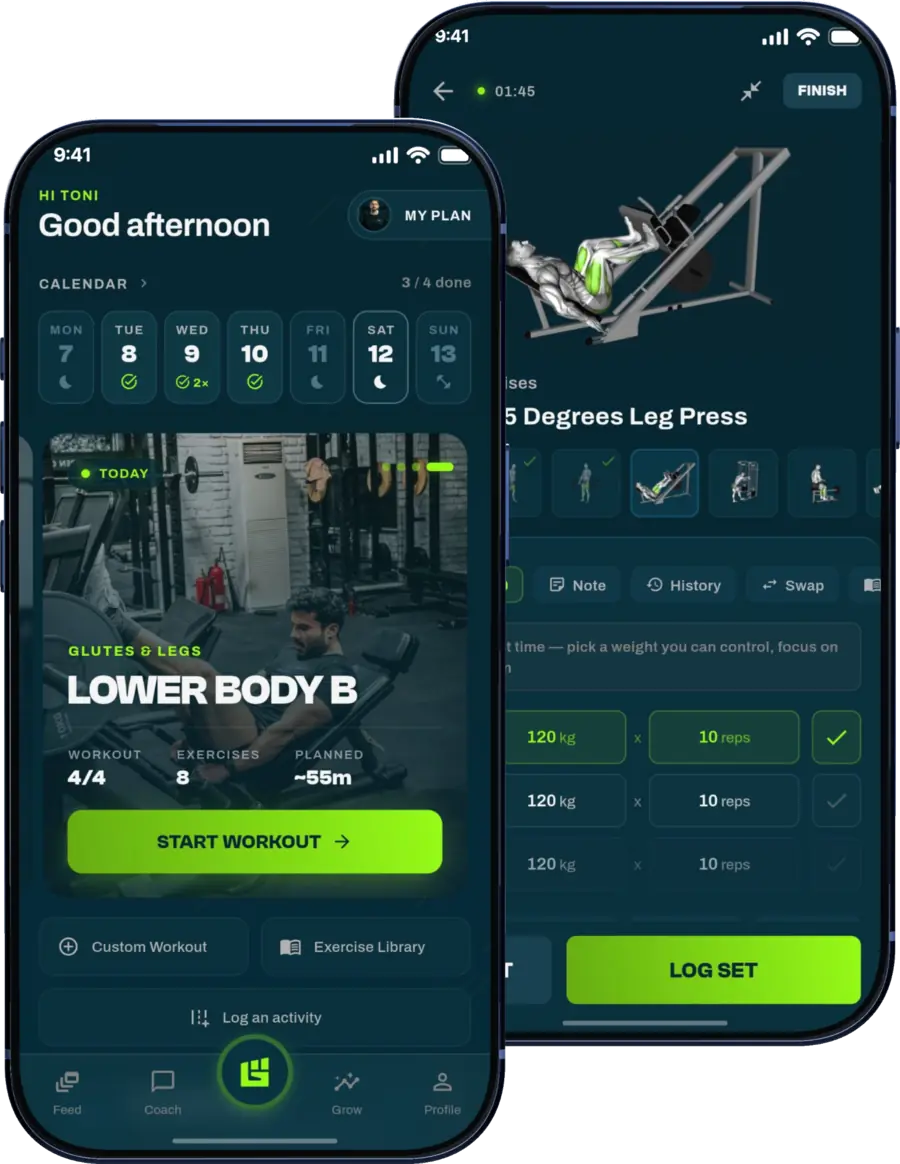
Get a personalized workout plan built around your goal, equipment and schedule. Train smarter, track every rep and keep moving forward, one workout at a time.






What toning actually means
Toning isn't a separate type of exercise, and you can't tone a muscle without changing it. In practical terms, a toned look usually means you've built some muscle and reduced body fat enough for that muscle to show. Light weights moved far from fatigue don't create a special toning effect. Neither does trying to spot reduce fat from one area with endless reps for that area.
That distinction matters because it changes your choices. If you want firmer arms, legs, or glutes, you need progressive work for those muscles. If you also want that muscle to be more visible, overall fat loss may be part of the picture. Training and nutrition handle different parts of the result.
Toning is not an exercise category. It's the visible result of more muscle and less body fat.
What the first 3 to 6 months can look like
Expect performance to change before appearance changes dramatically. In the first 3 to 6 months, realistic progress often includes lifting more weight, finishing sets with better control, standing with better posture, and noticing a firmer look as muscle develops and body fat drops. Clothes may fit differently even when scale weight moves slowly.
You also don't need to earn your place in the weight room. Women's competitive lifting has its own established history, including a first World Championships in 1987 and an Olympic debut in 2000, according to the International Weightlifting Federation history of women in weightlifting. You aren't borrowing a men's activity. You're using a training method your body is built to respond to.
Start with loads you can manage. A 4 kg (9 lb) dumbbell that challenges you with clean form is a better starting point than a 10 kg (22 lb) dumbbell you swing through half a range of motion.
Choose Your Starting Program
Before you pick exercises, answer four questions. What's your main goal right now? How many sessions can you complete each week? What equipment can you access without friction? How comfortable do you feel training around other people?
Those answers matter more than finding a perfect program online. A busy beginner who dreads a crowded free-weight area may progress faster with machines and dumbbells at a quieter time. A home trainee with adjustable dumbbells needs a different plan from someone with a full gym. Neither option is a lesser version of training. They're different routes to the same stimulus.
Match the structure to your constraint
Time and confidence stop more beginners than lack of motivation. A 2025 review of barriers for college women listed time and effort, fear of looking foolish, soreness, discomfort training alone, and intimidation in the weight room among the common obstacles. Your starting program should reduce those frictions, not ignore them.
| Reader need | Best starting structure | Main programming focus | Typical weekly pattern |
|---|---|---|---|
| General confidence | Full-body beginner plan | Stable movements and repeatable technique | Two non-consecutive sessions |
| Strength | Full-body plan with primary lifts first | Heavier compound work and gradual loading | Two or three sessions |
| Muscle shape | Full-body or simple split plan | Each major muscle trained regularly with effort | Two to four sessions |
| Limited equipment | Home dumbbell or band plan | Movement patterns you can load and progress | Two short full-body sessions |
Beginner plans prioritize whole-body patterns because you practice the basics often without needing long sessions. Strength plans put more energy into a few primary lifts early in the session, when you're fresh. Hypertrophy plans spread work so target muscles get enough challenging sets across the week. Home plans depend on whether your available resistance still lets you approach fatigue as you get stronger.
Keep the first commitment small
Two short full-body sessions beat an ambitious five-day plan you abandon in week two. That isn't settling. It's how consistency gets built when work, family, and energy fluctuate. You can add a session later, once the first two feel routine.
If building that structure yourself feels like another barrier, GrabGains functions as a weight training app that builds a plan around your goal, level, and equipment. That kind of setup helps because your first decision becomes showing up and executing, not redesigning the week every Monday.
Your starting program only needs to be good enough to repeat and progress. Complexity can wait until you have data from your own training.
Build Your Weekly Training Rhythm
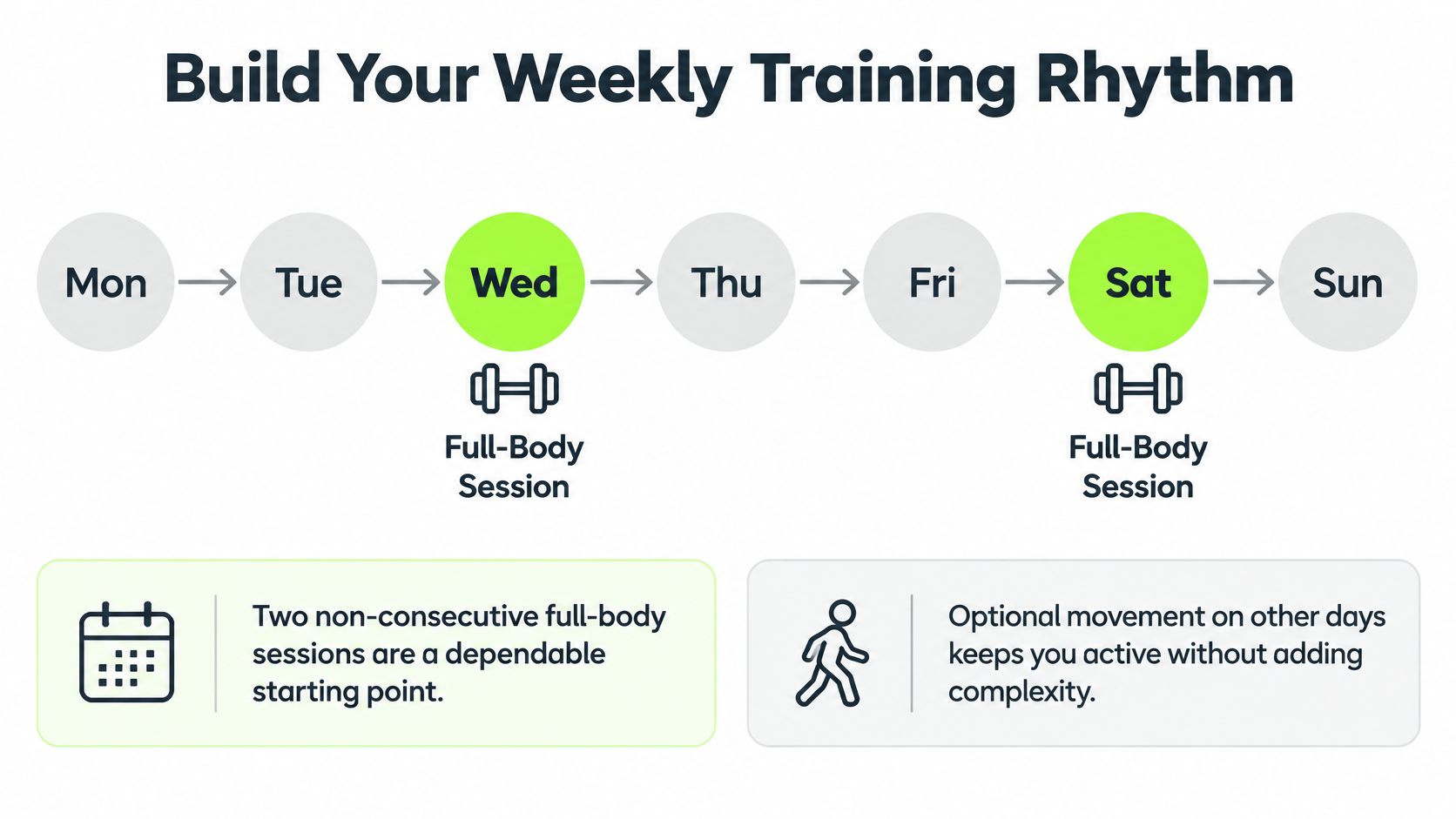
A dependable beginner rhythm is two non-consecutive full-body sessions per week, such as Wednesday and Saturday. ACSM guidance summarized for beginners recommends resistance training on at least 2 non-consecutive days per week using about 60–70% of one-repetition maximum for novice to intermediate trainees, as described in the ACSM exercise prescription guidance. You don't need to test a true maximum to use that idea. Pick a weight that feels moderately hard while your technique stays clean.
Full-body sessions suit beginners because one missed day doesn't leave half your body untrained for a week. You also practice squatting, hinging, pushing, and pulling patterns more often, which helps skill develop. Optional walking or light movement on other days can keep you active without turning recovery days into hidden workouts.
Warm-up sets are not working sets
A warm-up set prepares you for the movement. It's lighter, easier, and shouldn't fatigue you. A working set is the set that counts toward your training stimulus. Confusing the two is one reason beginners think they're training hard while the target muscle barely gets challenged.
For example, if your working weight for a goblet squat is 12 kg (26 lb), you might first move through the pattern with 6 kg (13 lb). That first set teaches position and rhythm. The working set should feel demanding by the final reps while your knees track well and your torso stays controlled.
Reps, load, and effort
Use this simple framework:
- Most exercises sit in the 8 to 12 rep range, which gives you enough reps to practice while still using a meaningful load.
- Main lifts can include some heavier sets of 5 to 8 reps once your technique is stable.
- Every working set should end about 1 to 3 reps short of failure, meaning you could do a few more clean reps, but not many.
Those guidelines aren't female-specific. The same approach applies to men and women because the underlying task is the same. Create tension, control the rep, and progress gradually.
Effort check: If you finish a set and could easily do ten more reps, that set was practice, not a working set.
A busy professional might train before work twice a week and keep sessions short. A home trainee might use the same two days but swap machine work for dumbbell patterns. The rhythm stays recognizable even when the setting changes. That repeatability is the point.
Progress Your Training Over 8 to 12 Weeks
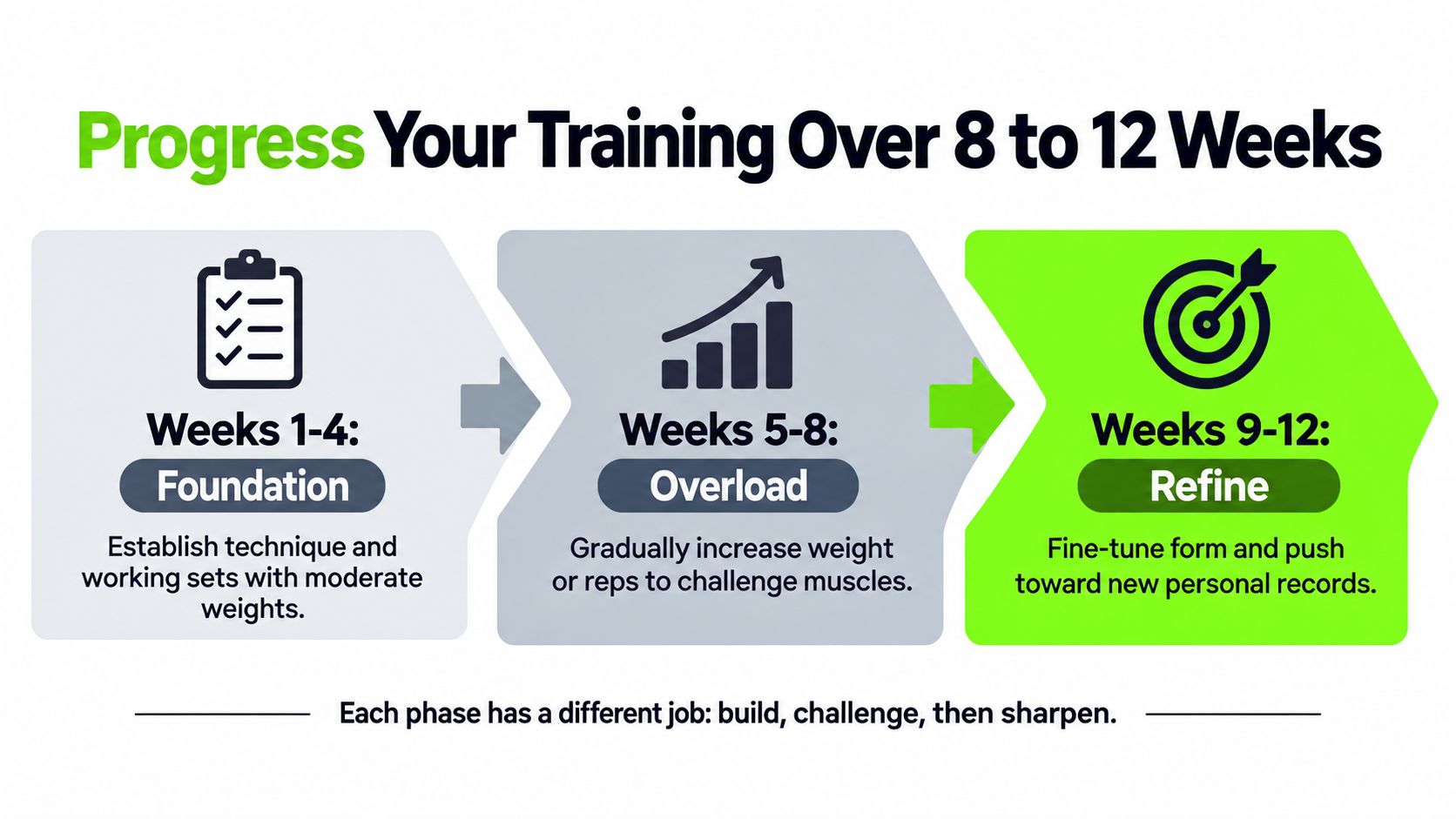
Progression is where a routine becomes a program. Doing the same weights for the same reps can maintain a habit, but it won't keep driving adaptation. Over 8 to 12 weeks, your job changes in phases. First you learn positions and establish honest working weights. Then you add challenge in a controlled way. Later you check what improved and decide what needs adjustment.
Three ways to progress a lift
You don't need to add weight every session. Progress can look like this:
- Add reps first. Turn sets of 8 into sets of 10, then 12, using the same weight and cleaner technique.
- Add load next. When you hit the top of the rep range on all sets with stable form, increase the weight slightly, for example from 10 kg (22 lb) to 12 kg (26 lb), and rebuild reps.
- Improve control. Use a fuller range of motion, pause briefly where you tend to rush, or slow the lowering phase without changing the load.
Change one primary variable at a time. If you add sets, add a day, and jump the weight in the same week, you won't know what caused a stall or a spike in fatigue. An ACSM progression summary describes beginners starting around 1–3 sets of 8–12 repetitions with moderate loads and controlled lifting speeds of roughly 1–2 seconds up and 1–2 seconds down, according to the ACSM progression models summary. That's enough structure to progress without maximal lifting.
Frequency and fatigue
For muscle gain, training each major muscle group at least twice weekly with about 2–4 challenging sets per exercise is a practical approach, and a meta-analysis of 45 studies on loading and hypertrophy found no meaningful hypertrophy difference between higher-load work above 60% of one-repetition maximum and lower-load work at or below 60%, provided effort was sufficient. Translation for real life: you can build muscle with moderate weights and higher reps, but those sets still have to get hard.
Strength-focused phases can prioritize stable compound lifts and lower reps. Evidence from a large Bayesian network meta-analysis in the British Journal of Sports Medicine included 178 strength studies with 5,097 adults, and women represented 45% of that sample. You're not following an untested workaround when you train for strength as a woman. You're using the same progression logic, scaled to your starting point.
If performance drops for several sessions, sleep is poor, and soreness lingers, hold the load or reduce a set. If every set feels easy, you're underloading. Your log should drive the next decision, not guilt or a random new routine.
Select Exercises and Practice Strong Form
Confidence grows faster when the setup feels stable. That's why machines and dumbbells often feel less intimidating than a barbell at first. A machine guides the path. A dumbbell lets you start light, adjust one side at a time, and put the weight down easily. A barbell is useful later for many people, but it's not an entry requirement.
Choose exercises by movement pattern and by whether you can control the full range. Six beginner-friendly families cover the basics without becoming a full workout list:
- Goblet squat for a squat pattern with the weight held close to your chest, making balance easier to learn.
- Dumbbell Romanian deadlift for a hip hinge that trains glutes and hamstrings while you practice a flat back.
- Hip thrust for direct glute work with a stable bench setup and clear end position.
- Lat pulldown for vertical pulling strength without needing a pull-up on day one.
- Seated cable row for horizontal pulling with support and a path you can control.
- Dumbbell shoulder press for overhead pushing that lets each arm work independently.
At home, keep the pattern and change the tool. A backpack or single dumbbell can load a squat pattern. A band can replace a row if you anchor it securely and keep tension through the rep. The question isn't whether the exercise name matches a gym plan exactly. It's whether you can load the pattern, feel the intended muscles work, and progress it over time.
Four form mistakes to fix early
Lifting too light for too long is the quietest mistake. Your form may look perfect because the weight never challenges it. Add reps, then load, once sets stop feeling demanding near the end.
Rounding the lower back in deadlift patterns usually means the weight drifted away from your legs or you reached down instead of pushing your hips back. Think ribs down, lats tight, and hips back until you feel your hamstrings load.
Knees caving in during squats often appears when the load gets hard or your feet lose pressure. Screw your feet into the floor and keep knees tracking over your toes. Reduce the weight if you can't maintain that path.
Rushing reps turns the lowering phase into a drop. Lower with intent, especially on rows, presses, and Romanian deadlifts. A controlled eccentric gives you more time under tension and more chances to notice position errors.
Chase the heaviest weight you can control, not the heaviest weight you can move once.
Good form isn't fragile or robotic. It means the joints move where you intend, the target muscle does the work, and the last rep looks close to the first. When speed replaces control, reduce the load by a small step, such as 2 kg (4 lb), and rebuild.
Support Progress With Food and Recovery
Training provides the signal. Food, sleep, and manageable workload determine whether you can repeat that signal and adapt to it. If you're exhausted, underfed, and adding volume every week, stalled lifts aren't a mystery. Your inputs can't support the output you're asking for.
For fat loss, the mechanism is a sustainable energy deficit over time, not spot reduction from training one body part harder. Resistance training helps you keep and build muscle while body fat drops, which is why the scale alone can mislead you. Waist measurements, photos taken in consistent light, strength trends, and how clothes fit give you a fuller picture.
Build the basics before chasing details
You don't need a perfect meal plan to start. Eat regular meals, include a clear protein source at each one, drink enough fluid to train comfortably, and avoid showing up to hard sessions underfueled. Protein supports repair and muscle gain, while total energy intake influences whether body weight trends up, down, or stays similar.
Sleep deserves the same direct treatment. A rough night doesn't ruin training, but repeated poor sleep makes loads feel heavier and patience thinner. On those days, keep the session, reduce the top weight slightly if needed, and protect technique. Consistency doesn't require identical performance every day.
Soreness needs context too. New exercises and slower lowering phases can make muscles sore for a day or two. That doesn't automatically mean the session was productive, and lack of soreness doesn't mean it failed. Judge the week by completed sessions, reps, load, and recovery between sessions.
Track what you'll actually use
Log four things after each session:
- Exercise and load, for example Romanian deadlift at 20 kg (44 lb).
- Reps completed on each working set.
- Perceived effort, including how many clean reps you think remained.
- Pain or unusual fatigue, noted plainly so patterns are visible later.
GrabGains fits here as a personalized training and tracking tool. It builds a plan around your goal, level, and equipment, includes an exercise library and performance analytics, and lets you choose up to two Priority Zones, such as glutes or shoulders, to train extra. That structure is useful when you want your log to influence the next session instead of sitting unused in a notes app.
Women in the menopause transition deserve the same honest framing. A 2025 systematic review on exercise during the menopausal transition found only six relevant studies and judged the evidence low quality, so optimal methods for preventing bone and muscle loss remain inconclusive. That uncertainty argues for progressive, recoverable training and realistic expectations, not for giving up on strength work.
Start Small and Keep What Works
The plan that works is usually smaller than the one you think you need. Two weekly sessions you can protect, a handful of movements you control, and one clear progression rule will outperform an ambitious split you abandon in week three. Choose one primary goal for the next block of training, since getting stronger, building visible muscle, and losing fat overlap but don't always demand identical priorities. Record your starting loads and reps, then review after several consistent weeks instead of judging a single workout.
Treat confidence, schedule fit, and equipment access as core programming variables, the same way you'd treat sets and reps. A plan built around the equipment and time you have beats a theoretically better one that depends on a gym you can't reach. Drop the myths that make starting harder. Women don't need a separate rep range from men, lifting doesn't make you bulky, and toning claims aside, visible muscle comes from progressive strength work paired with fat-loss habits when fat loss is the goal. Weight training for women is weight training, adjusted to your body, schedule, equipment, and preferences.
Quick answers to common sticking points
Are machines acceptable for beginners? Yes. Machines teach effort and target muscles with less setup anxiety. Add free-weight patterns as confidence grows, or keep machines where they work well.
What changes when your schedule or equipment changes? Keep the movement patterns and progression rule, then change the tool or session length. Two focused home sessions keep momentum through a busy month better than skipping training until the gym feels convenient again.
How do you know the plan is working? Your working weights or reps rise, technique stays stable, recovery feels manageable, and measurements or photos trend toward your goal. Progress doesn't need to be dramatic every week to be real.
If you want the planning handled while you focus on execution, use a personalized training app that matches your equipment and level. Use it to build muscle where you want it with Priority Zones, or to lose fat while you get stronger without abandoning progressive lifting. Pick your next two training days now, write them down, and make the first session easy enough to start and hard enough to count.
Start with GrabGains to turn your goal, experience level, schedule, and available equipment into a structured weight training plan, then log your first two full-body sessions and watch the reps and load climb week over week.
Get inspired and motivated