Should I Train When Tired? a Practical Decision Guide
Should I train when tired? Use this green, yellow, red guide to scale your workout safely, spot warning signs, and pick a modified session. Yes, you can usually train after ordinary tiredness, but lower the target instead of forcing the planned workout. Rest if you have a fever, dizziness, widespread aches, or poor coordination.
Should I train when tired? Usually, the answer depends on what kind of tired you are and how your body responds to the warm-up. Tiredness is a dial, not a switch: you can keep moving while reducing the session's load, volume, intensity, or technical demands. If fatigue comes with illness symptoms or your coordination feels off, skip the workout.
A practical traffic light rule
| Zone | What you notice | Session plan |
|---|---|---|
| Green | Seven or more hours of sleep, a normal warm-up feel, and performance near recent norms | Train as planned and progress normally |
| Yellow | One poor night or heavy legs, warm-ups feel harder than usual, and no illness signs | Keep the session pattern, cut hard sets, and stop 2 to 4 reps short of failure |
| Red | Fever, widespread aches, dizziness, poor coordination, or several days of short sleep with falling performance | Swap to mobility, easy aerobic work, or rest, then recheck symptoms |
The key question isn't whether you can get through the gym door. It's whether the session you planned matches your readiness today. A yellow day can still be a useful workout; a red day calls for recovery, not a test of grit.
If you're unsure what to change first, this guide to when to scale back your workout offers another practical way to think through the decision. Busy professionals, strength athletes, and beginners may each need a different yellow-day adjustment.
Built for progress
Take the guesswork out of training
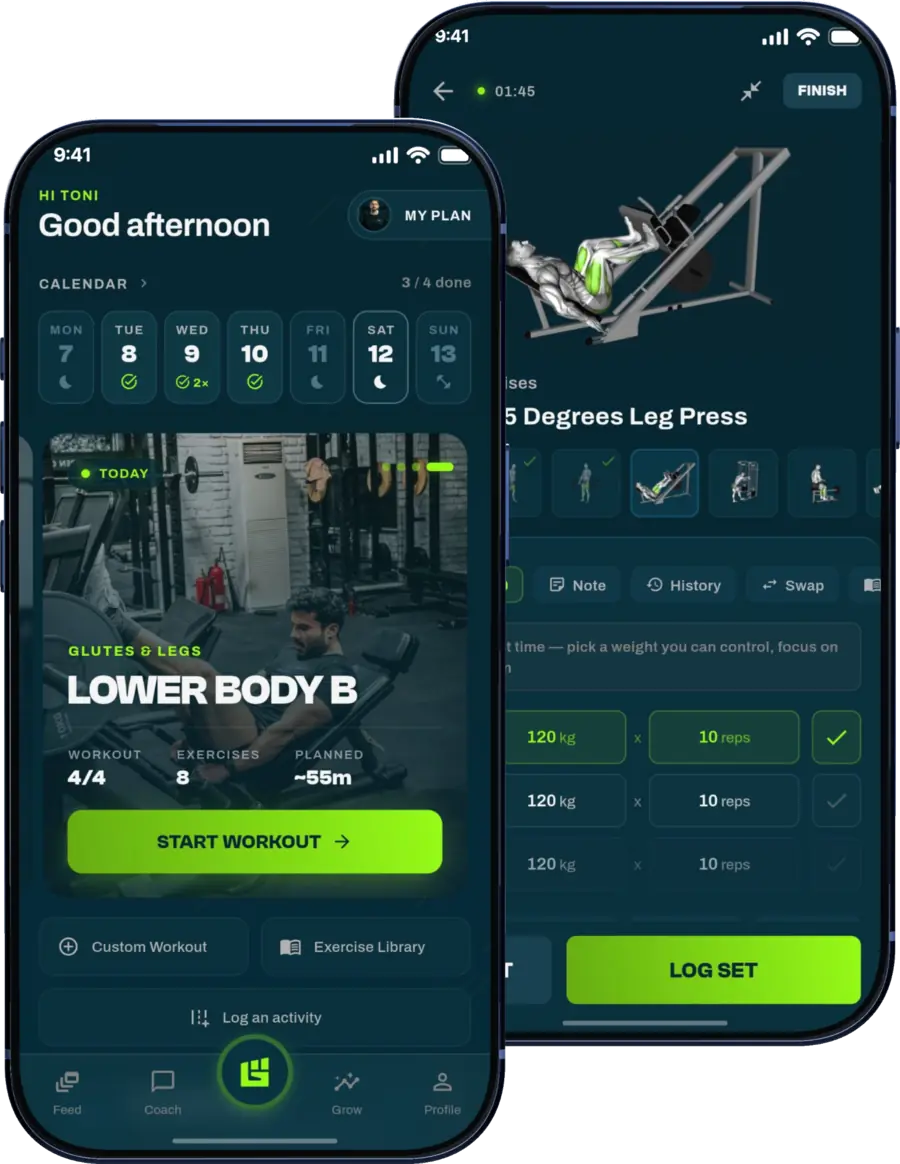
Get a personalized workout plan built around your goal, equipment and schedule. Train smarter, track every rep and keep moving forward, one workout at a time.






What Tiredness Does to Your Training Output
What does a tired session cost you? Less than most lifters fear, and more than a stubborn one admits. Tiredness works like a dial you can turn down on load, volume or intensity, and the right setting depends on which kind of tired walked in with you. A rough night, a run of demanding training and sore legs each call for a different adjustment.
Identify the kind of fatigue
- Acute sleep loss: One poor night leaves you sleepy or sluggish the next day.
- Chronic short sleep: Repeated nights below your usual needs can leave you feeling worn down beyond a single session.
- Accumulated training load: Several hard weeks with rising volume can make familiar weights feel unusually demanding.
- Psychological stress: Deadlines, low mood, or a disrupted routine can reduce focus and motivation.
- Localized soreness: One muscle group feels tender or stiff, while your overall energy may be fine.
The output drop is real and measurable. A 2022 systematic review and meta-analysis combining 77 studies and 959 participants found that sleep loss was associated with a weighted mean exercise-performance reduction of 7.56%. The reported reductions varied by task: anaerobic power fell by 6.26%, while strength fell by 2.85%. The review also found substantial variation between studies, so those averages describe a pattern rather than predict your exact day.
That distinction matters at the gym. You may be able to complete a session while producing less than your usual output, and that trade-off lands differently depending on who you are. A busy professional short on sleep may keep a full-body session and stop each set well short of failure. A strength athlete deep in a heavy block may cut the top set entirely and keep speed work light. A beginner with limited technique has the least margin for sloppy reps, so slowing the session down protects both safety and the habit. Explosive lifts, high-intensity intervals and maximal or near-maximal efforts are poor choices for anyone who feels flat or distracted, while a lighter technique session, mobility work or easy aerobic training keeps the streak alive without forcing high-demand work below your readiness.
Accumulated fatigue calls for easing the load back gradually rather than stacking another hard week on top. When demanding weeks pile up and familiar weights start feeling heavy, trim volume or intensity for a stretch, then build again once the warm-up feels normal. Piling on more work at that point digs the hole deeper instead of building fitness.
Sleep loss is also associated with injury risk, though that doesn't mean every tired workout causes an injury. A review of athlete research found adolescent athletes sleeping fewer than 8 hours were about 1.7 times more likely to sustain an injury than those sleeping at least 8 hours; a six-month study of 340 adolescent elite athletes found that sleeping more than 8 hours on weekdays reduced sports-injury odds by 61% (athlete sleep and injury review). These findings support extra caution around heavy lifts, sprinting and technical movements when tiredness is persistent.
There isn't one fatigue response that fits everyone. A 2026 crossover study of 24 resistance-trained adults found that four or zero hours of sleep reduced moderate-load performance by about 7% to 13% in males, while females showed roughly 7% to 12% reductions in muscular endurance during back squats. Treat your own warm-up and performance as part of the decision, alongside your sleep total.
Five Checks to Run Before You Lift
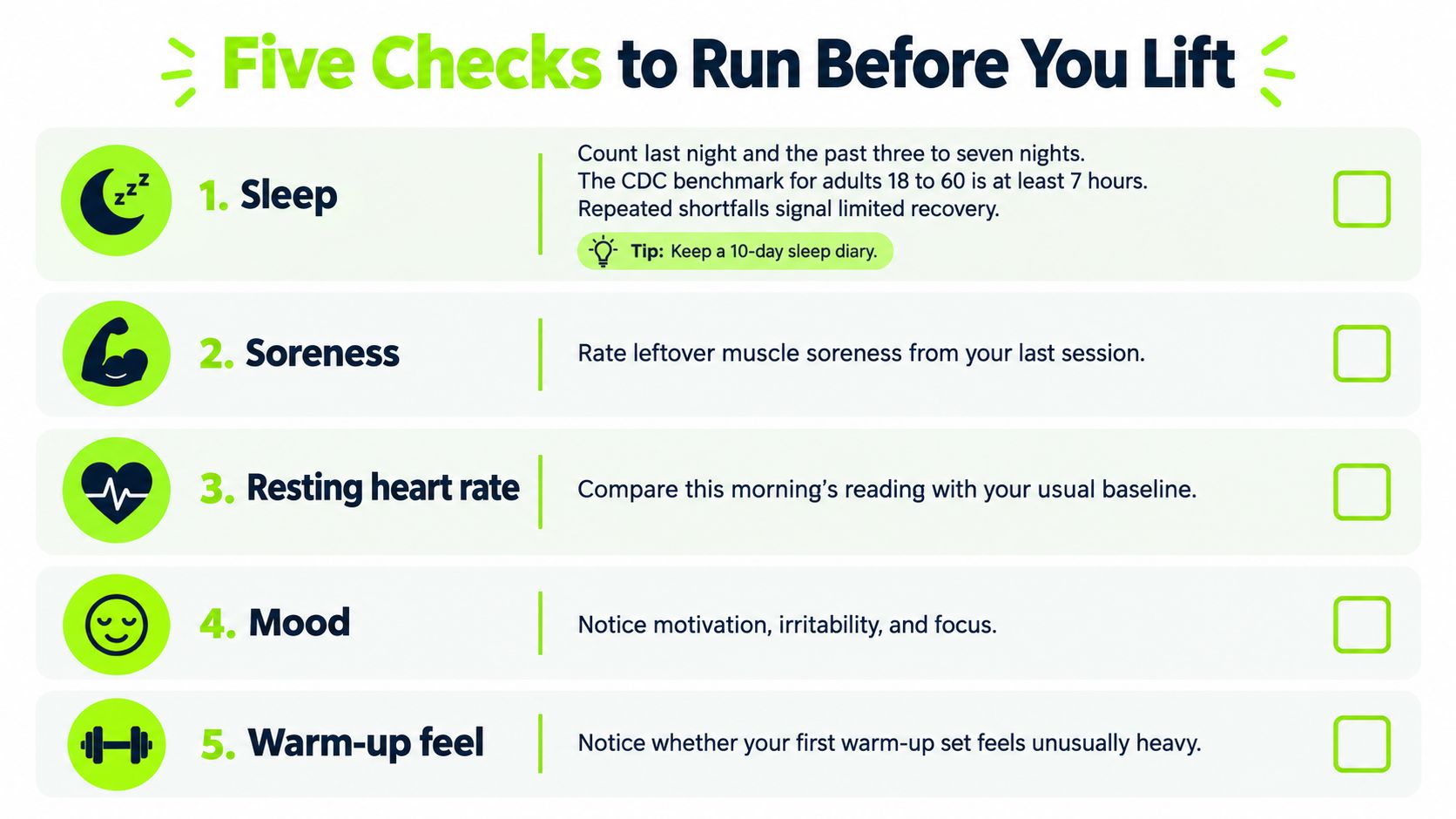
Make the call during your warm-up, not while you're bargaining with yourself in the parking lot. Run these checks in the first ten minutes, then reassess after your first working set. A warm-up can reveal that an ordinary groggy morning is still a green day, or that your body isn't ready for the planned load.
- Sleep: Count last night and the past several nights. The CDC recommends at least 7 hours per night for adults ages 18 to 60; regular shortfalls can signal limited recovery (CDC sleep recommendations). Keep a 10-day diary of bedtimes, wake times, naps, caffeine, alcohol, and training if tired mornings keep repeating.
- Warm-up feel: Compare your first working set with the same weight on a normal day. If a familiar load feels notably harder, treat that as a yellow flag rather than trying to prove you can muscle through it.
- Bar speed and coordination: Watch your ramp-up sets. A bar that moves unusually slowly, form that starts to drift, or balance that feels unreliable all argue against heavy or technical work.
- Demand of the planned session: Ask what the workout requires. Maximal attempts, explosive movements, and technical lifts leave less room for lapses in focus, so lower those demands first on a yellow day.
- Symptoms: Check for fever, widespread aches, dizziness, or feeling unwell. Those symptoms aren't a cue to make the warm-up longer and then push harder.
Use this scoring rule: All five checks green means train as planned. One or two yellow flags mean use the yellow template. Three or more yellow flags, or any red symptom, means switch to red.
When Tiredness Means Skip the Workout
Pushing through a cold to protect a training streak is a common mistake. A streak doesn't improve your judgment, and illness-related fatigue isn't the same as ordinary sleepiness after a demanding day.
Mayo Clinic guidance says mild-to-moderate activity is usually acceptable with a common cold if you don't have a fever. But it advises against exercise when you have a fever, fatigue, or widespread muscle aches; if you exercise with only mild cold symptoms, reduce both intensity and duration. Training at normal intensity while seriously ill can raise the risk of injury or more serious illness (Mayo Clinic exercise guidance).
Use the symptom filter
- Fever: Rest.
- Widespread aches: Rest.
- Feeling miserable: Rest instead of testing whether a workout will fix it.
- Dizziness or unusual loss of coordination: Stop exercising.
Ordinary tiredness after a demanding week may call for a modified session. Symptoms that point to illness change the answer. A few days off while sick shouldn't meaningfully damage your fitness, so don't turn recovery into another workout to complete.
Return gradually: start with an easy walk, then try a reduced session, then resume normal training as symptoms improve. Don't return to heavy work while fever or widespread aches linger. If you have a medical condition, are pregnant, are recovering from an injury, take medication, or haven't trained for a long time, talk to a doctor before starting or restarting training.
Modified Session Templates for Tired Days
On a yellow day, keep the session's basic pattern and lower its demands. On a red day, change the purpose of the session to easy movement, mobility, or recovery.
| Session type | Yellow adjustment | Red substitute |
|---|---|---|
| Heavy squat, bench, or deadlift day | Cap at 3 to 4 hard sets, stop 2 to 4 reps short, and skip 1RM tests | Technique practice with light loads or 20 minutes of easy cycling |
| Hypertrophy push or pull day | Drop 1 to 2 sets per exercise and favor machines or cables | Band rows, band pull-aparts, and 15 minutes of mobility |
| HYROX or interval conditioning | Run at a controlled pace, halve the interval count, and skip max-effort rounds | 30 to 40 minutes of easy steady running or rowing |
| Beginner full-body session | Two sets per exercise at familiar weights, with no new movements | 20-minute walk and gentle mobility |
| Busy professional 30-minute session | Three rounds of four moves, stopping each set 2 to 4 reps short | 15-minute walk plus stretching |
The yellow changes aren't just a way to make a session feel easier. They preserve the movement practice while reducing the chance that poor focus turns a hard set into a failed rep. A systematic review and meta-analysis found that acute sleep loss reduced overall exercise performance by an average of 7.56% across 77 studies involving 959 participants. A separate resistance-training review found that repeated nights of restricted sleep reduced force output in multi-joint movements more consistently than in single-joint exercises (resistance-training review).
Set a clear ceiling
Cut hard sets by about a third, stop each set with 2 to 4 reps in reserve, and skip one-rep-max tests and training to failure. If your concentration is impaired, favor machines or single-joint work over technically demanding barbell lifts. A leg press or hack squat is a sensible swap when a squat feels unpredictable.
For example, turn four sets of five back squats into three sets of five with two to three reps left in reserve. If coordination or concentration still feels off, use three sets of eight on the leg press instead. That keeps the lower-body focus without insisting on the original lift.
If performance has been dropping across several sessions, reduce total volume by roughly 20% to 40% rather than forcing the planned workload. For beginners and busy professionals, a three-exercise full-body session with two sets each, or a 30-minute circuit of three rounds and four moves, still counts as a complete workout. If you want help organizing a weight-training plan around your available time and equipment, use a workout-planning tool to keep the session structure clear.
Recovery Tactics That Help You Train Tired
A 2025 multidimensional review reported that performance declined by approximately 0.4% for every additional hour awake after sleep loss and suggested scheduling exercise as early as possible (2025 review on sleep loss and performance). Move a demanding session into your first workable window when the day allows. Sleep needs differ between people, so treat any standard sleep range as a guide rather than a pass-fail test.
| Tactic | Best timing | What it does | Limit |
|---|---|---|---|
| Earlier training slot | First free window in the day | Limits the extra impairment that can build with each hour awake | Doesn't replace missing sleep |
| Short nap | 10 to 20 minutes in the early afternoon, finished about 30 minutes before training | Can restore some alertness for a later session | A long or late nap can leave you groggy |
| Caffeine | 30 to 60 minutes before warm-up | Raises alertness and can make the first sets feel more ready | Masks fatigue without restoring coordination; avoid late in the day |
| Extended warm-up | About 10 extra minutes of ramp sets | Tests whether bar speed, joints, and effort feel normal | Can't fix red-zone symptoms |
If you want more context on focus and alertness, explore rhodiola's cognitive benefits. Treat any supplement as secondary to sleep, food, and workload. Caffeine can make you feel more awake without bringing back sound coordination or judgment, so never use it to justify maximal lifting or technical barbell work on a red day.
A missed morning session can move to the afternoon if you feel better and the workout still matches your readiness. If it doesn't, choose low-intensity recovery work: easy movement that boosts circulation and loosens tight muscles. GrabGains recovery workouts fit that slot when you want structure without turning the day into another hard session. On lighter days, keep easy stretching work gentle and brief alongside a walk or recovery session.
For shift workers and people training twice a day, place the hardest session in your best alertness window and the easier session in the worst one. The review found a larger performance drop in evening sessions, so if tiredness forces a late workout, cut the hard work first and keep only controlled technique or easy aerobic work. A busy professional can keep a short circuit and walk, a strength athlete can keep ramp sets and stop before grinding, and a beginner can keep two easy sets and leave with the habit intact.
Three Tired Mornings in Practice
The professional after a deadline
A busy professional sleeps about five and a half hours after a deadline and plans a 6 a.m. gym session. The warm-up feels heavy, but there's no dizziness, fever, or poor coordination. That's a yellow day, so the planned heavy lower-body workout moves to Thursday.
Instead, they do a 25-minute circuit of goblet squats, push-ups, and rows, two sets each, keeping the effort controlled. A 15-minute lunchtime walk adds movement without turning the morning into another test.
Zone: Yellow. The change that mattered: They kept the habit and cut the session's demand.

The strength athlete after travel
A strength athlete sleeps four hours after travel and plans a heavy set of five squats. During the warm-up, the bar moves slowly. They skip the planned top set, then do three sets of five at two to three reps in reserve. Accessory work shifts to three sets of eight on the leg press rather than adding more heavy compound lifting.
They log the session's RPE and check how they feel the next morning before deciding whether to return to normal loading. The point isn't to make up the missed top set later that day.
Zone: Yellow for the adjusted session, with the heavy top set treated as a no-go. The change that mattered: Slow bar speed ended the heavy work before technique had to prove itself.
The beginner after a double shift
A beginner in week three finishes a double shift feeling ordinarily tired but has no symptoms of illness. They use familiar weights and do two sets of each full-body exercise, leaving new movements for a better-rested day. If dizziness or a fever appears, the session stops and becomes rest.
Zone: Yellow. The change that mattered: They used familiar movements and reduced the amount of work instead of skipping automatically or pushing through the full plan.
Log Your Trend and Adjust the Plan
One tired morning is information; repeated tired sessions may be a pattern. After each workout, record the RPE of your first working set, completed reps, sleep hours, and the zone you trained in. Paper or a notes app is enough. Review the last several days together rather than changing your plan because of one low-energy morning.
A single yellow day between green days doesn't require a program overhaul. Train the next session as planned and keep logging. If yellow repeats across three or more sessions, reduce weekly volume by roughly 20% to 40% or replace one hard session with recovery work, and check whether your sleep has also been consistently short. Any red symptom means rest first, then return with an easy walk, a reduced session, and your normal plan only after symptoms have cleared.
For anyone who wants the adjustments built into their routine, GrabGains workout tracking helps you log sessions and follow a plan. GrabGains builds programs around your goal, equipment, and training days, and its AI adjusts workout difficulty based on your progress. Its recovery workouts are low-intensity sessions designed to boost circulation and loosen tight muscles, and you can train at home, in the gym, or on the go.
Use GrabGains to build a training plan around your schedule, equipment, and goals, then track how your sessions feel on tired days. Start with a manageable workout, adjust the effort when readiness drops, and let your training record help guide the next call.
Get inspired and motivated