How Much Weight Should I Lift: A Practical Guide
Learn how much weight should I lift for strength, muscle growth, or endurance. A practical guide to choosing the right load for your goal and experience.
You're standing in front of a rack, looking at the bar and wondering whether to add plates or start empty. Someone nearby is lifting far more than you expected, and suddenly your planned workout feels like a guessing game. If you're asking, “How much weight should I lift?” the answer starts with your planned reps and your technique, not someone else's plate setup.
Why the right weight depends on more than numbers
Choose a weight you can control, not a weight you want to impress yourself with. Your goal, the exercise, your lifting experience, and how much effort the set requires all matter. There isn't a universally correct starting load, and the American College of Sports Medicine's resistance-training framework treats load selection as part of a program rather than an isolated number.
Copying another lifter skips that context. You don't know their training history, their intended effort, or whether they're doing a demanding working set or an easy warm-up. Even your own usual weight isn't automatically right for a different exercise or training goal.
Built for progress
Take the guesswork out of training
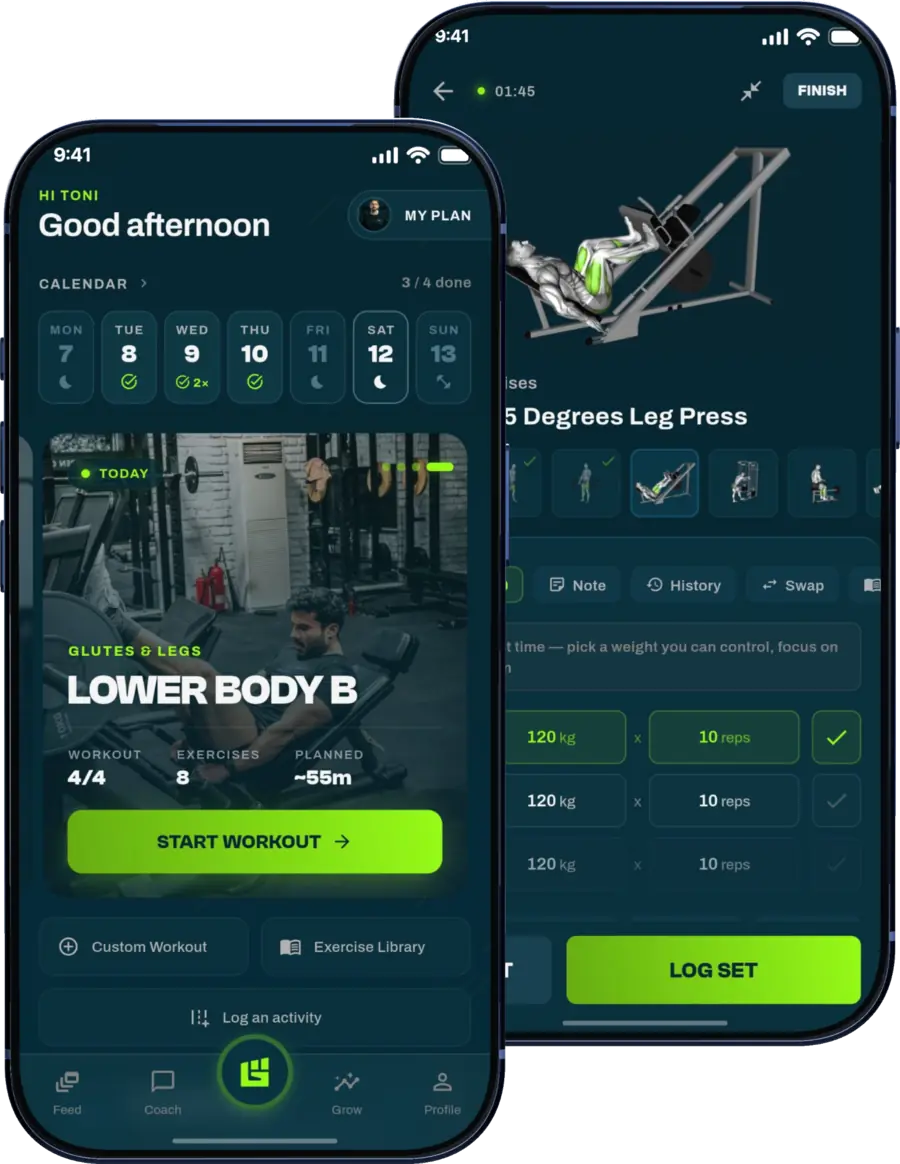
Get a personalized workout plan built around your goal, equipment and schedule. Train smarter, track every rep and keep moving forward, one workout at a time.






Judge the movement before the number
Use these checks before deciding that a load belongs in your workout:
- Goal: Decide whether you're prioritizing strength, muscle growth, endurance, or learning the movement.
- Technique: Keep the intended range of motion without bouncing, twisting, or changing position to finish.
- Effort: Finish with a small reserve of technically sound repetitions rather than forcing a maximal attempt.
A squat and a bench press don't need matching numbers. Neither do a dumbbell press and a machine press. Treat each exercise as its own task, and judge the load against the movement you're performing.
Starting principle: A challenging weight still lets you perform the exercise you intended. If you have to turn it into a different movement, reduce the load.
For general training, heavier isn't automatically more appropriate. The ACSM's updated resistance-training guidance distinguishes heavier strength loading from lighter, faster power work. That distinction matters: choose the purpose first, then select resistance that supports it.
Matching the load to your goal
Pick your training priority before touching a weight. You can train the same exercise with different loads, but those choices should be deliberate. Don't turn every workout into a test of the heaviest weight you can move.
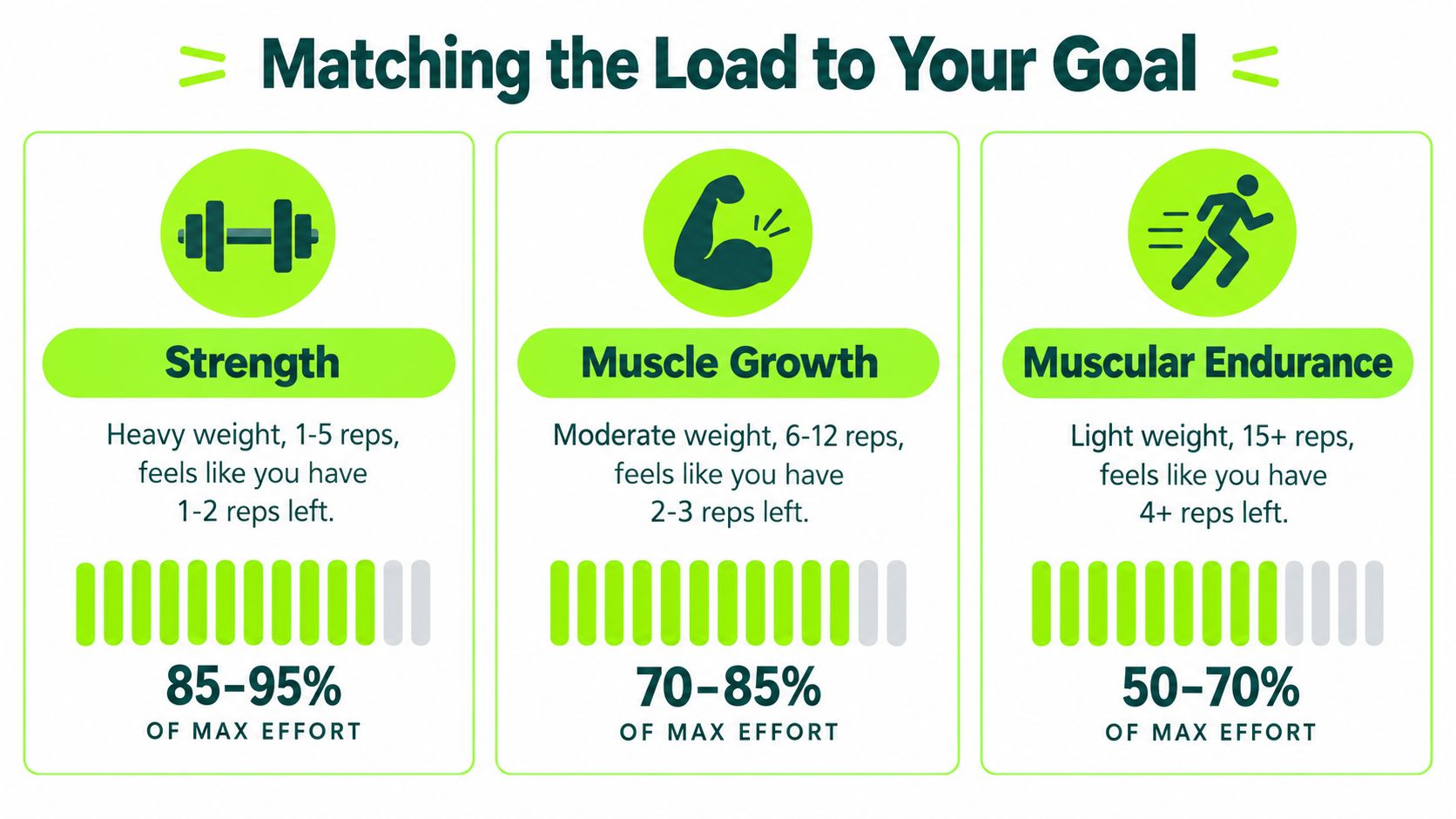
The NSCA's load-and-repetition guidance associates strength work with 6 or fewer reps, muscle-building work with approximately 6–12 reps, and endurance work with 12 or more reps. These are useful programming ranges, not rigid boundaries.
Strength demands heavier, controlled work
Choose a heavier load and a lower repetition target. The set should require concentration, but you shouldn't need to bounce the weight or shorten the movement to finish.
My recommendation is to keep a small technical reserve rather than chase failed repetitions. Heavy practice should teach you to produce force while maintaining position, not teach you to escape a difficult rep.
Muscle growth doesn't require maximal weight
Moderate loads are a practical default because they balance challenge with manageable set length. However, a systematic review of volume-matched resistance training found no meaningful hypertrophy difference across load categories, while heavier loads produced greater maximal-strength gains.
That doesn't mean every easy set builds muscle equally well. Choose resistance that makes the end of the set demanding without making your technique negotiable. The hypertrophy rep-range guide gives more context for choosing your working range.
Endurance favors lighter, longer sets
Use a lighter load and a higher repetition target when sustaining muscular effort is the priority. Don't mistake burning muscles or heavy breathing for permission to lose control.
For a closer comparison, explore high reps versus low reps. Choose a consistent goal-based structure for your weight-training workouts, then adjust individual exercises to match your ability.
Using reps in reserve to pick the weight
Repetitions in reserve, or RIR, means the additional clean repetitions you believe you could perform when you stop a set. It's an estimate of remaining muscular effort, not how many ugly repetitions you could force through.
If you finish 8 reps and believe another 2 were possible with the same technique, you finished at 2 RIR; for most working sets, a practical target is roughly 1–3 RIR, as described in this resistance-training study using RIR-based prescriptions.
Count clean reps, not possible cheats
After a test set, ask yourself:
- Range of motion: Could I repeat the same movement depth or distance?
- Position: Could I continue without swinging, arching more, or shifting my stance?
- Control: Were the final repetitions deliberate, even if they slowed?
- Limiting factor: Did the working muscles stop me, or did balance, grip, or breathlessness end the set?
Suppose your workout calls for several sets at a fixed repetition target. You finish the first set comfortably, with noticeably more reserve than intended. That's a reason to test a slightly heavier load, not a reason to rush straight to something dramatically heavier.
If you barely complete the target and your last rep changes shape, go lighter. Count only repetitions you could reproduce with the same technique. Reaching failure means no further complete repetition is available, and it shouldn't be the default target for someone still learning load selection.
Don't ask whether you could move the weight again somehow. Ask whether you could repeat the same rep.
The method works across equipment. With machines, adjust the stack; with dumbbells, choose a different pair; with barbells, change the plates. For bodyweight exercises, choose an easier or harder variation, and with bands, change the resistance or setup while keeping it repeatable.
If you prefer rating overall set difficulty, the RPE training guide explains a related effort-based approach. Keep the rating honest rather than chasing mathematical precision.
A beginner's first session step by step
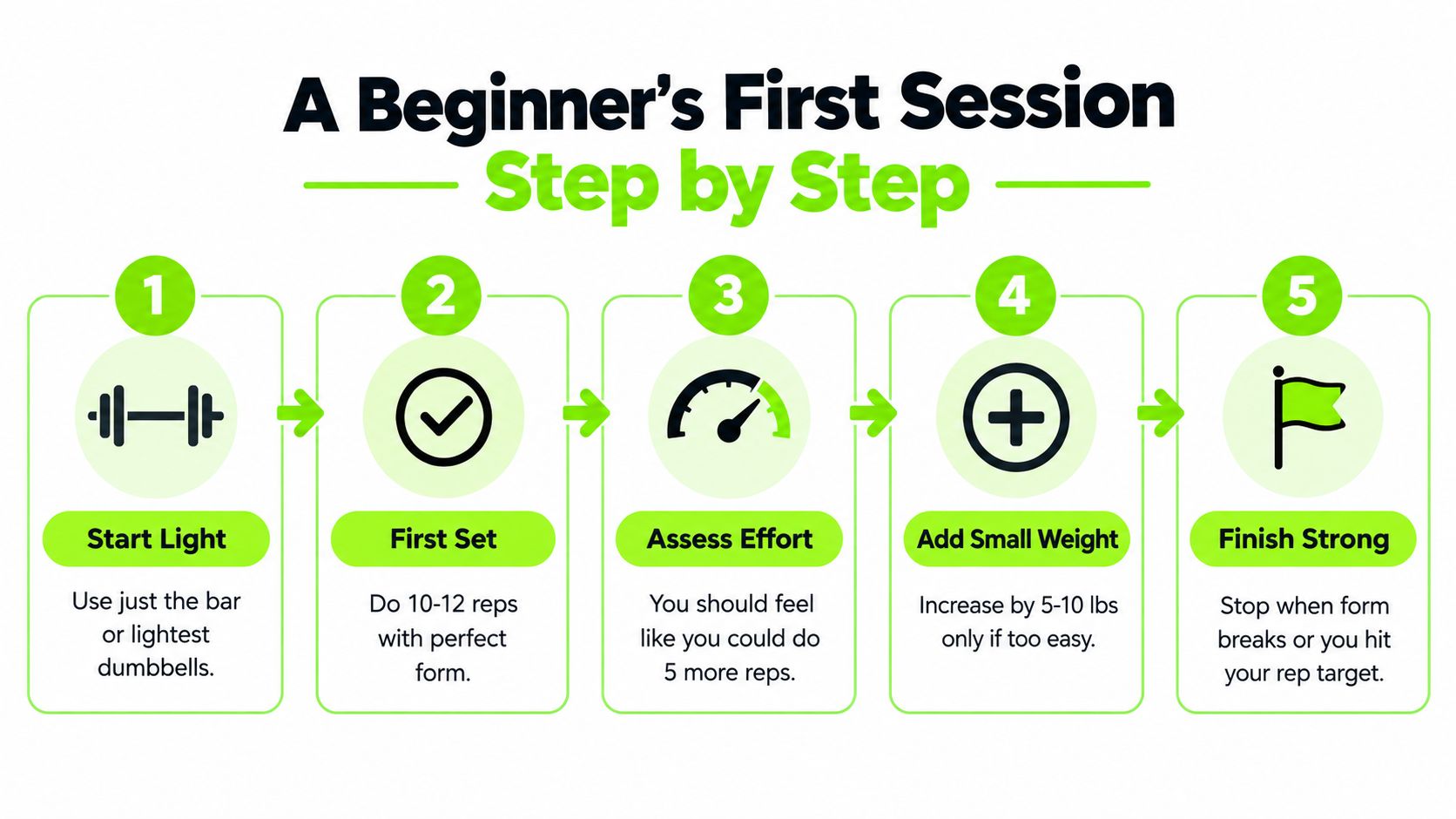
Your first workout should establish usable starting loads, not prove your strength. Start clearly light, learn how the movement feels, and stop adding weight when you find a technically sound challenge.
A beginner resistance-training program guide recommends light starting loads and approximately 1–3 sets of 6–15 reps, followed by gradual progression. You don't need a tested maximum to begin.
Start light, test, adjust, and log
- Rehearse the movement. Use an unloaded variation, the lightest suitable dumbbells, or an empty bar if you can control it comfortably. An empty bar isn't automatically light enough for everyone.
- Perform a test set. Work within your chosen beginner rep range. Pay attention to movement quality before judging muscular effort.
- Assess your reserve. If you could clearly perform several more clean repetitions than intended, add a small amount. If your technique deteriorates or you miss the target, reduce resistance.
- Retest without chasing fatigue. Make a modest adjustment and check again. You're finding a baseline, not exhausting yourself through endless trial sets.
- Record the result. Log the exercise, weight, completed reps, and perceived reserve. Note setup details that will help you repeat the movement.
Apply it to an upper-body push and a squat
For an upper-body push, start with a light dumbbell press or an appropriately adjusted machine. Check whether you can maintain the same pressing path throughout the set. If you're specifically learning the barbell movement, use the beginner bench press weight guide rather than copying another person's load.
For a lower-body pattern, rehearse a controlled bodyweight squat before adding resistance. If balance or movement control limits you, practice the variation you can perform consistently instead of loading a version you haven't learned.
These are practice examples, not performance standards. The guide to starting strength training can help you organize the exercises around a repeatable routine.
Progression rules that actually work week to week
Earn a heavier weight by improving performance at your current weight. Don't add plates because the calendar says another week has passed.
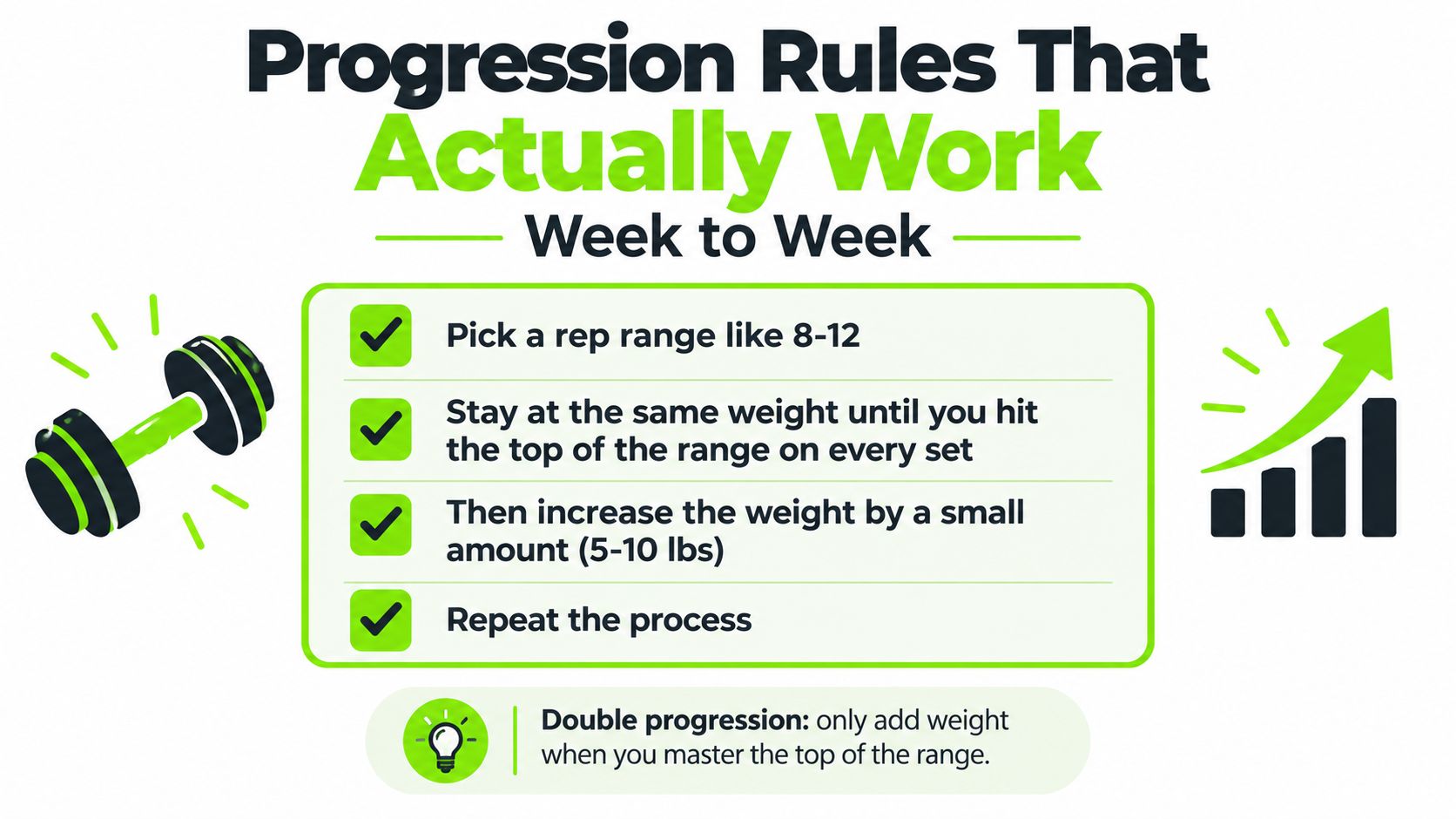
Use double progression: choose a repetition range, build toward its upper end, and increase resistance after every prescribed set reaches that upper end with controlled technique. After increasing the load, work from the lower end again. Your workout log should show why you made the change.
Increase only after the whole exercise qualifies
A strong opening set doesn't justify an increase if the remaining sets fall short. Check the complete exercise: repetition targets, range of motion, technique, and intended effort.
The NSCA position statement on resistance training for older adults emphasizes establishing technique before progression and maintaining it as resistance increases. That's a sensible standard for your loading decisions, regardless of whether you're chasing larger muscles or general fitness.
Use this decision checklist:
- Every set meets the target with control: Try the smallest appropriate increase next session.
- Some sets still fall short: Keep the weight and improve repeatable performance.
- Technique deteriorates: Reduce the load or reconsider the target.
- Equipment forces a large jump: Build more confidence at the current resistance or choose equipment with finer increments.
For barbell work, practical increases are often around 2.5 kg for upper-body lifts and 2.5–5 kg for lower-body lifts. Those are equipment-based examples, not mandatory jumps; the ACSM progression model supports individualized increases, commonly about 2–5% for upper-body work and 2–10% for lower-body work.
Dumbbells may require smaller increases. Beginners can sometimes progress weekly, while experienced lifters often need longer at a load. Neither schedule should override what your sets show.
Use estimated maximums as references, not orders
A one-repetition maximum, or 1RM, is the heaviest load you can lift once with proper form. You can estimate it from a submaximal set using a repetition-based equation instead of attempting a true maximum.
Warm up with progressively heavier, clean sets, then use a manageable working set and enter its weight and repetitions into a one-rep max calculator. For a strength-focused starting reference, approximately 75–80% of estimated 1RM is reasonable under the ACSM progression model cited above, but your technique and reserve should determine the final working load.
An estimate is useful for tracking familiar barbell movements such as the squat, bench press, deadlift, and overhead press. It's usually unnecessary for dumbbell isolation exercises, bands, or machines, and maximum testing is a poor choice when coordination is your main limitation.
Progression checkpoint: Your next weight should follow evidence from your training, not pressure to beat last week at any cost.
GrabGains' workout tracker shows previous exercise performance and progression suggestions during your workout. Personal records, estimated maximums, training history, and weekly and monthly analyses help you evaluate trends. Smart Workouts adjust suggested weights, reps, and progression over time, while you remain in control of the final choice.
For the broader principle behind adding challenge, see the progressive overload training guide.
Adjusting the load on bad days and busy weeks
Your planned weight is a starting point, not a contract. Poor sleep, high stress, heavy fatigue, or lingering soreness can make your usual work feel different. Don't force the original load just to keep your log looking tidy.
Watch your warm-up before deciding how hard to train. Unusually heavy-feeling sets, slower repetitions than normal, or earlier technique breakdown are useful reasons to adjust. Low motivation alone doesn't prove the weight is wrong, so judge your movement rather than your mood.
Change the dose without rebuilding the program
You have practical options:
- Lower the resistance: Keep the planned movement and repetition target, but choose a load you can control today.
- Reduce the sets: Keep a manageable load while doing less total work.
- Simplify the exercise: Choose a familiar variation when coordination or balance feels unreliable.
In GrabGains, you can adjust your training load to match how you feel without changing your whole program. Its adaptive workout coaching provides a place to make those adjustments while keeping your broader plan organized.
Make recovery and consistency realistic
If you're exploring recovery products, SleepHabits' sleep-focused recovery stack provides context for that topic. Treat it as reading material, not evidence that supplements make a fatigued training session appropriate.
A shorter workout isn't automatically wasted. A systematic review of resistance-training volume in healthy older adults found that low-volume training can improve physical function, lean mass, and muscle size, although greater volume appeared more necessary for larger strength gains.
For busy weeks or limited training capacity, prioritize a manageable routine. Choose work you can perform and recover from, rather than repeatedly abandoning a demanding plan.
Putting it all together with a sample week
Use a push session, a pull session, and a lower-body session as an adaptable example, not a required schedule. Choose familiar movements and apply your goal-based repetition range to each exercise. Leave the intended reserve and log the result before deciding what comes next.
The key is consistency of measurement. Repeat the same exercise setup, record actual performance, and distinguish a stronger set from one performed with less range of motion.
Push, pull, and lower-body practice
| Session | Example movements | Load-selection priority |
|---|---|---|
| Push | Dumbbell press, machine press, or a suitable push-up variation | Keep the pressing path and body position consistent |
| Pull | Cable row, dumbbell row, or band row | Avoid using torso movement to finish repetitions |
| Lower body | Squat variation and a familiar hip-hinge exercise | Choose resistance that preserves balance and movement control |
For a strength priority, use heavier, lower-repetition work on movements you already perform confidently. For muscle growth, select a demanding moderate-repetition target. For endurance, use lighter resistance and longer sets without letting fatigue alter the exercise.
Equipment doesn't change the core decision. A bodyweight variation that fits your target is more useful than forcing a difficult version, and a manageable machine load is more useful than copying the stack setting of the person before you.
Plan the next session from what you completed
Pick a weight that lets you finish your target reps with good form and a small reserve, log the result, and increase only after every set meets the progression target. Keep the weight when performance is still developing, and reduce it when control deteriorates.
Before starting, account for your health as well as your training goal. GrabGains offers general fitness information only. Consult a healthcare professional before beginning a new training program, especially if you have a medical condition, are pregnant, are recovering from an injury, or are returning after a long break.
GrabGains offers workout logging, previous-performance tracking, and progression suggestions to help you choose your next load from actual training results. Visit GrabGains to plan your next workout, record your working sets, and make weight increases you can justify.
Get inspired and motivated