Missed Workout What to Do: Move, Skip or Combine
Missed workout what to do? A clear rule for moving, skipping or combining sessions, plus how to ease back in after a full missed week. Missing one workout will not wreck your progress. The catch-up usually will. Doubling the next session, tacking on extra cardio, or cutting food to "pay it back" raises fatigue and makes the workouts after it worse. Strength holds through short breaks. What actually changes your results is the pattern you keep across weeks, not a perfect Tuesday.
If you're looking for what to do after a missed workout, treat the miss as a scheduling decision. The default is simple. In most cases you continue the plan as written.


Decide Whether to Move, Skip or Combine
Treat the empty slot as a scheduling decision with a rule attached. Pick one option, apply it once, and let the rest of the week stand.
The miss itself cost you little. The World Health Organization frames activity as a weekly range rather than a required calendar day: adults can gain substantial benefits from 150 to 300 minutes of moderate aerobic activity, 75 to 150 minutes of vigorous activity, or a mix, plus strengthening on 2 or more days. One blank day does not erase that week. A bad reaction to it can.
You have three options.
Built for progress
Take the guesswork out of training
Get a personalized workout plan built around your goal, equipment and schedule. Train smarter, track every rep and keep moving forward, one workout at a time.






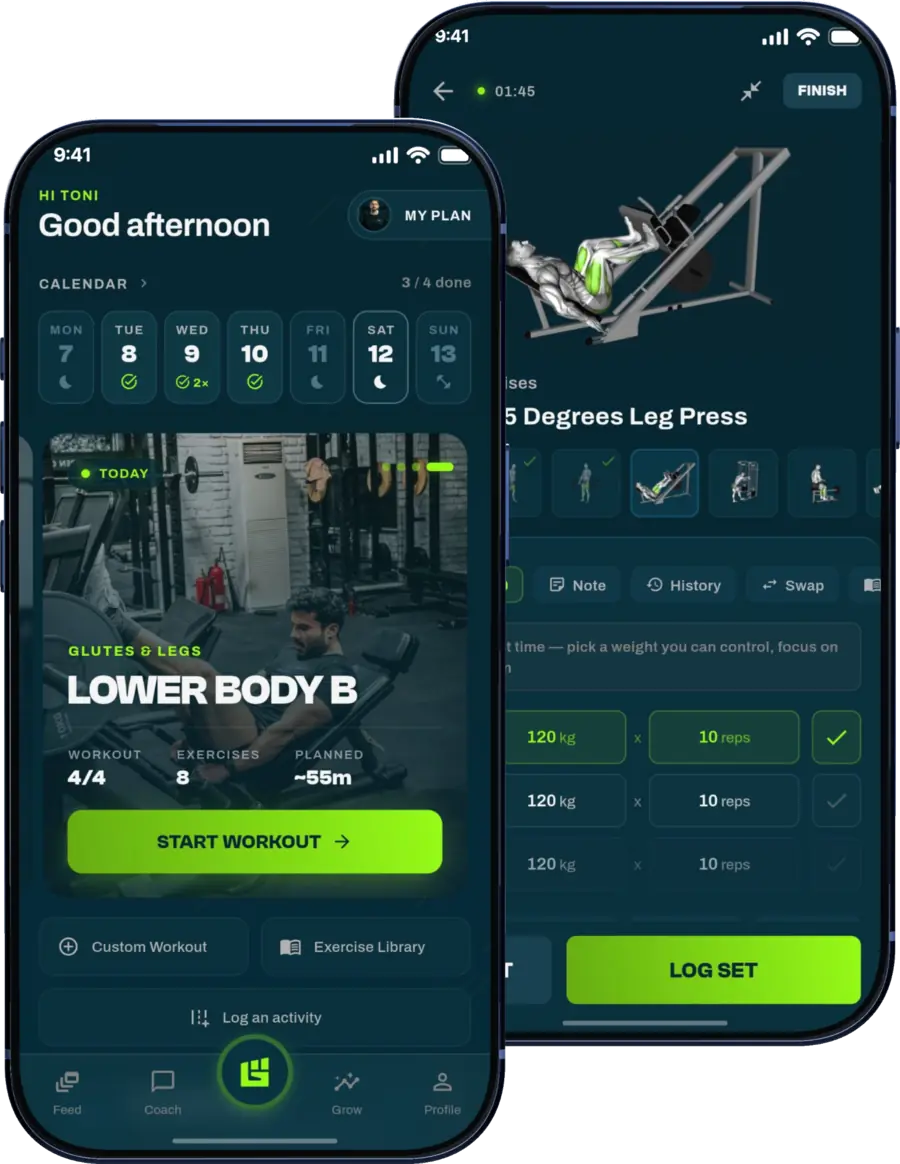
Move the session when a free day still leaves at least 24 hours of rest before your next scheduled session. The week keeps its shape.
Skip the session when no such gap exists. A routine conflict (a late meeting, a trip, a closed gym) means you continue as planned. A body that was not ready (illness, pain, heavy fatigue, poor sleep) means you skip and ease back in. Either way, squeezing the session in would compress recovery and stack hard days.
Combine a small piece of it only when the missed session held a main lift you train nowhere else that week. Add 1 or 2 sets of that lift to the next session and leave the rest of it behind.
One case sits outside a single miss: the same session gone two weeks in a row. Stop treating it as bad luck. The slot does not fit your life, so use the move option and make it permanent. Put that workout on a day you can actually keep. Repeated misses need a new time, not a rescue plan.
Default: A scheduling conflict follows the three options above. A readiness problem (illness, heavy fatigue, or poor sleep) always resolves to skip and ease back in.
The bigger risk is the reaction. After a miss, lifters often add cardio, cut food, or double up to pay it back. Research on exercise lapses found compensatory behavior common, and a regret manipulation did not reliably increase activity. Guilt is not a training plan. Match the option to the cause, then execute it once.
| Situation | Best option | Why it fits |
|---|---|---|
| Free day with at least 24 hours of rest before your next session | Move the workout to that day | Keeps the weekly pattern and avoids a missed session |
| No free day with 24 hours of rest, and the miss was logistical | Skip it and continue as planned | Adding a session compresses recovery |
| Missed because of illness, pain, or heavy fatigue | Skip it and ease back in | Readiness sets the pace for the next sessions |
| Missed session held a main lift you do not train elsewhere that week | Combine 1 or 2 sets of that lift into the next session | Keeps the lift in your week without a full extra session |
| Same session missed two weeks in a row | Move it to a better day and keep it there | Repeated misses mean the slot is wrong, so fix the schedule |
How to Move a Missed Workout Without Breaking Your Week
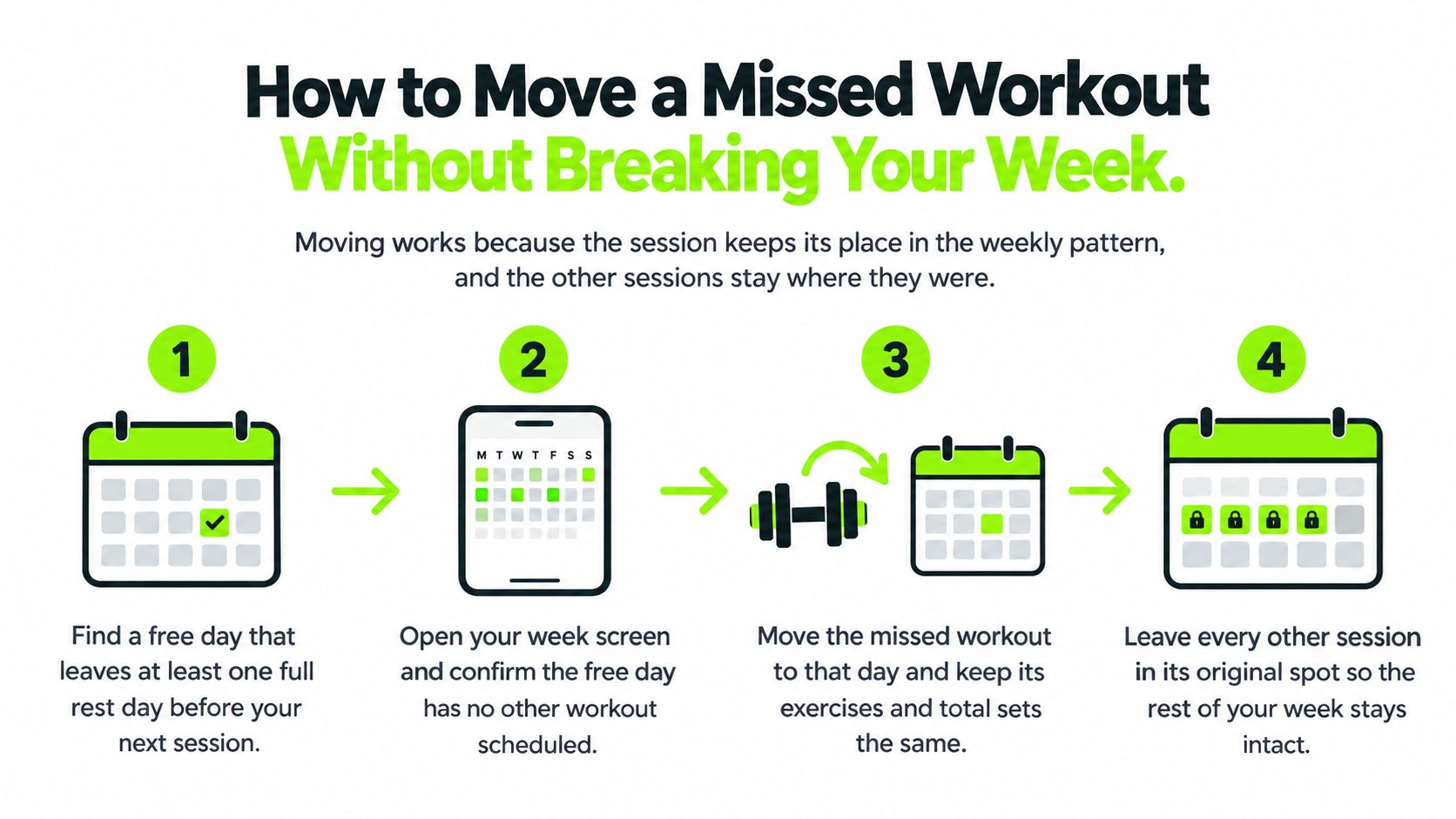
Moving works because the session keeps its place in the weekly pattern and the other sessions stay where they were. You are relocating one workout, not rebuilding the week. We build that program around your training goal, your equipment, and the days you can train, so a single shift should not force a new plan.
Run the six checks
- Find the gap. Pick a free day that leaves at least 24 hours before the next scheduled session.
- Check the neighbors. The moved session must not sit against another heavy day for the same muscles, and it must not create a run of hard days.
- Move only that workout. Put it on the free day and keep its exercises and total sets the same.
- Confirm nothing else moved. The rest of the week stays as it is. If other sessions shifted, undo it.
- Rate how you feel before you start. Suggested weights should match today's readiness, not the number you wrote last week.
- Log the session as done. Your weekly count stays accurate only if the completed day is recorded.
Say Monday's lifting session is missed, and the week already has lifting on Thursday and Saturday. Tuesday is free. Moving Monday to Tuesday works, because Tuesday still leaves about 48 hours before Thursday, well above the 24-hour minimum. Wednesday does not qualify. It sits too close to Thursday.
If the only free day is inside that 24-hour window, skip the session and continue as planned. Do not slide Thursday to make room. The change never cascades.
Why Stacking Two Sessions Usually Backfires
Catching up by doubling sessions rarely helps. You get the missed volume on paper and a worse workout in the room. Added volume raises fatigue, and fatigue lowers the quality of the sessions that follow. That is how one miss turns into a bad week.
ACSM guidance describes resistance training for healthy adults as generally appropriate on 2 to 3 nonconsecutive days per week. For beginners, the cited prescription uses about 60 to 70% of one-repetition maximum, and general guidance uses 8 to 12 repetitions for major muscle groups. Those days are spaced on purpose. Stacking two full sessions cuts the recovery those recommendations assume, and the second half is where technique goes first.
The narrow exception
Combine only when the missed session held a main lift you do not train elsewhere that week. Choose that one lift. Warm up, use the planned load, and leave a few reps in reserve. Add 1 or 2 sets. Then stop. You kept the lift in the week without importing a second workout.
Do not add these three things:
- Extra cardio to "burn it off." It adds fatigue without restoring the missed lift.
- A food cut. Under-eating does not replace a session you already skipped.
- A second full session. That is the double-up that makes the next workout worse.
A missed squat day is not a combine if the week already includes leg work for the same muscles. Skip it. The pattern already covers those muscles.
Endurance and HYROX athletes get caught here too. Compressing a missed conditioning piece onto the next hard day creates back-to-back fatigue that the race plan never asked for. Stacking is a precise tool for one missing lift. It is not the default.
Ease Back In Using Readiness Signals
Rate yourself before you touch the bar. That score is your readiness: sleep, soreness, energy, stress. The missed workout is irrelevant here. Your honest rating sets today's load.
Autoregulation research supports a readiness-based return rather than fixed makeup loading. RIR and RPE protocols show small benefits over fixed-percentage loading for squat and bench-press 1RM, and velocity- or RPE-guided programming can improve strength without more total volume. Use this return:
- Resume the next scheduled pattern. Do not restart the week.
- Ramp longer. Take 2 to 4 progressively heavier warm-up sets.
- Keep the planned load, then stop early. End each working set at about 2 to 4 reps in reserve.
- Restore normal effort only when bar speed, technique, and recovery feel typical.
If sleep, soreness, illness, or a wrecked schedule pulled your rating down, cut that first session's working sets by roughly 20 to 30%. If the session stays stable, go back to normal volume next time.
One miss does not require a reset.
Perceived readiness is not perfectly accurate, so check your rating against completed reps, technique, and bar speed when you can see it. Soreness is not proof the session worked. The gap itself is already absorbed. What hurts progress is the chase, loading extra work to pay back a debt that never existed. After you are back, keep logging every set, and an AI coach that reads your training can tell you whether the week's pattern still holds.
| Readiness signal | Working sets | Effort per set | Next step |
|---|---|---|---|
| Sleep, soreness, illness, or schedule disruption lowered readiness | Cut by roughly 20 to 30% | Stop each working set at 2 to 4 RIR | Return to normal volume next session if stable |
| Readiness feels typical, with normal bar speed and technique | Planned volume | Stop each working set at 2 to 4 RIR | Continue the plan as written |
| Technique or bar speed clearly below usual | Keep the reduced volume | Stay at the easier end of 2 to 4 RIR | Restore normal effort only when the session feels typical |
Recover After a Full Missed Week
Detraining is gradual, and strength and muscle do not fade at the same rate. A blank week costs you practice time, not your progress.
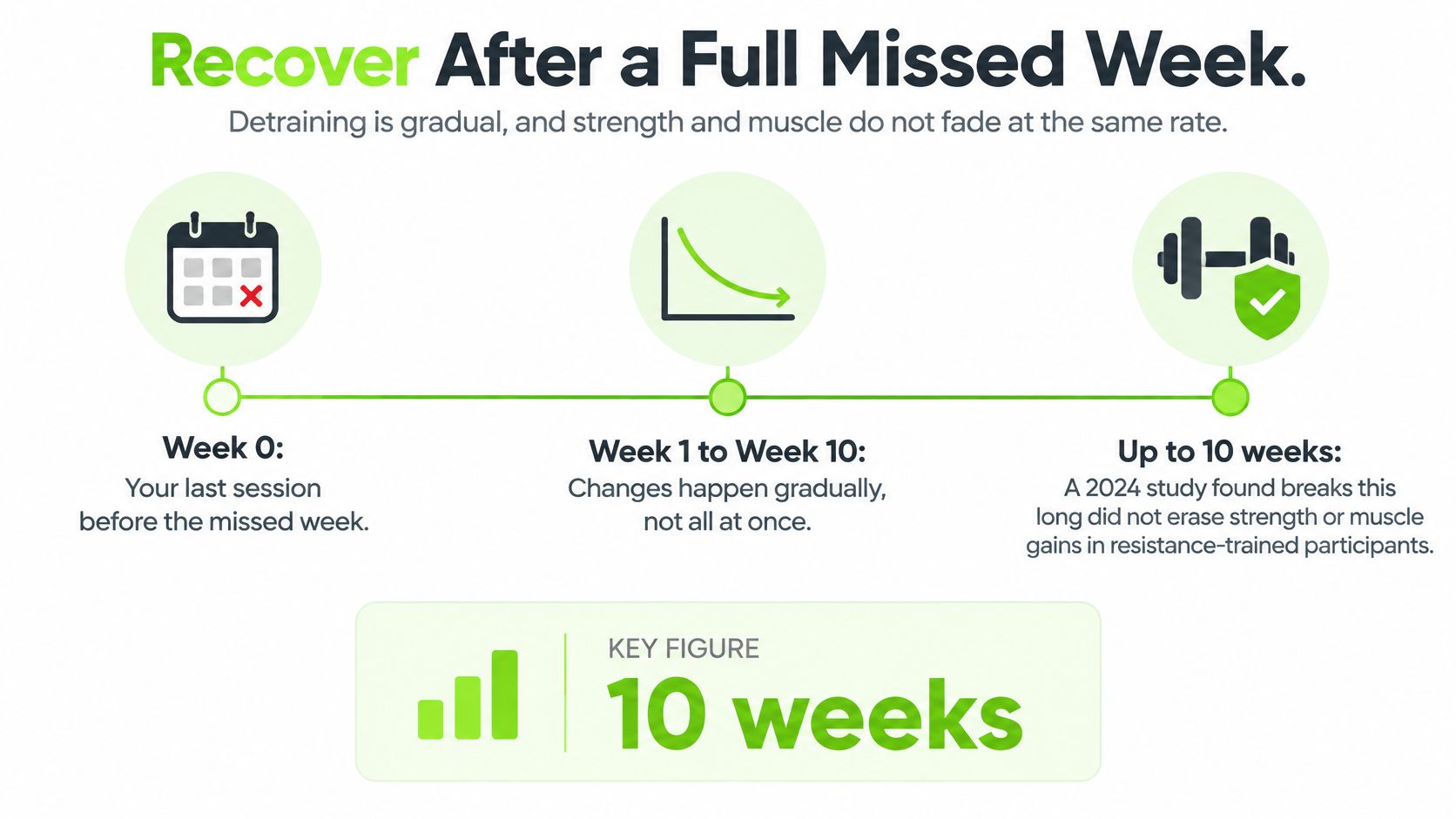
A 2024 study on resistance training breaks found that pauses of up to 10 weeks in resistance-trained participants did not erase long-term strength or muscle-size adaptations, though gains can show up more slowly afterward. Treat that as the evidence for patience. The dangerous move after a lost week is the catch-up reaction: cramming two weeks of volume into three days, adding punishment cardio, or cutting food to compensate.
Decide by goal. A missed hypertrophy week can be absorbed by resuming the plan where you left off. A strength athlete closing in on a test should repeat the week at reduced intensity rather than cram volume. One gap does not create a debt you have to repay in a single session.
Five steps for a one- to four-week gap
For an interruption of 1 to 4 weeks, use a graduated re-entry instead of testing old personal records. The figures below are general coaching guidelines for easing back in, not numbers drawn from that research. Adjust them to how the first session feels.
- Name the gap and the cause. Illness, travel, and a scheduling hole are different problems with different re-entry speeds. Use the longest interruption.
- Start lighter. Resume around 70 to 85% of the previous working load, or a conservative RPE of 6 to 7.
- Cut the set count, keep the range. Complete about 60 to 80% of the previous session's sets with full range of motion and clean reps.
- Raise one variable. Once every prescribed rep is done with reps still in the tank, add roughly 5 to 10% to load or to volume at the next session, not both.
- Return after two clean sessions. Two symptom-free, technically consistent sessions, then go back to normal programming.
Endurance athletes should be stricter with high-intensity conditioning, because that tolerance can fall faster than maximal strength. Start with easy aerobic work and build interval density back gradually. Chasing soreness or stacking back-to-back hard days creates a second problem to recover from.
Build a Schedule You Can Keep
Plan for your worst normal week, not your best one. A schedule you can finish on a busy week beats a perfect plan you abandon. The right frequency is the one you can repeat.
ACSM materials set a practical baseline of at least 2 training days per week for beginners. More experienced trainees pick a frequency that lets them hit the volume they want. That is the whole prevention strategy: choose a number you can realistically complete, and keep a shorter version ready so a busy day is not all or nothing.
| Weekly sessions | Best for | Busy-week fallback |
|---|---|---|
| 2 sessions | Beginners building the habit, matching the ACSM baseline | One shorter session covering the main lifts |
| 3 sessions | Trainees with a steady week, spaced on nonconsecutive days | Swap one session for a shorter version on the busiest day |
| 4 or more sessions | Experienced trainees who want more weekly volume | Keep one shorter session and move the rest to free days |
Make the week hard to break
Place sessions on nonconsecutive days so recovery is built in. Decide the busy-day version before the week gets messy. Keep the main lifts and drop the accessories. Put each session in the calendar as a fixed appointment, and name a backup day. When that backup is the better fit, move a workout in your plan and leave the other days alone.
Consistency is measured across weeks, not days. One missed day changes almost nothing. What breaks progress is the guilt loop: extra cardio, skipped meals, or back-to-back sessions after a single miss. Those reactions undo the consistency the schedule exists to protect. The miss costs you one session. The catch-up costs you the next three.
A shorter session on a bad day beats a heroic double that ruins Thursday.
Take the Next Step in Your Plan
The only decision you need today is whether this week's miss can still move.
Open your week screen first. It shows every workout of the week with its exercises and total sets, so you can judge the whole week before touching a single day. If a free slot with enough recovery room exists, put the session there. If it doesn't, let it go and train the next one as written.
Then log every set in the workout tracker by tapping in weight and reps after each set. Those logged numbers are what the workout generator uses to pick your next weight, so an honest log matters more than a perfect week. Smart Workouts already planned your week from your goal, schedule, and equipment, which means one changed day does not force you to rebuild anything by hand. Running a custom workout instead? Swap or reorder exercises without losing your history.
Skip the penalty reps, the extra cardio, and the skipped meals. One missed workout does not change your progress. The weeks you keep do. Open GrabGains and log the next session today.
Get inspired and motivated