Hotel Gym Workout Plans for 20 to 45 Minutes
A practical hotel gym workout guide: 20 to 45 minute routines, equipment swaps, warm-ups and progress tracking for busy travelers. Your flight landed at 9 p.m., and the hotel gym has two pairs of dumbbells, one treadmill, and a cable stack that's already taken.
Pick Your Hotel Workout by Time and Goal
| Time available | Goal | Format | How often |
|---|---|---|---|
| 20 minutes | Recovery and mobility | Walking, unloaded mobility, and easy breathing | On rough travel days |
| 20 minutes | Cardio | Walking base or bike intervals | 2 to 3 times a week |
| 30 to 40 minutes | Strength | Full-body session covering four movement patterns | 2 to 3 times a week, 48 hours apart |
| 45 minutes | Hypertrophy | Alternating full-body Session A and Session B | 3 times a week, alternating A and B |
| 45 minutes | HYROX-style conditioning | Cardio and strength stations in intervals | 1 to 2 times a week |
Choose tonight's hotel gym workout by time, goal, and readiness, not by what you usually do at home. Use the strength and hypertrophy plans for lifting, the cardio blocks for conditioning, or the recovery routine when travel has left you depleted. The frequencies above are planning options, not a requirement to complete every row.
The CDC's adult activity guidelines recommend at least 150 minutes of moderate aerobic activity or 75 minutes of vigorous activity weekly, plus muscle-strengthening activity on at least 2 days. Treat that as a weekly baseline, not something to squeeze into tonight; strength and aerobic work serve different purposes.
Make the schedule fit the trip
Start by protecting a strength day, a cardio day, and a recovery walk. Then fill the remaining gaps with another lifting session and aerobic blocks that fit around meetings. That starting schedule isn't the complete weekly target, but it's more useful than postponing everything until you have an uninterrupted evening.
Built for progress
Take the guesswork out of training
Get a personalized workout plan built around your goal, equipment and schedule. Train smarter, track every rep and keep moving forward, one workout at a time.






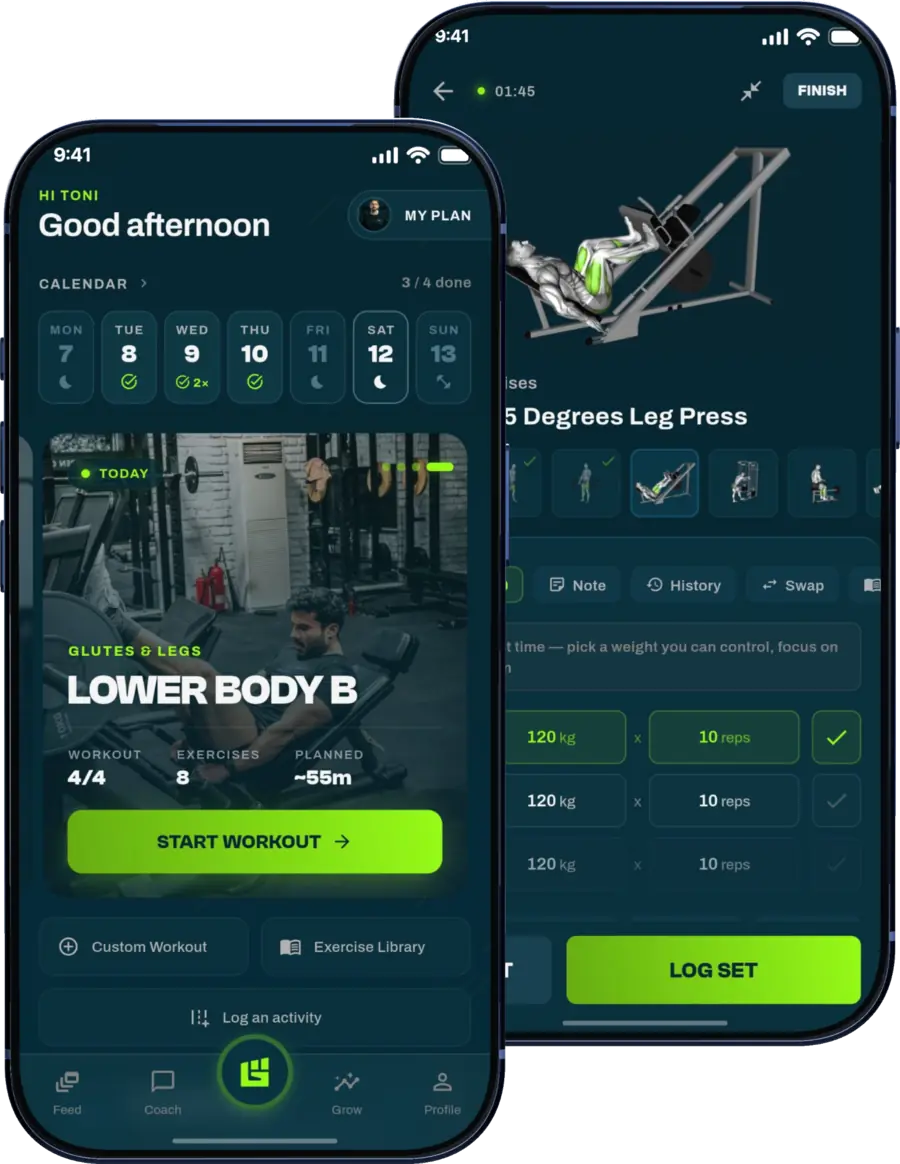
For strength, choose exercises that collectively train your legs, hips, back, abdomen, chest, shoulders, and arms. For cardio, choose a machine you can use comfortably without waiting. A short session contributes even when it doesn't complete your weekly plan.
Keep the trip to the gym simple: shoes, water, room key, and whatever you need to record your sets. If carrying those items is awkward, the Urban Totes guide to hands-free carry offers a practical way to organize a gym bag without bringing your entire travel setup.
Pick a row for tonight before you change clothes. Then check whether your body and the available equipment support that choice.
Check Your Readiness Before You Train
The same workout doesn't fit every travel day. Check your sleep, lingering soreness, energy after walking to the gym, time-zone disruption, and tomorrow's commitments before touching a weight.
Use these sleep bands as coaching prompts, not medical clearance. Good sleep doesn't cancel out illness, dizziness, or unusual pain.
| Readiness signal | Version to run | Time | Effort cue |
|---|---|---|---|
| Under 5 hours of sleep, or jet lag with nausea | Recovery circuit of walking, mobility, and light cardio | Up to 20 minutes, only if symptoms settle | Talk-test pace, no sets to failure |
| 5 to 6 hours of sleep, or ordinary travel fatigue | Reduced strength with 2 sets per exercise, same four patterns | 30 minutes | Stop with 3 or more reps in reserve |
| 7 or more hours of sleep, good energy, no lingering soreness | Full strength or hypertrophy session as planned | 30 to 45 minutes | Stop with 1 to 3 reps in reserve |
| Soreness from a hard session or a high-stress day | Heavy lifts swapped for light tempo sets and a cardio block | 30 minutes | Keep every rep clean and controlled |
Travel doesn't affect everyone the same way. In UK-US business-traveler research described by Booking.com for Business, 36% reported reduced physical activity, while 57% reported no change or a slight increase.
Let the warm-up confirm the choice
If any fatigue warning appears, drop a level. If your first warm-up set feels unusually slow or heavy, switch down before the working sets rather than hoping you'll wake up under load.
Heat, prolonged sitting, and dehydration are additional reasons to reduce the session. Drink, cool down, and reassess; don't try to sweat your way through feeling unwell. Persistent nausea, faintness, chest pain, or unusual breathlessness calls for stopping, not choosing a lighter circuit.
Readiness rule: Arrive with a plan, but let today's condition set the effort.
Label tonight recovery, reduced, or full before the first working set.
Swap Equipment When the Gym Falls Short
Match effort, not the number on the weight. A lighter dumbbell can still produce a demanding set when you change your lever positioning, use a controlled lowering phase, or train a leg at a time.
| Missing equipment | Substitute | Load or volume adjustment | Watch for |
|---|---|---|---|
| Barbell bench press | Dumbbell floor press | Same reps, 1-second pause on the floor | Shorter range; keep elbows around 45 degrees |
| Squat rack or barbell | Split squat or goblet squat | Lower for 3 seconds | Keep the front foot planted and pressure even |
| Heavy dumbbells | Tempo work, pauses, and single-leg variations | Add reps first, then a 1-second pause | A tougher set, not a heavier one |
| Cable row | Band row with a purpose-built door anchor, or single-arm dumbbell row | Hold the top for 2 seconds | Door must open away from you; inspect the band |
| Lat pulldown | Band pulldown or towel-assisted row using a rated exercise anchor | Match reps and effort, then add 2 reps if controlled | Discard damaged bands; never anchor to furniture |
Only about 2 in 10 business travelers exercise regularly while traveling, according to BCD Travel's traveler-wellbeing report. A plan that stops working when a bench is occupied creates another reason to skip training.
Change the exercise without losing the purpose
For a push, keep a push. For a pull, keep a pull. Replacing a cable row with extra push-ups doesn't solve the missing pulling work.
When the heaviest usable weight feels easy, slow the lowering phase, add a pause, or increase repetitions before chasing a heavier implement. These adjustments can maintain a useful training stimulus, but they won't fully replace heavy-load practice for someone preparing to lift maximal weights.
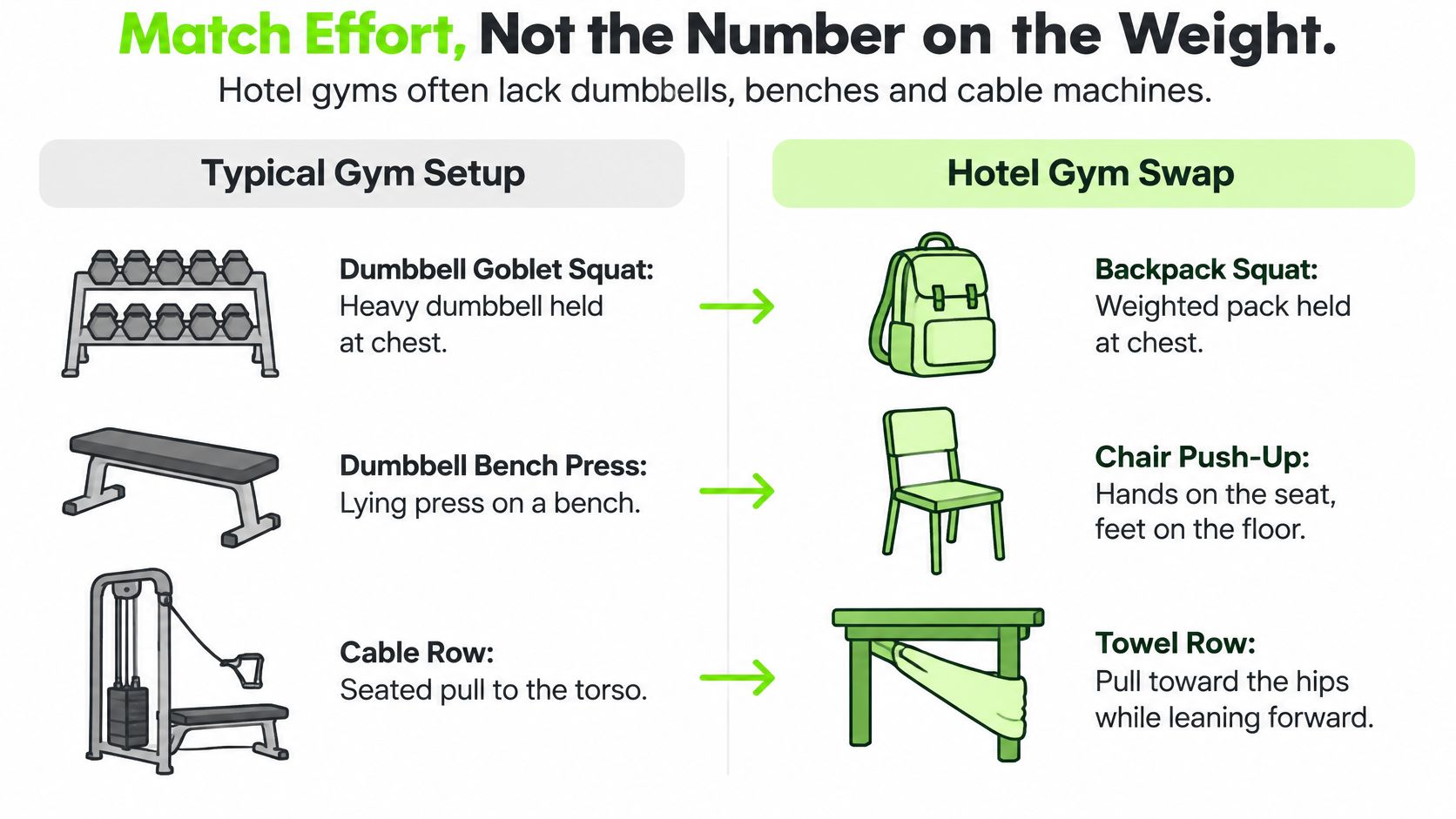
Treat household-item illustrations as movement ideas, not proof that hotel furniture can support exercise. Don't use unstable furniture, stacked chairs, luggage, or bathroom fixtures as anchors or benches. For towel rows, use a rated exercise anchor; if none exists, choose a dumbbell row instead.
Skip any machine you haven't used before for tonight's workout. An occupied familiar station is an inconvenience; guessing how an unfamiliar machine locks or adjusts is an unnecessary risk.
Walk the gym on arrival. List every usable item, check its condition, and assign a substitute to each planned movement before starting.
Warm Up and Cool Down in Under Ten Minutes
A hotel warm-up needs no dedicated equipment and can take under ten minutes. Start with the unloaded sequence below; lifting days also need ramp-up sets with the equipment you'll really use.
Warm up before loading
- Start easy for 3 minutes. Walk or ride a bike until breathing rises gently.
- Perform 10 bodyweight squats and 10 hip hinges, hands on hips. Allow about a minute and use a stable chair back or desk only for light balance.
- Spend about a minute on 10 arm circles each direction and 8 gentle towel or belt pass-throughs. Keep your grip wide and stop before shoulder discomfort.
- Swing each leg 8 to 10 times, holding a wall or sturdy door frame. Allow about a minute; don't force height.
- Before lifting, perform two ramp-up sets of the first exercise: about 5 light reps, then 5 moderate reps. Allow time to adjust the equipment without rushing.
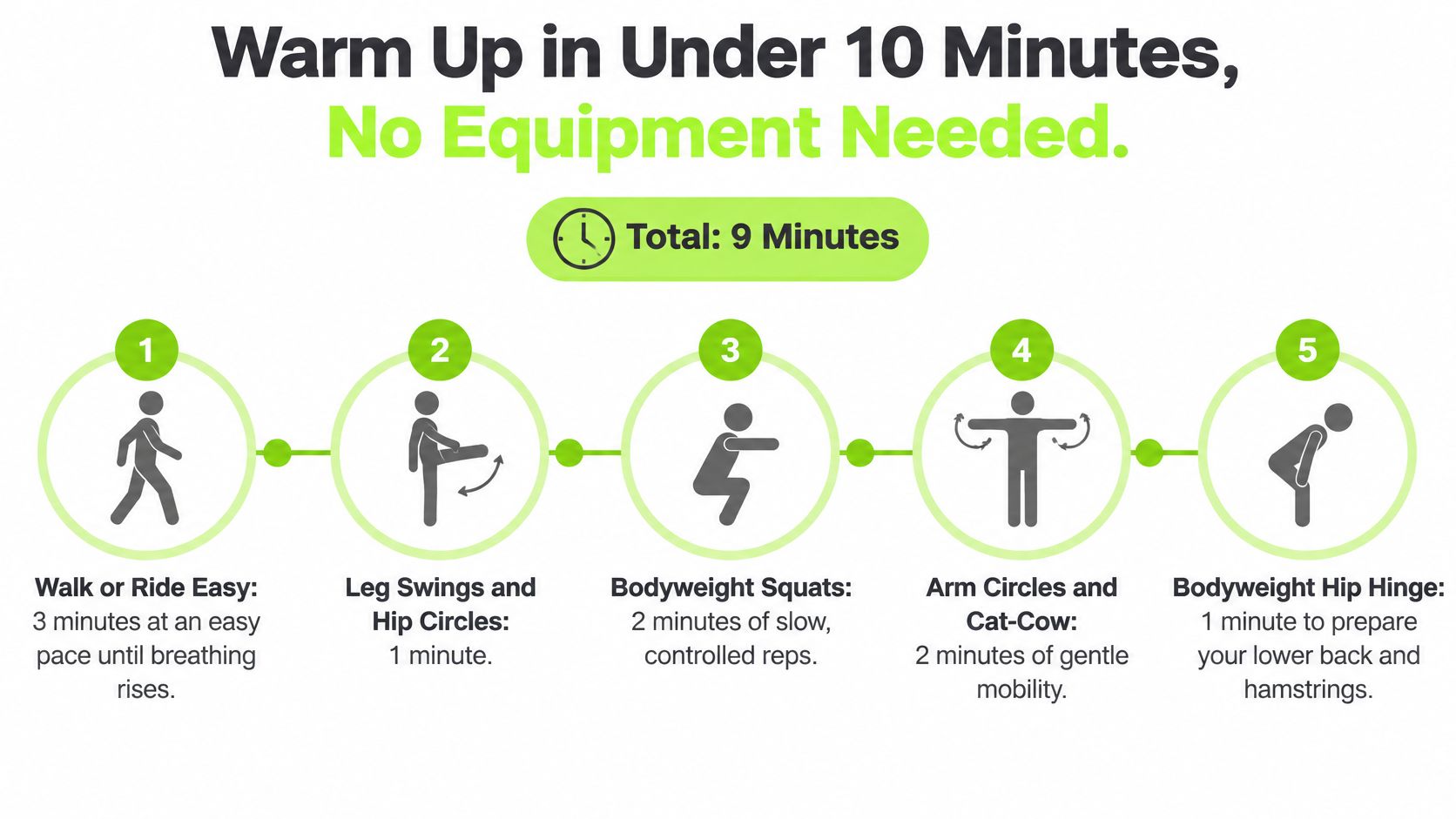
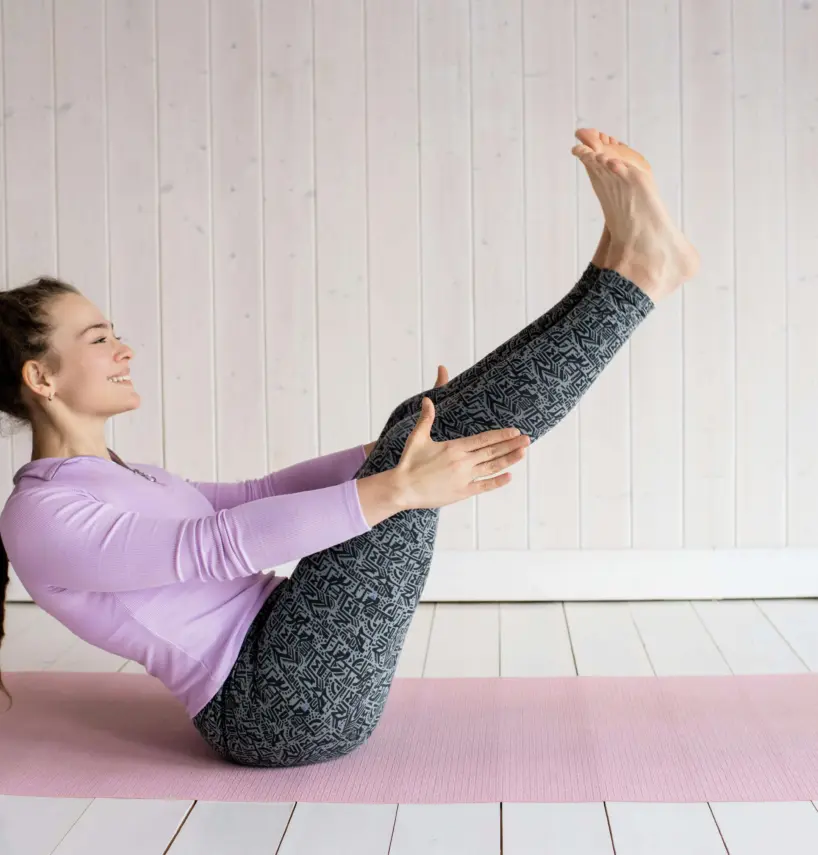
The graphic offers an unloaded mobility alternative. Choose a sequence rather than stacking both routines together.
Cool down without making it another workout
- Walk slowly for 2 minutes.
- Hold a hamstring stretch for 30 seconds per side.
- Hold a kneeling hip-flexor stretch for 30 seconds per side.
- Breathe slowly in child's pose for 1 minute, or sit comfortably if kneeling bothers you.
The CDC's physical activity guidance identifies brisk walking as moderate-intensity activity. Your easy warm-up and cool-down may be gentler than that, which is fine: their job is preparation and a gradual finish.
Never use unstable furniture, stacked chairs, or a bed frame for support. Move to a clear hallway if the room is too tight, without blocking other guests.
Strength and Hypertrophy Sessions for Hotel Gyms
Make the full-body strength session your default when you have a single lifting opportunity. Cover squat or leg press, horizontal push, horizontal pull, and hip hinge, then finish with core work.
Run the full-body strength session
The ACSM exercise-prescription guidelines support a beginner starting point of approximately 60–70% of estimated one-repetition maximum, 8–12 repetitions, and 1–3 sets per major muscle group, with about 2–3 minutes of rest. In an unfamiliar gym, estimate conservatively and stop with 1–3 technically clean repetitions in reserve rather than testing a true maximum.
- Warm up for 5 minutes using walking and the unloaded movements above.
- Perform two ramp-up sets of goblet squat or leg press.
- Complete 2–3 working sets each of goblet squat or leg press, push-up or dumbbell bench press, one-arm dumbbell row or seated cable row, and Romanian deadlift.
- Rest 2–3 minutes between multi-set exercises, taking enough recovery to keep technique stable.
- Finish with 2 sets of plank variations held for 20–40 seconds. End the hold when you can no longer maintain position.
For a 30–40-minute visit, start at the lower set count. Equipment adjustments and sensible rest take time; don't shorten every recovery period just to force extra sets into the clock.
Keep goblet squats upright without forcing depth. During Romanian deadlifts, push your hips back and stop when you can't continue without rounding your back.
Use a weight-training exercise reference to settle technique questions before loading, not while struggling through a working set.
Alternate sessions for hypertrophy
For muscle growth, the ACSM resistance-training update supports roughly 10 weekly sets per muscle group when recovery and training experience permit, with 2–4 sets of 6–12 controlled repetitions as a practical travel format. Prioritize multi-joint movements and add repetitions before load.
| Session | Exercise | Working sets | Repetitions |
|---|---|---|---|
| A | Leg press | 2–4 | 6–12 |
| A | Dumbbell bench press | 2–4 | 6–12 |
| A | Seated cable row | 2–4 | 6–12 |
| A | Romanian deadlift | 2–4 | 6–12 |
| B | Split squat | 2–4 | 6–12 per side |
| B | Incline dumbbell press | 2–4 | 6–12 |
| B | Lat pulldown | 2–4 | 6–12 |
| B | Hip thrust | 2–4 | 6–12 |
Use the strength session's rest allowance and choose the lower set count when your visit is capped at 45 minutes. Split squats take longer because both sides need work, and equipment changes can consume the remaining time.
Alternate A and B across available training days rather than restarting with A every trip. Count the work each muscle receives; completing the table doesn't automatically give every muscle the same weekly volume.
A repeatable session beats an exhausting attempt to make up for every missed workout.
Don't cram the week's lifting into tonight. Avoid jumps beyond about 10% in load or volume, and don't increase both together merely because the hotel weights use unfamiliar increments.
Cardio Blocks for Treadmills, Bikes and Ellipticals
Cardio is its own training block, not just the minutes before lifting. Choose the format you can perform well today instead of assuming running is always the best use of a treadmill.
| Block | Structure | Equipment | Best use |
|---|---|---|---|
| Brisk walk base | 20 minutes at a sustainable talk-test pace | Treadmill at 2–4% incline, if comfortable | Recovery days and travel fatigue |
| Steady zone 2 | 30–40 minutes at a pace where you can speak in short sentences | Bike, elliptical, or treadmill | Weekly aerobic work |
| Bike or elliptical intervals | 30 seconds hard, 90 seconds easy, 8–10 rounds | Bike or elliptical | Conditioning when running is limited |
| Treadmill run intervals | 1 minute hard, 2 minutes walking, 6 rounds | Treadmill | Fresh day with good readiness |
| Rower or SkiErg intervals | 500 meters controlled, then 60 seconds easy; repeat while technique holds | Rower or SkiErg | HYROX-style event preparation |
Treat these as sample workout prescriptions, not mandatory intensities. For walking, lower the incline if you need to grip the rails or shorten your stride awkwardly.
Choose the machine by the limitation
Walking and steady aerobic work are the better choices when you're tired. Bike and elliptical intervals reduce running impact, but hard intervals still demand recovery.
Reserve treadmill run intervals for a fresh day. Set a speed you can control, attach the safety clip, and change speed while staying on the belt rather than jumping onto the side rails.
For a sample week, three 25-minute walks plus a 35-minute session total 110 minutes, not the full weekly moderate-activity baseline. Add other purposeful walking or another aerobic block rather than counting warm-up minutes automatically.
Use HYROX-style work without pretending it's race simulation
For a hotel session capped at 45 minutes:
- Warm up for 5 minutes.
- Complete up to 4 rounds of 500 meters rowing, 15 goblet squats, and 20 walking lunges, followed by 60 seconds of easy walking.
- Reserve 5 minutes for an easy finishing walk.
Stop the rounds early if needed to preserve the finish and clean technique. This trains transitions and mixed effort, but it doesn't replace practice with actual race stations.
After an overnight flight, keep every block conversational instead of using the hard intervals. Assign a block to each suitable day of the trip, leaving room to downgrade it.
Recovery and mobility routine for rough travel days
After a red-flag night, move gently and loosen up rather than chasing repetitions. A recovery block should leave you comfortable enough to continue your evening, not shaky or exhausted.
Run an unloaded recovery circuit
Use this as a 20-minute session, moving without rushing. If the sequence takes longer, trim repetitions rather than forcing the pace.
- Walk on the treadmill or in the hallway for 5 minutes at a talk-test pace.
- Do 8 slow cat-cow cycles and 8 standing hip circles per side. Use a wall or stable desk for balance only.
- Hold a half-kneeling hip-flexor stretch for 45 seconds per side.
- Perform 10 slow floor glute bridges, pausing 2 seconds at the top without arching your lower back.
- Complete 2 rounds of 30-second wall-supported thoracic rotations per side and 10 bird-dog repetitions per side. Keep the rotations small and the bird dogs steady.
- Finish with 3 minutes of slow nasal breathing in a comfortable seated forward fold. Sit upright if folding makes breathing harder.
Keep the effort low enough to speak comfortably. Repeat on consecutive days while your readiness remains poor, provided movement feels better rather than worse.
Protect the rest of the evening
Use the stretching exercise reference to choose comfortable alternatives when a position doesn't suit your knees, shoulders, or back. Stretching shouldn't require pushing through pain.
If you're trying to improve sleep after a workout, River of Life's recovery guide offers additional reading for planning your evening. Don't use a late session as a reason to delay bedtime further.
If ordinary soreness remains after two days, choose a 25-minute walk later in the week instead of automatically adding a heavier lift. Persistent, worsening, or sharply localized pain deserves assessment rather than more stretching.
Log Your Sessions and Choose Tomorrow's Workout
The simplest useful log records exercise, load, repetitions, and reps in reserve for each set. Add the equipment variant when it matters, such as floor press instead of bench press or the specific cable station used.
In GrabGains, open today's workout or a custom workout and tap in weight and reps after each set. Our program is built around your training goal, equipment, and available training days, so your plan can reflect the hotel setup rather than your usual gym.
Record enough to make the next decision
Use the workout tracker to record completed sets while they're fresh. Note effort alongside the numbers so you can distinguish a controlled set from one that nearly failed.
- Earn repetitions first. Build toward the top of your chosen range with consistent technique.
- Then increase load. Once every working set reaches that upper limit cleanly, choose the smallest available increase rather than forcing a large jump.
- Compare like with like. A different machine's displayed weight isn't a reliable measure of progress against the previous machine.
For your weekly check, protect the strengthening days, add aerobic blocks toward the weekly baseline, and leave a recovery day after back-to-back demanding sessions. That's a scheduling judgment, not permission to ignore fatigue until the calendar says rest.
Let the log change tomorrow
If the same load feels harder for three sessions in a row, move down a readiness level and review sleep, food, illness symptoms, and accumulated workload. Don't respond by adding more work to prove your fitness hasn't changed.
Choose tonight's version from the readiness table and record the first working set as soon as it's done. On the final day of the trip, review the full log for repeatable performance, useful substitutions, and a realistic starting point for your next workout.
GrabGains builds workout programs around your goal, available equipment, and training schedule. Visit GrabGains to plan a hotel gym workout that fits the weights you have and the time you can realistically protect.
Get inspired and motivated