Resistance Bands vs Weights: Which Builds Strength Better?
Compare resistance bands vs weights for strength, hypertrophy, and home training. Learn which suits your goals and how to combine both effectively. The most popular advice in the Resistance Bands vs Weights debate is also the least useful. Pick weights if you're serious, pick bands if you're not. That framing treats one tool as real training and the other as a compromise, and it doesn't survive contact with the evidence. Bands aren't inferior for building strength by default, and free weights aren't automatically better for everyone. The useful question is narrower and more practical. Where does equivalence hold, where does it break down, and what should you do at that boundary?
The Real Question Behind the Bands vs Weights Debate
Most comparisons ask which tool wins. That's the wrong unit of analysis. Muscle responds to progressive, sufficiently challenging tension, not to the material providing it, so the useful question is which tool lets you apply that tension consistently, progress it over time, and fit it into the space you train in.
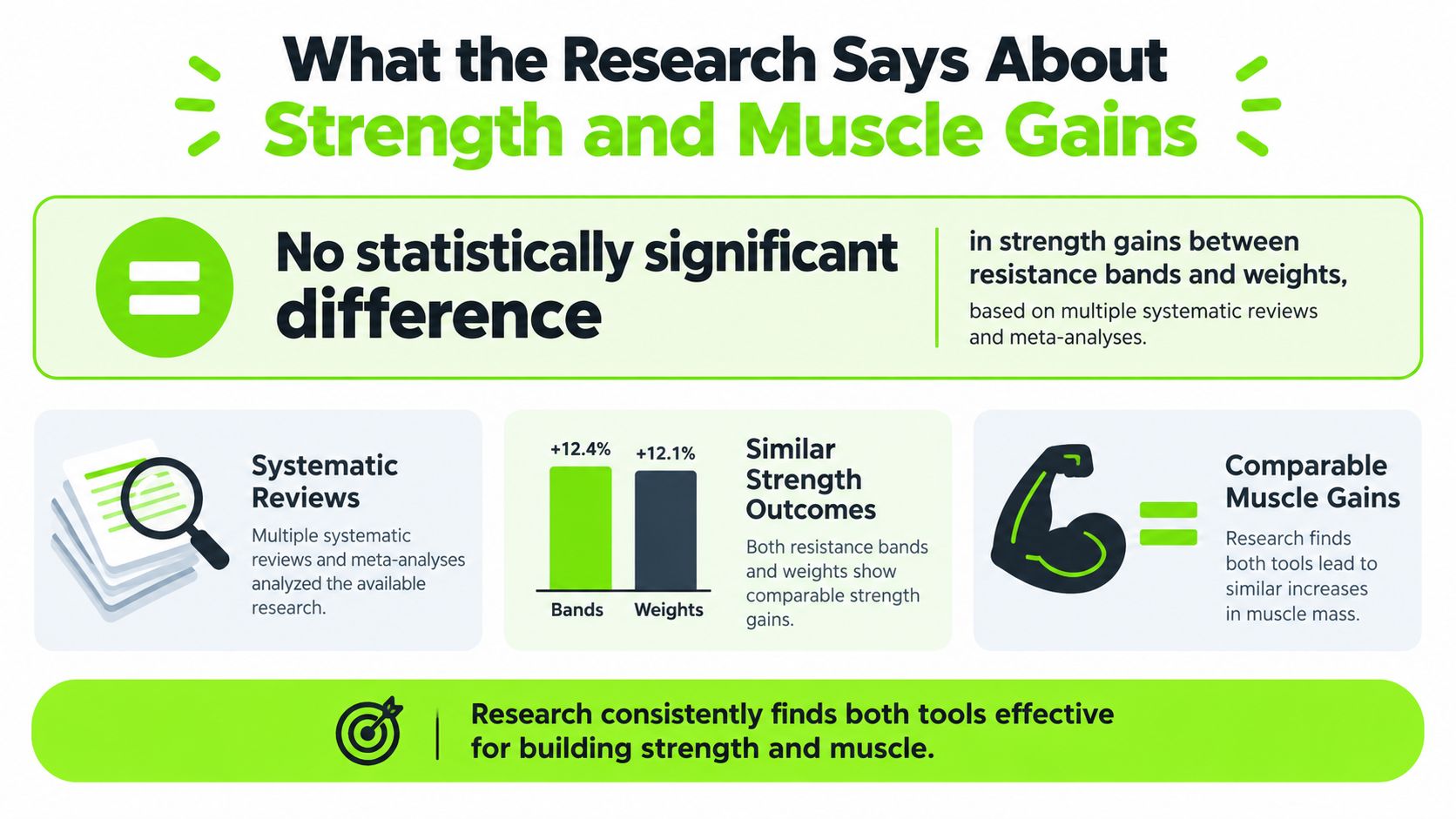
The strongest summary evidence doesn't support a blanket hierarchy. A 2019 systematic review and meta-analysis of elastic versus conventional resistance found no statistically significant superiority for either approach. For upper-limb strength, the standardized mean difference was -0.11 (95% CI -0.40 to 0.19, p = 0.48) in the same review, and for lower-limb strength it was 0.09 (95% CI -0.18 to 0.35, p = 0.52). The pooled results couldn't reliably separate the two methods.
That null result deserves a closer reading.
Built for progress
Take the guesswork out of training
Get a personalized workout plan built around your goal, equipment and schedule. Train smarter, track every rep and keep moving forward, one workout at a time.






Why a tie is not the whole answer
A statistical tie in pooled studies doesn't mean the tools are interchangeable for every exercise, every person, and every stage of training. It means that, under the conditions studied, both can work. The conditions are the interesting part.
- Training status changes the answer: Beginners gain strength from almost any consistent, progressive stimulus, so access and adherence often matter more than small mechanical differences.
- Exercise selection changes the answer: A tool that loads a row well may load a squat poorly, even if both look equivalent when results are averaged across studies.
- Progression changes the answer: A method only keeps working if you can make it harder in a repeatable, measurable way.
The honest verdict: bands and weights can both build strength, but they stop being equivalent when you need very heavy, precisely measured lower-body loading.
Equivalence has a boundary, and most advice ignores it. "Both work" is true and incomplete. "Weights always win" is simple and wrong. The evidence supports a conditional answer: use bands where their resistance profile, portability, and cost let you train hard and often; use weights where you need calibrated load and a high ceiling; use both when you have both, because each covers a weakness in the other.
How Bands and Weights Create Resistance Differently
You can't judge these tools fairly without understanding what each one is doing to a muscle through a repetition. They don't just feel different. They load different parts of the movement.
Variable resistance from bands
Bands create variable resistance. As research on elastic resistance mechanics explains, force generally rises as the band is stretched, so the same band provides substantially different loading depending on its starting length, anchor position, and range of motion. Ease off the stretch and tension falls. Stretch further and tension climbs.
That profile suits movements where you're stronger toward the end of the range and where rising tension is useful. Think rows, presses, curls, lateral raises, and pull-aparts. It also makes bands practical for face pulls and assisted pull-ups at home, and for warm-up work such as pull-aparts and shoulder dislocates, where you want light, controllable tension through a wide arc.
Constant load from free weights
Free weights work through gravity. The implement's mass in kilograms (pounds) stays comparatively constant, while joint mechanical advantage and joint angle change how hard each position feels. A dumbbell doesn't get heavier as you lift it, but your mechanical advantage improves or worsens through the rep, which changes the demand.
Weights also bring inertia and a clear eccentric demand as you lower the load against gravity. Bands have different inertial characteristics and don't automatically replicate that lowering demand, which is one reason tempo control matters more with elastic resistance.
| Factor | Resistance Bands | Free Weights |
|---|---|---|
| Resistance source | Elastic tension that rises with stretch | Gravity acting on a fixed mass |
| Hardest point | Usually near full stretch | Depends on leverage and joint angle |
| Load tracking | Indirect, depends on setup | Direct, in kilograms (pounds) |
| Best fit | Rows, face pulls, pull-aparts, warm-ups | Heavy squats, deadlifts, presses |
| Portability | Fits in a bag or drawer | Heavy and bulky |
| Progression | Thicker band, more stretch, more reps | Add load in calibrated increments |
This mechanical split explains a common frustration. A band squat can feel too easy at the bottom, where the band is least stretched and the squat is hardest, then abruptly hard near the top. A barbell squat loads that bottom position far more convincingly. Neither profile is correct in the abstract. Each matches some movements and mismatches others.
That is also why equipment selection inside a weight training app matters more than brand loyalty to one tool. The program should match the exercise to the resistance curve you have, not force a barbell movement pattern onto elastic tension and call it equivalent.
What the Research Says About Strength and Muscle Gains
The headline finding is consistent across reviews, but the details decide how far you should trust it. Read the evidence in layers, because strength, muscle mass, and body composition don't tell identical stories.
Strength outcomes look similar
A 2022 systematic review of 15 studies with 18 trials and 669 participants compared body-weight exercise, bands, and free weights in overweight or obese populations. All approaches improved muscle strength, with no statistically significant difference between exercise types in that 2022 review. Band training did show an advantage for reducing body fat, with a standardized mean difference of -0.79 (95% CI -1.25 to -0.33), while body-weight training produced the strongest measured improvement in skeletal muscle mass.
Treat that body fat result with care. Equipment alone doesn't determine body composition. Total training effort, consistency, and energy balance do the heavy lifting, and a modality you use several times a week will usually beat a theoretically better one you skip.
Where the evidence gets thin
The equivalence claim has real limits, and an analyst should state them plainly. The boundary cases matter more than the average finding, because the average finding describes beginners on short programs.
- Few direct multi-joint comparisons: Much of the elastic resistance literature leans on simpler movements, so big compound lifts are less well represented than the headline suggests.
- Lower activation in some band-only squats: Band-only squatting has produced lower muscle activation than free-weight squatting in healthy adults, which fits the mechanics described earlier. The bottom position is underloaded.
- Short and beginner-heavy samples: Similarity over a short program in less trained people doesn't prove similarity for an advanced lifter chasing maximal strength over years.
Programming quality explains more of your result than equipment category does, until you reach loads bands can't deliver cleanly.
That last clause is where the research stops being a tie. Below the load threshold bands can reach, the studies support near-equivalence for strength and hypertrophy. Above it, the studies mostly stop applying, because few of them test trained lifters at high intensities.
Muscle building follows the same logic. If sets are hard, volume accumulates, and you progress tension, reps, range of motion, or proximity to failure, bands can provide a genuine growth stimulus, especially for upper-body and single-joint work. If tension stays fixed because you never change band, stance, or reps, growth stalls for the mundane reason that the stimulus stopped changing.
For planning purposes, treat the evidence as permission to choose based on fit, not as a guarantee of identical outcomes forever. A structured muscle building program that adapts exercises to your equipment is the mechanism that turns that permission into results, because progression, not novelty, is what keeps either tool effective.
Practical Trade-Offs Cost Space Portability and Progression
Physiology gets you to a tie. Logistics break it. For people training at home or on the road, the deciding factors are embarrassingly practical.
Where bands win clearly
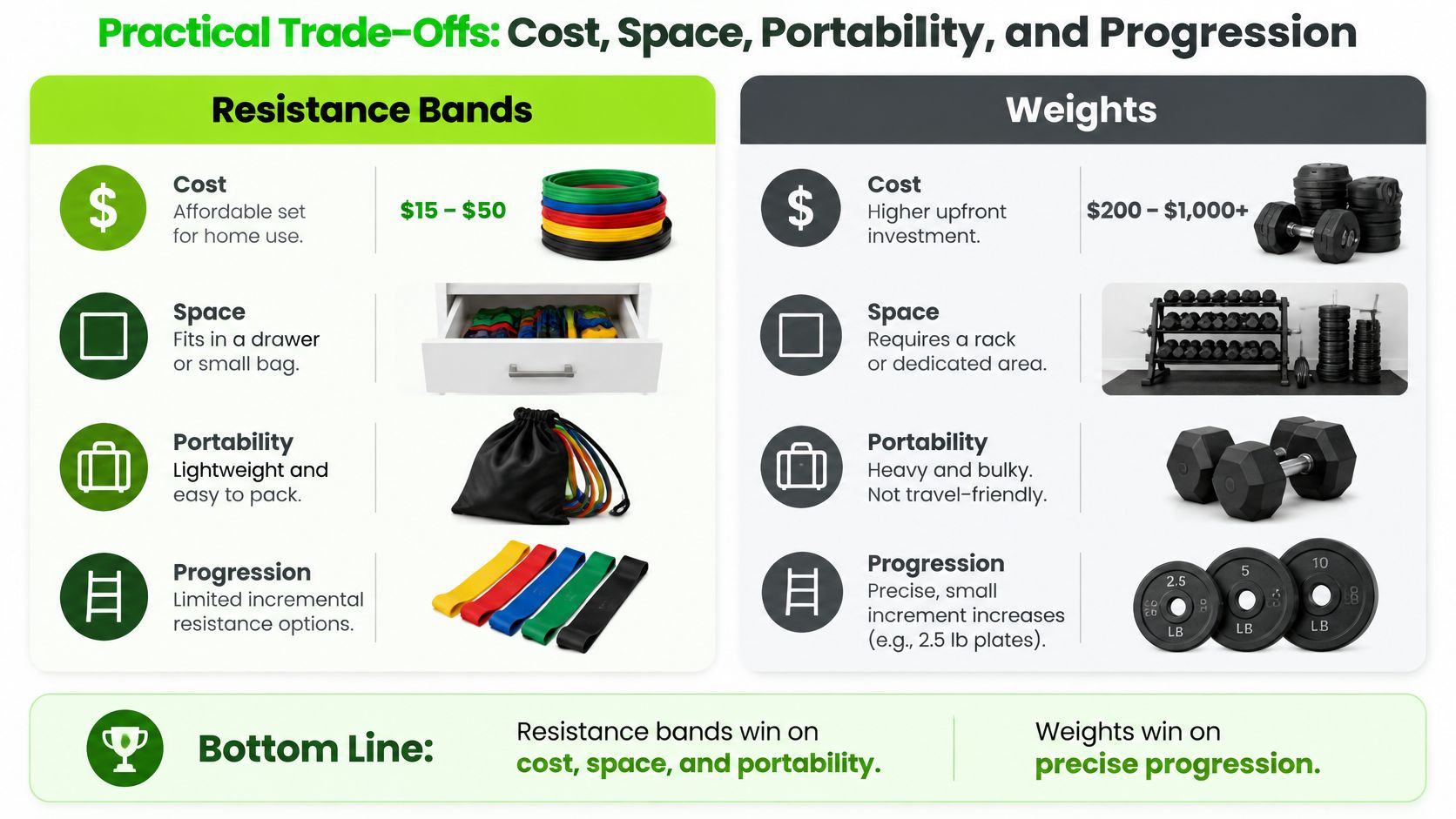
Bands weigh almost nothing, take no meaningful space, and cost much less than a set of weights. You can store a full set in a drawer, pack it in hand luggage, and train in a hotel room or a small flat without rearranging furniture. They also enable movements that are awkward with free weights alone at home, including anchored rows, face pulls, pull-aparts, and assisted pull-ups.
That convenience isn't a soft benefit. It directly affects frequency, and frequency affects results. Equipment that's present beats equipment that's theoretically superior but stored somewhere inconvenient or left behind when you travel.
Where weights win clearly
Progression precision belongs to weights, and it isn't close. As a systematic review comparing elastic bands with machines and free weights notes, free weights provide externally calibrated kilogram increments, while band resistance varies with stretch length and setup. Unless you standardize anchor position and starting tension every session, you don't know whether you progressed or just stood differently.
- Cost: Bands win. A set costs much less than covering a similar range with dumbbells or plates.
- Space: Bands win. Weights need floor space, storage, and often a rack.
- Portability: Bands win by a wide margin, especially for travel.
- Progression precision: Weights win. The load is printed on the implement.
- Maximum load: Weights win. Very heavy lower-body loading is hard to replicate with elastic tension alone.
You can narrow the progression gap with bands if you're disciplined. Use the same anchor point, the same foot position, and the same grip. Record band color or thickness, stance, and reps. Progress by adding reps first, then shortening the band or moving up a thickness, then adding sets or slowing the return. That system works, but it asks more of you than picking up the next dumbbell.
Which Tool Fits Your Training Goal
The debate assumes a single winner exists. The evidence points somewhere less satisfying and more useful: each tool wins inside a boundary set by your goal, and the wrong choice only starts costing you progress once you cross that boundary.
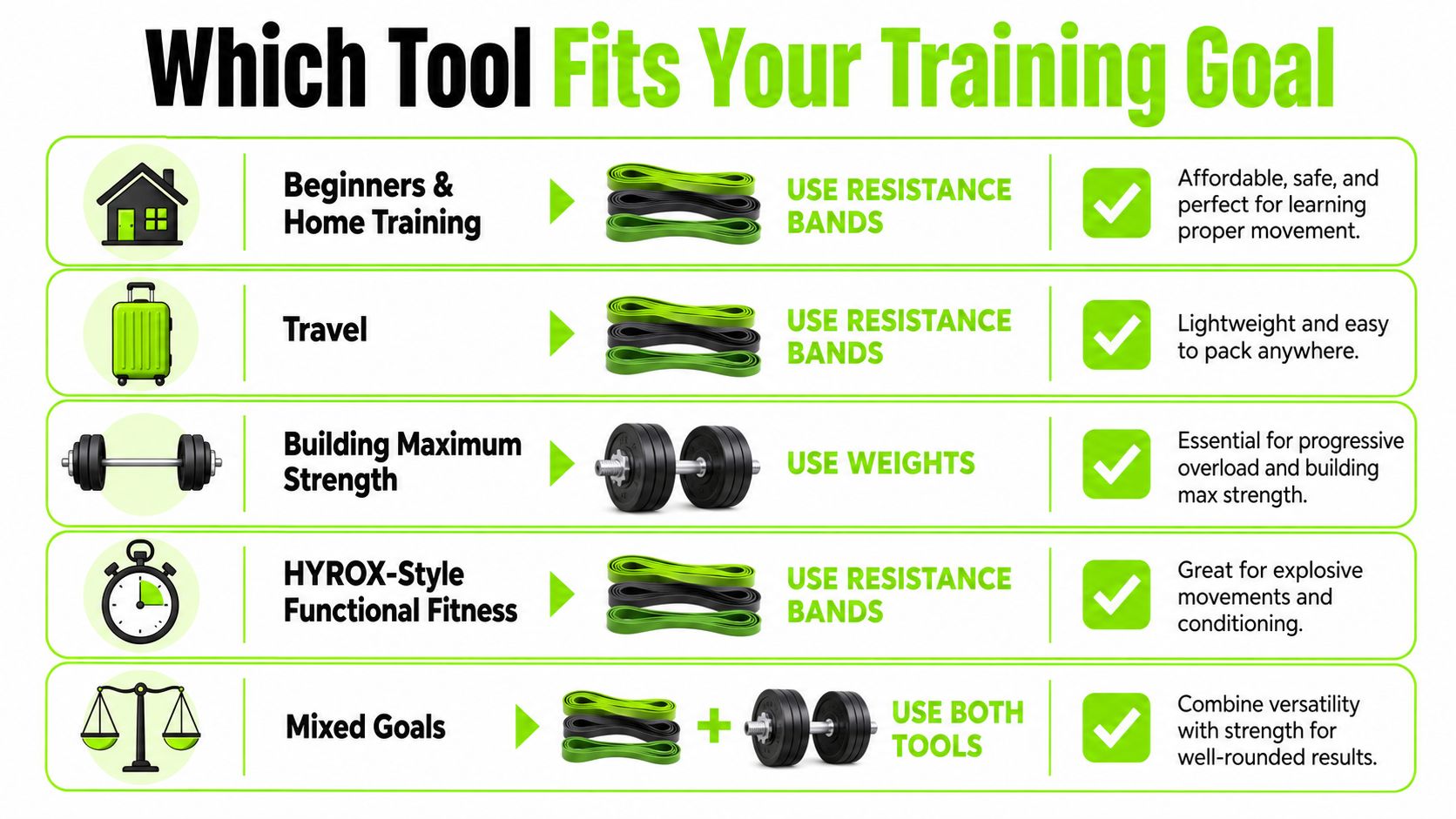
Beginners and home training
Bands remove the three barriers that stop beginners before adaptation starts: price, storage, and intimidation. A beginner's limiting factor is rarely the loading ceiling. It is session frequency, and bands make frequent sessions easy to repeat while you learn rows, presses, hinges, and pull-aparts at home.
Once squat and hinge patterns are grooved and a rack fits the budget and the room, weights start earning their floor space. Many home trainees end up owning both, and that reflects coverage of different jobs rather than indecision.
Travel
Bands win outright. They weigh almost nothing, fit in a carry-on, and preserve the pulling work most hotel gyms cannot provide: rows, face pulls, pull-aparts, hinging. A week or two of maintained stimulus beats a week of skipped sessions, and no travel scenario reverses that math.
Maximum strength
Free weights, clearly. Maximal strength is specific to producing high force against heavy, quantifiable loads, and bands cannot match calibrated loading, fine increments, or convincing tension at the bottom of a squat. This is the sharpest boundary condition in the comparison.
The nuance sits in the trial data. A randomized study of 32 women comparing free weights with bands plus free weights found both groups improved six-repetition-maximum squat performance substantially, by 23% with free weights alone and 25% with the combined approach in the same randomized trial. Squat gains were similar, yet maximal contraction and jump measures came out larger and more consistent in the free-weight group. Adding bands to a strength program worked. It still did not replace heavy, standard loading for maximal outcomes.
HYROX-style functional fitness
Weights carry the program and bands fill the gaps. Sled work, loaded carries, and strength stations require real external load and trackable progression. Bands serve warm-ups, shoulder preparation, accessory pulling volume, and the sessions you squeeze in between gym days. Treating them as the main stimulus would undercook the exact quality the event tests.
How to Combine Bands and Weights in One Program
The strongest case for owning both tools is mechanical, not motivational. Weights deliver constant, quantifiable load; bands deliver tension that rises through the range of motion. A hybrid program assigns each exercise to the tool whose resistance profile fits the job, instead of swapping at random.
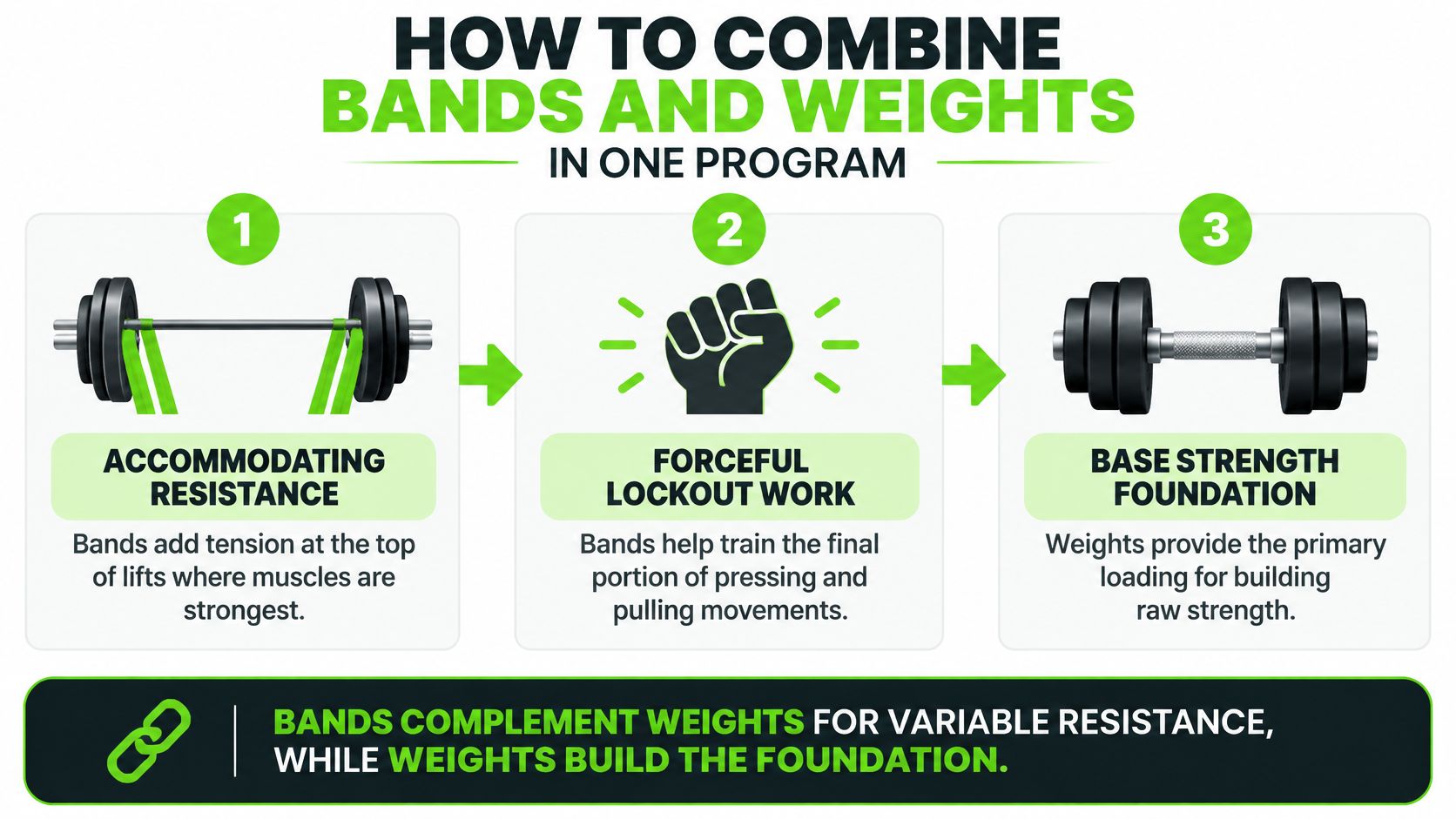
That assignment has trial data behind it. In a controlled deadlift study of 16 resistance-trained men, adding bands to free weights raised average and peak force compared with free weights alone, with effect sizes of 0.29 to 0.58, and participants reached peak velocity sooner. Free-weight deadlifts still reached peak force faster, with very large effect sizes of 1.58 to 2.10 in the same study.
The practical reading: bands on a barbell suit accommodating resistance and forceful lockout work, where elastic tension climbs as the lever gets easier. Straight weight suits predictable loading from the floor, where force production needs a stable number to push against. One study, two different jobs.
Assign the slot, then the tool
A hybrid program holds together when every slot in the week has a designated tool and a defined way to progress it:
| Weekly slot | Tool | How to progress it |
|---|---|---|
| Primary strength work (squats, deadlifts, presses) | Free weights | Small load increases on a logged number |
| Speed work and lockout emphasis on those lifts | Barbell plus bands | Thicker band or more band tension at a fixed bar load |
| Activation before heavy sets | Bands | More reps and stricter control, not more tension |
| Sessions without gym access | Bands | Harder band, less starting slack, slower tempo |
One boundary matters more than any schedule. Keep the movement pattern constant when you swap the tool, and adjust what you expect from it. An anchored band row can replace a dumbbell row with the same intent, hard sets taken close to failure in a repeatable setup. A light band squat cannot stand in for a heavy barbell squat, because the absolute load and the tension curve differ too much to count as the same stimulus.
Equipment-aware planning keeps the two tools inside one progression system. Selecting resistance bands as available equipment in a training plan built around what you own means exercise swaps stay within your actual options, so travel weeks and home sessions feed the same log instead of becoming disconnected workouts.
The Bottom Line for Your Training Setup
Bands aren't a lesser tool and weights aren't a magic one. The research supports similar strength gains when training is progressive and hard, and it also shows you exactly where that similarity ends.
Choose bands for beginners, small spaces, travel, warm-ups, and pulling accessories. Choose weights for maximum strength, heavy lower-body work, and precise progression in kilograms (pounds). Choose both if you can, because weights supply the ceiling and the measurement system, while bands supply portability, angles, and rising tension where you want it.
Your next step isn't buying everything. It's removing the friction that stops sessions from happening, then progressing whatever you own. Time your conditioning work with a circuit training timer, log band setups as carefully as you'd log dumbbell loads, and track your progress over time so you can see whether reps, tension, or load moved. The tool you can progress consistently is the one that builds your strength.
Set your available equipment once and let your workouts adapt when you're at home, in a gym, or traveling with only bands in your bag. Visit GrabGains to build a plan that swaps exercises around what you have, so a missing dumbbell never becomes a missed session.
Get inspired and motivated