How Much Does a Personal Trainer Cost: 2026 Price Guide
How much does a personal trainer cost in 2026? See hourly and monthly rates by location, session type and credentials, plus ways to save.


A standard one-on-one 60-minute personal training session in the US commonly costs about $40 to $100 per hour, with a national midpoint near $55 to $65. In 2024, the US average was $60 per hour.
That range answers how much does a personal trainer cost on paper, but it doesn't tell you what you'll spend each month or what you'll get for it. Two trainers can quote the same hourly rate and deliver very different amounts of coaching, programming, and follow-up. The smarter question isn't just the price per session. It's what a completed training week costs you, and whether you'll still be doing those weeks three months from now.
Personal Trainer Rates per Hour at a Glance
A standard one-on-one 60-minute session in the US commonly costs about $40 to $100, with a national midpoint near $55 to $65. Use the 60-minute session as your unit of comparison. When every quote is converted to that same hour, you're comparing like with like instead of guessing whether a shorter, cheaper session is really a better deal.
Built for progress
Take the guesswork out of training
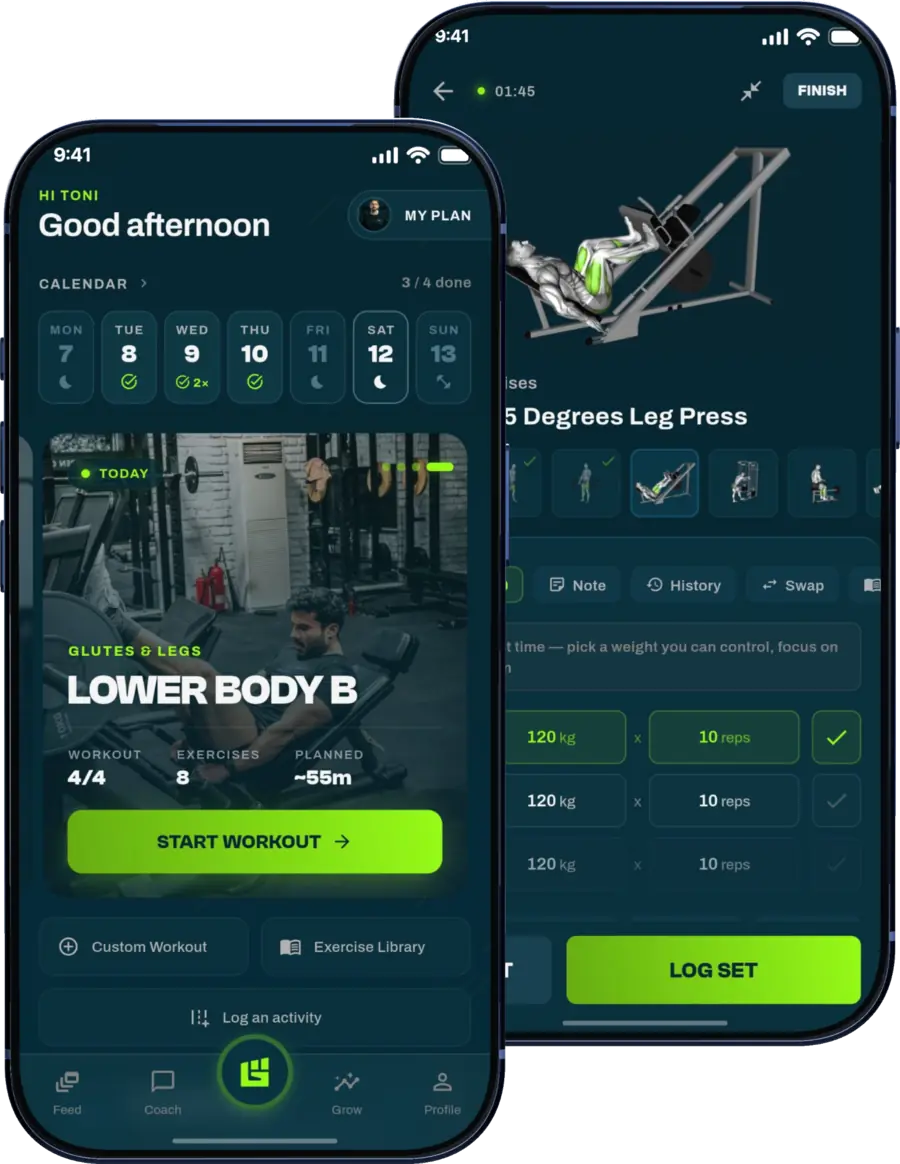
Get a personalized workout plan built around your goal, equipment and schedule. Train smarter, track every rep and keep moving forward, one workout at a time.






Personal trainer rates per hour by tier
| Tier | Price per hour | Who it suits |
|---|---|---|
| Budget gym trainer | About $40 | Beginners on a tight budget |
| National midpoint | $55 to $65 | Most independent trainers |
| US average, 2024 | $60 | Reference point from aggregated pricing data |
| Experienced or specialist trainer | About $100 | Specific goals or high-cost metro markets |
| Elite trainer in a major city | $300 or more | Highly specialized or high-profile coaching |
The middle of that table is where clients typically land. Axiobench aggregated industry pricing data reported $60 per hour as the average U.S. personal-training rate in 2024. That figure sits neatly inside the midpoint range, so you can use it as a sanity check when a quote feels unusually high or low for your area.
At the low end, a budget gym trainer near $40 per hour can be a sensible starting point if you're new, your goals are general, and you mainly need someone to teach you the basics safely. You may get less detailed programming between sessions, and scheduling may be less flexible, but the live coaching can still be useful.
Move up to an experienced or specialist trainer near $100 per hour and you should expect a clearer reason for the premium. That might be deep experience with your exact goal, careful assessment, or a high-cost city where rent and demand push every service price up. Elite coaches in major cities at $300 or more are a different market altogether, built around reputation, scarcity, and highly specialized work.
These are the prices you see on a quote. They aren't what the trainer keeps, and they don't yet include package discounts, gym membership, or travel fees.
Find the tier closest to your location and the trainer's experience level. That gives you a realistic starting bracket. The format you choose next, one-on-one, shared, at home, or online, will move your actual cost up or down from there.
How Session Format Changes What You Pay
Format often matters more than the headline rate because it decides how many people share the trainer's time. You're not really buying an hour on a clock. You're buying a share of one person's attention for that hour.
Cost and value by training format
| Format | How the fee works | Cost per person | What you get |
|---|---|---|---|
| One-on-one, in person | One trainer for the full session | Highest per session | Full attention, real-time correction, custom programming |
| Semi-private, two clients | Trainer's time split between two people | Lower per person | Shared attention, some individual correction |
| Small group, three to six clients | Trainer's time spread across a class | Lowest among trainer-led options | Shared coaching and group motivation |
| Home visit | Fee includes travel and equipment logistics | Premium over gym sessions | Convenience, usually less equipment |
| Online coaching | Usually a monthly program or messaging fee | Compare monthly total to in-person equivalent | Written programming and video check-ins |
One-on-one training gives you the trainer's full focus. They watch every rep, adjust loads on the spot, and build the session around how you're moving that day. That level of correction is why it carries the highest price per session, and it's most valuable when you're learning new lifts or working around limitations.
Semi-private training splits the trainer's fixed time between two clients, so each person pays less. You still get individual correction, just not on every set. For many people with general strength or fitness goals, that trade is worth it, especially if training with a partner helps you show up consistently.
In a small group of three to six, the trainer spreads attention across the class and the per-person cost drops to the lowest level among trainer-led options. You gain energy and accountability from the group. You lose some personalization, since the workout has to work for everyone in the room.
A home visit flips the cost back up. The fee has to cover travel time and hauling or improvising equipment, so it sits above a comparable gym session. You're paying for convenience and privacy, and you'll usually train with less equipment than a gym offers.
Online coaching usually isn't sold by the hour at all. It's a monthly program or messaging fee for written programming and video check-ins, and there's no single reliable national figure to compare against. Judge it by the monthly total versus the in-person equivalent, and by how much feedback you receive. If you follow a structured program on your own, keeping your plan in a tool like our personalized training plan builder helps you see what each week should look like before you start it.
Pay for attention per person, not for the clock alone. That's the rule that makes every format easier to judge.
What Moves a Trainer's Rate Up or Down
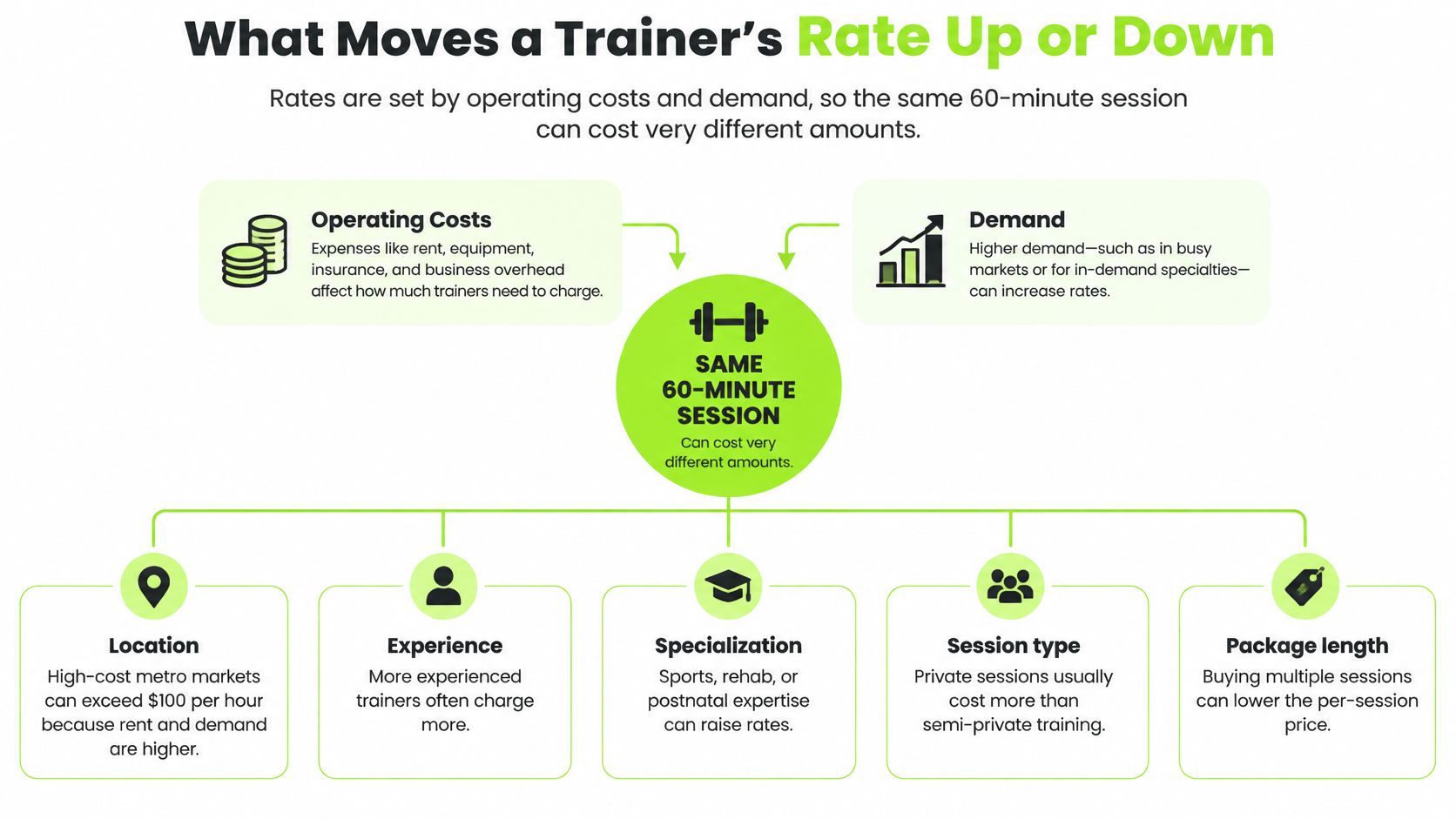
Two trainers can run an identical 60-minute session and quote very different prices, and the gap usually traces back to operating costs and local demand rather than coaching skill. A FitBudd pricing breakdown puts a standard one-hour, one-on-one session at about $40 to $100, with high-cost metropolitan markets exceeding $100 per hour because demand, rent, and trainer opportunity costs are higher. Suburban and rural markets generally price lower for the same hour of coaching.
Keep one thing in mind while you compare quotes. The rate on the price list is what the trainer bills, not what the trainer keeps.
Location changes the same session
The pattern holds outside the US too. A Bark personal trainer price guide puts London at roughly £45 to £70 per hour, Manchester at about £35 to £45, Edinburgh at £30 to £40, and Liverpool at £25 to £45. Two clients can receive a similar session and pay materially different amounts because of where they live, so compare a quote against trainers in your own area before judging it as expensive.
Experience, specialization, and the room you're in
Experience and specialization add work you don't see during the session. Strength coaching, injury-aware training, or work with older adults requires more assessment, more careful programming, and more risk management than supervising a general workout. That extra preparation is a legitimate reason for a higher rate, provided the trainer can explain what it includes.
Facility type matters just as much. A budget gym, a boutique studio, and a private gym carry very different overheads, and those costs land in your quote. In the UK, SalaryTax UK data on personal trainers notes that independently operating trainers may pay a gym roughly £200 to £700 per month for floor access before they earn any session revenue. Part of your fee is covering that rent, which is why a polished studio charges more for the same hour than a trainer working the gym floor at a chain.
Shorter doesn't mean half price
Session length surprises people. A 30-minute appointment usually costs more than half of the 60-minute rate, because assessment, setup, scheduling, and transition time stay roughly the same whether the session runs 30 minutes or 60. You compress the coaching, not the fixed work around it.
A shorter session can still be good value for focused work, but don't assume the price scales in a straight line. And a higher rate isn't automatically better coaching. What it should buy you is a clearer reason, such as deeper specialization, better facilities, or programming built around your assessment rather than a template.
Which Credentials Justify a Higher Rate
A certification is a starting qualification, not a price tag. The Bureau of Labor Statistics profile for fitness trainers and instructors lists high school diploma or equivalent as the typical entry-level education and $47,160 as median annual pay. That wage describes earnings across the occupation; it does not tell you what a private session should cost or what qualifications your trainer holds.
To judge a premium, connect the credential to the help you need.
What can support a higher fee
Ask who issued the trainer's certification and whether it is accredited. Check for current CPR and first-aid training, too. These checks establish a foundation; they do not, by themselves, explain a higher rate.
Relevant specialist training deserves a closer look. If you want advanced strength coaching or support returning to exercise after rehabilitation, ask how the trainer's qualifications apply to that goal. They should be able to explain what they can help with and where their role ends.
A certificate works like a driving licence: it establishes a qualification, while experience shows how someone applies it. Ask for concrete examples of work with clients who share your goals or limitations, rather than treating a long list of certificates as proof of better coaching.
Don't confuse two different professions
Athletic trainers prevent, diagnose, and treat muscle and bone injuries and illnesses. That is a different service from personal fitness training. If you need injury diagnosis or treatment, compare appropriate clinical services rather than expecting a more expensive personal trainer to provide them.
Before paying a premium, ask four questions:
- Certification: Which certification do you hold, who issued it, and how does it relate to my goal?
- Scope: What does the quoted rate include, and what falls outside your role?
- Experience: How have you helped people with goals or limitations like mine?
- Insurance: Do you carry liability insurance?
Then judge the cost per completed training week: divide your total training spend by the weeks you complete. A relevant qualification earns its premium through coaching you can use consistently, not through the certificate alone.
What Your Money Covers Beyond the Hour
The session price is not the trainer's take-home pay. That's the most common misunderstanding behind how much does a personal trainer cost, and clearing it up changes how you judge every quote.
The Bureau of Labor Statistics guide to fitness trainers and instructors reports a 2025 median wage of $22.67 per hour for the occupation, which includes employees, part-time workers, and self-employed trainers. The spread is wide. The lowest 10 percent earned $28,800 or less annually, while the highest 10 percent earned $83,100 or more. Your $60 session fee and the trainer's actual earnings are two different numbers.
Where the rest of the fee goes
Your money also covers work that never shows up as contact time. Programming your sessions, reviewing your progress, answering messages, traveling to you, handling scheduling and administration, paying facility rent, absorbing cancellations, covering taxes, and keeping up continuing education all sit behind the hour you see. A trainer who does that work well is delivering more than supervision. A trainer who doesn't is expensive at any price.
Cost per completed training week
This is why cost per session is a weak way to compare. Cost per completed training week tells you what your actual routine costs to sustain.
| Scenario | Monthly cost |
|---|---|
| One 60-minute session weekly at $60 | $240 |
| Two 60-minute sessions weekly at $60 | $480 |
| Two sessions per month plus independent workouts | $120 |
| One weekly session in a high-cost metro at $100 | $400 |
Run those out over a year and the differences grow. One weekly session at $60 adds up to $3,120 per year, and two weekly sessions reach $6,240 per year. A metro-area weekly session at $100 comes to $5,200 per year, while two sessions a month plus independent workouts totals $1,440 per year.
Practical rule: A cheaper plan you complete every week beats an intensive plan you abandon by month two, both for results and for money spent per finished week.
That math points to an underused option. If you're a busy professional who'll train on your own, an assessment plus periodic check-ins and independently completed workouts can deliver better value than weekly one-on-one sessions. Logging those solo sessions in a workout tracker that records every set gives your trainer something concrete to review at each check-in. The condition is honesty about yourself. The lower-frequency model only works if you do the work between sessions.
Cheaper Options Like Fitness Apps and Self-Guided Plans
The lowest-cost route is an app that builds your plan and tracks it, paired with occasional professional input when you need eyes on your form. For people who mainly lack structure, that combination covers most of what they're missing.
What an app actually does for you
Our AI-powered app creates fully personalized workouts based on your goals, fitness level, and available equipment, then adjusts as you progress. You pick a goal, tell it what equipment you have and which days you can train, and it builds the program around those constraints. Whether you're following that kind of plan at home, in a gym, or on the go, the structure stays consistent from week to week.
GrabGains is free to download, and new accounts get 14 days of Pro for free. That's enough time to run two full training weeks and judge whether the programming fits your schedule and equipment before you spend anything.
The limits you should respect
Be clear about what you're not getting. GrabGains is not a gym, not a personal trainer, and not a medical service. An app can't watch your squat in real time, spot a breakdown in your form mid-set, or assess an injury in person. If something hurts in a way that concerns you, that's a job for a qualified professional in the room, not software.
An app also can't make you show up. It can plan, track, and remind, but the accountability of a person waiting for you at a set time is a different thing.
The hybrid middle ground
For many people, the practical answer sits between the two extremes. Use an app for your weekly program, follow the guidance in our AI coach that reads your training between sessions, and book one or two one-on-one sessions a month for form checks and plan reviews. Your monthly spending stays well below weekly coaching, and you still get professional correction where it matters most.
Choose based on your real bottleneck. If you train consistently and need structure, an app fits. If you skip sessions when nobody's watching or you're unsure your technique is safe, pay for the trainer, at least until those habits and skills are in place.
Confirm the Price Before You Book
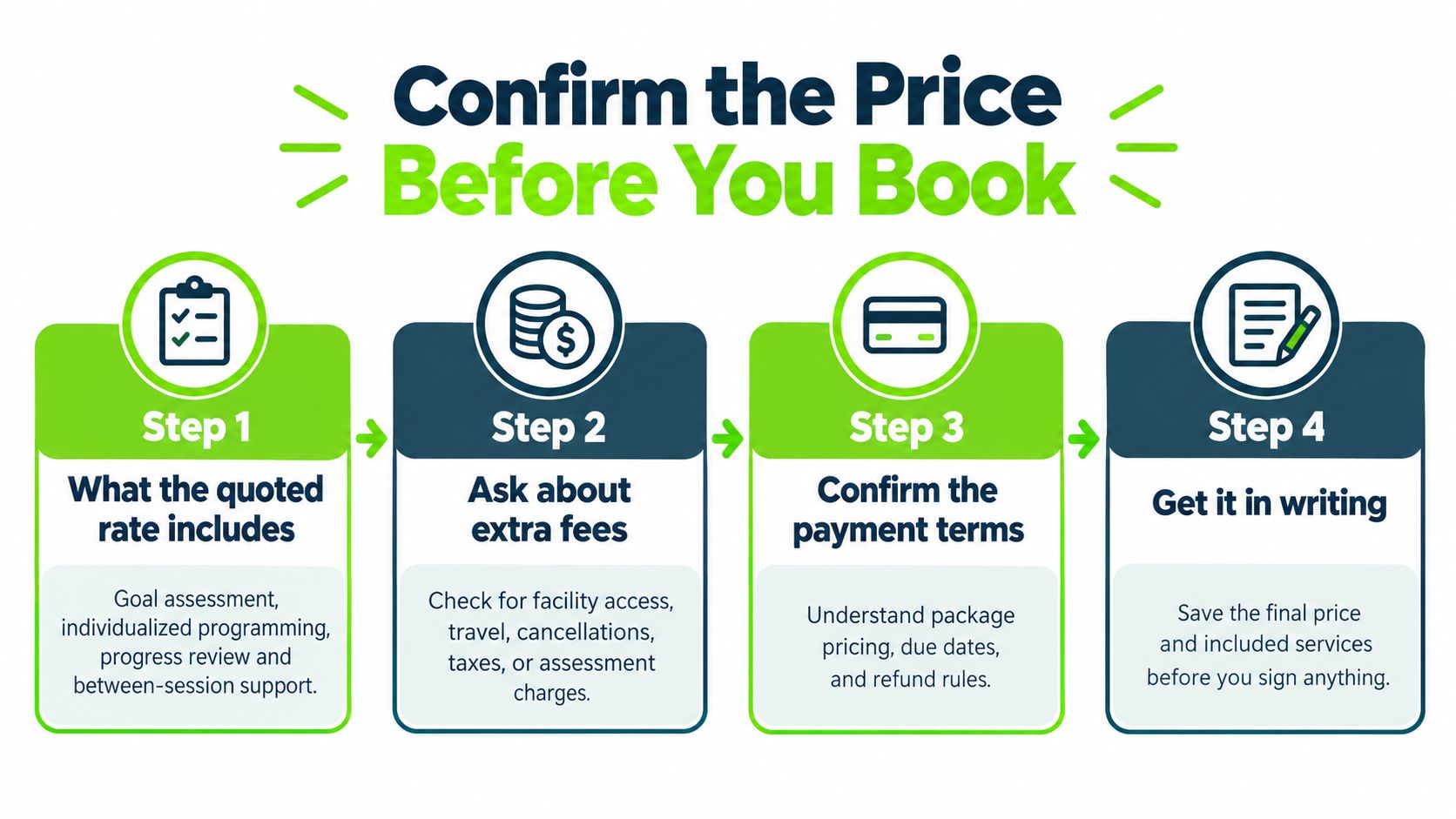
A quote only becomes useful once you've checked what's behind it. The American College of Sports Medicine handout on investing in a personal trainer puts personal-training fees commonly at $20 to $100 per hour, varying with qualifications, experience, geographic location, session length, and workout specialization. That range is wide because the services inside it differ. Work through these steps before you sign anything.
Six checks before you commit
- List what's included: Ask whether the rate covers a goal assessment, individualized programming, progress reviews, and between-session support, or only the session itself. Two quotes at the same price can include very different amounts of work.
- Compare cost per completed week: Convert each option into what a full week of your routine costs, including solo sessions you'll do alone. That number, not the hourly rate, is what your budget has to carry.
- Do the package math: Divide the total package price by the number of included sessions to get the true per-session cost, and check the expiry date. Prepaid sessions and longer-term packages can reduce the effective hourly rate, but only if you'll use every session before it expires.
- Ask about cancellations: Find out the rescheduling window and whether late cancellations are charged in full. If your work schedule is unpredictable, a strict policy can raise your real cost per completed session.
- Negotiate with specifics: Instead of asking for a vague discount, propose something concrete, such as a package rate, a fixed weekly time slot, a paid trial session, or splitting semi-private training with a friend. Trainers can say yes to a specific arrangement more easily than to an open-ended request.
- Book one trial session: Watch whether the trainer explains the plan, corrects your form, and follows up afterward. You're testing communication and coaching quality, not just personality.
Get the final price and included services in writing before you pay. A clear written quote protects you and sets expectations for the trainer too.
If you're testing the app route instead, the same habit of checking terms applies. After our 14-day Pro trial, logging workouts, previous sessions, PRs, the exercise library, the feed, and leaderboards stay free, so your training history isn't held hostage if you decide not to continue.
Now make the decision. Pick the format and price tier that match your budget and your need for supervision, then book the trial session before committing to a long package. One well-chosen trial will teach you more about value than another hour of comparing quotes.
If weekly one-on-one coaching is more than your budget can carry, we built GrabGains to give you the structure of a personalized, adaptive program that tracks your progress and adjusts as you train. Pair it with an occasional form-check session from a local trainer and you'll know exactly what each training week costs. Start planning your first week at GrabGains.
Get inspired and motivated