Can AI Replace a Personal Trainer in 2026?
Still asking: can AI replace a personal trainer? See what AI does well, where it falls short, and when to add a human coach. For most healthy adults, AI can replace routine planning, scheduling, and tracking, but not hands-on form assessment, safety screening, or accountability for higher-risk users. A 16-week written plan for one 24-year-old sat in the same quality band as plans from three coaches, which is a real result and a very narrow one.
That cuts against the usual comparison. Cost and convenience make an app look like a cheaper trainer. The dividing line is the referral. Software can keep a week organized. It cannot watch a knee collapse, clear chest pain, or notice that you vanished because life got heavy. A healthy adult with a rack and a simple strength goal can let an app run the calendar. The same calendar is the wrong tool eight weeks postpartum, or when a hinge keeps grabbing the low back. The rows below sort those cases before the next session.

The Short Answer for Most Adults
For most healthy adults, AI can replace the routine parts of a trainer's job, which are planning, scheduling, and tracking. It cannot replace judgment when health, pain, or technique is at issue.
The scale of the gap is access, not a shortage of programs. The World Health Organization reported that approximately 1.8 billion adults, 31% of the global adult population, failed to meet recommended physical-activity levels in 2022. The guideline is at least 150 minutes of moderate-intensity activity or 75 minutes of vigorous activity per week. Adult inactivity increased by roughly 5 percentage points between 2010 and 2022 and, if current trends continue, is projected to reach 35% by 2030. Inactivity was 48% in high-income Asia-Pacific countries and 45% in South Asia, compared with 28% in high-income Western countries and 14% in Oceania. Women had a higher global inactivity rate than men, 34% versus 29%.
Convenience can reach people who never book a coach. Beginners, older adults, people with chronic disease, and people coming back from injury still need screening that an automated plan may not supply.
Built for progress
Take the guesswork out of training
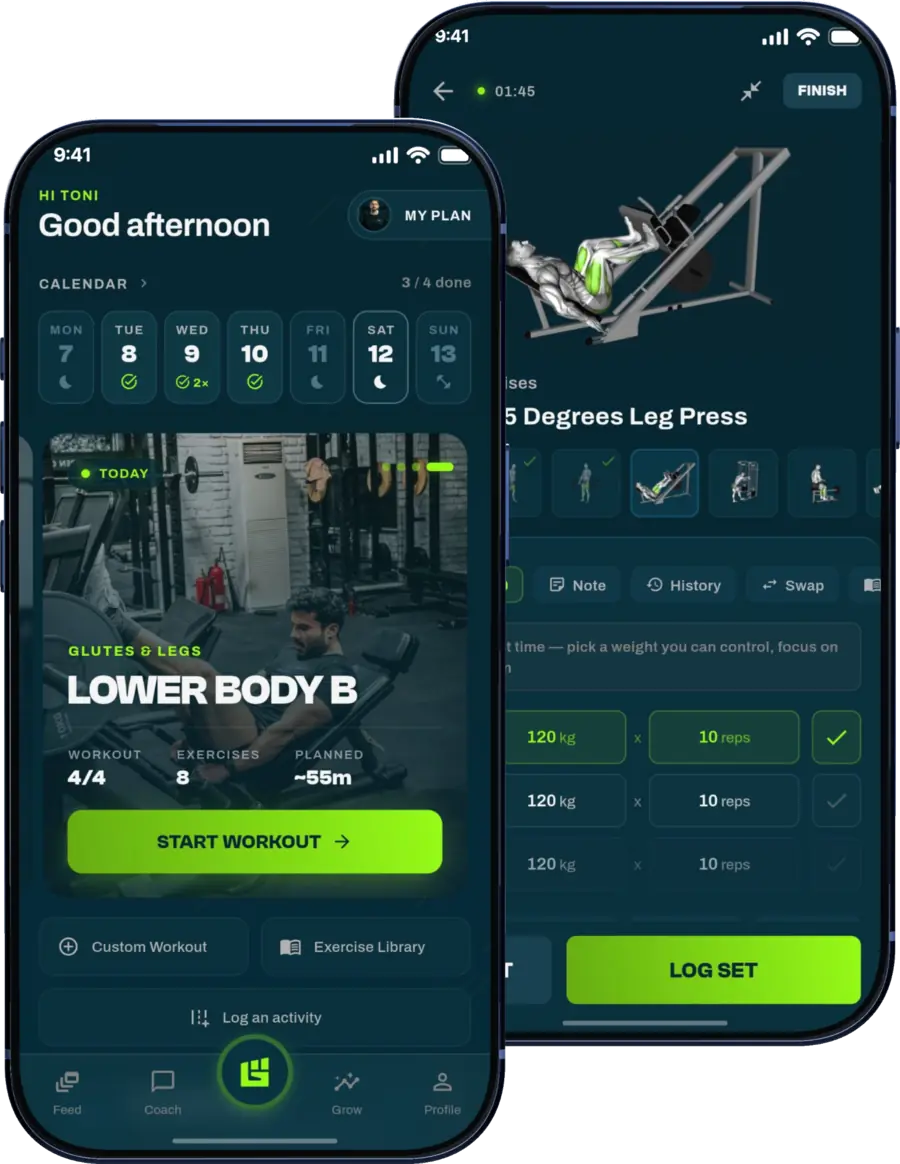
Get a personalized workout plan built around your goal, equipment and schedule. Train smarter, track every rep and keep moving forward, one workout at a time.






Where AI fits and where a trainer is needed
| Situation | AI fit | Trainer needed | Why |
|---|---|---|---|
| Healthy adult with general fitness goals | Strong | Optional | Routine planning and tracking suit AI well |
| Beginner with no lifting experience | Partial | Helpful for first month | Technique checks and pacing need observation |
| Hypertrophy-focused lifter | Strong | Optional | Volume and progression rules are easy to apply |
| Returning from injury | Weak | Yes | Needs assessment and gradual loading |
| Chronic condition such as heart disease or diabetes | Weak | Yes, with clinician input | Needs screening and medical advice |
| Pregnant or postpartum | Weak | Yes, with clinician input | Needs individual medical guidance |
| Competitive athlete in HYROX or powerlifting | Partial | Recommended | Technique and fatigue judgment matter under load |
| Low motivation with frequent missed sessions | Partial | Helpful | Accountability and direct encouragement come from people |
Match health status first, then goal. If two rows fit, take the stricter one. A strong lifter who is also postpartum follows the postpartum row. The rest of this guide is the reasoning behind each row.
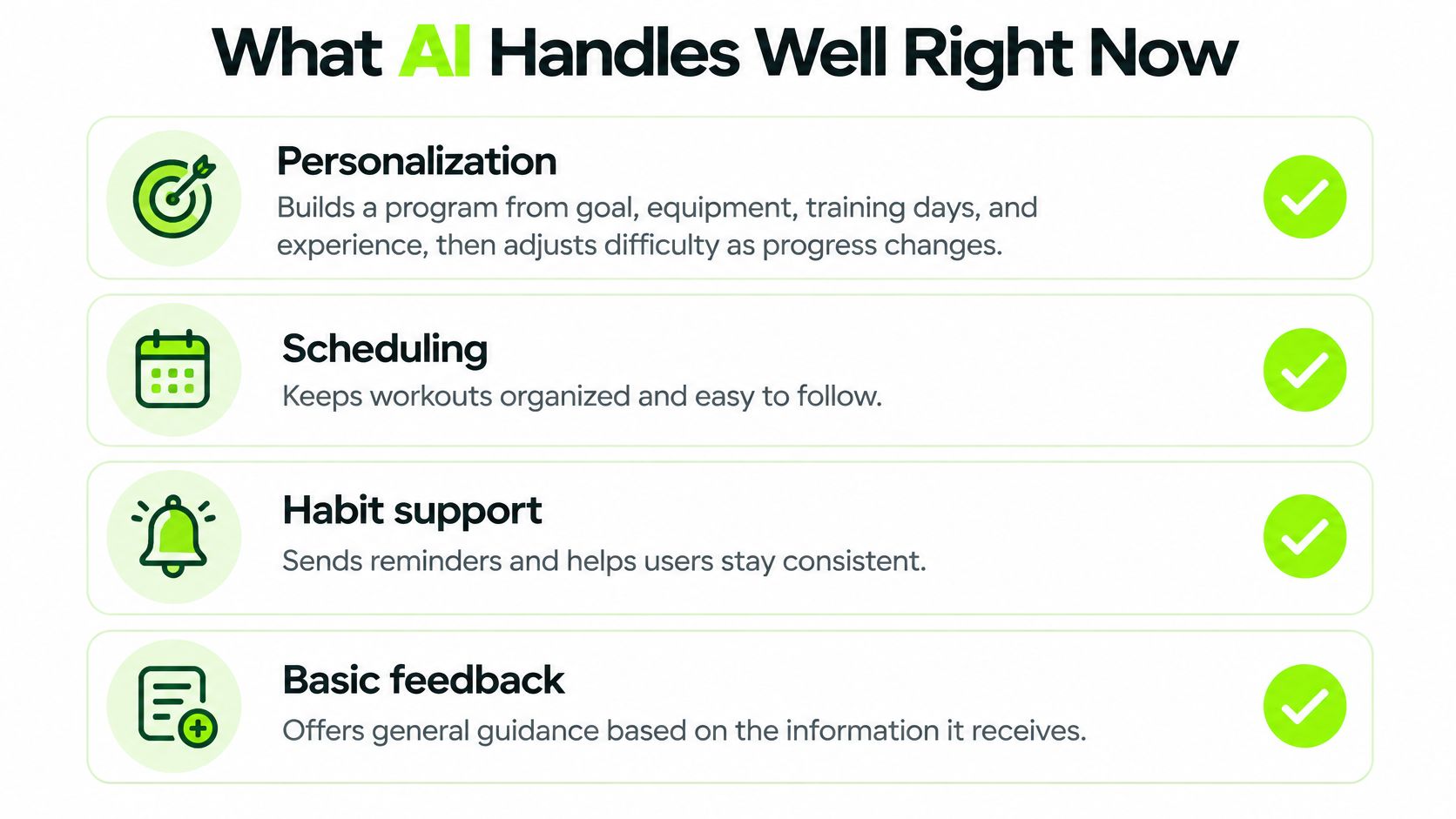
What AI Handles Well Right Now
Personalization is the strongest current use. You enter a goal, the gear you have, the days you can train, and how long you have been lifting. The plan should change when the log changes, not when the calendar flips.
A 2025 case study in BMC Public Health compared 16-week plans from GPT-4 with plans from three professional coaches for the same 24-year-old. On personalization, GPT-4 scored 12.80 and the coaches 11.53, and the difference was not statistically significant (p > 0.05). Coaches scored slightly higher on effectiveness (12.80 versus 12.60) and safety (12.33 versus 12.20), as well as thoroughness (12.13 versus 12.00). None of those gaps were significant either. The plans were written programs for one person, not measured gains across many bodies.
Scheduling and set math
Public targets give software a clear weekly skeleton. WHO guidance for adults 18 to 64 calls for 150 to 300 minutes of moderate aerobic activity, or 75 to 150 minutes of vigorous work, or a mix, plus muscle-strengthening for all major groups on at least two days. An app can spread that across a short week. Say Thursday disappears. It can move the session to Sunday instead of leaving a blank.
Hypertrophy has a countable rule too. Updated American College of Sports Medicine resistance-training guidance, drawn from 137 systematic reviews and more than 30,000 participants, points to about 10 sets per muscle group each week, with major groups trained at least twice and load built gradually. Software can count those sets. It still cannot see whether the tenth set was clean.
Logging and swaps are the other reliable jobs. Miss a bench because the rack is taken, and a sound planner offers a dumbbell press without wiping your history. A training plan built around your goal, equipment, and available days is doing this layer, not a physical assessment.
Wearables pioneer Erik Korem has argued, in a Peak Performance interview on avoiding injuries and burnout, that data helps only when you act before fatigue becomes an injury. That is a human decision sitting on top of the log.
Audit what you already have
- Personalization: The plan uses your goal, equipment, days, and experience, and it changes when progress changes.
- Scheduling: Sessions land on days you can keep, including a backup when one day drops.
- Volume count: Weekly sets per muscle group are visible, not guessed.
- Swap logic: A missing machine changes the exercise and keeps the history.
- Still yours: Pain calls, medical limits, and whether the bar path looked right.
If the first four are missing, the app is a template. If the last line is blank, you still need a person for anything beyond a healthy, low-complexity week.
Where AI Falls Short on Form and Corrective Work
A workout can be well organized and still be wrong for the person performing it. The dividing line is whether a human needs to observe a movement, interpret pain, or change the plan because of a physical response the user may not describe accurately.
A trainer can watch a set unfold: a knee moves inward during a squat, or the lower back rounds as a deadlift leaves the floor. They can adjust the cue or exercise before the next repetition. Text-based coaching depends on what the user notices and reports. If the user misses the fault, the AI may miss it too.
A systematic review of 24 empirical studies involving 2,512 participants found that large-language-model exercise plans were inferior to human experts in five of six direct comparisons for producing physiological adaptations. Safety problems appeared in 14 of 24 studies, including exercise recommendations unsuitable for some clinical populations. Those findings point to a practical limit: a plan generated from information in a prompt cannot reliably replace assessment of the person doing the movement.
A tidy plan can still prescribe the wrong movement for the person who has to do it.
Where plans usually break
- Corrective work: A posture label or description of asymmetry cannot show how someone moves. Choosing an appropriate exercise may require observing the movement itself.
- Pain changes: A sharp pinch at the bottom of a squat is a reason to stop and reassess. Making the same movement lighter may not address the problem.
- Unfamiliar equipment: A cable stack and a resistance band may both train the back, but they are not automatically interchangeable for a particular person.
- Bad inputs: If a reported one-rep max comes from a technically poor set, the plan may prescribe loads that do not reflect the user's ability.
For a healthy, low-complexity session, AI can help organize training. When form, persistent asymmetry, pain, or unfamiliar movements are central, refer the decision to a qualified human rather than relying on a text description. A useful check is to film one working set of a main lift from the side and compare it with a clear demonstration or a coach's cues. The aim is to notice what a written account may leave out.
A stretching routine can support a warm-up, but it cannot assess lifting technique. Good safeguards include screening for contraindications, setting intensity and progression limits, and pausing training when pain or unusual fatigue appears. AI can assist with programming; high-risk decisions call for human judgment.
How Strong the Evidence Really Is
Weigh claims by how they were tested, not by how confident the copy sounds.
The best-looking head-to-head is a single written-plan comparison for one young adult. Expert scores landed close. Nobody measured a year of strength, adherence, or injuries. Treat "matched a coach on paper" as a ceiling for plan writing, not proof that unsupervised training works for you.
What each layer can support
Cardiac rehab is the next layer, and it is thin. A 2025 systematic review of AI in exercise-based cardiovascular rehabilitation found only nine eligible studies, including two randomized controlled trials, with gains reported for daily steps, adherence, and cardiorespiratory fitness. Methods differed widely. That is a reason to keep testing, not a reason to hand clinical rehab to a chatbot.
The firmest ground is older and narrower. Resistance-training rules for volume, frequency, and gradual load sit on a large stack of reviews, not on a language model. Use those rules as constraints. Do not let a fluent paragraph override them.
The newest layer is the weakest. A 2025 scoping review in the Journal of Medical Internet Research covered 20 studies of LLM-based exercise and health coaches. 75% tested proprietary models such as ChatGPT, 80% used human ratings, and 40% used automated metrics. Much of that work scores whether a plan looks reasonable. A separate rigor check put a large share of this literature in the low-rigor bin.
Solid evidence supports structuring known training rules. Behavior change is promising and thin. Safe unsupervised work for clinical groups is barely tested.
When a vendor says the model replaces a trainer, ask which of those three claims they mean. Only the first has enough weight for a healthy adult with a simple goal.
Motivation and Accountability Gaps
Personalization is not adherence. A plan can fit a calendar and still die in week three.
Take a project manager who trains at 6 a.m. The week is built. Then a launch slips, sleep drops to five hours, and three sessions vanish. The app can shrink the next workout and keep the math honest. It cannot make the missed session feel like someone noticed. WHO draft guidance is blunt on the floor: any activity is better than none, inactive adults should build gradually, and the broad target is 150 to 300 minutes of moderate aerobic activity a week plus muscle-strengthening on at least two days. An app can schedule that ramp. It cannot supply the social cost of skipping.
A trainer adds a booked hour, a person who sees the absence, and a voice during a hard set. Our AI coach sends check-ins about training, reads the log for consistency, and can flag a stall. That reduces friction. It does not replace the relationship when motivation collapses.
Two stalls that look the same
Logs can usually separate a programming stall from a life stall.
- Program stall: Sessions happened, sets were completed, and load or reps stopped moving for several weeks. Change volume, exercise, or recovery days.
- Execution stall: Sessions are missing, sleep is poor, or meals fell apart. The program is not the first fix. A workout tracker shows the holes. It does not explain the fight at home or the month of overtime.
A coach hears the frustration and changes tone. Software sees a drop in completed sets. It does not know the reason, and it cannot answer with empathy. Plan creation and progress math are automatable. The part that gets a tired person back on Thursday is still mostly human.
When to Stop Relying on AI and See a Professional
AI can organize ordinary training for healthy users, but it cannot examine an injury, make a clinical judgment, or respond to an emergency. GrabGains' AI Coach is a language model, not a person. It can be wrong and does not give medical advice.
Use clear handoff rules. Emergency-type symptoms mean stop exercising and seek care now. Persistent pain means pause the movement and consult a clinician or physiotherapist. Pregnancy, postpartum training, known heart or metabolic disease, and disability or movement limits call for professional guidance before increasing intensity. WHO physical-activity guidance advises extra precautions or medical advice for pregnant and postpartum people, people with cardiac conditions, and people with disease-related limits. It also recommends that inactive adults start small and gradually build duration, frequency, and intensity. If your space is unsafe or equipment is missing, modify or postpone the session until you can train safely.
Warning signs that call for a professional
| Warning sign | What it may mean | What to do |
|---|---|---|
| Chest pain, pressure, or unusual breathlessness | Possible cardiac problem | Stop and seek medical care now |
| Dizziness, fainting, or heart palpitations | Circulation or rhythm concern | Stop and get checked before training again |
| Persistent joint or muscle pain after training | Injury or overload | Pause that movement and see a clinician or physiotherapist |
| Pregnancy or postpartum | Needs individual medical guidance | Get clinician approval and consult a trainer experienced with this stage |
| Known heart, metabolic, or other chronic condition | Intensity limits may apply | Get medical advice before raising intensity |
| Disability or movement restriction | Standard exercises may be unsafe | Work with a qualified trainer or therapist on adapted versions |
| Unsafe space or missing equipment | Higher injury risk | Move or modify the session until conditions are safe |
A referral is a sound outcome, not a failure of the tool. The dividing line is whether the next decision requires a human to assess your health or movement, rather than software to adjust a routine. Lab results also need clinical interpretation. A training chat cannot assess results in the context of your health; see why blood results need clinical context. If you are unsure whether exercise is safe, pause and ask a qualified professional before your next session.
Hybrid Models That Combine AI and Human Coaching
The workable middle is a tier. Automation runs low-risk programming for generally healthy users. Escalation rules send pain, medical history, odd symptoms, medication issues, or a long stall to a human.
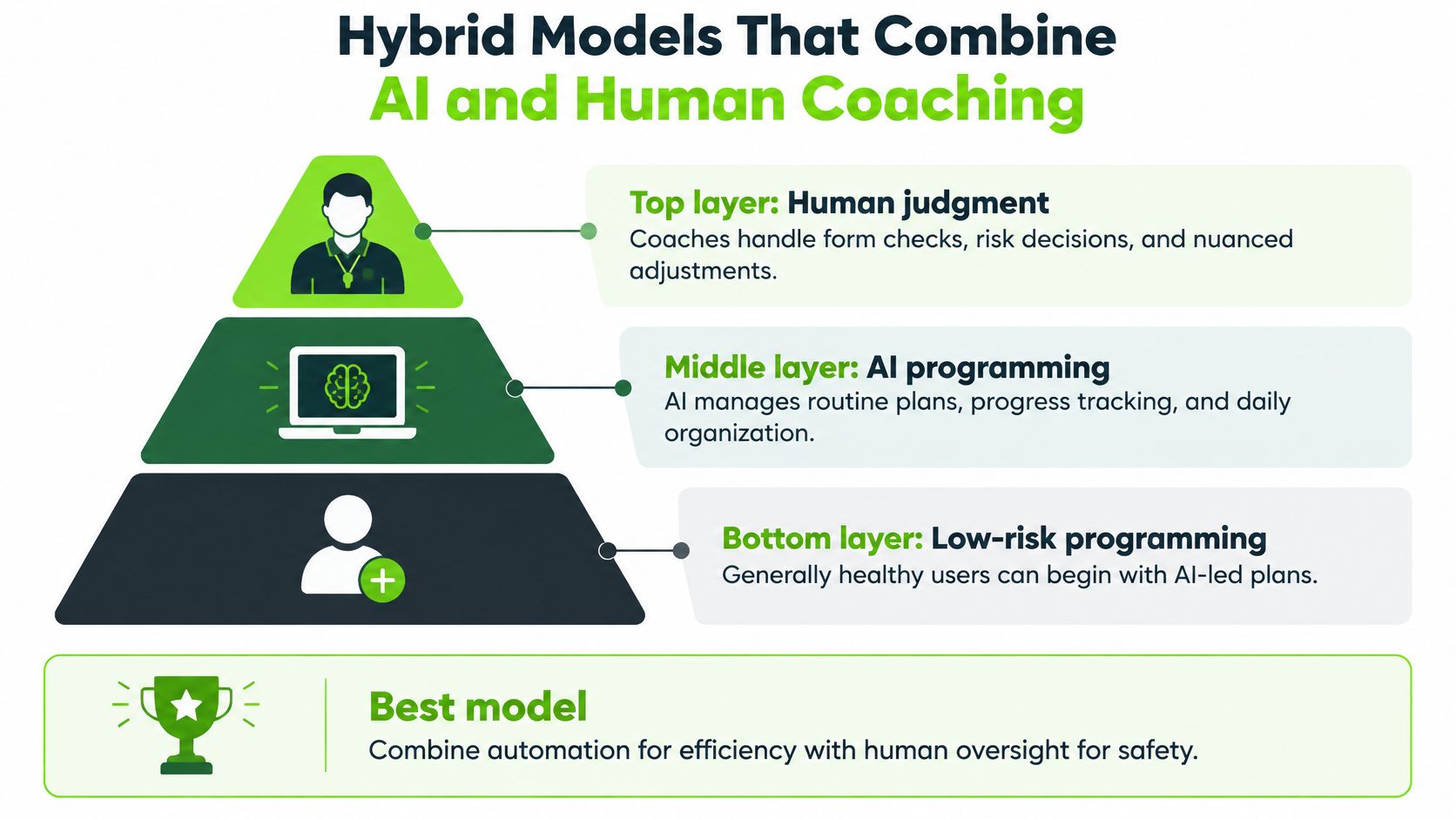
AI is strong at consistency, arithmetic, reminders, and moving a session when the week changes. Trainers are stronger at watching movement, talking someone through a bad week, and solving problems that were not in the template.
Hybrid coaching models compared
| Model | How it works | Best for | Trainer time |
|---|---|---|---|
| AI only | AI builds, tracks, and adjusts the plan | Healthy generalists with no red flags | None |
| AI with one assessment | One in-person session for form and baseline, then AI runs the plan | Beginners and returning lifters | One session at the start |
| AI with monthly review | Trainer reviews logged progress and adjusts goals | Busy professionals who need accountability | Monthly check-in |
| AI with weekly coaching | Trainer reviews filmed lifts and tweaks the plan | Competitive athletes such as HYROX racers | Regular weekly check-ins |
| Trainer-led with AI tracking | Trainer designs and supervises, AI logs sets and volume | Clinical or rehabilitation cases | Ongoing supervision |
Say you train four days on an app-built plan. Book one session to check squat depth and bracing. Once a month, sit with a coach and the log: loads, missed days, how sessions felt. You keep the calendar. The coach spends time on the two things the log cannot settle.
Move up a tier after an injury, a new diagnosis, a plateau that lasts several weeks despite completed sessions, or a goal like a HYROX race where pacing and positions under fatigue matter. Moving up is a plan, not a failure of the app.
Best Practices for Using AI as Your Training Partner
Enter injury history, equipment, training days, experience, and exercise preferences. Our personalization uses those inputs plus performance patterns. A hidden shoulder issue becomes a plan that keeps aggravating it.
Log every set, not only the session. Volume and progression live in the sets. Marking "done" hides whether you hit the weekly target or quit after two sets. The miss is treating a partial workout as a full one.
Add load only after every set is clean. A small jump after solid reps beats a hero number on a ugly last set. The miss is chasing the app's suggestion when the bar path already broke down.
Set stop rules before you warm up. Stop a movement for persistent or sharp pain. Stop the session if you feel dizzy or lightheaded. The common miss is finishing the schedule so the streak survives.
Treat the reply as a suggestion. Take medical questions to a clinician, not the chat. The miss is asking the model to clear a symptom because it answers faster than a clinic.
Review the whole plan every six to eight weeks. Compare the log with the original goal and change exercises, volume, or days. The miss is running the same block until boredom looks like a plateau.
Confirm Your Next Step Before Your Next Workout
- Check your row in the verdict table and the warning signs above. If any sign applies, book a clinician or a qualified trainer before you lift.
- Pick the hybrid model that matches your goal and your time. Start with AI only when no flags apply. Add one in-person assessment if you are new or coming back.
- Run four weeks. Log every set. Film one main lift in week one and week four.
- Compare. If form, consistency, and progress hold, stay. If pain shows up, or progress stalls for several weeks, move up one tier.
GrabGains can sit in the planning and tracking layer. It is not a gym, not a personal trainer, and not a medical service. The AI coach is a language model, not a person, and you can change or ignore what it says.
Start with step one today.
GrabGains builds adaptive workouts around your goal, your equipment, and the days you can train, then tracks the work so the plan can change with you. That is the routine layer this guide says software can own, with a clear stop when you need a clinician or a coach in the room. If you want that planning layer on your phone, visit GrabGains and set the first week from your real schedule, not from a generic split.
Get inspired and motivated