Build Muscle After 40: A Practical Plan
Build muscle after 40 with about 10 weekly sets, 1.2–1.6 g/kg of protein, and a 16-week plan busy adults can actually keep.
In older adults with sarcopenia, combining protein supplementation with resistance exercise significantly increased muscle mass, with a standardized mean difference of 0.95 in the 2024 systematic review and meta-analysis in Epidemiology and Health. That number reframes how to build muscle after 40. You're not chasing a perfect post-workout shake or a brutal six-day split. You're building a repeatable system where training gives the signal, food supplies the material, and time lets the result show.
That distinction matters if you're busy. Strength usually improves first. Visible size takes longer, and joint comfort decides whether you'll stick with the plan long enough to see it. Pick a dose you can repeat, eat enough protein across the whole day, and judge the plan over months, not single workouts.
What Changes in Muscle After 40
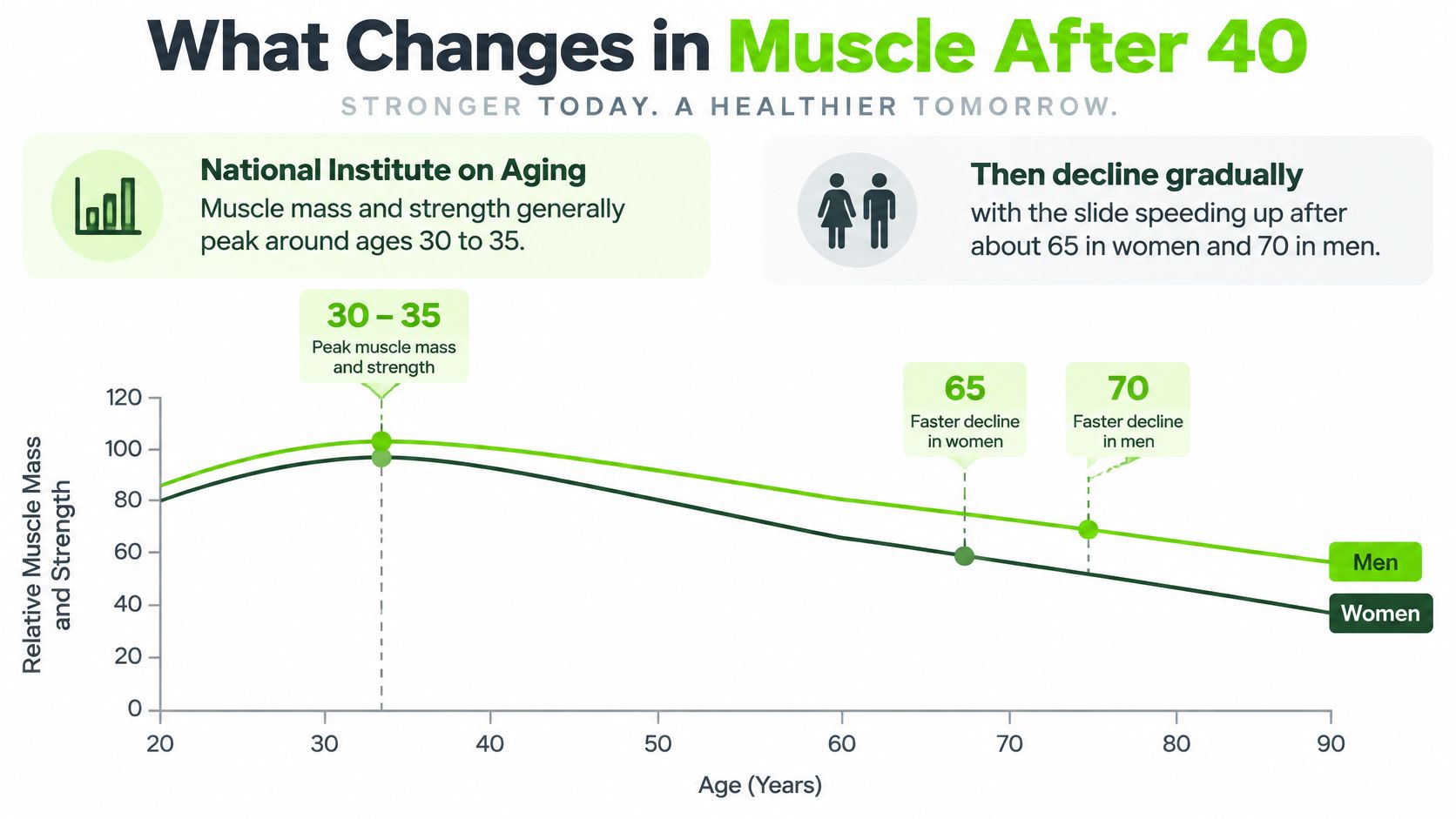
The National Institute on Aging explains that muscle mass and strength generally peak around ages 30 to 35. After that, muscle power and physical performance tend to decline gradually, with the rate accelerating around age 65 in women and age 70 in men. The pace varies, but getting older does not switch off your ability to build muscle.
Built for progress
Take the guesswork out of training
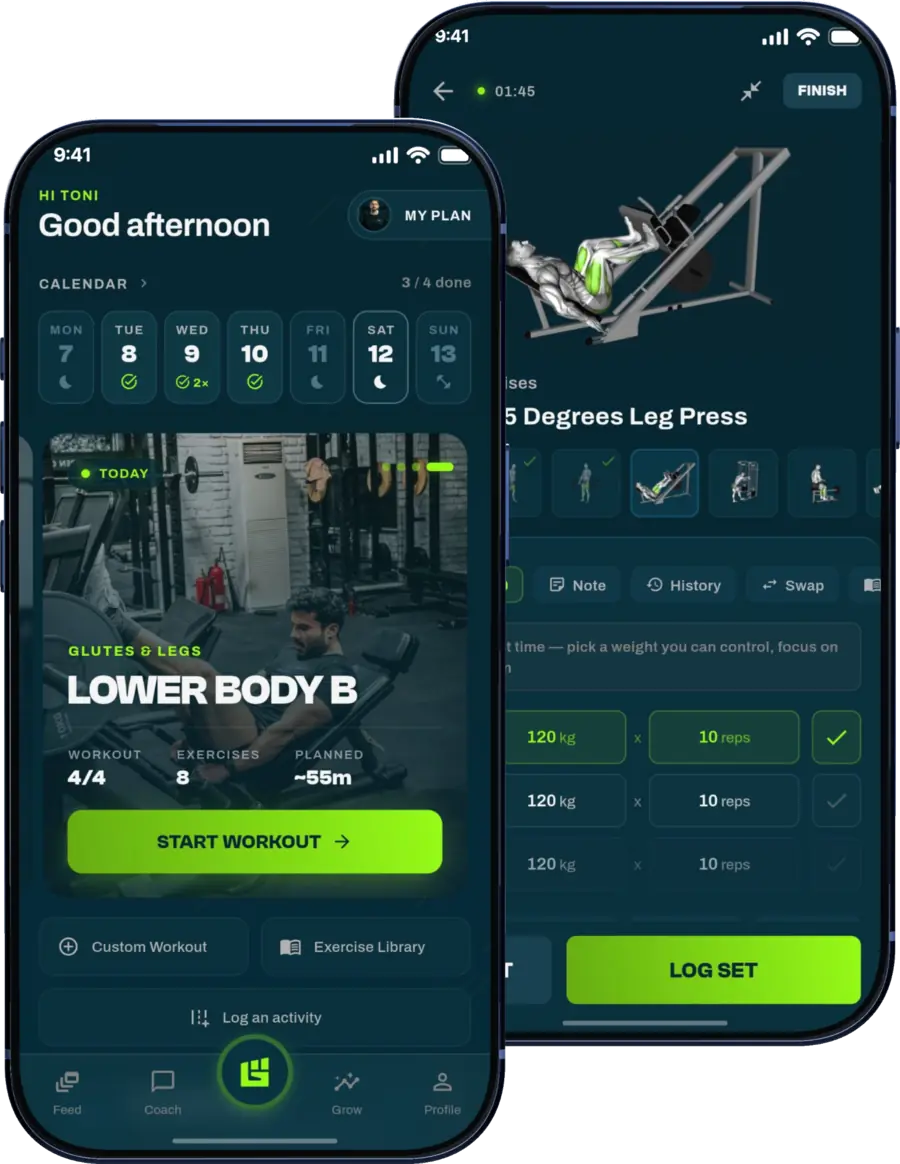
Get a personalized workout plan built around your goal, equipment and schedule. Train smarter, track every rep and keep moving forward, one workout at a time.






Resistance training gives muscles a reason to adapt. With consistent, progressive training, older adults can gain strength and muscle, including people who are physically frail. Strength often shows up before visible size. Give changes in muscle size a 16-week horizon, and focus on steady training and enough total protein across the day rather than precise anabolic-window timing or endlessly adding volume.
A typical starting point at 44
At 44, you might sit most of the day and find that your shoulders get cranky when you rush pressing movements. A practical starting point is two or three lifting days that train your legs, back, chest and shoulders with controlled technique.
Training works like a recurring signal: repeat a squat pattern, a hinge, a push and a pull, and your muscles have a reason to adapt. Use loads you can control, including during the lowering phase. Testing a maximum single is less useful than practicing sound movement while your joints adjust to training.
Power, or the ability to produce force quickly, can fade before you notice much change in muscle size. Everyday tasks may feel harder even if your body weight stays the same. Carrying groceries may still be manageable, while getting up quickly, catching your balance or climbing stairs with a load feels less automatic.
Muscle can still respond after 40. A repeatable plan gives that response time to add up.
Check red flags before heavy training
Get medical guidance before heavy training if you have chest pain or pressure, unexplained dizziness, recent surgery or a new joint injury.
- Chest pain or pressure: Stop exercising and seek medical care.
- Unexplained dizziness: Find the cause before loading lifts that require balance and bracing.
- Recent surgery: Follow your surgical restrictions before adding external load.
- New joint injury: Have the joint assessed before testing it under a barbell or heavy dumbbells.
Weekly Sets Loads and Recovery Gaps
Pick your row first. Then build your week around it and leave the plan alone long enough to learn whether it works.
Weekly training dose after 40
| Goal | Days per week | Weekly dose | Load and reps | Same-muscle gap |
|---|---|---|---|---|
| Hypertrophy | At least 2 | About 10 sets per muscle group | Moderate load, often 8 to 12 reps | At least 48 hours |
| Strength | 2 to 3 | 2 to 3 sets per exercise | Near 80% of 1RM, lower reps | At least 48 hours |
| Older-adult baseline | 2 to 3 | 1 to 3 sets per exercise | 8 to 12 reps, load increased gradually | At least 48 hours |
| Busy minimum | 2 full-body days | Fewer than 10 sets, still useful for function | 8 to 12 reps, 1 to 3 reps in reserve | At least 48 hours |
The American College of Sports Medicine resistance-training guidance identifies approximately 10 weekly sets per muscle group as a target for hypertrophy. It recommends heavier loads near 80% of one-repetition maximum for strength-focused work, typically performed for 2 to 3 sets per exercise. Earlier ACSM guidance for older adults recommends resistance training 2 to 3 days per week, using 1 to 3 sets of 8 to 12 repetitions per exercise, with at least 48 hours between sessions that train the same muscle group.
What counts as a major muscle group
Count sets for the large areas that drive most of your training. For this plan, those are quads, hamstrings and glutes, chest, back, and shoulders. Arms and calves get work from the main patterns, and you can add direct work later if recovery is solid.
Don't try to hit every target in one giant session. Split the work across two or more days so each set stays useful. A chest press done fresh on Monday and again on Thursday usually beats six sloppy sets squeezed into one tired workout.
One two-day week for a desk worker
Train Monday and Thursday. Each day, do a squat or leg press, a hinge such as a Romanian deadlift, a horizontal push, a row, and a loaded carry. Keep the order stable so you can compare performance from week to week.
Stop most sets with 1 to 3 reps in reserve. That means you could do one to three more clean reps, but you don't grind until your form changes. You'll still work hard, and you'll leave the gym able to repeat the session.
If you're sorting out your own structure, a weight training program organized by goal and training days can help you see how the pieces fit before you write your week. If soreness keeps lingering, this recovery guidance for aching joints is useful context for checking whether your gap between sessions is long enough.
Progress without changing everything
Progressive overload means you make the work slightly harder over time. First add a rep inside your range. When every set stays clean at the top of the range, add the smallest plate or the next dumbbell.
Hold your chosen row for four weeks before you edit it. That rule sounds boring, but it protects you from changing exercises every time one workout feels flat. You're trying to build muscle after 40 with a dose your joints, schedule, and energy can support.
Sample 12 Week Plans by Experience Level
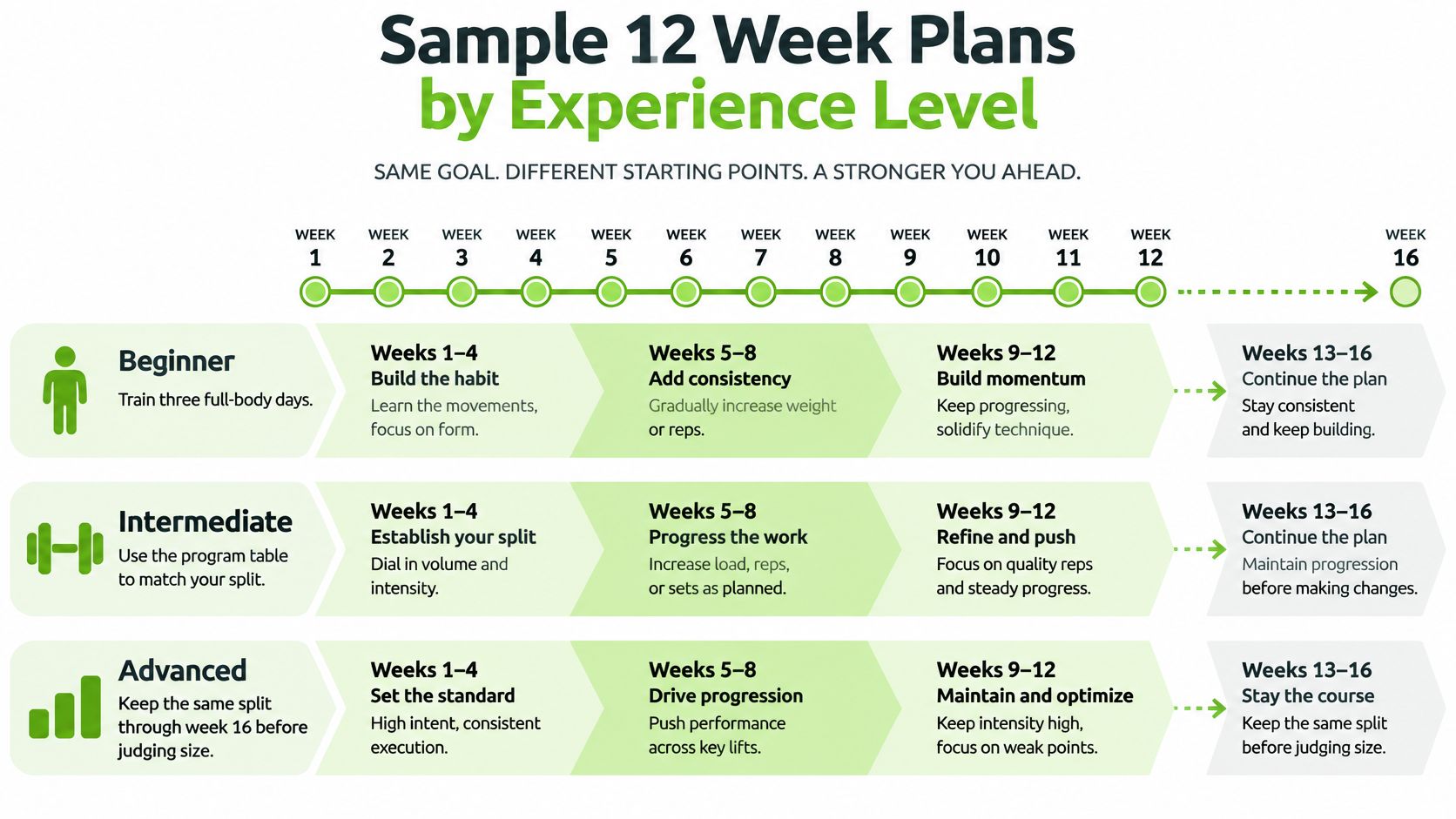
Muscle size can take longer to show than strength gains. Use these three 16-week templates to choose a split that fits your experience, then give it enough time to judge visible changes.
16-week plans by experience
| Level | Days | Split | Main patterns | When to judge size |
|---|---|---|---|---|
| Beginner | 3 | Full body | Squat or leg press, hinge, push, pull, carry | 16 weeks |
| Intermediate | 4 | Upper/lower | Same patterns, about 10 sets per muscle | 16 weeks |
| Advanced | 4 | Heavy day and lighter day | Same patterns, load rotated | 16 weeks |
A 2025 systematic review of resistance programs in older adults reported no statistically significant overall change in skeletal muscle mass. The review noted that meaningful hypertrophy may require at least 16 weeks of progressive overload, rather than the shorter blocks often emphasized for younger adults. Strength may improve before your measurements change, so use the full block to assess size.
Start this week in six steps
- Swap for joints before adding load: Use a leg press or goblet squat if your knees are irritable. Choose a machine or dumbbell press if a barbell bothers your shoulder, and use a pulldown until pull-ups feel steady.
- Log every session: Record each exercise, load, sets, and reps. The log makes changes in performance easier to see.
- Progress inside the rep range first: Build from 8 toward 12 controlled reps. Add the smallest load increase only after every work set stays smooth.
- Deload every fourth week: Cut sets by about 40% and keep the same movements. This lowers fatigue while preserving the routine.
- Repeat the structure through week 16: Add reps or load when your performance supports it. Keep the schedule steady instead of adding a fifth day after one easy week.
- Measure at week 16: Use the same measurement site, time of day, and relaxed posture each time.
Three full-body days give beginners frequent practice with the main movement patterns. Intermediate lifters can spread weekly sets across four upper- and lower-body sessions. Advanced lifters can rotate heavier and lighter days while keeping the same overall split.
If the bar moves better but the tape has not changed by week 12, keep the plan in place through week 16. Check your food, sleep, and logged training before changing the schedule. A training plan built around your goal, equipment, and available days can help you follow a consistent structure.
Judging rule: If strength is rising and your joints feel manageable, keep the plan through week 16 before judging size.
Daily Protein Without the Anabolic Window
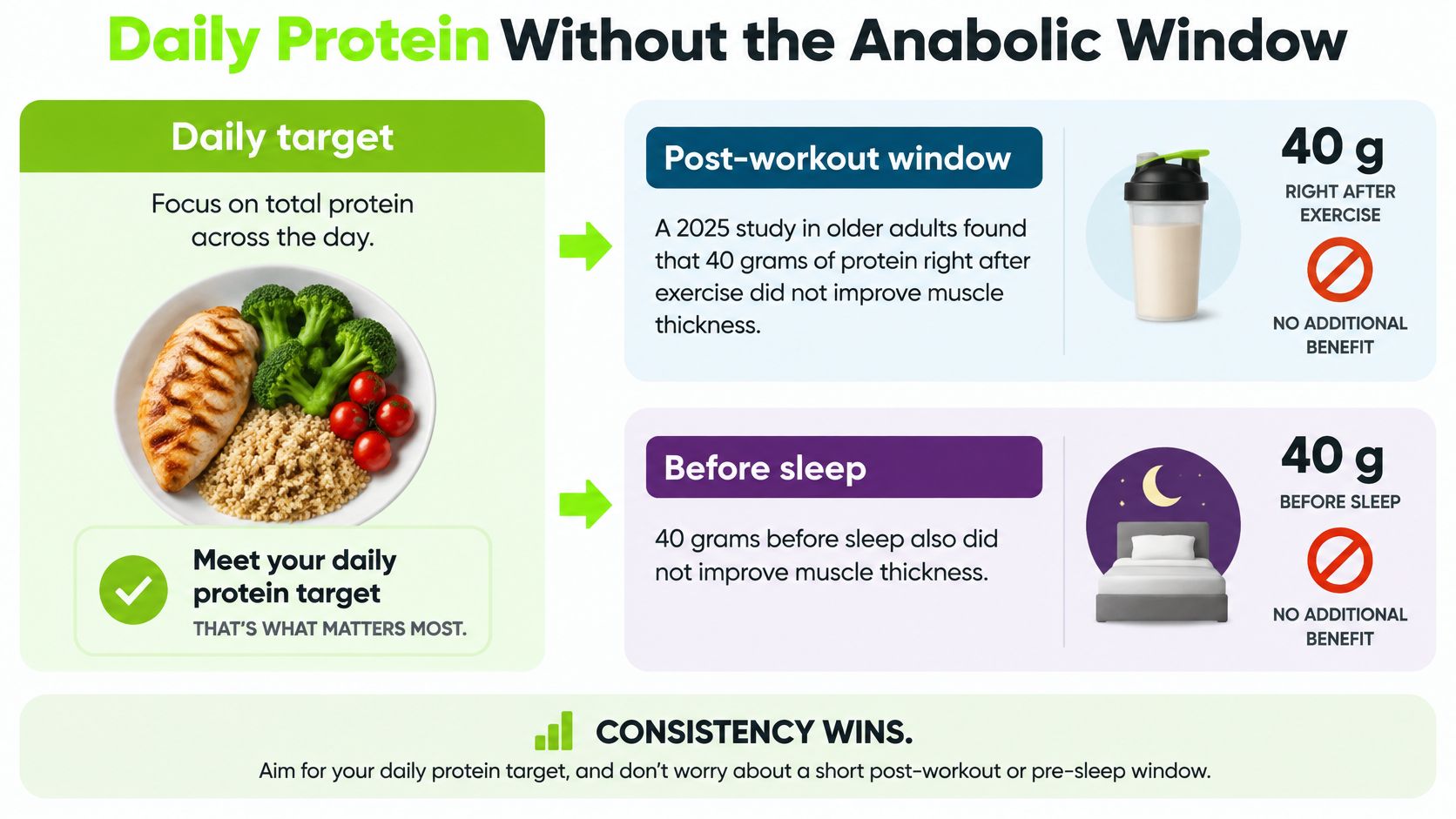
A protein shake does not need to beat you to the locker room. A 2025 study in older adults found that adding 40 g of protein immediately after exercise or before sleep did not improve muscle thickness or strength when participants already consumed at least 1.0 g/kg/day. Resistance training alone produced significant adaptations in that study.
For people already eating enough protein, total daily intake matters more than hitting a narrow post-workout window. Spreading protein across meals can make that daily total easier to reach, while meal timing can fit around your schedule.
Use a daily range and a per-meal floor
There is no single protein target that fits everyone. Body size, total calories, dietary pattern, training status, and kidney health all affect what makes sense. Use the table as a practical illustration of how daily and meal totals scale with body weight, rather than as a prescription.
Daily and per-meal protein by body weight
| Body weight | Daily at 1.2 g/kg | Daily at 1.6 g/kg | One meal at 0.40 g/kg |
|---|---|---|---|
| 70 kg | 84 g | 112 g | 28 g |
| 80 kg | 96 g | 128 g | 32 g |
| 90 kg | 108 g | 144 g | 36 g |
| 100 kg (220 lb) | 120 g | 160 g | 40 g |
At 80 kg, for example, a meal with about 32 g of protein gives you a simple reference point. If you train at 6 a.m., breakfast can follow your session; if you train at 8 p.m., dinner can come afterward. The clock changes, but the daily total remains the main target.
One three-meal template
Build breakfast around eggs and Greek yogurt for a protein-rich start that needs little cooking. At lunch, choose chicken, tofu, or another protein that works with your routine. At dinner, rotate fish, lean beef, or lentils to keep meals varied.
Add a snack when your meals leave a gap. Cottage cheese, Greek yogurt, milk, or a shake can help you reach your daily total, but a shake is optional. Whole foods can do the same job when they fit your schedule.
Protein also supports the body's repair processes. For context on supporting strength after a car accident, consider how intake can matter during recovery.
If you have kidney disease, a prescribed protein limit, or a very low-calorie diet, get medical advice before raising your intake. Adequate total food matters too; adding a protein target to an under-fueled diet may not support your training.
Protein powder is a convenient food when time is short. Training and adequate daily intake do the main work.
Fixes When Joints or Progress Stall
When progress slows, adjust one variable at a time. First check whether sleep and recovery between sessions are adequate, then review load jumps and exercise fit. A workout should challenge your muscles without forcing you to repeat painful or sloppy reps.
Don't add complexity before addressing those basics and eating enough overall. Compare your loads, reps, and exercise quality across sessions rather than judging progress by how sore or tired you feel after one workout.
Match the symptom to one change
Stall and joint symptoms with one fix
| What you notice | Likely issue | First change |
|---|---|---|
| Elbow aches on curls or presses | Tendon irritation from load spikes | Shorten range and drop one set |
| Shoulder pinch at the bottom of a press | Too much stretch under load | Switch to a machine or dumbbell press |
| Low back rounds on hinges | Position breaks before the muscle does | Use a higher hip hinge or leg press |
| Same reps for two weeks | Progression stalled, not a need for new exercises | Add a rep, then the smallest plate |
| Sharp soreness past 72 hours | Recovery gap too short | Insert the week-4 deload and walk easy |
Choose one adjustment and give it a week. Changing several things at once makes it harder to tell what helped. If a movement irritates a joint, use a comfortable variation and keep the rest of your routine steady.
Warm up the joints you'll load
Spend a few minutes preparing the joints you'll use. Before lower-body work, walk or cycle easily, then try bodyweight squats to a comfortable depth. Before pressing, use light band work and a few easy press reps.
Rotate simple drills through the week: a half-kneeling hip flexor stretch after desk-heavy days, thoracic extensions over a foam roller before upper-body work, and band external rotations before shoulder work. Keep each drill gentle. Easy walks on off days can also help you feel looser without adding another hard session.
A repeatable stretching routine for off days can keep the mobility work simple. For additional context on mobility support for active men, keep the focus here on training adjustments: warm-ups, gentle drills, and easy walks.
Retest Your Lifts and Get Cleared
Your next move is a decision, not another exercise list. Retest two or three main lifts every 4 weeks using the same exercise and rep range. Take a waist or limb tape measurement every 8 weeks, under the same conditions each time.
Expect the bar to move before the tape does. Early strength gains often come from better coordination, steadier bracing, and cleaner reps. That still counts, because stronger clean reps are how you'll accumulate the harder work that supports size later.
Use simple retest rules
Pick lifts you can perform safely and repeat exactly. A leg press, machine press, row, or trap bar hinge can be easier to standardize than a shaky free-weight test. Warm up the same way, rest the same amount, and stop the set when form changes.
- Load went up with clean form: Keep the plan and continue progressing gradually.
- Reps went up at the same load: You're improving, even if the plate math hasn't changed yet.
- Tape is flat before week 16: Check protein, calories, sleep, and missed sessions before you rebuild the program.
- Pain keeps returning: Change the exercise variation and get assessed if it persists.
Don't call the plan a failure before week 16. A calendar reminder helps here. Put your retest weeks and your week-16 measurement date in writing when you start, not when motivation dips.
Get cleared before you push
See a clinician before you start, or as soon as symptoms appear, if you have chest pain, uncontrolled blood pressure, a recent surgery, unexplained weight loss, dizziness, or a new joint injury. Do the same if you have kidney disease and plan to raise protein. This is general fitness information, not medical advice.
GrabGains provides general fitness and training information only and is not a medical service. Once you're cleared, beginners should start with fundamental movements and move to more complex exercises gradually as strength and confidence build, with programming that prioritizes proper form over heavy weights.
Now put two or three lifting sessions on this week's calendar. Choose the dose row that matches your experience, pick joint-friendly variations, and hold the set target for four weeks before changing anything. That's a practical way to build muscle after 40 without guessing.
Book the sessions first. A modest plan you attend beats a perfect plan you keep postponing.
Build your first four weeks around your goal, equipment, and the days you can train, then log each set so you can see strength move before size does. Visit GrabGains to set up a program that keeps your weekly sets, progression, and retests in one place.
Get inspired and motivated