Build Muscle at Home with Dumbbells: A 6-Week Plan
Learn how to build muscle at home with dumbbells using proven sets, reps and progression rules, plus a 6-week sample plan you can follow.
You've got one pair of dumbbells by the couch, 30 minutes before work, and sets that used to feel hard now finish with reps to spare. That's where most home plans stall. You don't need a garage full of equipment to build muscle at home with dumbbells, but you do need clear targets, honest effort, and a way to progress when your heaviest pair feels light. This plan gives you all three.
Start With the Numbers That Drive Muscle Growth
Forget vague advice to train hard. Use these targets this week, then adjust based on what your log shows.
| Variable | Starting target | Building target | Why it matters |
|---|---|---|---|
| Weekly sets per muscle group | 6 to 8 | About 10 | Counts every press, row, curl or squat that trains the muscle |
| Training days per muscle group | 2 | 2 to 3 | Twice-weekly training ranked well for hypertrophy |
| Reps per set | 8 to 12 | 6 to 15 | A flexible range matters more than one exact number |
| Reps in reserve at the end of a set | 2 to 3 | 0 to 2 | Keeps effort high without grinding out bad reps |
| Rest between sets | 60 to 90 seconds | 90 to 120 seconds | Longer rest suits heavier compound moves |
| Lowering tempo | About 2 seconds | 2 to 3 seconds | Stay under 10 seconds per rep to avoid junk fatigue |
What the evidence actually supports
The American College of Sports Medicine's 2026 resistance-training position stand synthesized 137 systematic reviews involving more than 30,000 participants and identifies approximately 10 weekly sets per muscle group as a useful target for hypertrophy. That same guidance says home-based routines can produce meaningful improvements in strength and hypertrophy when sets are challenging and progression is gradual. I wouldn't chase 10 sets on day one. Start at 6 to 8 sets, learn clean reps, then build up as recovery allows.
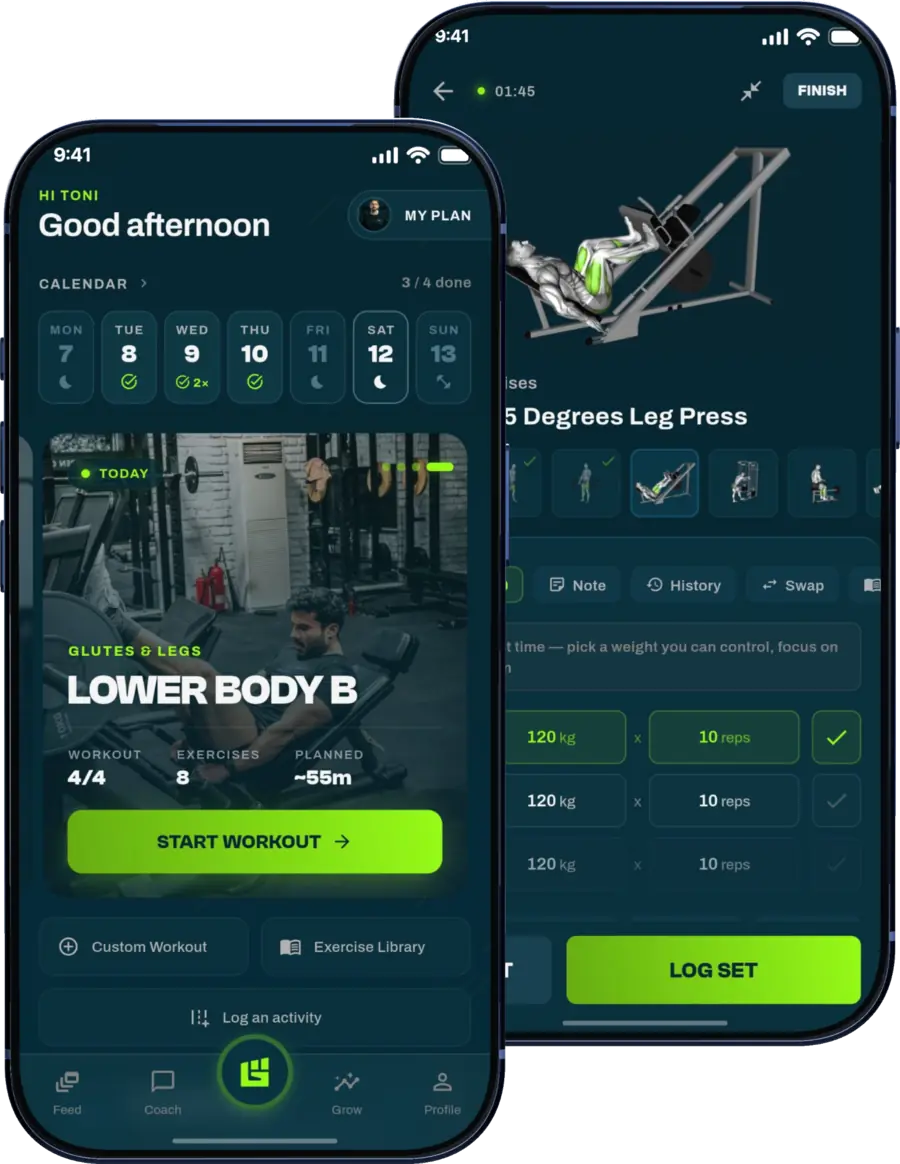
Built for progress
Take the guesswork out of training
Get a personalized workout plan built around your goal, equipment and schedule. Train smarter, track every rep and keep moving forward, one workout at a time.






A rep count alone doesn't decide growth. Weekly volume and effort do most of the work, which is why reps in reserve matters. Finish early sets with two or three clean reps left, then move closer to failure in later weeks as your technique holds up.
Rest and tempo keep those sets honest. Use 60 to 90 seconds for curls and lateral raises, and 90 to 120 seconds for floor presses, rows, and split squats. Lower the dumbbell under control for two to three seconds, because dragging a rep out just adds fatigue without a better stimulus.
Self-check: If most sets finish with zero to three clean reps left and you hit the top of your rep range two sessions in a row, the numbers are working.
Training is only half the input. If you're unsure how much protein supports those sets, this daily protein guidance for supplement shoppers helps you set a personal target before you buy anything. Keep it simple, log your weight and reps, and let the trend tell you when to add work.
Dumbbell Exercises for Every Major Muscle Group
Build every session around one simple rule. You need at least one press, one pull, one squat or hinge, and one isolation move so a single pair covers your whole body across the week.
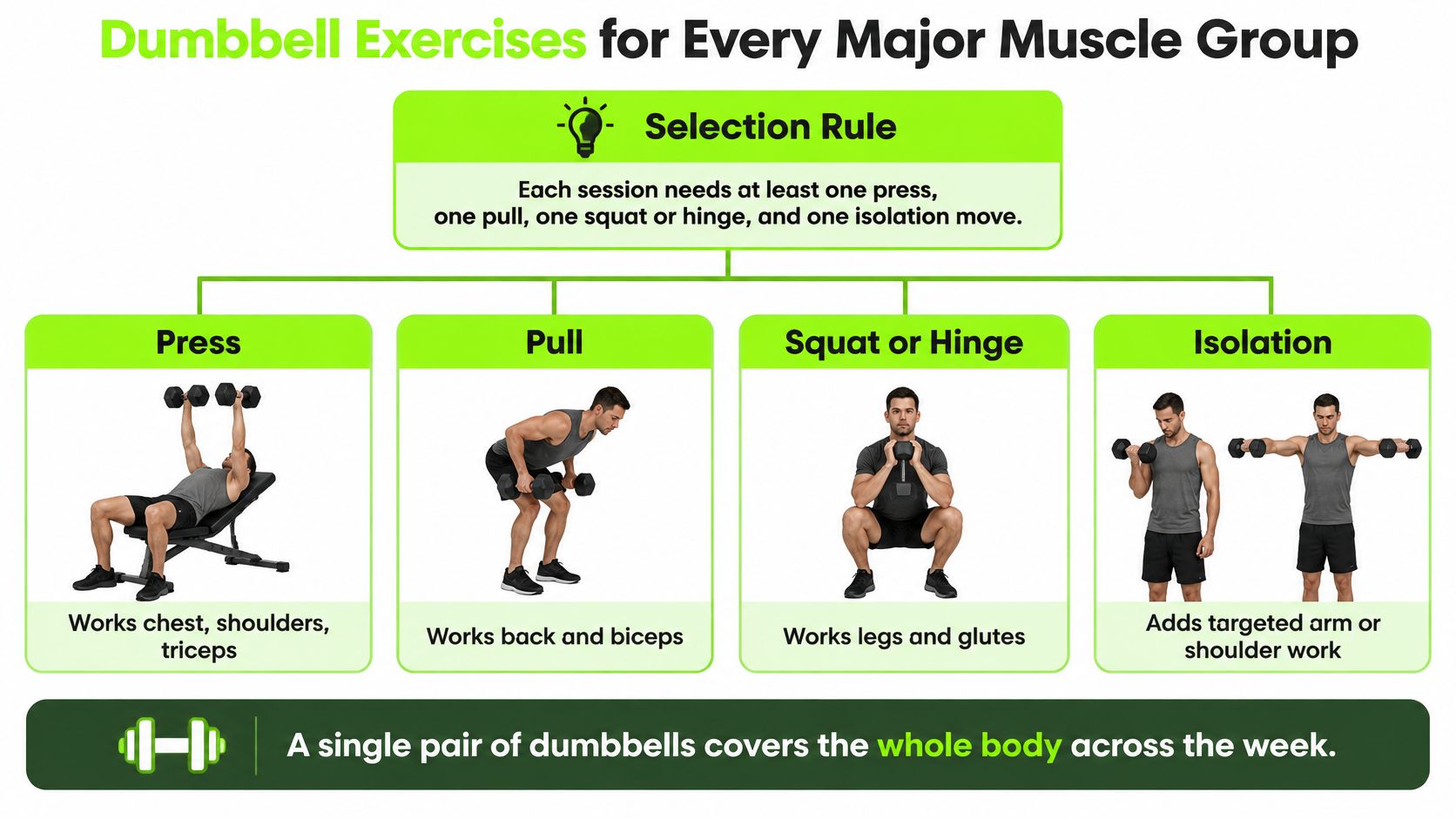
| Muscle group | Best dumbbell exercises | Setup tip |
|---|---|---|
| Chest | Floor press, incline press, push-up | Use a bench for the incline angle |
| Back | Single-arm row, chest-supported row, pullover | Brace one hand on a bench |
| Shoulders | Seated overhead press, lateral raise, rear fly | Keep lateral raises light at 12 to 15 reps |
| Quads and glutes | Goblet squat, split squat, step-up | Hold one dumbbell at the chest |
| Hamstrings and glutes | Romanian deadlift, single-leg hip thrust | Keep a slight knee bend on the deadlift |
| Biceps | Hammer curl, incline curl | Lower the weight over two to three seconds |
| Triceps | Overhead extension, lying extension | Keep elbows pointed toward the ceiling |
| Calves | Standing single-leg raise | Pause one second at the top |
Why these pairings work
Chest work starts with the floor press if you don't have a bench. Add the incline press once you do, because the angle shifts more load toward your upper chest. Mix in push-ups and you've got three angles sharing chest volume without repeating identical stress.
For your back, pair a single-arm row with a chest-supported row. The first lets you load one side hard, the second keeps your torso honest so you can't swing the weight up. That stricter pull is where a lot of home trainees finally feel their lats work.
Legs need two patterns, not three versions of the same one. Pick a knee-dominant move like the goblet squat or split squat, then a hip-dominant move like the Romanian deadlift. One builds quads and glutes, the other builds hamstrings and glutes, and together they cover what a leg extension and leg curl would at a gym.
Keep lateral raises light at 12 to 15 reps. Heavier loads pull your torso and traps into the movement, so the side delt does less, not more. If you're building sessions inside an app, our weight training workout builder lets you slot these patterns by muscle group instead of guessing.
If an exercise bothers a joint, don't drop the muscle. Swap to another variation with the same movement pattern, such as a floor press for an overhead press that pinches, and keep your weekly sets intact.
Choosing a Home Workout Template by Experience Level
The best split is the one you can repeat for three straight weeks. Match the template to your recovery and your calendar, not to what looks impressive on paper.
| Experience level | Sessions per week | Split | Session length |
|---|---|---|---|
| Beginner | 3 | Full body on alternate days | 30 to 40 minutes |
| Intermediate | 3 to 4 | Upper and lower body | 45 to 60 minutes |
| Advanced | 4 to 5 | Push, pull, legs and arms and shoulders | 50 to 70 minutes |
How frequency should shape your choice
A systematic review and network meta-analysis of resistance-training prescriptions found its highest-ranked prescription for hypertrophy involved higher-load, multiple-set training performed twice weekly, while strength ranked highest at three times weekly. That ranking isn't a universal rule for every person. It does support training each major muscle about twice per week with multiple challenging sets rather than one token set.
Beginners in the table train full body three times, so each muscle gets hit more often at a modest per-session cost. That's useful when you're still learning form, because a missed day costs less and you practice each movement frequently. Beginners start with fundamental movements and are introduced to more complex exercises gradually as strength and confidence build, with programming that prioritizes proper form over heavy weights.
One beginner session, in order
Run it exactly like this, resting between moves:
- Goblet squat: Your main knee-dominant work while you're fresh.
- Dumbbell floor press: Your horizontal press.
- Single-arm row: Balance the press with a heavy pull.
- Romanian deadlift: Your hinge for hamstrings and glutes.
- Seated overhead press: Vertical pressing to finish shoulders.
- Short core finisher: Two controlled sets, then stop.
Use one exercise per muscle group, plus a second for larger muscles like legs and back. Add a third exercise only after the first two feel controlled for every set. Intermediates earn upper and lower splits because they need more exercises per muscle, and advanced trainees spread push, pull, legs, and arms across more days to manage fatigue.
How to Progress When Your Dumbbells Feel Light
Heavier dumbbells aren't the only route forward. That's the assumption that leaves home trainees stuck once they outgrow the pair they own.
A systematic review comparing low-load, moderate-load, and high-load resistance training found no meaningful overall difference in muscle hypertrophy when sets were taken to volitional failure, with low load defined as more than 15-repetition maximum, moderate load as 9 to 15 repetitions maximum, and high load as 8 or fewer repetitions maximum. High loads of at least 80% of one-repetition maximum are efficient for strength, but lighter work taken close to technical failure still builds size.
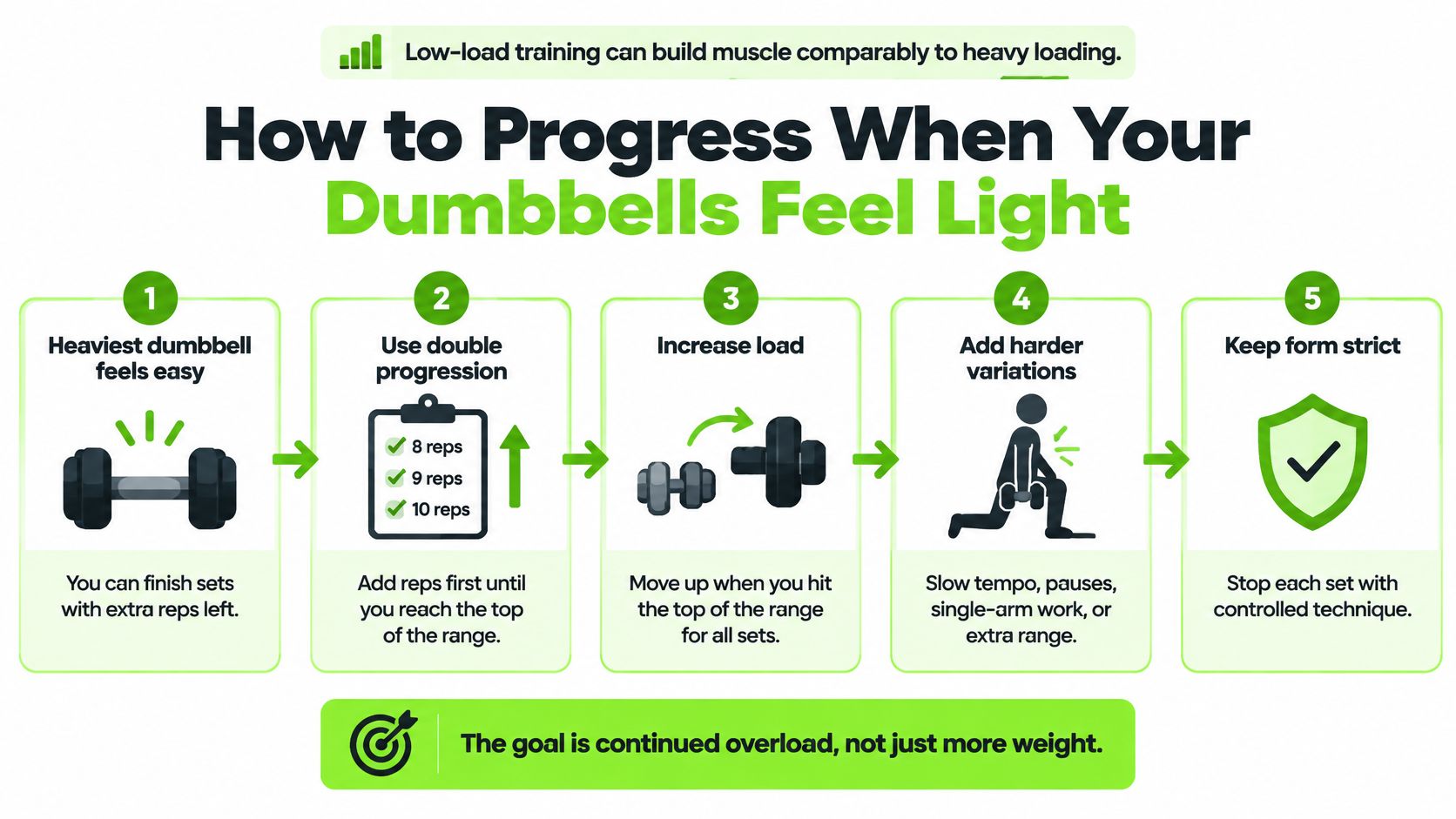
Levers that make a light dumbbell harder
You have more options than adding plates:
- More reps: Work to the top of your range before changing anything else.
- Extra sets: Add one set to a lagging muscle for two weeks and watch recovery.
- Slower lowering: Use about three seconds down to increase time under tension.
- Pauses: Hold briefly at the stretched or contracted position.
- Unilateral versions: Split squats and single-arm presses roughly double the work per side.
- Fuller range and shorter rest: Use complete reps and try 45 to 60 seconds between isolation sets to raise demand.
The progression routine
Follow this order instead of randomly adding reps:
- Choose a rep range: Start with 12 to 15 for light dumbbells.
- Add reps first: Keep the same weight and add one rep per set next session.
- Add a harder lever: When every set hits the top with clean form, add a pause or switch to a single-arm version.
- Increase load last: Move up only when a heavier dumbbell is available or your lever options run out.
Track which lever you used, not just the weight. A workout tracker for logging sets and progression keeps those notes in one place so you don't repeat the same easy session by accident.
Don't chase reps with momentum. Swinging curls to 20 reps isn't progression, it's your lower back doing the work. Be honest about the trade-off too. Visible size can keep progressing with light dumbbells taken near failure, though those sets burn and fatigue adds up. A stronger one-rep max eventually needs heavier loads, and no tempo trick fully replaces that.
A Six-Week Sample Routine With an Optional Deload
Six weeks is long enough to learn the movements, add volume, and push effort without guessing each Monday. The deload sits outside the core plan, so the block stays six weeks long.
| Week | Focus | Sets and reps | Load rule |
|---|---|---|---|
| 1 to 2 | Learn form with 2 to 3 reps in reserve | 2 to 3 sets of 10 to 12 | Choose a weight that lets you finish 12 clean reps |
| 3 to 4 | Build volume | 3 sets of 8 to 12 | Add reps until the top of the range, then add weight |
| 5 to 6 | Train closer to failure | 3 to 4 sets of 6 to 15 | Stop with 0 to 2 reps in reserve |
| 7 | Optional deload | 2 sets, well short of failure | Restart at week 1 loads after recovery |
How each block should feel
Weeks 1 and 2 are technique weeks. You'll finish sets knowing you had two or three reps left, and that's intentional. You're grooving the press, row, squat, and hinge before fatigue tests your form.
Weeks 3 and 4 add volume and introduce double progression. Add reps across the range first, then move up in weight once every set reaches the top with clean form. Weeks 5 and 6 push closer to failure at zero to two reps in reserve, using three to four sets across a wider 6 to 15 rep range so heavier compound moves and lighter isolation moves both fit.
After week six, take the optional deload if joints feel beat up or performance dipped. Two easy sets per exercise, well short of failure, then restart at week-one loads and beat your old log.
Reps or load, both can work
A 2024 study comparing increasing load versus increasing repetitions found both approaches improved one-repetition-maximum strength and muscle cross-sectional area, with average one-repetition-maximum performance rising from 52.90 kilograms to 69.05 kilograms in the load group and from 51.67 kilograms to 66.82 kilograms in the repetition group, with no statistically significant difference between methods. If you own one pair, choose the rep route without worrying you're taking a lesser path. Barbell, dumbbell, machine, cable, band and bodyweight training all count toward the same progress, so substitutions don't restart your block.
Log exercise, weight, reps, sets, tempo, and reps in reserve for every session. Our training plan builder for structured dumbbell blocks can hold that six-week structure, and the workout generator uses a user's logged sets and weights only to pick the next weight for them. Count weekly sets per muscle against your target, and mark a session as a win whenever you add one rep or one weight increment.
One extra clean rep is progress. Write it down like it matters, because over six weeks it does.
Mistakes That Stall Home Muscle Gains
Most stalls aren't mysterious. They show up in your log weeks before they show up in the mirror.
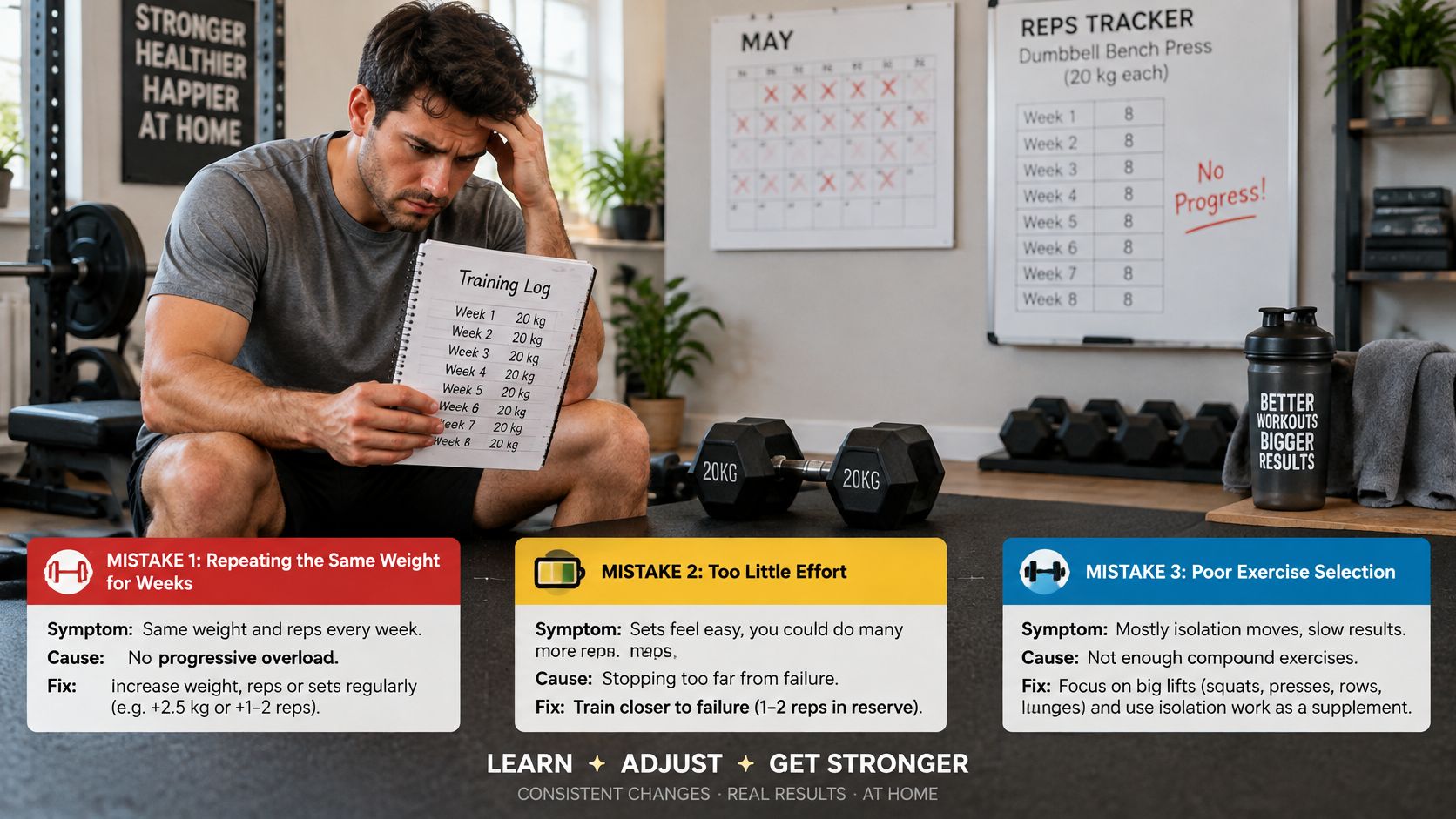
- Repeating the same weight for weeks: Your log looks identical session after session. Fix it with double progression, adding reps until you reach the top of the range before moving on.
- Cutting range of motion to finish reps: Half presses and shallow squats inflate your numbers. Count only reps through a full, controlled range, and use a sturdy bench or the floor so depth stays honest.
- Lowering too slowly: Reps dragged out to extremes add fatigue without a better stimulus. Keep the lowering phase to about two to four seconds and lift with intent.
- Jumping to too many sets too soon: Starting near 20 sets per muscle usually brings soreness you can't recover from. Begin at 6 to 8 sets and build toward your target over several weeks.
- Ignoring recovery: Sessions feel worse, weights feel heavier, and motivation drops. If that lasts two weeks, drop one set per muscle or add a rest day before you change exercises.
The log check that catches it
Say you're curling a 15-pound dumbbell for 25 reps with swinging elbows. The rep count climbs, but the weight never changes and your form notes say the same thing every week. That's not overload, that's endurance practice with worse technique.
Review your log every Sunday for two minutes. If reps rise while weight, tempo, and form notes don't improve, tighten the reps, shorten the range back to full, and rebuild from a number you can control.
Recovery, Nutrition and Your First Week
Muscle grows between sessions, not during them. Your job outside the workout is to give those hard sets something to build with.
The basics that support growth
Protein comes first. Aim for about 1.6 to 2.2 grams per kilogram of body weight per day, split across three or four meals so each one delivers a useful dose. If mornings are rushed, an organic matcha shake for busy mornings is one convenient way to start the day with protein instead of skipping breakfast entirely.
Eat enough total food to support training. Beginners who want to add size usually do well with a modest surplus of 100 to 300 calories above maintenance, enough to gain slowly without burying progress under excess fat. If your weight hasn't moved in three weeks and your log is improving, add a small snack rather than overhauling everything.
Sleep seven to nine hours when you can. Short sleep won't erase a good session, but chronic short sleep makes hard sets feel harder and hunger harder to manage. Give each muscle at least 48 hours before you train it hard again, and treat the rest days in your template as part of the program, not missed opportunities.
If sessions feel worse two weeks in a row, reduce volume or add rest before you add anything new. Adding exercises to an under-recovered week usually digs the hole deeper.
Your first week, step by step
Start by testing your dumbbells. You should finish 8 to 12 reps on presses, rows, squats, and hinges with about two reps left in reserve. If you can't, don't wait for heavier equipment to arrive. Add bodyweight variations like push-ups and unloaded split squats, because GrabGains home workouts can be done with a full set of dumbbells or with only bodyweight.
Schedule two or three sessions on fixed days and put them in your calendar like meetings. Log every set, including the messy ones, then review that log at week six before choosing your next cycle. GrabGains builds a workout program around your training goal, your equipment and the days you can train, which helps if your schedule shifts mid-block.
Start this week with what you have, even if it's one light pair and a corner of the living room. Perfect equipment next month loses to consistent, logged, progressive work today.
The plan you actually complete beats the perfect one you never start.
Build your first six-week dumbbell block around your goal, your equipment, and the days you can train, then log every set so progression is visible instead of guessed. Visit GrabGains to set up a personalized home plan with guided exercises and progress tracking that adapts as your dumbbells start to feel light.
Get inspired and motivated