Muscle Imbalance Symptoms, Tests and Fixes That Work
Spot a muscle imbalance with simple self-checks and strength tests, then fix it with mobility, unilateral work and smarter programming.
The most popular advice on muscle imbalance sounds neat. Find a side that is 10% weaker, fix it, and you will move better and stay injury free. That is too tidy to be true.
A 10% gap can be normal for one joint, meaningless on a noisy test, and worth attention in another context. Your goal isn't perfect symmetry. It's learning whether a difference repeats, whether it changes how you move, and whether it lines up with pain, fatigue, or stalled progress. Start with what you feel, test it, then match the fix to what the test showed.
What a Muscle Imbalance Is and Why It Matters
Two lifters bench the same weight. One presses smoothly. The other feels the left shoulder pinch every time the bar gets heavy, so the right side takes over and the bar tilts. On paper their strength looks equal. Under load, their sides are doing different jobs.
Built for progress
Take the guesswork out of training
Get a personalized workout plan built around your goal, equipment and schedule. Train smarter, track every rep and keep moving forward, one workout at a time.






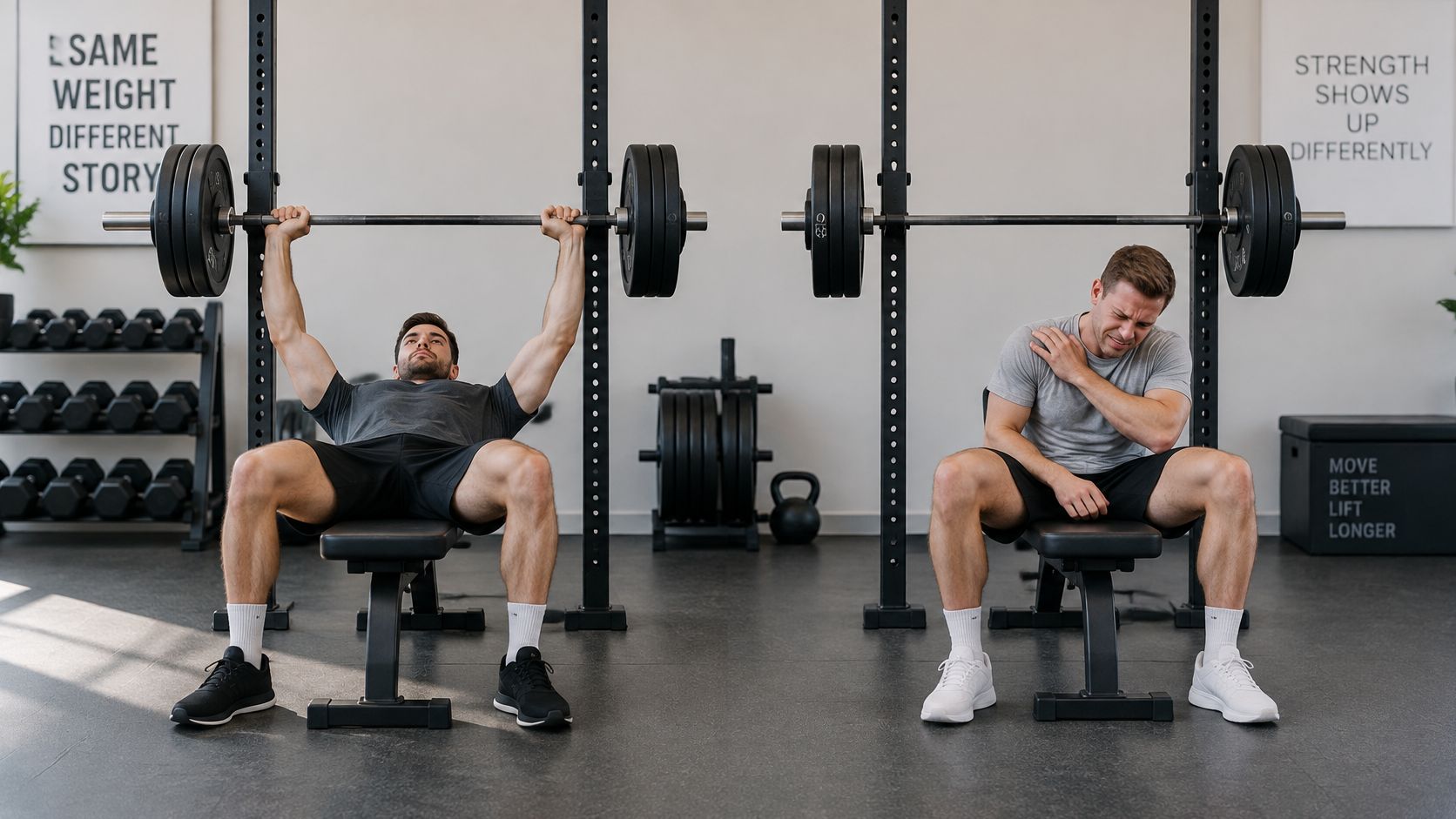
A muscle imbalance is a significant difference in strength, size, or movement control between left and right muscles, or between opposing muscle groups. It differs from having a slightly stronger dominant side, which is normal.
The two patterns to recognize
Side-to-side imbalance means one hamstring, shoulder, or arm is weaker or less controlled than the other. Opposing-muscle imbalance means one group dominates its partner, such as a tight chest paired with a weak upper back, or tight hip flexors paired with weak glutes.
Think of a bicycle brake pad that grips harder on one side. The wheels can look fine, but the bike pulls sideways when you brake. Your body does something similar. It shifts work to the side or muscle that feels more reliable.
Some people carry asymmetry, so focus on imbalances that change movement, recovery, or progress. Notice one pattern you already feel today.
- One side tires first: The same leg or arm fades earlier in the same lift
- Recurring one-sided ache: Soreness or tightness returns after training on one side
- Joint drift: A knee caves, a shoulder rolls, or a hip shifts under load
- Movement looks different: One side looks smoother in the mirror or on video
These are cues to test, not proof of a problem.
Quick Self-Checks You Can Do at Home
You need a mirror, a wall, and a timer. Run all five checks, write down what happens, and repeat them on another day before you decide anything.
| Self-check | Balanced result | Possible imbalance sign |
|---|---|---|
| Single-leg balance, eyes open | Steady for 30 seconds on each side | Wobbling, foot touching down, or a clear time gap between sides |
| Overhead reach | Arms straight up with a neutral lower back | Lower back arches or one arm drifts forward |
| Shoulder height side view | Shoulders level and facing forward | One shoulder visibly higher or rotated forward |
| Bodyweight squat in mirror | Knees track over the toes on both sides | One knee caves inward or one hip rides higher |
| Single-arm row, same dumbbell | Same reps and smooth pull on each side | One side fatigues sooner or pulls with less control |
How to run each check
Single-leg balance: Stand barefoot near a wall, lift one foot, and time 30 seconds per side. Count touches down, not just total time. If you grab the wall three times on the left and never on the right, that's useful information even if you finish both sides.
Overhead reach: Stand with your back near a wall and raise both arms straight up. Watch whether your lower back arches hard to get there, or one arm stops forward of your ear. Tight shoulders often borrow motion from the spine.
Shoulder height: Turn sideways to the mirror, then face it. Look for one shoulder sitting higher, rolling forward, or rotating inward more than the other. Check at rest first, before you try to fix your posture for the mirror.
Hip and knee position: Squat slowly facing the mirror, five controlled reps. Watch the knees and hips, not your face. Does one knee dive inward on the way up? Does one hip stay higher at the bottom?
Single-arm pulling: Pick a dumbbell you can row for 8 to 10 clean reps. Row one side, rest briefly, then match it on the other. Note reps completed, control, and whether your torso twists more on one side.
A single odd result isn't a diagnosis. A pattern that repeats across a week is what earns your attention.
A small difference that disappears on retest is usually normal variation, poor sleep, or a sloppy first attempt. A clear pattern, such as the same knee collapsing and the same leg wobbling in balance, points to something worth training. Write down reps, times, and what you saw. You'll need that baseline later, and memory is unreliable.
Strength and Mobility Screens That Measure Asymmetry
Home checks show you where to look. Measured screens put a number on it, but the number only helps if you test the same way every time. Use the same warm-up, time of day, equipment, and counting method.
The common 10% rule is a screening reference, not a diagnosis. A systematic review of 53 studies found 27 studies used a threshold between 10% and 15%, with 12 using 10%, eight using 15%, and seven using both values, yet many didn't provide adequate evidence for their chosen cutoff.
| Screen | How to run it | How to read the result |
|---|---|---|
| Single-leg squat | 5 reps per side, record depth and knee alignment | Knee alignment or depth clearly worse on one side |
| Single-leg hop | 3 hops per side, record best distance | Side difference above 10% is a screening reference |
| Single-arm row or press | Same load, same reps to near-failure | Side difference above 10% in reps or load |
| Knee-to-wall ankle mobility | Measure distance in centimeters per side | Consistent side gap across repeated sessions |
Calculate asymmetry this way. Take the stronger side minus the weaker side, divide by the stronger side, then multiply by 100. If your right leg hops 180 centimeters and your left hops 162, the gap is 10%. For runners who want to connect leg asymmetry to stride and loading, Swift Running's gait analysis guide is a helpful next read on what gait testing can and can't show.
Three rules before you call it real
First, beat the test's own noise. Repeat the same test on separate days and estimate its coefficient of variation. A difference only counts when it's larger than that normal variation. If your hop distance swings 6% day to day, an 8% side gap may be noise.
Second, expect the test to change the answer. A 2025 synthesis of more than 18,000 participants found asymmetry ranging from 2.1% to 19.5% by joint and movement, with the dominant upper limb averaging 11.6% stronger than the nondominant limb, while functional movements and manual arm-strength tests tended to show greater symmetry.
Third, don't compare unlike tests. Research on bilateral and unilateral hamstring testing found asymmetries in bilateral tasks didn't reliably carry over to unilateral tests. Track one test consistently.
If you have a medical condition, are pregnant, are recovering from an injury, take medication, or haven't trained for a long time, talk to a doctor before testing or training hard.
What Causes Muscle Imbalances to Develop
Imbalances rarely come from one bad workout. They build from what you repeat most, at work, in sport, and in the gym.
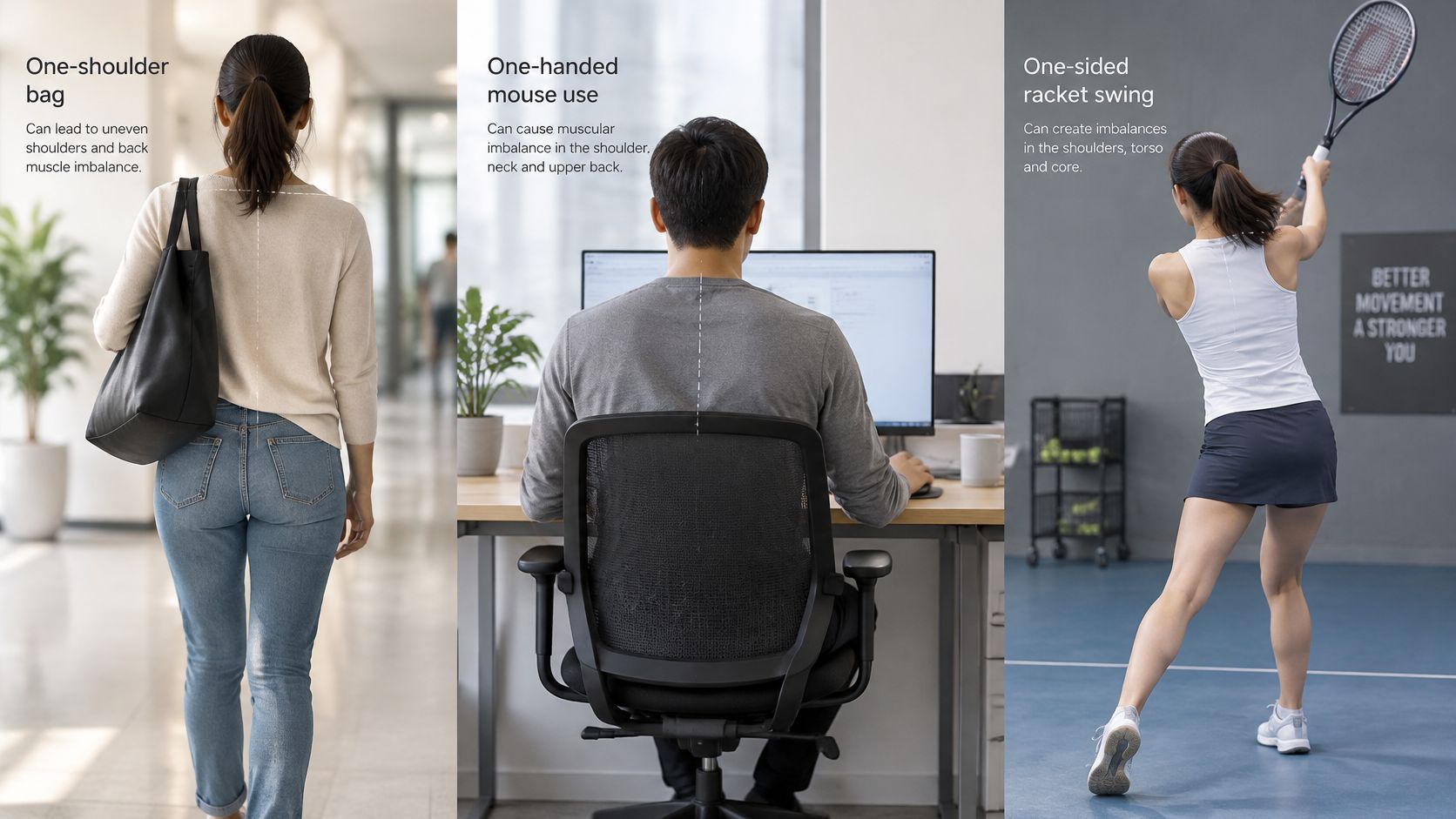
Repeated one-sided habits are the quiet driver. Carrying a bag on one shoulder, driving with one arm high, holding a child on one hip, or using a mouse all day loads one pattern thousands of times. None of it feels like training, but your body adapts anyway.
Sport demands do the same thing faster. Tennis, rowing, throwing, and golf load one side or one direction far more than the other. Cycling and running are more symmetrical, yet a small leg difference can still steer how force is shared when you're tired.
Guarding and uneven volume
After an injury, guarding makes sense. You shift away from a sore ankle or shoulder. The problem starts when that shift stays after the tissue calms down, and the stronger side keeps getting stronger because it keeps doing more work.
Uneven training volume works the same way in the gym. A controlled resistance-training study compared groups completing approximately 3 to 7, 6 to 14, or 12 to 28 weekly sets per muscle group over 10 weeks and found higher-volume conditions produced greater increases in muscle size at the elbow flexors, mid-thigh, and lateral thigh. If one side consistently gets more effective sets, it can pull ahead in size even when exercises look identical.
Two taught patterns help you organize what you see. An upper crossed pattern pairs a tight chest and front shoulders with a weak upper back and deep neck flexors. A lower crossed pattern pairs tight hip flexors and lower back with weak glutes and deep core. Treat these labels as a prompt to test, not a conclusion. They're a widely taught model, not a diagnosis, and not every posture fits them.
List your two most repeated daily habits now. They're often a better clue than your hardest workout.
Corrective Strategies That Match the Deficit
Don't fix a mobility problem with more strength work, or a strength gap with stretching alone. Match the tool to what the test showed.
| Deficit found | Corrective focus | Example exercises |
|---|---|---|
| Restricted range of motion | Mobility drills held for time | Knee-to-wall ankle drill, thoracic rotation |
| Weak stabilizer | Activation before loading | Glute bridge hold, side plank |
| Side strength gap | Unilateral strength work, weaker side sets the load | Split squat, single-arm row, step-up |
| Jump or sprint gap | Small doses of unilateral plyometrics | Single-leg hop, lateral bound |
| Fatigue-driven asymmetry | Reorder exercises and trim total sets | Weaker side first, fewer hard sets per session |
If range of motion is restricted, start there. Use ankle and thoracic drills held for 30 to 60 seconds, breathing slowly, before you load the pattern. Our stretching work in the app fits this short, repeatable approach, but any consistent routine you do beats a perfect one you skip.
If a stabilizer is sleepy, wake it before the heavy set. Glute bridge holds and side planks teach the muscle to show up early. For readers retraining control after pain or injury, movement retraining at MedAmerica Rehab Center explains how clinicians rebuild coordination step by step.
Strength, power, and honest expectations
If one side is weaker, add unilateral strength work and let the weaker side set the load. Split squats, single-leg presses, step-ups, and single-arm rows expose what bilateral lifts hide. Start with the weaker side while you're fresh, match reps on the stronger side, and stop when quality drops.
If the gap shows up in jumps, use small plyometric doses. A 2025 meta-analysis of eight studies found unilateral plyometric training produced moderate improvements in single-leg countermovement-jump asymmetry with SMD = 0.51, broad-jump asymmetry with SMD = 0.56, and lateral-jump asymmetry with SMD = 1.24, while showing no significant effect for single-leg horizontal triple jumps.
Reducing asymmetry doesn't automatically reduce injury risk. Treat symmetry as one signal, not a guarantee.
For volume, add a little, not double. A 2022 review of resistance-training variables concluded even low volumes of up to four weekly sets per muscle group can produce substantial hypertrophy, with a graded dose-response as volume rises. Add one or two quality sets for a lagging side, then reassess.
Sample Four-Week Plan for Correcting an Imbalance
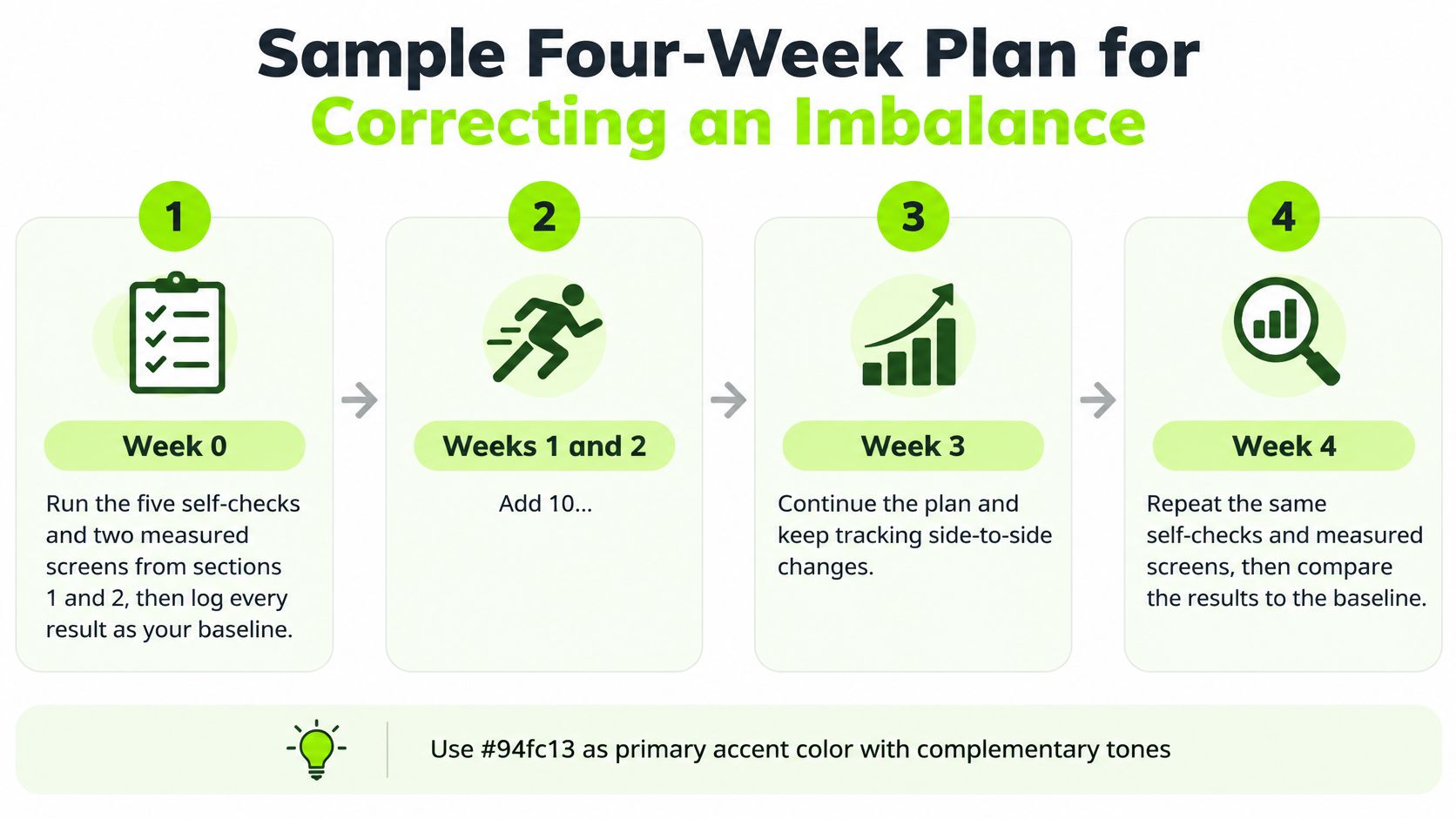
This plan assumes you've found one repeatable pattern, not five. Pick one main target, such as a left leg strength gap or a stiff right ankle, and keep the rest of training normal.
The four phases
- Week 0, baseline: Run the five self-checks and two measured screens that match your suspected issue. Log reps, distance, time, and alignment notes. Don't try to fix anything yet.
- Weeks 1 and 2, mobility and activation: Add 10 minutes before each session. Use ankle and thoracic drills held for 30 to 60 seconds, plus glute bridge holds or side planks. Train the weaker side first in every paired exercise.
- Weeks 3 and 4, unilateral strength: Add two targeted sessions per week. Try 3 sets of 8 to 10 split squats per leg and 3 sets of 10 single-arm rows, matching reps to the weaker side. You can organize the work with a structured training plan so the extra sets don't crowd out recovery.
- Throughout weeks 3 and 4, progress with quality: Add load only when the weaker side completes the same clean reps as the stronger side. Keep bilateral lifts for total strength, but place unilateral work early while you're fresh.
A busy split can be two full-body sessions plus one upper or lower session weekly. Barbell, dumbbell, machine, cable, band, and bodyweight training all count toward the same progress, so use what you have. A step-up at home with a backpack can do the job if reps are controlled and logged.
If back pain is part of your pattern, pacing matters as much as exercise choice, and a structured approach to back recovery outlines how graded rehabilitation is often organized. Hold back if you feel sharp discomfort or rep quality collapses. Reduce load, shorten range, and speak with a professional if pain persists.
Track Your Progress and Start Your Imbalance Check
Retest in four weeks under the same conditions. Same warm-up, same test order, same equipment, same time of day if you can. Calculate the side-to-side difference again and compare it with the test's normal variation, not just with 10%.
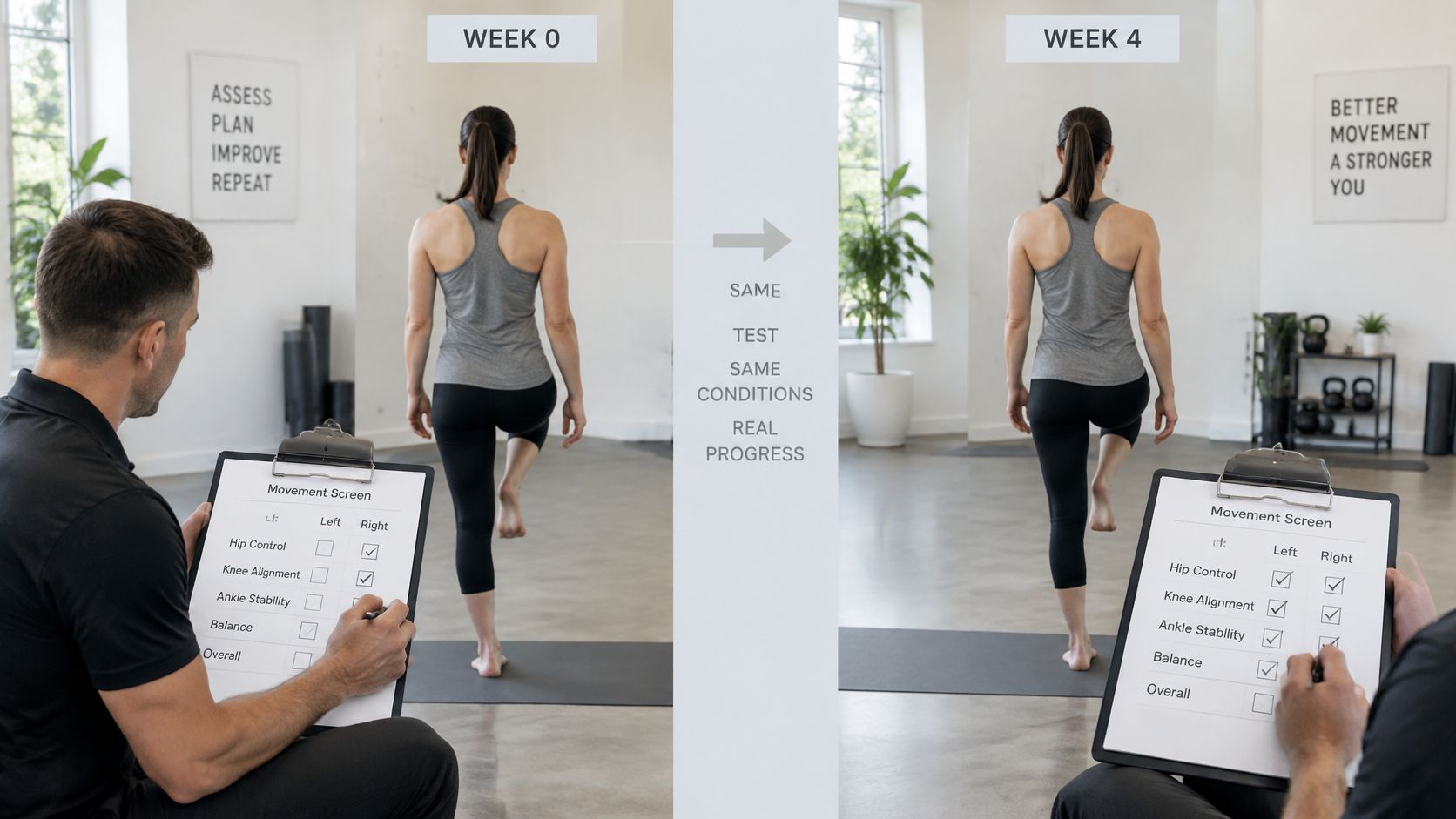
A shrinking gap that holds across two or three checks signals progress. A flat gap tells you to adjust the focus. Maybe you strengthened a leg that needed ankle mobility first, or you added sets to a side that was already fatigued by exercise order. Change one variable, then retest.
Log sets so the gap doesn't rebuild itself
Track weekly sets per muscle and per side where it matters. Count challenging sets, reps, range of motion, and proximity to failure. A side that gets three extra hard sets every week will pull ahead again.
Tools help if they're simple. In GrabGains, Muscle Zone Tracking turns logged sets into volume per muscle group, and Grow shows how many sets each muscle group has had against your weekly target. You pick one fitness goal, Build Muscle, Lift Heavier, Get Lean, or Lose Weight, and the app builds your program around it, your equipment, and the days you can train. A workout tracker only helps if you log every set, including the messy sets where form broke down.
Start this week with one self-check and one measured screen. Log the baseline, pick one corrective focus, train it for four weeks, and retest. That's enough to turn a vague worry about symmetry into a clear decision.
Pick your goal in GrabGains, log each set by muscle group, and use the weekly volume view to spot a side or muscle that is falling behind. Run your first imbalance check this week, add one targeted unilateral or mobility focus, and retest in four weeks with your baseline saved.
Get inspired and motivated