Lean Bulk (Middel): Step-by-Step Plan for Muscle Gain
Learn how to run a lean bulk (middel) with the right calorie surplus, macros, training and progress checks for steady muscle gain.
“Eat more and lift heavy” is how plenty of lifters end up with a bigger waist and disappointing strength gains. More food can support muscle growth, but it can't compensate for training that never progresses or a surplus that keeps growing without a reason.
A better lean bulk (middel) plan treats weight gain as a controlled rate, not permission to eat indefinitely. You'll judge it by your weight trend, waist measurements, and performance together, then change the smallest thing that needs changing.
What a lean bulk is and how fast it should work
A lean bulk is a planned gaining phase that uses a small calorie surplus to support muscle growth while limiting unnecessary fat gain. A 2019 review of off-season bodybuilding nutrition recommends approximately 10 to 20% above maintenance and 0.25 to 0.5% bodyweight gain per week for novice and intermediate natural bodybuilders. It also recommends daily protein of 1.6 to 2.2 g/kg.
Built for progress
Take the guesswork out of training
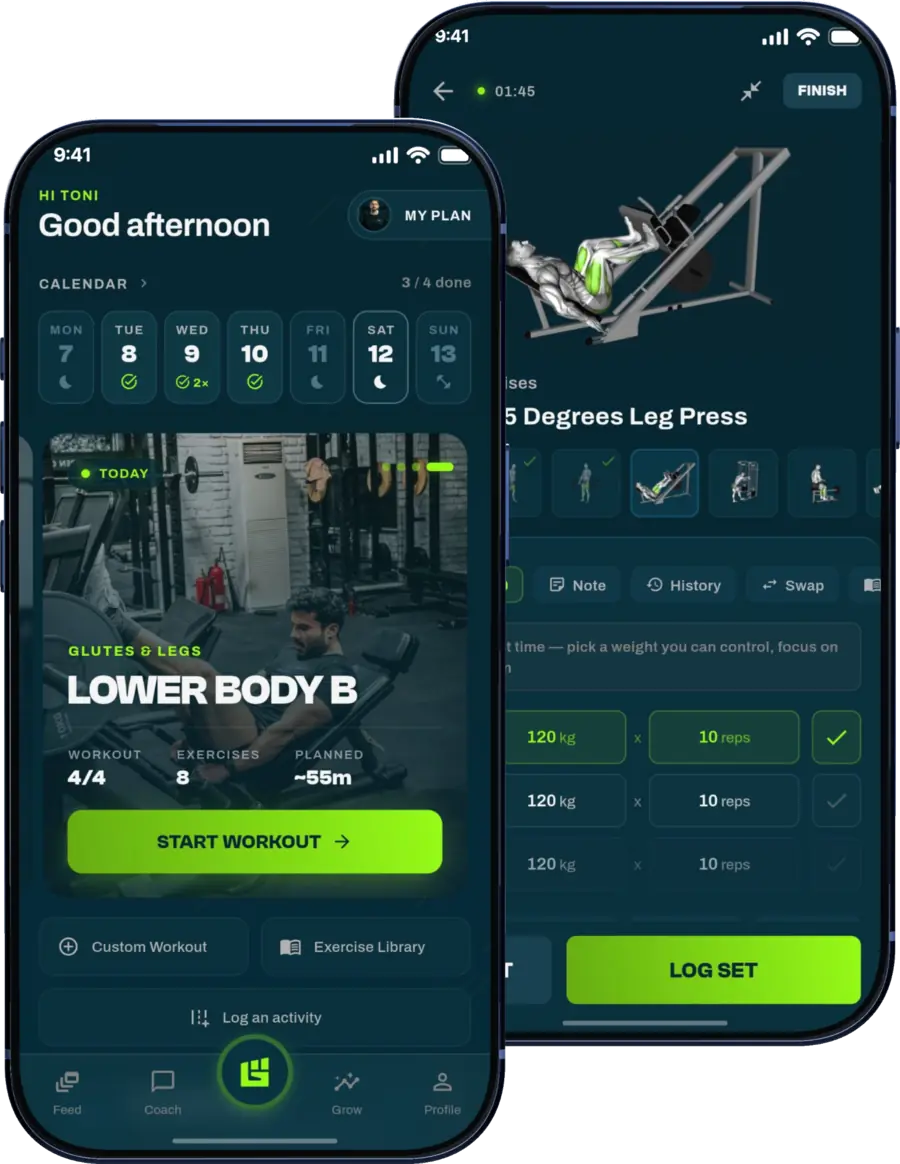
Get a personalized workout plan built around your goal, equipment and schedule. Train smarter, track every rep and keep moving forward, one workout at a time.






Those are starting recommendations, not promises about how much muscle you'll gain. Your bodyweight includes fat, water, glycogen, and digestive contents as well as muscle. A successful bulk doesn't turn every pound gained into new muscle tissue.
For an 80 kg lifter, the review's rate works out to approximately 0.2 to 0.4 kg weekly, or 2.4 to 4.8 kg over 12 weeks. That can feel underwhelming if your previous bulk involved chasing a new scale record every morning.
Lean bulk targets by bodyweight
The calculated rows below apply the review's recommended rates to starting bodyweight. They're planning ranges, with the period totals calculated linearly rather than compounded.
| Bodyweight | Weekly gain | 12-week gain | Daily protein (1.6 to 2.2 g/kg) | Surplus above maintenance |
|---|---|---|---|---|
| 60 kg | 0.15 to 0.30 kg | 1.8 to 3.6 kg | 96 to 132 g | 10 to 20% |
| 70 kg | 0.175 to 0.35 kg | 2.1 to 4.2 kg | 112 to 154 g | 10 to 20% |
| 80 kg | 0.2 to 0.4 kg | 2.4 to 4.8 kg | 128 to 176 g | 10 to 20% |
| 90 kg | 0.225 to 0.45 kg | 2.7 to 5.4 kg | 144 to 198 g | 10 to 20% |
The missing number is maintenance calories, the intake at which your weight stays broadly stable. Without that baseline, even carefully logged food can leave you guessing whether you're eating a surplus.
Match expectations to training experience
Novice and intermediate lifters can use the recommended surplus range, but starting at its conservative end makes sense if you've bulked too aggressively before. Advanced trainees should generally choose a smaller surplus and slower gain because their remaining muscle-building potential is lower.
Practical boundary: If your sustained weight trend exceeds the recommended ceiling, suspect unnecessary fat gain rather than assuming you've accelerated muscle growth.
A sudden scale jump isn't enough to make that judgment. A persistently fast trend, especially alongside a growing waist and unchanging lifts, deserves attention.
GrabGains provides general fitness and training information only and isn't a medical service. This is general training and nutrition information, not medical advice. If you have diabetes, a history of disordered eating, or another medical condition, speak with your doctor before deliberately changing your intake or tracking routine.
How to calculate your surplus and macros
Start with an estimate, then make your own food log and weight trend more important than the calculator.
Build the calorie target
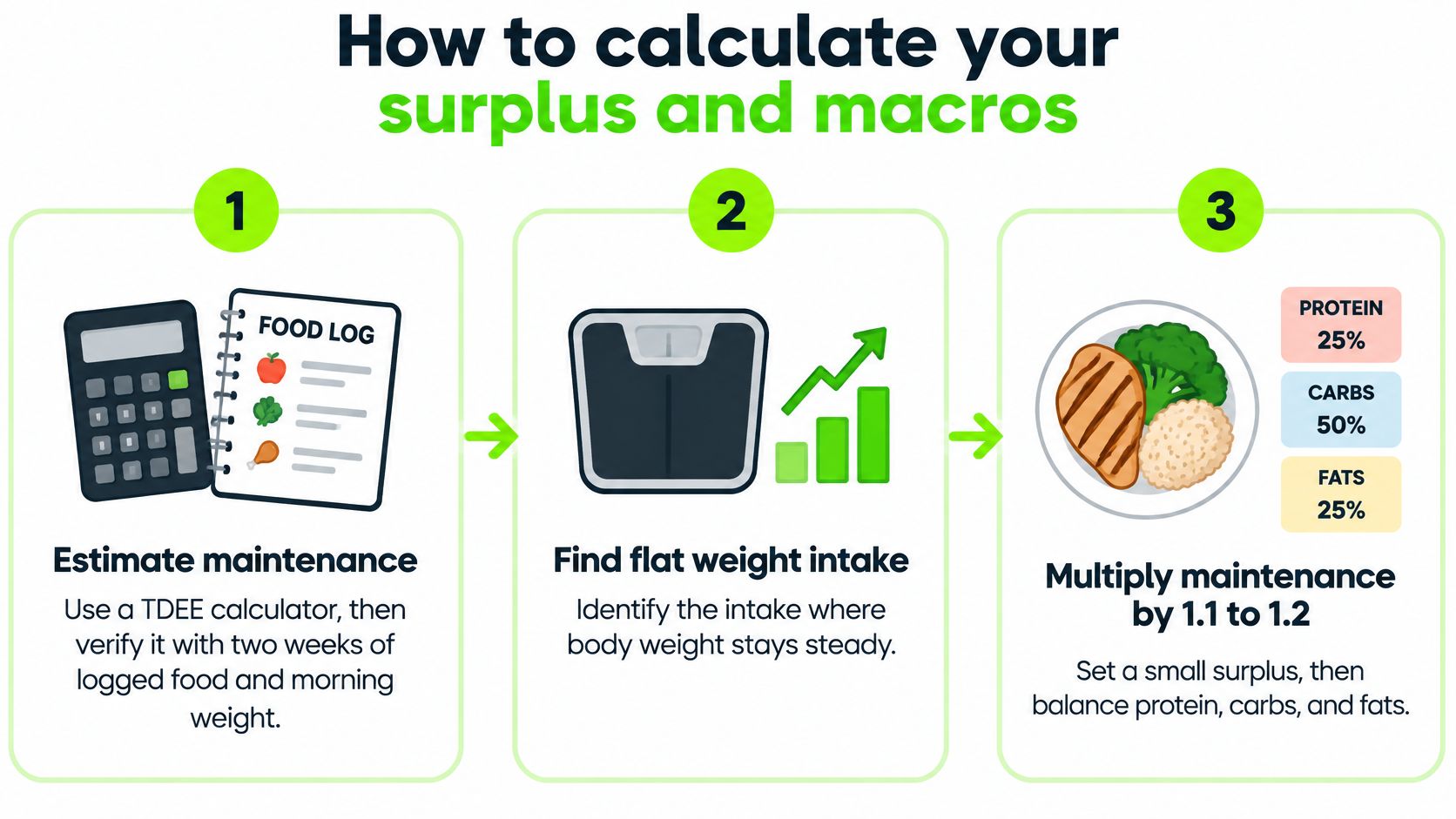
- Estimate maintenance. Use a total daily energy expenditure calculator. For a practical baseline check, log your usual food and morning weight for two weeks without deliberately overeating.
- Find the steady intake. Look for broadly flat average weight, not identical daily readings. Include oils, drinks, sauces, and weekend meals in your log.
- Apply a modest surplus. Multiply your maintenance estimate by the surplus factor appropriate to your experience. Treat the result as a testable starting point, not a permanent prescription.
- Set protein, then allocate fats and carbohydrates. The International Society of Sports Nutrition position stand places most exercising adults' protein needs at approximately 1.4 to 2.0 g/kg/day. The bodybuilding target used in the table sits above that lower benchmark.
A hypothetical macro calculation
Say an 80 kg lifter maintains weight at 2,800 kcal. Adding 15% gives 3,220 kcal, which they round to a workable 3,200 kcal target.
An illustrative allocation is 150 g protein, 80 g fat, and 470 g carbohydrate. Using conventional calorie accounting, that's 600 kcal from protein, 720 kcal from fat, and 1,880 kcal from carbohydrate. Fat supplies 22.5% of this example's calories.
These are example allocations, not universal macro requirements. Keep enough carbohydrate to support demanding sessions, and choose a fat intake that makes meals satisfying and sustainable.
For homemade meals, you can calculate meal calories with Recipe One, then divide the recipe by the portions you serve. Consistent portion accounting matters more than chasing a falsely precise calculator result.
How to structure training for muscle growth
Build your routine around repeatable work, not exhausting yourself whenever your calendar allows. A 2023 systematic review and network meta-analysis in the British Journal of Sports Medicine found a 95% probability that prescriptions involving at least two sets and two weekly sessions increased hypertrophy compared with no exercise.
That isn't proof that a tiny weekly set total maximizes growth. Use multiple working sets and repeated exposure, then adjust according to performance and recovery.
Four-day upper and lower split
| Day | Focus | Sample exercises |
|---|---|---|
| Monday | Upper body | Bench press, chest-supported row, lateral raise, cable curl |
| Tuesday | Lower body | Back squat, Romanian deadlift, leg curl, calf raise |
| Thursday | Upper body | Incline dumbbell press, lat pulldown, overhead press, triceps pushdown |
| Friday | Lower body | Leg press, hip thrust, leg extension, seated calf raise |
| Wednesday, Saturday, Sunday | Rest or easy walking | Recovery only |
For a busy schedule, an alternative is full-body training on Monday, Wednesday, and Friday. This sample session is a coaching starting point, not a research-tested prescription for every reader:
- Back squat: 3 sets of 6 to 8.
- Romanian deadlift: 3 sets of 8 to 10.
- Dumbbell bench press: 3 sets of 8 to 10.
- Chest-supported row: 3 sets of 10.
- Lateral raise: 3 sets of 12 to 15.
- Cable curl: 2 sets of 12.
Make progression measurable
Use moderate loads for most work. If strength is also a priority, an optional heavy top set around 80% of estimated one-repetition maximum can complement the routine. Enter a clean set of 5 to 8 repetitions into a 1RM calculator rather than testing a maximum.
Log sets using a consistent weight-training structure. Add a repetition or small load increase when you reach your target with controlled technique.
I'd usually leave one to three repetitions in reserve, reserving failure for selected final sets on suitable exercises. Budget roughly 45 to 60 minutes as a scheduling target, but don't rush compound-lift rests to meet the clock. Leave a recovery day between heavy sessions for the same muscles.
Meal examples and protein timing that fit a surplus
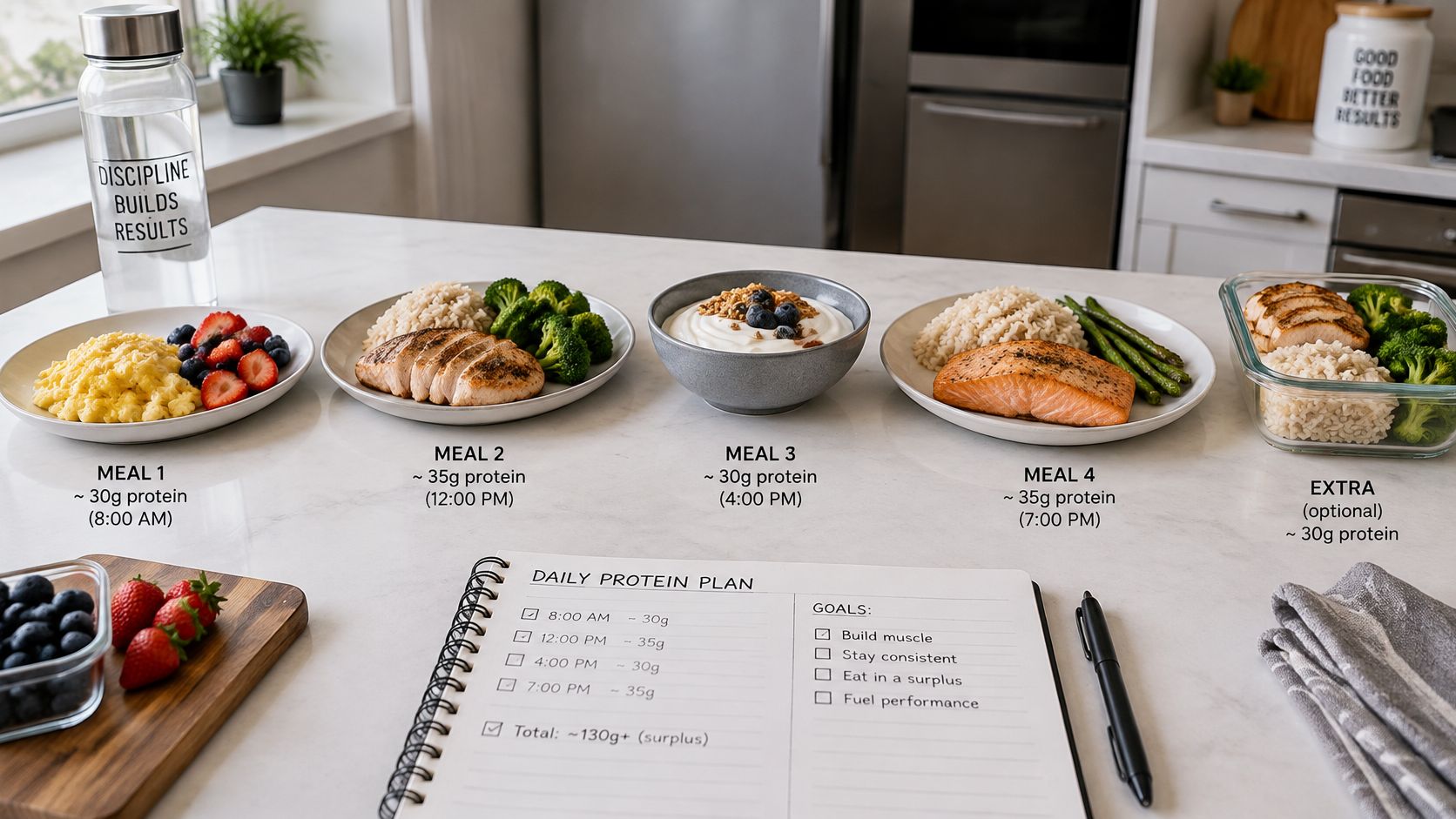
Choose a meal schedule you can repeat on an ordinary workday. Dividing protein across meals makes the daily target easier to manage, but eating more frequently isn't automatically better.
Protein per meal for an 80 kg lifter
These serving ranges divide the daily protein target across different meal counts. Food examples are approximate planning estimates, so check your product labels and whether weights are raw or cooked.
| Meals per day | Protein per meal | Example meal |
|---|---|---|
| 3 meals | 43 to 59 g | Chicken, rice, and vegetables, portioned to the target |
| 4 meals | 32 to 44 g | 180 g raw salmon fillet with potatoes and greens, about 36 g protein |
| 5 meals | 26 to 35 g | Three eggs with 150 g Greek yogurt and berries, about 33 g protein |
| 6 meals | 21 to 29 g | 120 g lean turkey mince in a wrap, about 25 g protein |
A hypothetical four-meal day could include:
- Breakfast: Three eggs, 150 g cottage cheese, and a banana, approximately 35 g protein.
- Lunch: About 130 g cooked chicken breast with 150 g cooked rice and vegetables, approximately 40 to 44 g protein.
- Pre-training snack: 300 g Greek yogurt, 50 g oats, and berries, approximately 36 g protein.
- Dinner: The salmon meal in the table, approximately 36 g protein.
Adjust the portions against labels rather than assuming every brand matches these estimates. Spread additional calories across meals instead of forcing most of your surplus into dinner.
Timing should fit your life
Place a protein-containing meal within a few hours before or after training. For plant-based options, Louisville Jerky Co.’s guide to vegan meal planning for muscle growth offers meal-planning ideas.
In a 2025 randomized study indexed by PubMed, resistance-trained men eating three meals daily gained 1.15 ± 1.54 kg of lean mass over eight weeks, compared with 0.63 ± 1.32 kg in the five-meal group. Those group results don't establish a universally superior meal count.
If food leaves you short of your protein target, use a shake as a fallback. Count it within your intake, not on top of an already adequate day.
Track progress and adjust a stalled bulk
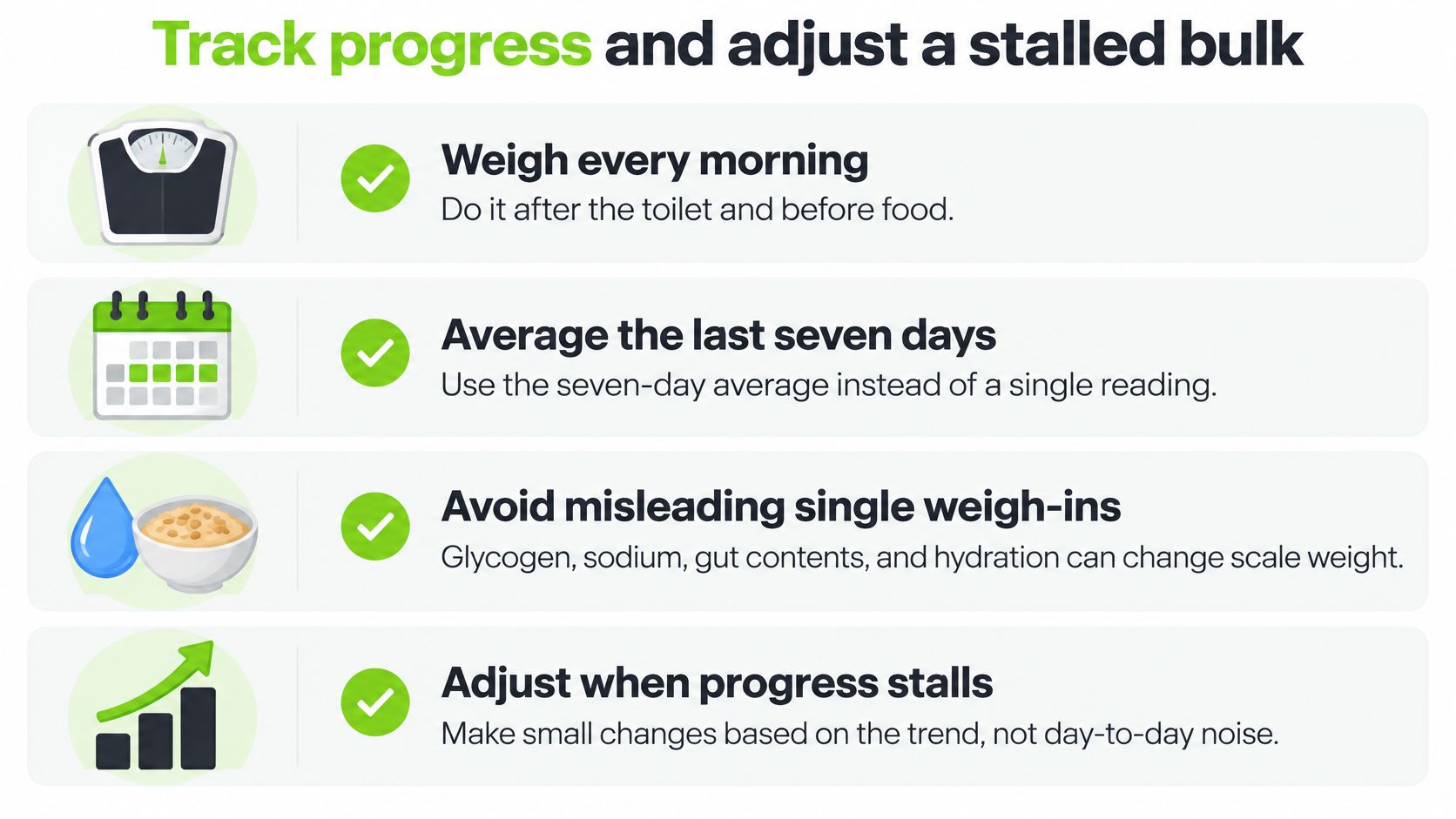
Weigh yourself every morning after using the bathroom and before eating or drinking. Keep the scale on the same hard surface and use comparable clothing conditions. Calculate a rolling average rather than reacting to whichever reading feels most encouraging.
The off-season bodybuilding nutrition review supports targeting approximately 0.25 to 0.5% weekly bodyweight gain, with more conservative control for advanced trainees. A practical implementation is to use seven-day averages and investigate a trend that remains flat for two consecutive weeks.
Use a small adjustment, then observe
Before adding food, check whether you've eaten the target. A missing lunch, unlogged restaurant meal, or different weekend routine can make the apparent surplus unreliable.
As a coaching adjustment, try adding 150 to 200 kcal daily after a confirmed stall. If the sustained trend exceeds the target range, remove a similarly small amount. These increments are practical starting choices, not a universally validated dose.
Lean bulk symptoms, likely causes and fixes
| Symptom | Likely cause | Fix |
|---|---|---|
| Rolling average flat for 2 weeks | Surplus too small or food logging incomplete | Audit intake, then add about 150 to 200 kcal daily if adherence is consistent |
| Weight rising over 0.5% a week | Surplus may be too large, increasing unnecessary fat gain | Confirm the trend, then reduce intake by about 150 to 200 kcal daily |
| Lifts stalled for 3 or more weeks | Volume, recovery, or sleep may not support progress | Check sleep and rest days first; add a rep or set only if recovery supports it |
| Sudden 1 to 2 kg jump overnight | Water, sodium, glycogen, or gut contents may explain the change | Don't classify it as tissue gain; watch the average |
| Sessions feel flat with low energy | Carbohydrate availability may be inadequate | Try moving carbohydrate-containing meals closer to training; also check sleep and total intake |
The overnight-jump row is an illustrative scenario, not a diagnostic rule. Unexpected weight changes accompanied by swelling, breathlessness, or other symptoms warrant medical advice rather than a calorie adjustment.
A scale trend tells you whether you're gaining weight. Your waist and training log help you judge whether the plan deserves to continue.
Make Sunday the decision day
Review the average, your top sets, and how sessions felt. Use a workout tracker or a simple notebook to compare the same exercises under similar conditions. Heavier weights don't represent progress if you shorten the movement or change technique to finish the set.
Take your waist measurement on the first Sunday of each month as a practical tracking habit. Measure at the same location, with the tape level and your abdomen relaxed, then read that monthly change alongside the weekly review.
If weight is rising gradually, lifts are improving, and your waist isn't expanding rapidly, keep eating the same amount. If weight and waist climb while performance stays unchanged, investigate training quality and recovery before celebrating the gain.
One unusual week rarely justifies a change. Keep a short note explaining each adjustment so you don't repeatedly add and remove calories in response to normal noise.
Mistakes that turn a lean bulk into a dirty bulk
A dirty bulk isn't defined by eating a burger. It's defined by abandoning control over intake while assuming extra bodyweight must mean extra muscle.
The Frontiers in Nutrition review of energy surplus and hypertrophy concludes that evidence doesn't establish a universally optimal surplus or justify obtaining it primarily from one macronutrient. That leaves room for preference, but not for unlimited eating.
- Treating protein as unlimited insurance. Once you're meeting your target, repeatedly adding shakes can crowd out carbohydrate-containing meals without fixing poor training. Keep the protein target stable and allocate food to support the whole session.
- Changing cardio without changing the plan. Adding demanding conditioning while expecting the same intake and recovery routine to work can undermine consistency. Keep activity reasonably stable, then account for deliberate changes.
- Saving every missed calorie for bedtime. A huge late meal can make digestion and food logging harder. Prepare a portable lunch or snack so catching up doesn't become your default.
- Confusing clean food with controlled intake. Nuts, oils, and oversized smoothies still contribute calories. Measure calorie-dense additions rather than estimating them by sight.
- Abandoning the plan too early. A quiet start isn't proof that you need an aggressive bulk. Check adherence and wait for a usable trend before making another change.
Change calories only after checking whether the weight trend and training performance support the decision.
Start your lean bulk this week
Launch with a baseline, not a shopping cart full of mass gainer. The first useful action is making your current routine measurable enough that later changes mean something.
Establish the baseline before adding food
During weeks one and two, estimate maintenance, begin the morning weighing routine, and log what you eat. Start the training schedule at manageable loads so you can learn the movements and record repeatable performances.
If the average is broadly stable, begin the surplus in week three. If your weight is already drifting, adjust the maintenance estimate before adding a deliberate surplus. Choose your meal pattern around your workday, commute, and training time rather than an ideal schedule you can't maintain.
During weeks four through eight, focus on execution. Complete the planned sessions, progress repetitions or load when technique allows, and use the Sunday review to decide whether anything needs changing.
Continue only while the plan earns it
During weeks nine through twelve, compare your waist trend, exercise performance, and average gain with your starting position. These weeks are a suggested review schedule, not biological deadlines.
Continue if the combination looks productive. Make a small intake adjustment if it doesn't, or spend a short period at maintenance if food fatigue, recovery demands, or life commitments make continued gaining impractical. A maintenance break isn't a special muscle-building trick; it's a way to make the next decision without forcing the bulk.
GrabGains is one option for organizing the training side through a personalized training plan. Pick Build Muscle, and we build your program around that goal, your equipment, and the days you can train. Our macro calculator handles intake arithmetic, while Muscle Zone Tracking turns logged sets into volume per muscle group; the app also includes 1RM and Hyrox calculators.
Calculators and apps support the decision. They don't replace checking whether your actual intake, recovery, and training trend justify continuing.
GrabGains offers goal-based workout planning and set tracking to help you give a lean bulk the consistent training it needs. Visit GrabGains, choose Build Muscle, and organize your next training block around your equipment and available days.
Get inspired and motivated