How to Gain Muscle Skinny Guy: A 12-Week Plan That Works
Want to know how to gain muscle skinny guy? Get protein targets, a 12-week lifting plan, calorie adjustments and simple progress checks.
You're eating bigger dinners, showing up at the gym, and checking your arms in the mirror. Then your weight drops overnight, your bench press feels worse, and you wonder whether anything's working.
For a skinny guy, learning how to gain muscle means replacing those daily guesses with a repeatable system. This twelve-week plan gives you a starting protein target, manageable training, and clear rules for adjusting food and workload. Expect gradual progress, not a guaranteed transformation by a deadline.
Starting Numbers Before Week One
Protein targets by body weight
Built for progress
Take the guesswork out of training
Get a personalized workout plan built around your goal, equipment and schedule. Train smarter, track every rep and keep moving forward, one workout at a time.






| Body weight | Protein at 1.6 g/kg | Range at 1.4-2.0 g/kg | Per-meal dose at 0.25 g/kg |
|---|---|---|---|
| 55 kg | 88 g | 77-110 g | about 14 g |
| 60 kg | 96 g | 84-120 g | about 15 g |
| 70 kg | 112 g | 98-140 g | about 18 g |
| 75 kg | 120 g | 105-150 g | about 19 g |
The daily target column uses 1.6 grams per kilogram, a level associated with significant lean-mass benefits in younger adults doing resistance exercise in a systematic review and meta-analysis of protein intake. The range and per-meal columns are calculated from the International Society of Sports Nutrition position stand, which recommends 1.4-2.0 g/kg daily for most exercising individuals and identifies approximately 0.25 g/kg per feeding as a practical dose.
Read the 60 kg row as a starting point, not a rigid prescription. Aim near its daily target, and treat the meal figure as a useful reference rather than a ceiling. Eating that small meal dose at every meal won't necessarily add up to your daily requirement.
Record your baseline
Use this opening-week checklist:
- Body weight: Weigh every morning after using the bathroom, before eating. Average the seven readings.
- Measurements: Record waist, chest, and upper-arm circumference at clearly identified points.
- Working loads: Record your squat, bench press, row, and overhead press loads using controlled sets in the planned rep range.
- Normal eating: Note which meals contain a substantial protein source.
A single weigh-in includes changes in hydration and food still being digested. An average gives you a more useful comparison.
Save everything in a notes app or spreadsheet. Your week-four review needs a baseline, not a memory of how you looked.
How to Build Your First Lifting Week
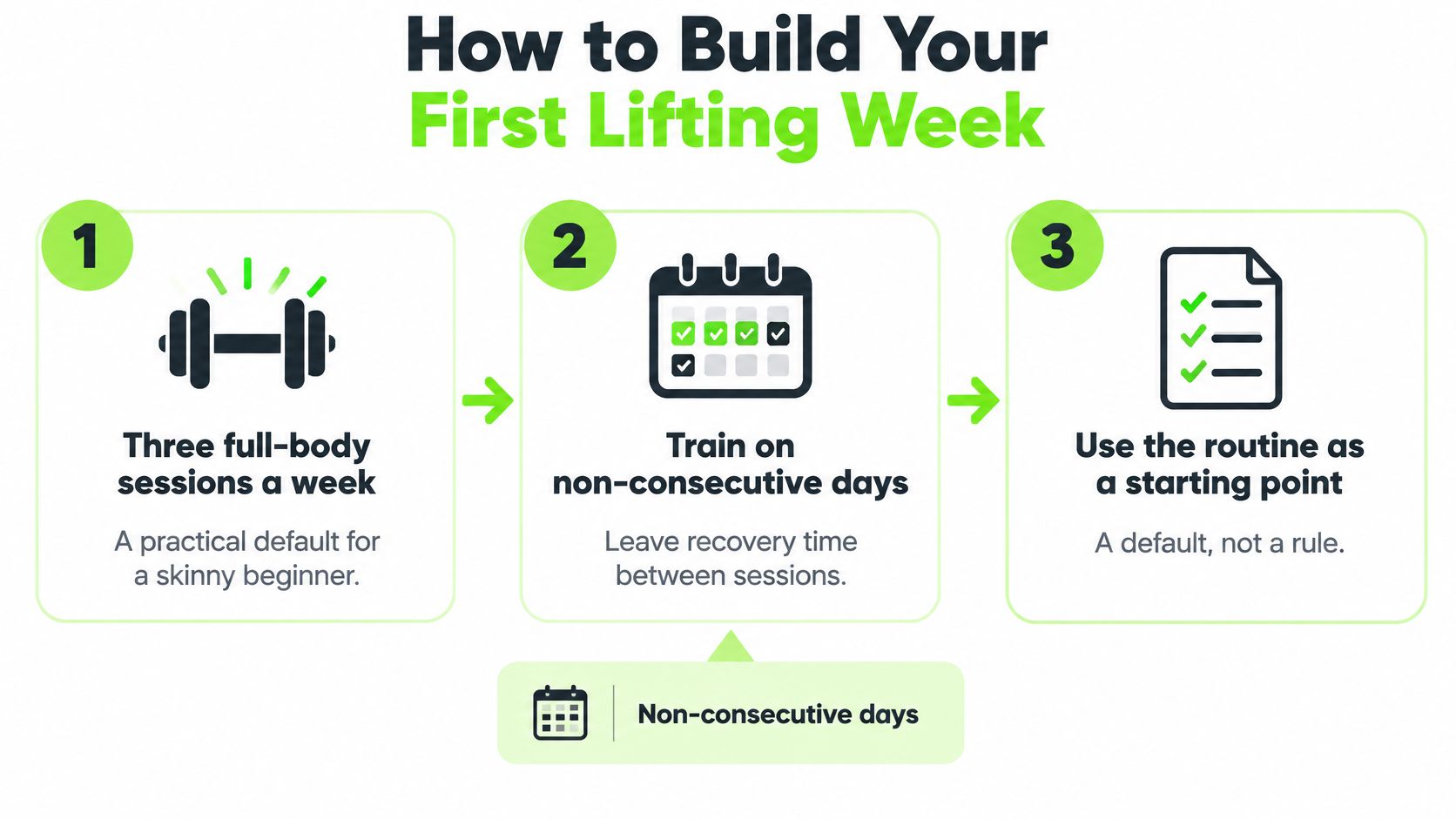
I'd start with three full-body sessions on non-consecutive days, such as Monday, Wednesday, and Friday. That's a practical default for this example program, not a requirement to organize your life around the gym.
Use stable exercises you can repeat with confidence. Beginners should start with fundamental movements, then introduce more complex exercises gradually as strength and confidence build, with proper form ahead of heavy weights.
Your session checklist
The following set counts are an example starting prescription. The 8-12-rep range and stopping with one to two repetitions in reserve are practical novice guidelines discussed in the ACSM review of resistance training to failure.
Warm up with two light sets of your first lift. Rehearse the movement before adding your working weight. Don't turn the warm-up into a tiring workout or assume your later exercises need no preparation.
Start with a squat or leg press for two to three working sets. Choose the version you can control through a comfortable range of motion. The usual mistake is adding weight before you can repeat the same depth and position.
Pair a push with a row for two to three sets each. Use push-ups, dumbbell presses, or a machine chest press alongside a supported row. Alternate exercises if convenient, but don't rush your rest so much that the next set becomes weaker than planned.
Add a hip hinge, such as a Romanian deadlift, for two to three sets. Practice moving your hips backward while keeping the weight close. Stop the descent before you have to round your back to reach farther.
Finish with a plank and a single-arm exercise. A single-arm cable press or dumbbell curl lets you practice control without adding another demanding compound lift. Don't twist through the repetition just to move more weight.
Finish working sets with technically sound repetitions left. The final repetition can be challenging without becoming a grind. End the set when your next repetition would require bouncing, shortening the movement, or changing position.
Use the weight-training guide when choosing movements you can perform with your available equipment.
A completed session isn't measured by exhaustion. It means you logged every working set, stayed inside your intended rep range, and used form you can reproduce next time.
Weekly Sets and When to Add Weight
Weekly sets and rep ranges by training phase
This is an example progression, not a research-tested schedule you must advance through on exact dates.
| Phase | Weeks | Hard sets per muscle per week | Rep range | Main risk |
|---|---|---|---|---|
| Foundation | 1-3 | 6-8 | 8-12 | rushing technique before the pattern feels automatic |
| Build | 4-7 | 10 | 8-12 | adding sets and load in the same week |
| Push | 8-12 | 12-14 | 8-12 | poor recovery from accumulated fatigue |
A hard set is a working set that challenges the intended muscle while your technique stays consistent. Warm-ups don't count toward this target.
The broad direction is supported by a systematic review of training volume and hypertrophy: higher weekly volume generally produces more growth than very low volume, with approximately 12-20 weekly sets per muscle identified as an effective range for young, trained men. That population isn't the same as an untrained beginner, so there's no reason to start at its upper end.
Earn the next increase
For this example program, once every prescribed set reaches the top of the range cleanly with repetitions left, try adding 2.5 kg to an upper-body lift or 5 kg to a lower-body lift. Those are coaching increments, not mandatory jumps. If the increase spoils your form or pushes you below the range, use smaller plates or add repetitions before increasing resistance.
Distribute your work rather than cramming it into a marathon session. The ACSM resistance-training guidance identifies approximately 10 weekly sets per muscle as a useful hypertrophy target and recommends training major muscle groups at least twice weekly.
Progression rule: Change one variable at a time so you can tell whether it helped.
The common trap is adding sets and load together because the calendar says you've entered a harder phase. Hold your workload when performance or recovery slips.
Keep your own record even when using an AI coach. Useful entries include load, repetitions, exercise setup, and whether the final repetition stayed controlled.
How to Eat for a Lean Surplus
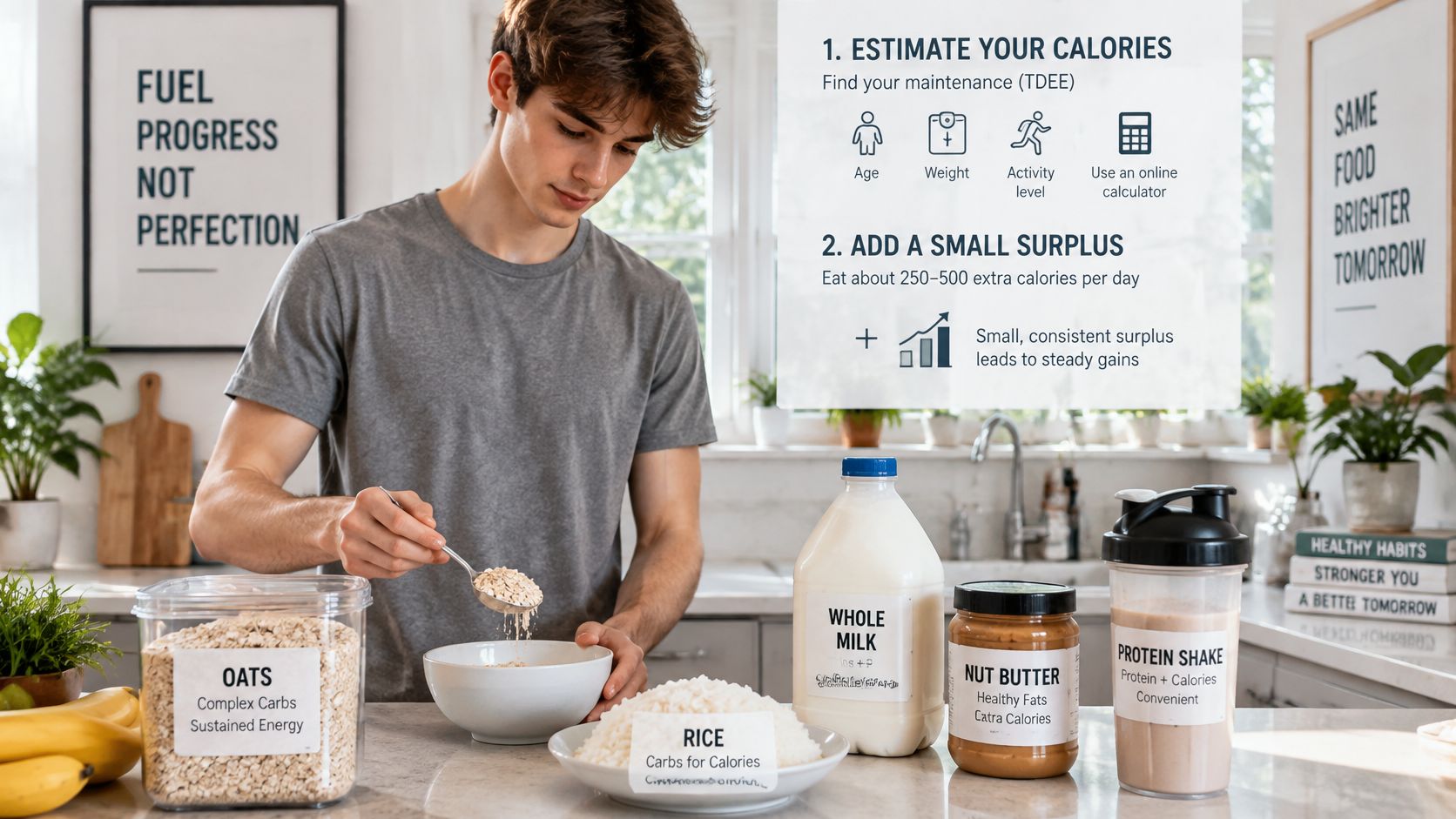
Find your maintenance intake before adding food. As a practical baseline exercise, eat your usual amount for two weeks while recording intake and averaged body weight. If the average holds steady, that intake is your working maintenance estimate.
The UK National Health Service guidance on healthy weight gain recommends adding approximately 300-500 calories daily for gradual adult weight gain. Treat that as a starting adjustment, not a universal prescription, because needs vary with body size, activity, age, and sex.
Use foods you already tolerate: oats, rice, whole milk, nut butter, or a homemade shake. Adding something predictable is easier to adjust than deciding to eat everything.
Adjust the trend, not yesterday's weight
Use this example adjustment loop:
- Collect consistent weigh-ins. Calculate an average for each week rather than reacting to individual mornings.
- Allow a comparison window. Review the trend after two to three weeks of reasonably consistent eating.
- If the average stays flat, add a small amount. An example adjustment is another 150-250 calories daily from a repeatable snack.
- If weight rises quickly alongside your waist, reduce the addition. Don't keep increasing food because you're naturally thin.
A realistic day of eating
Start with oatmeal, milk, and banana. Have a chicken-and-rice bowl for lunch, Greek yogurt with nuts as a snack, and salmon with potatoes for dinner.
A milk or casein shake before bed is optional if you're short of your daily total. Portion the protein-containing foods around your target, using the per-meal table as a reference rather than forcing every meal to be identical.
If convenience is the obstacle, a flavored whey isolate supplement from Supplemynts Inc. is one product format to compare by serving information, ingredients, and cost. You don't need it if ordinary meals already cover your needs.
This is general nutrition information, not medical advice. We provide general fitness and training information only, not a medical service. Speak with a doctor or dietitian before adding calories if you have a medical condition or an eating concern.
A 12-Week Routine You Can Repeat
Say you begin with manageable loads and a schedule you can keep. Your task isn't to collect exercises. It's to make familiar movements more productive without exceeding the weekly workload you can recover from.
The blocks below are a worked example. Their dates guide your review, but your performance determines whether you advance.
Three-block routine for weeks 1-12
| Block | Weeks | Sessions per week | Exercises added |
|---|---|---|---|
| Block 1 | 1-3 | 3 full-body | Week-one routine, unchanged |
| Block 2 | 4-7 | 3-4 | incline press, lat pulldown, walking lunge, seated leg curl, standing calf raise |
| Block 3 | 8-12 | 4 upper/lower | chest fly, dips, leg press, face pull, triceps extension, seated calf raise |
Establish the movements, then broaden the routine
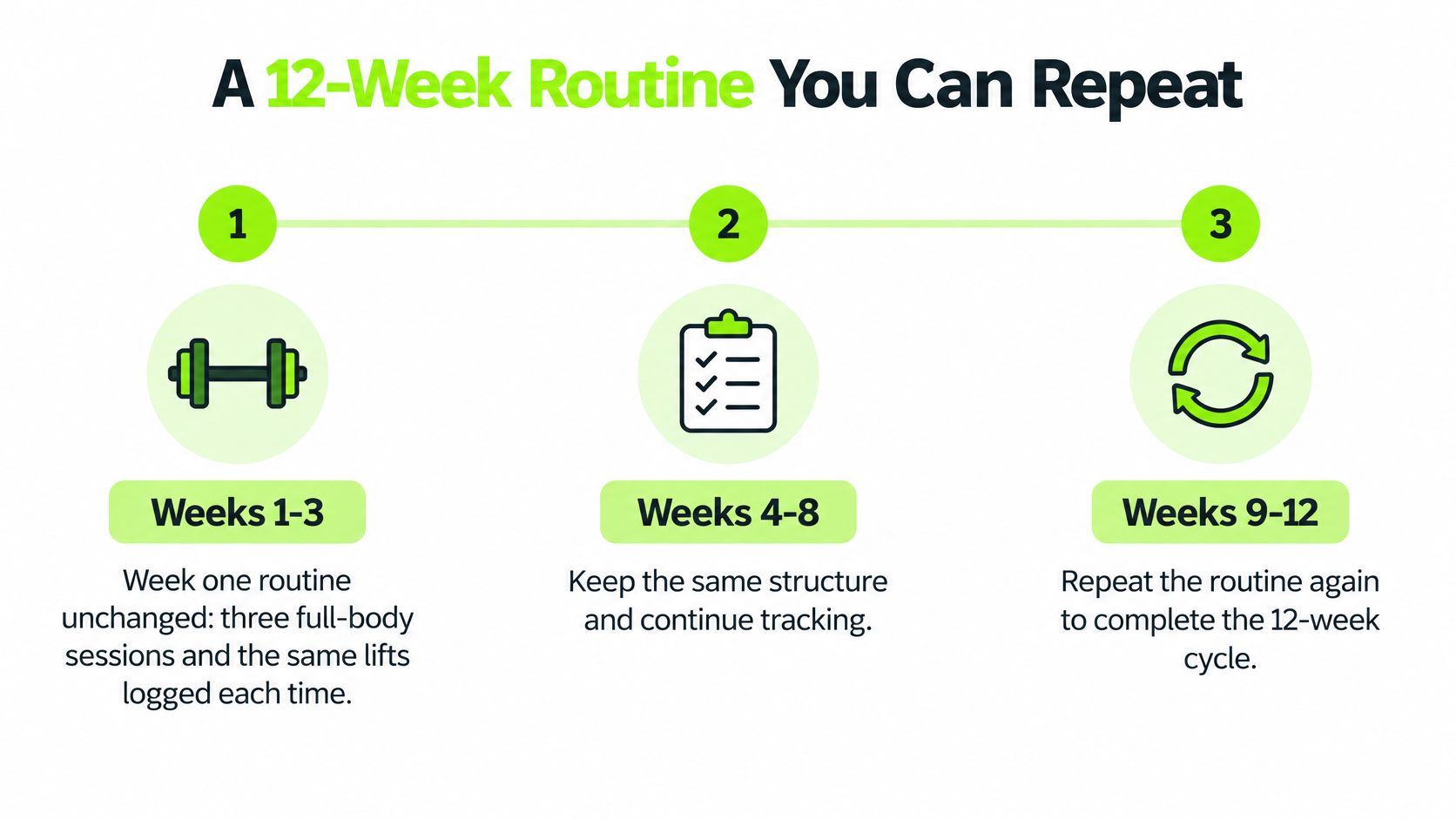
Block 1 keeps the opening routine unchanged. Repeat the same exercise versions, machine settings, and order so your log compares like with like. Start at the lower end of the set prescription rather than automatically choosing the maximum.
Block 2 adds variety selectively. Use incline pressing as an alternative push and lat pulldowns to introduce vertical pulling. Walking lunges, seated leg curls, and standing calf raises fill gaps in lower-body work.
These additions aren't instructions to stack every new movement onto every session. Replace some existing work or distribute the exercises across training days while staying within your planned set totals.
For example, suppose your incline press reaches 30 kg for 10 repetitions on every prescribed set with clean form and reserve. A later attempt at 32.5 kg for 10 is a reasonable next step in this hypothetical log. If that attempt becomes unstable, keep practicing at the earlier load instead of calling the workout a failure.
Organize the harder block
Block 3 uses an upper/lower schedule: upper body, lower body, rest, upper body, lower body. This creates room for more targeted work without making every workout longer.
Chest flyes and triceps extensions can supplement pressing. Face pulls provide a lighter pulling option, while leg presses and seated calf raises fit lower-body days. Dips are optional, and assisted dips or another press are better choices if you can't control the movement comfortably.
Add exercises to solve a programming gap, not because a longer workout looks more serious.
Keep exercise order stable within each block. At the end of this example's twelve weeks, repeat Block 3 for another four weeks if performance is still improving and recovery is manageable. If several lifts have stalled and fatigue remains high, return to the simpler opening structure with starting loads that reflect your improved ability.
Recovery, Sleep and Optional Supplements
Your workout provides the stimulus. Your time between sessions is when you need enough food and rest to adapt.
For this plan, I'd reserve roughly seven to nine hours in bed as a practical sleep target, then adjust your routine around how rested you feel. Don't keep adding gym work while repeatedly cutting sleep short.
Build a recovery routine
- Keep a consistent bedtime and wake time. Make room for sleep before filling your evening with optional tasks.
- Prepare protein-containing meals ahead. A packed lunch or ready-to-eat yogurt helps prevent a busy day from becoming an underfed one.
- Take an easy walk on rest days. Keep the effort comfortable rather than turning recovery into another demanding workout.
Preserve the rest days in your schedule. As a conservative coaching rule, take an easier week if soreness lasts beyond three days, especially when it changes your movement.
For additional ideas to compare with your routine, browse the recovery advice from MEDISTIK. Don't use recovery products to push through sharp pain or worsening symptoms.
Supplements stay optional
Whole food comes first. Protein powder is a convenience for covering a shortfall, not a requirement.
Creatine is another optional supplement, but it doesn't replace training, food, or sleep. Check with your doctor before starting supplements or adding calories if you have a medical condition.
Track Progress and Fix a Stall
Use your weekly average as the decision point. Weigh each morning under similar conditions, average the readings, and assess the overall plan over six to eight weeks, an evaluation window described in the ACSM resistance-training progression guidance.
For intentional weight gain, an eight-week study of trained lifters comparing energy surpluses recommended targeting approximately 0.25-0.5% of body weight weekly, which calculates to about 0.18-0.35 kg for a 70 kg person. That's a body-weight trend, not a promise that the added weight will all be muscle.
Read the signals together
For this example tracking schedule, measure your waist, chest, and upper arm every two weeks. Take photos every four weeks using the same light, distance, clothing, and pose.
Log load and repetitions for every working set, plus any meaningful change in technique or equipment. A heavier row performed with a shorter movement isn't a clean performance improvement.
If weight rises while lifts remain flat, check whether your surplus is excessive, your effort is too low, or fatigue is masking performance. If lifts improve while the scale stays flat, you're progressing, but you may need more food if gaining body weight remains the goal.
Decision filter: Confirm a pattern before fixing it. A single bad workout isn't a stalled program.
Choose one fix first
Use this troubleshooting table as a set of coaching responses, not a diagnosis.
Stalled progress: symptom, cause and fix
| Symptom | Likely cause | Fix |
|---|---|---|
| Scale flat for 3 weeks | calories too low | add a calorie-dense snack or shake for 2 weeks |
| Weight up 1 kg in a week | water and glycogen, or surplus too large | ignore the single week and check the 2-3 week average |
| Lifts stall for 2 sessions | too much work or short sleep | hold the load and cut one set per muscle for a week |
| Soreness lasts 3+ days | jumped to a harder phase too fast | return to the previous phase for one week |
Except for pain or other concerning symptoms, give yourself two to three weeks of consistent records before making a major change. Then change one variable during a two-week review window so you can judge the result.
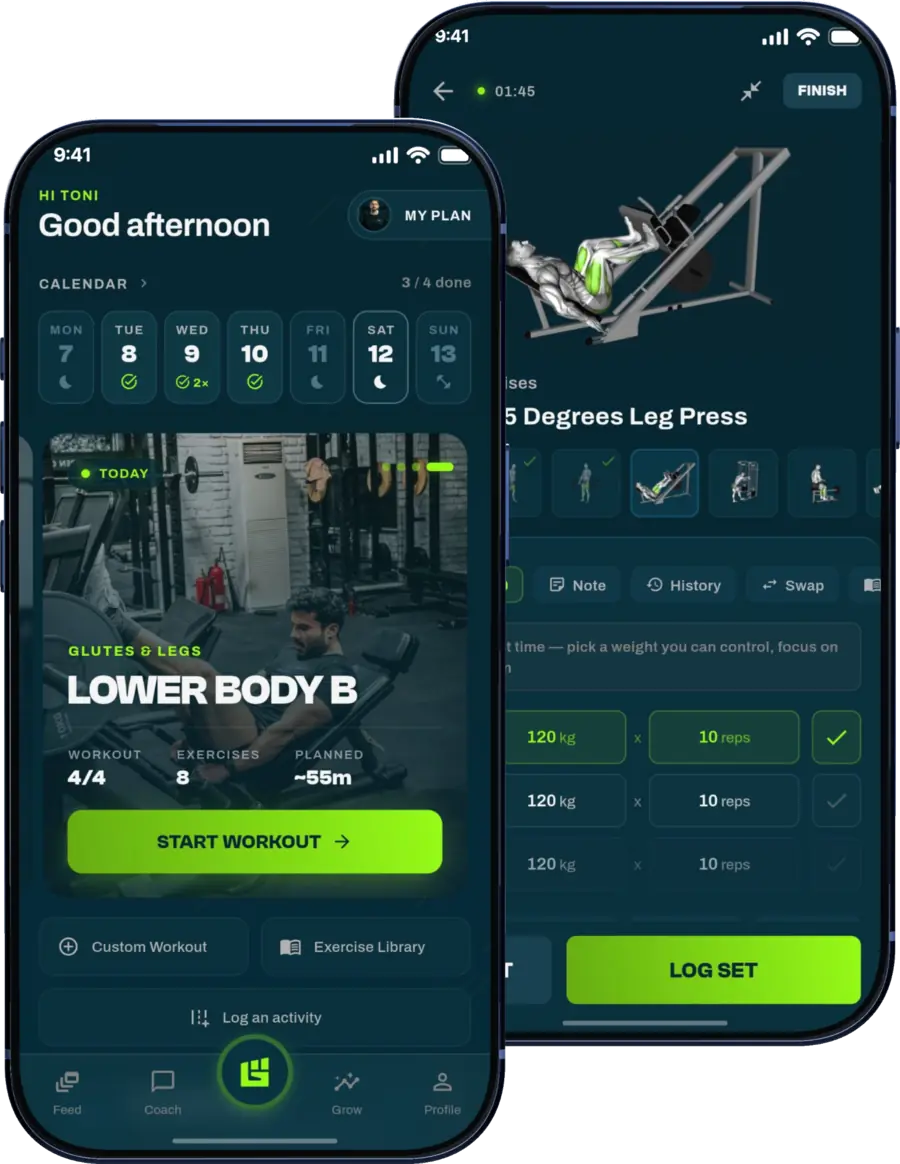
Our workout tracker supports that recordkeeping: you can log sessions from a Wear OS or Apple Watch app, which sends them to the GrabGains phone app and saves them to your account. Choose Build Muscle from the available goals, alongside Lift Heavier, Get Lean, and Lose Weight; your program can be built around your equipment and training days and adjusted as performance changes. Grow shows sets per muscle against your weekly target, while Muscle Zone Tracking turns logged sets into muscle-group volume.
Consistency beats perfection. A missed week means resuming with appropriate loads, not discarding every useful habit you've built.
GrabGains builds training around your goal, equipment, and available days, helping you organize a muscle-gain plan you can sustain. Visit GrabGains, pick a start day this week, and log your first session.
Get inspired and motivated