Gym Notebook vs App: Which Should You Use
Gym notebook vs app: a clear, practical guide to choosing how you log workouts, with scenarios, pros and cons, and when a hybrid workflow works best.
You're at the rack, bar loaded, sweat drying on the knurling, and your last set is already slipping out of your head. You've got two choices. Flip back through a notebook for last week's numbers, or tap open an app and let it show you what happened last time on this exact lift. That split-second decision matters more than people admit, because progress lives or dies on what you record, not on which tool looks cleaner.
| Criterion | Paper notebook | Workout app |
|---|---|---|
| Entry speed | Very fast for a simple session | Fast if the interface stays simple |
| History access | Manual, page by page | Exercise history appears on screen |
| Progression feedback | You calculate it yourself | Suggestions can appear during the workout |
| Volume analysis | Manual math only | Volume can be organized automatically |
| Offline reliability | Always available | Depends on the specific app's design |
If you want a wider training context while you think through your logging setup, the Vitamin Planet exercise guide is a decent place to sanity-check the basics. But the question here is simpler, which format helps you track the right details consistently?
The Notebook and the Phone at the Same Bench
A lifter finishing a heavy bench set usually isn't choosing between philosophy and technology. They're choosing between speed and recall. One tool is sitting in the gym bag, cheap, plain, and waiting. The other is sitting in a pocket, ready to show history if the log is set up well.
Built for progress
Take the guesswork out of training
Get a personalized workout plan built around your goal, equipment and schedule. Train smarter, track every rep and keep moving forward, one workout at a time.






The comparison gets muddied when people talk about paper and apps like they're two brands of the same thing. They're not. A notebook records what you choose to write down. A workout app can connect the current set to past sessions and surface that history while you're still training. That difference changes the quality of the data, not just the convenience.
A good exercise routine guide can tell you what movements to do, but it won't save you from logging them badly. If you skip rest times, forget effort level, or mix warm-up sets into work sets, both formats lose value. The winner is the tool that captures the session well enough to guide the next one.
Practical rule: if your log doesn't help you beat last time without mental math, it's not doing enough.
That's why this comparison should be judged by what gets tracked correctly. Not what feels old-school. Not what looks advanced. What helps you train better next week, and next month.
What a Paper Notebook Actually Does Well
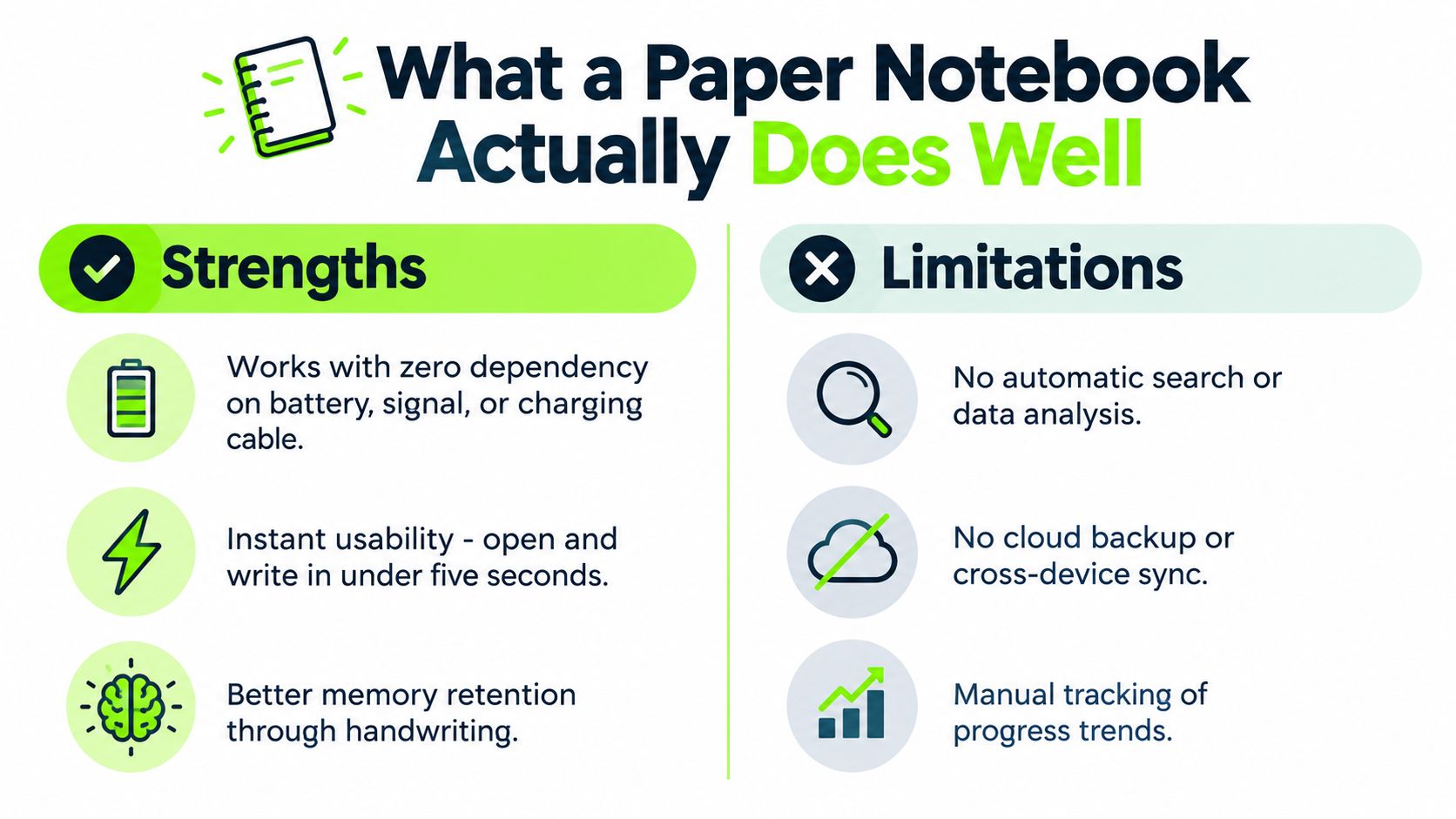
A notebook earns its keep because it's brutally simple. It needs no battery, no signal, no charging cable, and no login screen between you and your set. If you only train a few fixed movements and don't care about long-term analysis, that simplicity is real value. It's also cheap, which matters more than people want to admit when they just need something that works.
That simplicity has another upside, you can keep your phone out of your hand between sets. For some lifters, that alone improves focus. A handwritten log also fits the basic behavioral point from the research, the value comes from consistent self-monitoring, not from paper itself systematic-review evidence. The notebook is just the container.
A good physical log also satisfies the instinct to write fast and move on. You can note the exercise, the weight, and the reps without wrestling with menus. If you want a notebook that feels easy to keep in the gym bag, CITYSHEEP writing notebooks are the kind of practical option people buy for exactly that reason.
The weakness shows up a few weeks later. Many lifters write weight and reps, then forget the things that make old entries useful. Rest times, perceived effort, and whether a set was a warm-up or a working set often disappear. That's a problem because a heavier set with longer rest isn't the same as a real performance jump.
A notebook stores the number. It doesn't interpret the number for you.
The other limitation is slower comparison. Paper can absolutely hold a training history, but it can't surface last week's exact bench entry without flipping pages. It also can't calculate training volume per muscle group. That's fine if your plan is simple. It's a real bottleneck once you want to manage progression across months instead of just surviving each session.
What an App Adds That Paper Cannot
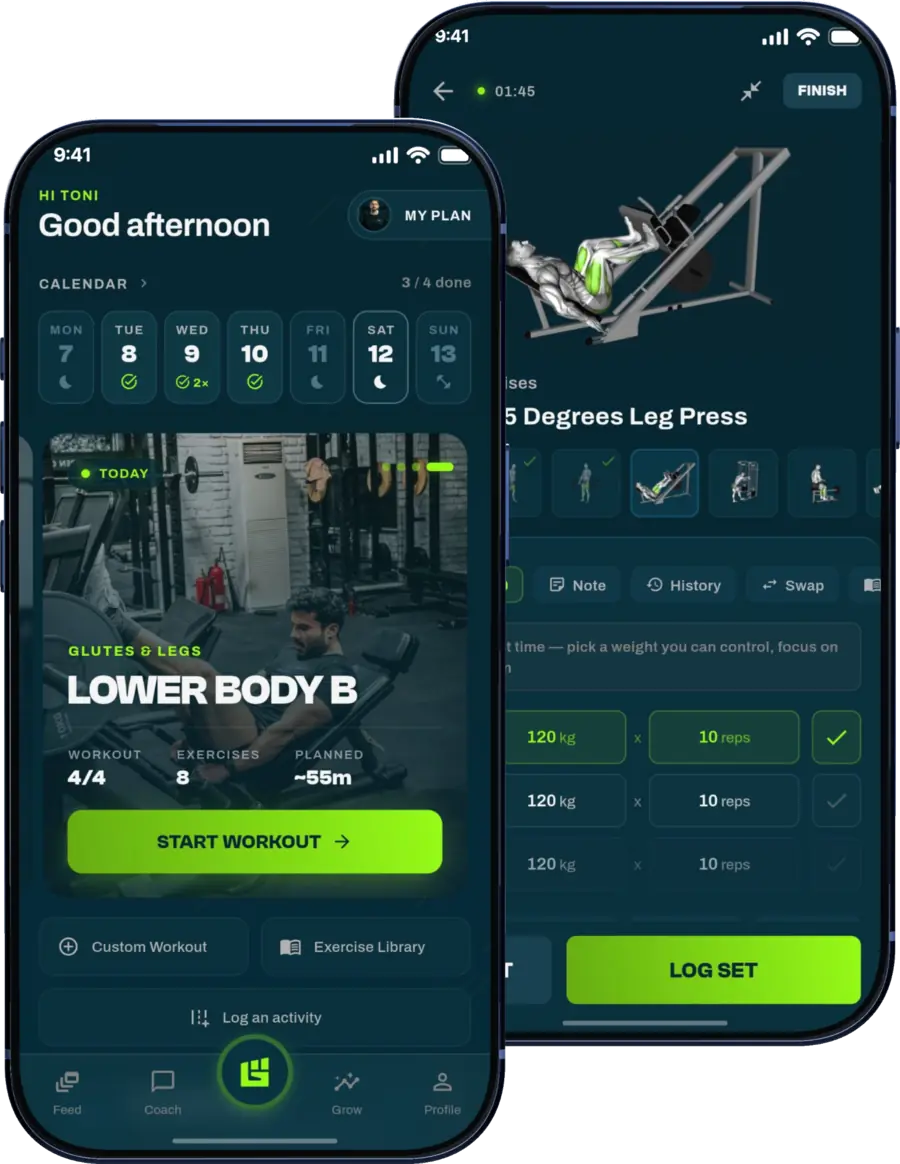
An app earns its keep when it attaches exercise-linked history to the lift you are doing right now. Open the workout tracker, and last session's numbers are already in front of you. No flipping through pages, no guessing, no rebuilding your memory between sets. GrabGains' workout tracker is built around that idea, and its AI coach uses the same log to keep the next decision tied to the work you already did.
That is what makes progression easier to manage. If the app shows your last load and reps, it can surface the next target instead of making you reconstruct it mid-session. That is the practical side of progressive overload. If you want the principle spelled out clearly, the progressive overload guide covers it well.
Apps also remove the small math and memory jobs that slow lifters down. A good log can flag personal records, estimate one-rep max, and show those numbers without making you do the arithmetic yourself. If you want a quick reference for that estimate, the one-rep max calculator shows the same calculation you would otherwise try to hold in your head.
Muscle Zone Tracking is another real advantage. Paper can tell you what you lifted. It cannot show whether chest, back, legs, or shoulders are getting enough training volume over time. An app can group that volume by muscle group, so weak spots stop hiding behind a pile of handwritten sets.
The quiet win is the rest timer. Without it, rest stretches or shrinks, effort gets sloppy, and two sets that look identical on paper may not be comparable. An app keeps the timer attached to the session, so rest stays consistent instead of becoming a guess.
Digital tracking still needs judgment. Automated numbers should help you spot patterns, not replace your eyes when a set looks off, which is the same caution echoed in the validation study.
A Side-by-Side Look at the Two Formats
| Criterion | Paper notebook | Workout app |
|---|---|---|
| Entry speed | Very quick for straight set-and-rep logging | Quick when the interface is clean |
| History access | You have to search old pages | Past performance shows up during the workout |
| Progression feedback | You infer it yourself | Suggestions can appear automatically |
| Volume analysis | Manual and slow | Organized by muscle group |
| Offline reliability | Always there | Depends on the app and setup |
The split is not style, it is what gets tracked correctly. A notebook records what you write in the moment. A workout app keeps the context attached to the lift, so you can see past performance in the fitness tracker view while the session is still live. That matters more than a polished layout.
Warm-ups, rest, and effort are where the gap shows up. Paper can capture them if you are disciplined, but it does not help you compare them cleanly from one session to the next. An app makes those details easier to keep with the set, so the numbers stay usable instead of turning into a pile of separate notes.
The notebook remembers what you wrote. The app remembers what you did on that exact exercise.
That is why a notebook still makes sense for very simple training. If the workout is so basic that you do not need live comparison, paper stays honest and fast. Once you care about whether a lift is stalling, whether rest times are drifting, or whether your warm-up work is consistent, the app is the better tool because it keeps the right information attached to the set.
Who Should Use Which and When
A beginner on a simple full-body program two days a week can start with a notebook. If the whole routine is squat, press, row, and a couple of accessories, paper is enough to build the habit. The trigger to switch is obvious, once you start wondering whether last week's session was heavier, easier, or just longer rest, the notebook stops being efficient.
A busy professional training at odd hours should use an app. They need the next set's target visible without hunting through old entries, and they usually don't have time to reconstruct a whole session from memory. The signal to move on from paper is when the workout log starts living in your head between meetings because the page isn't telling you enough.
A hypertrophy-focused lifter should also lean app-first. Weekly volume distribution by muscle group is too important to leave to guesswork, especially when growth depends on more than just whether a lift felt hard. If you care about whether delts, lats, or quads are getting enough work, the app is the cleaner tool. The switch point is when your notebook can't answer, fast, “what did I train too little this week?”
A minimalist who trains the same five movements for years can stay with paper. If the pattern never changes and the goal is to show up, a notebook is honest and low-friction. The trigger to upgrade is when you start wanting monthly comparisons instead of just today's numbers.
The one case where a paper notebook still has a real edge is distraction. If your phone keeps pulling your attention between sets, the notebook stays in the gym bag and keeps the session clean. For people who only need a few fixed lifts and don't care about long-term analysis, that's enough.
A Quick Decision Checklist
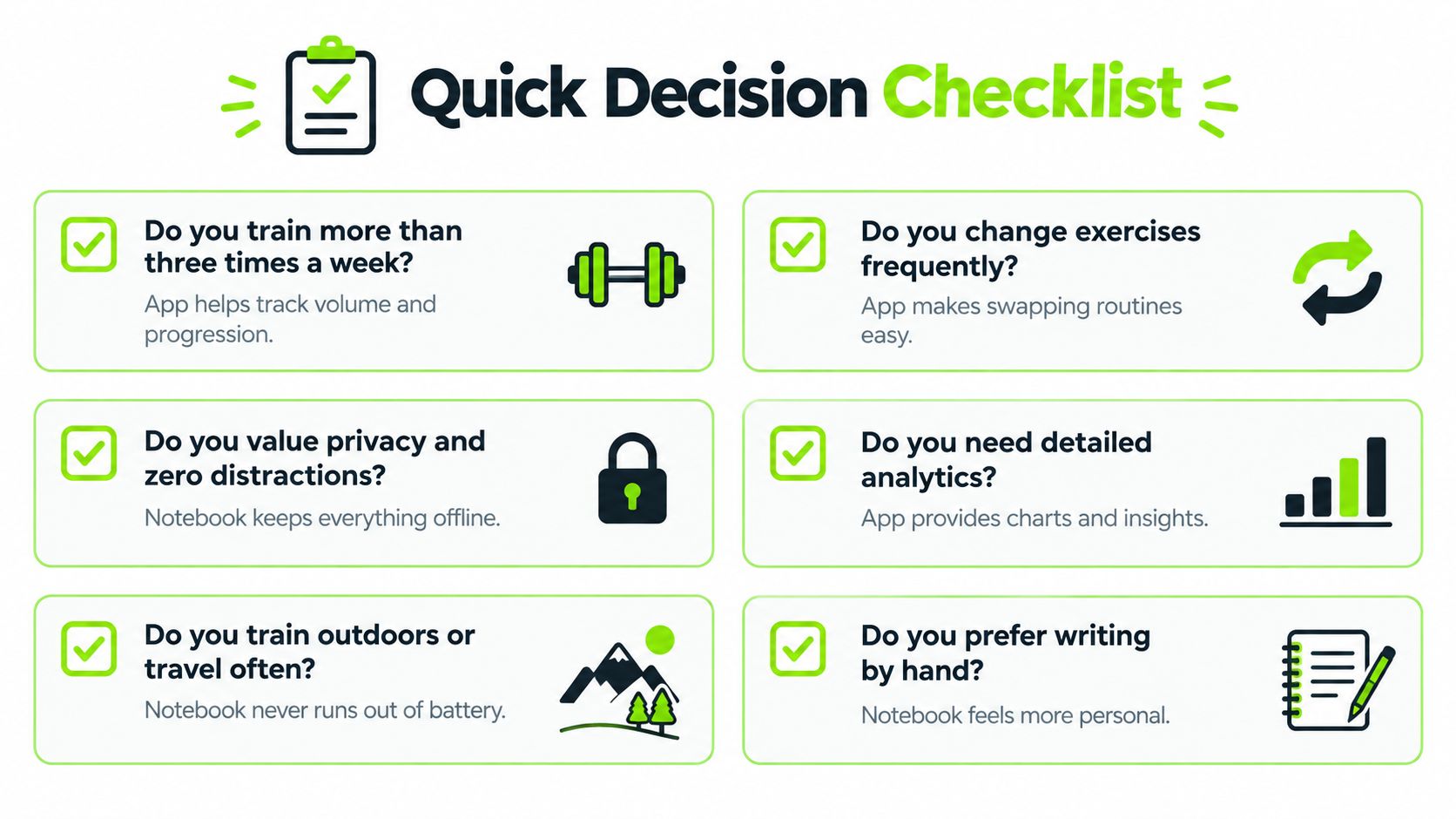
- Do you train more than three times a week? If yes, use an app, because volume and progression get harder to track by hand.
- Do you change exercises often? If yes, use an app, because history tied to each exercise matters more when the routine moves.
- Do you care most about privacy and zero distractions? If yes, use a notebook, because it stays offline and stays out of your way.
- Do you want detailed analytics or muscle-group volume? If yes, use an app, because paper won't organize that for you.
- Do you train outdoors or travel a lot? If yes, lean notebook, because it never needs power, signal, or a compatible device.
- Do you write down rest times and effort consistently? If no, switch to an app or a hybrid, because that's where old logs start lying to you.
If you need a one-line answer, here it is. Notebook for simplicity, app for progression, hybrid for people who want both.
Hybrid Workflows and Migrating From Notebook to App
A hybrid setup works for a lot of lifters. Write the session in the notebook when the gym is busy, then let the app hold the running history that shapes next week's decision. The notebook keeps logging fast in the moment, and the app keeps the record usable later.
If you want to move over cleanly, do it in three steps. Photograph the old notebook pages or transcribe the last four weeks of working sets. Match those lifts to a starter template that mirrors your current routine. Then run both systems side by side for two weeks so the history builds before the notebook retires.
That keeps you from losing the context you already earned. It also stops the common mistake of switching tools and resetting your training brain at the same time. If you want a practical look at how gym software is built around this kind of logging and tracking, the gym app development guide is worth a look.
The real question is simple, what did you do last time, what should you do now, and are you recovering? GrabGains' workout tracker is one way to keep that history in one place while keeping the session itself simple. The part many lifters ignore is the minimum data the app needs to adjust training, and whether you can still control it without letting the tool run the workout for you.
Get inspired and motivated