Bench Lat Stretch
Reviewed by Tim Renting, Physiotherapist
The Bench Lat Stretch is a mobility exercise that opens up your lats and the side of your torso, helping you move and reach more freely overhead.

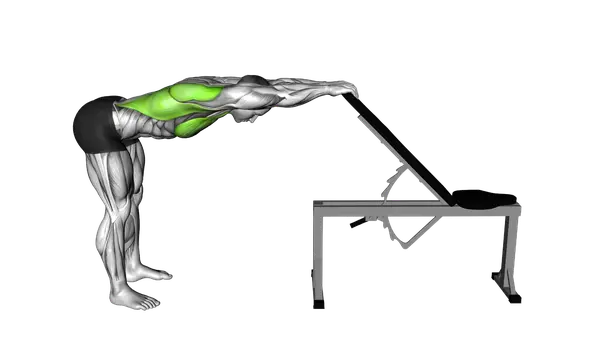
Bench Lat Stretch
Muscles Worked: Bench Lat Stretch
The Bench Lat Stretch mainly lengthens your lats, especially the side of your torso that gets tight from pulling movements, sitting, or carrying heavy loads. Your teres major is involved too, since it works closely with the lats to pull your arm down and back. Since this is a bodyweight stretch, the goal is not fatigue but easing tightness along your side and upper back. You should feel a long stretch from your armpit down toward your hip, not pinching in your shoulder, and that matters because a tight lat can limit how far you can reach overhead.
Built for progress
Take the guesswork out of training
Get a personalized workout plan built around your goal, equipment and schedule. Train smarter, track every rep and keep moving forward, one workout at a time.






Technique and form
How to perform the Bench Lat Stretch
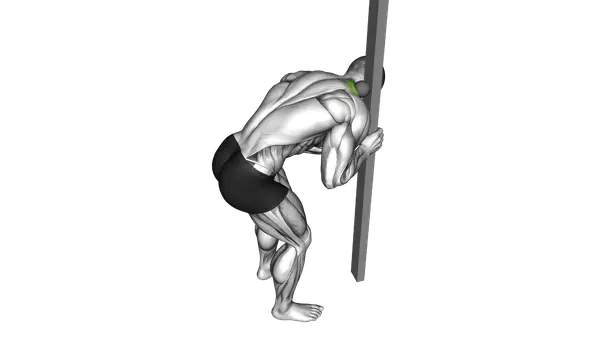
- Stand facing a bench, rack, or elevated pad set at around chest height, feet hip-width apart.
- Reach one arm forward and place your hand or forearm on the pad, keeping your elbow soft.
- Bend your knees slightly and hinge forward at your hips.
- Let your hips sink back and down while your extended arm stays anchored on the pad.
- Sink your chest toward the floor, feeling the stretch build along the side of your torso.
- Keep your head relaxed between your arms and avoid rounding your lower back.
- Hold the position for 15 to 30 seconds while breathing steadily.
- Slowly rise back up to standing, then repeat on the opposite side.
Important information
- Keep a slight bend in your knees to avoid locking your lower back into extra flexion.
- Avoid yanking or bouncing into the stretch, ease into it gradually.
- If you feel sharp pain in your shoulder rather than a stretch along your side, reduce the range of motion.
- This stretch works well before pulling exercises or on recovery days to keep your lats moving freely.
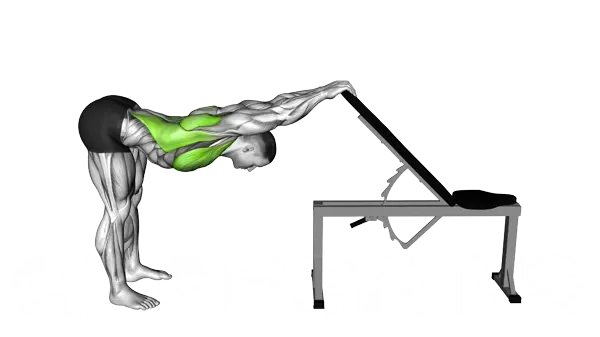
Does the Bench Lat Stretch improve flexibility?
Yes. The Bench Lat Stretch can help improve lat and side-body flexibility by putting your lats in a lengthened position and teaching you to open up through your torso. That matters if tight lats make it harder to reach overhead, row with a full range of motion, or keep your shoulders moving freely.
- Targets a hard-to-reach spot — Your lats often get stiff from pulling movements, carrying loads, or long hours sitting. This stretch reaches directly along your side, an area that regular shoulder or chest stretches do not cover.
- Improves overhead reach — When your lats are less tight, your arms usually move more freely overhead during presses, pull-ups, and rows. That can make pulling and overhead work feel smoother and less restricted.
- Useful between pulling days — This stretch creates almost no fatigue, so it fits well on recovery days or after back sessions. Low-fatigue mobility work is helpful because it gives you a way to work on movement quality without adding more training stress.
- Better posture awareness — Holding this position teaches you what an open, tall upper body feels like. That body awareness carries over to gym cues like keeping your chest up and your lats engaged during pulling work.
Programming for flexibility
Do 2-4 sets of 20-45 seconds per side, resting about 15-30 seconds between sides. Use it 3-7 days per week depending on how tight your lats feel. Shorter holds work well in a warm-up, while longer holds fit better after training or on recovery days when you want to relax into the stretch.
Alternative Exercises


FAQ - Bench Lat Stretch
Stand facing a bench, rack, or elevated pad set at around chest height, feet hip-width apart. Reach one arm forward and rest your hand or forearm on the pad, then bend your knees slightly and hinge at your hips, letting your torso and hips sink back and down. Hold for 15-30 seconds while breathing normally, then switch sides.
Aim to perform the Bench Lat Stretch a few times per week, especially if you do a lot of pulling work or carry heavy loads that leave your lats feeling tight. Include it before back or pulling workouts and as part of your cool-down routine for the best results.
Yes, the Bench Lat Stretch can help ease upper back tension caused by tight lats limiting your shoulder movement. By lengthening your lats and the side of your torso, you free up your shoulders to move more naturally, which can take some of the load off your upper back over time.
The most common errors include rounding your lower back instead of hinging at your hips, letting your supporting arm bend instead of staying anchored, and pulling into the stretch too aggressively. Focus on quality over intensity, keep a slight bend in your knees to protect your lower back, and ease into the stretch rather than forcing it.
For beginners, use a lower pad and take a smaller step back to keep the stretch gentle. More advanced practitioners can use a higher pad, step further back, or hold the position longer, up to 60 seconds, for a deeper stretch along the lat.
Workouts with Bench Lat Stretch




Reviewed by

Physiotherapist
Highlights Physiotherapist at GrabGains: Brings specialized clinical expertise to verify exercise content and ensure safe, effective movement guidance across the platform. Licensed Physiotherapist: Registered in the Dutch BIG Register (BIG: 59930315504) as a…
Bench Lat Stretch
Thank you for your feedback!
Thank you for your feedback!